The Murugappa Group is one of South India's largest and oldest business conglomerates, founded in 1900 by the Nattukotai Chettiar community and built across more than a century into a diversified enterprise spanning abrasives, fertilizers, bicycles, financial services and sugar. Its deliberate quietness, its deep roots in Tamil commercial tradition and its consistent preference for professional governance over family management at the operational level have made it one of the most admired and least publicly discussed business families in India.| Detail | Information |
| Subject | Murugappa Group |
| Founded | 1900, by Divan Bahadur A.M. Murugappa Chettiar |
| Headquarters | Chennai, Tamil Nadu, India |
| Community | Nattukotai Chettiar |
| Primary Industries | Abrasives, fertilizers, bicycles, finance, sugar |
| Flagship Company | Tube Investments of India, Coromandel International, Cholamandalam |
| Revenue | Over 48,000 crore rupees annually |
| Governance Style | Family governed, professionally managed |
War as the Catalyst for Reinvention
The Murugappa Group is one of South India’s largest and oldest business conglomerates, founded in 1900 by Divan Bahadur A.M. Murugappa Chettiar in Burma as a money-lending and banking business. Over the following decades, the family expanded through Southeast Asia and diversified into plantations, insurance, textiles and stockbroking. When Japan’s advance into Burma during the Second World War threatened the world in which the business had grown, the group relocated its assets to India before the invasion. Back in India, it did not simply reopen the same business. It began becoming an industrial group. This transformation from merchant banking to manufacturing, forced by wartime loss, was the beginning of what became one of India’s most significant family conglomerates.
A very different post-independence route to building a major Indian company appears in Shiv Nadar’s HCL.
The Chettiar Commercial Tradition
The Murugappas belonged to the Nattukottai Chettiar, or Nagarathar, commercial community. Chettiar firms built extensive credit networks across South and Southeast Asia and were especially important in colonial Burma. The community had deep commercial traditions shaped by the colonial Indian Ocean economy.
A.M. Murugappa Chettiar’s banking business belonged to this world. For the family, Burma was not a side venture. It was where the group began. Before Murugappa made bicycles or abrasives, its business was built around money moving through Burma and Southeast Asia. Nattukottai Chettiar finance depended heavily on family firms, community connections and trusted agents who could move capital between South India and commercial centres across Southeast Asia.
The group’s early business belonged to this mobile world. Its assets and relationships were spread across borders, making the network both powerful and exposed to political shocks. In Burma, Chettiar lenders became deeply involved in the rural credit economy as well as trade, and their expansion was tied to British imperial transport, law and commodity markets.
The War and the Relocation
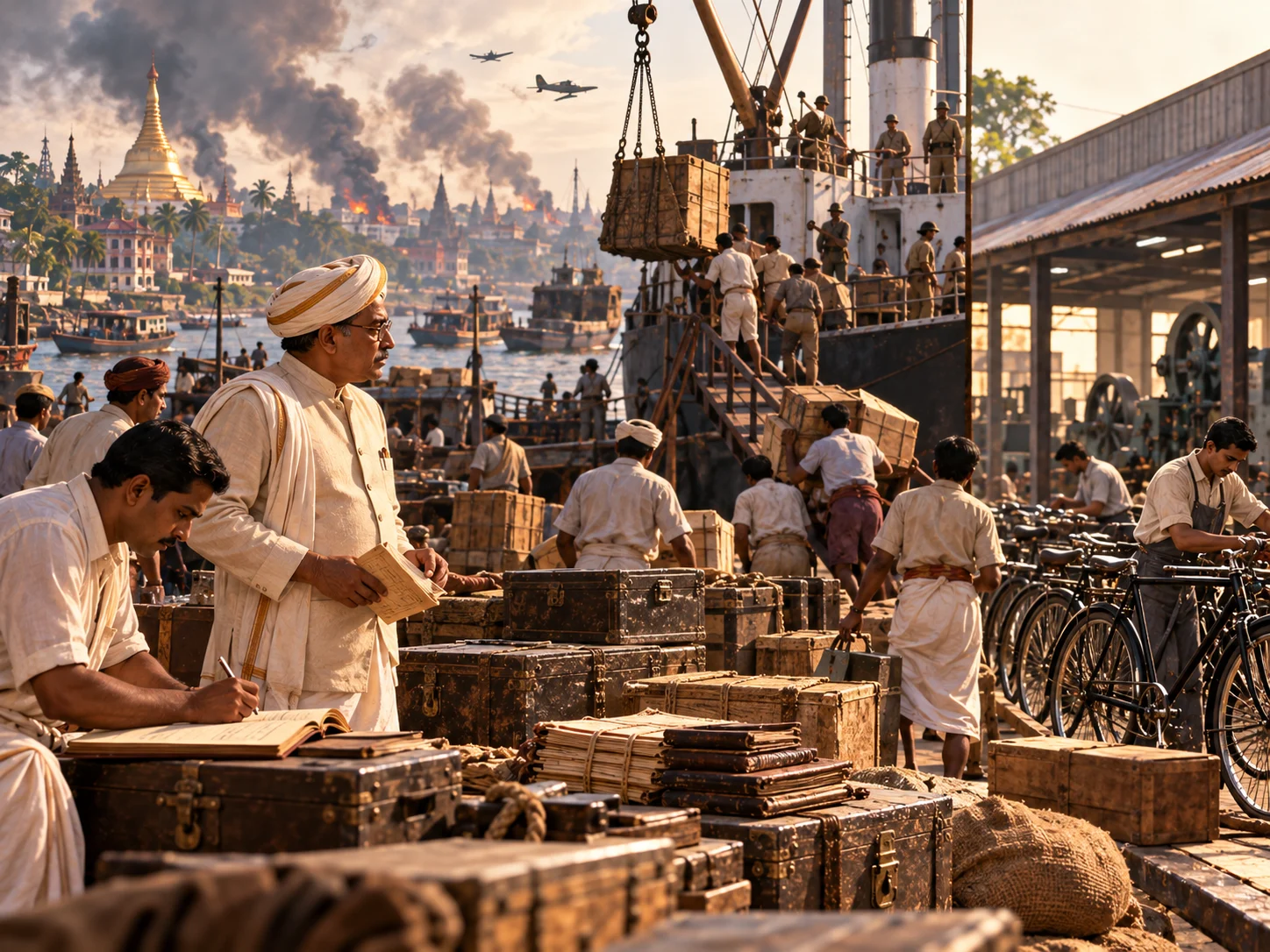
The Japanese invasion of Burma in 1942 shattered commercial networks and drove a mass evacuation toward India. Murugappa’s corporate history says the family had moved assets to India before the invasion. That timing gave the group a base from which to rebuild, but the question had changed. The challenge was no longer how to expand an overseas Chettiar banking network. It was what kind of business the family could build in India.
The group’s heritage account is careful on this point: significant assets were moved to India, but also a good portion of the family’s hard-earned fortune was lost when war and political upheaval cut short the Southeast Asian business. The relocation was prudent, not magical. It preserved enough capital and organisational continuity to rebuild; it did not transport the old empire intact.
By 1942, Burma’s collapse had turned commercial geography into an existential risk. A business model built on regional mobility now needed a secure home base. The group invested in emery paper and steel furniture—modest industrial steps, but a different kind of enterprise from merchant finance.
Learning Manufacturing
Money-lending and trade revolve around credit, information, relationships and judgement of risk. Manufacturing adds another layer: machines, production schedules, labour, technical standards, inventories and physical quality control.
The group’s experiments with steel cabinets, rubber, yarn and emery products were therefore a learning period as much as diversification. When TI Cycles arrived in 1949, the British partnership with Tube Investments of the United Kingdom supplied technical experience the family did not pretend to possess. The Murugappas contributed capital, organisation and knowledge of the Indian market; Tube Investments brought bicycle-manufacturing expertise.
This willingness to learn through partnership rather than to assume existing expertise became characteristic of the group’s approach. The group did not pretend it already possessed every technical skill. It used partnerships to acquire what it lacked.
The Bicycle as Proof of Concept
In 1949, Murugappa established TI Cycles of India with Tube Investments of the United Kingdom. For a family whose history lay in finance and trade, this was a decisive change in what the organisation knew how to do. Murugappa’s timeline records that TI Cycles produced its one-millionth bicycle by 1960.
Post-independence India needed inexpensive transport for workers, students, traders and households. A bicycle could be sold in very large numbers without the fuel or infrastructure demands of a motor vehicle. That matched the family’s stated search for a product for the common man. It also created opportunities for deeper manufacturing. Tube Products of India followed in 1955 to make steel tubes used in bicycle frames, and chain production followed later.
Those extensions show why the bicycle venture was more than a single product line. It became a school in industrial production. By the time the millionth bicycle was produced, the family had crossed a line that the simple phrase “shifted from Burma to India” does not capture. The geographic move had forced a change in capability. A merchant-banking family was learning to own factories, work with foreign technical partners and manufacture for a mass Indian market.
How Banjara Embroidery Maps the Journeys of a Nomadic People
The Disputed and Fascinating Origins of Kashmiri Pashmina
Quick Comparison Table
| Feature | Murugappa Group | TVS Group | Bajaj Group | Mahindra Group |
| Community | Nattukotai Chettiar | Iyengar, Tamil Nadu | Marwari, Rajasthan | Marwari, Maharashtra |
| Headquarters | Chennai | Chennai | Pune | Mumbai |
| Primary Industries | Diversified, abrasives, finance, agri | Automobiles, finance | Automobiles, finance | Automobiles, aerospace, farm |
| Governance | Family governed, professional management | Family governed | Family governed | Professional with family oversight |
| Public Profile | Deliberately low | Moderate | High | High |
| Regional Identity | Deeply South Indian | Deeply South Indian | Pan Indian | Pan Indian |
Curious Indian: Fast Facts
- The Murugappa Group was founded in 1900 by Divan Bahadur A.M. Murugappa Chettiar, initially based in Burma through money-lending and trading operations.
- The Nattukotai Chettiar community, from which the Murugappa family comes, developed banking networks across Southeast Asia that preceded European banking by centuries.
- Carborundum Universal, the Group’s abrasives company, is one of the largest manufacturers of abrasive products in Asia.
- Cholamandalam Investment and Finance Company, founded in 1978, reflects direct institutional continuity with the Nattukotai Chettiar banking tradition.
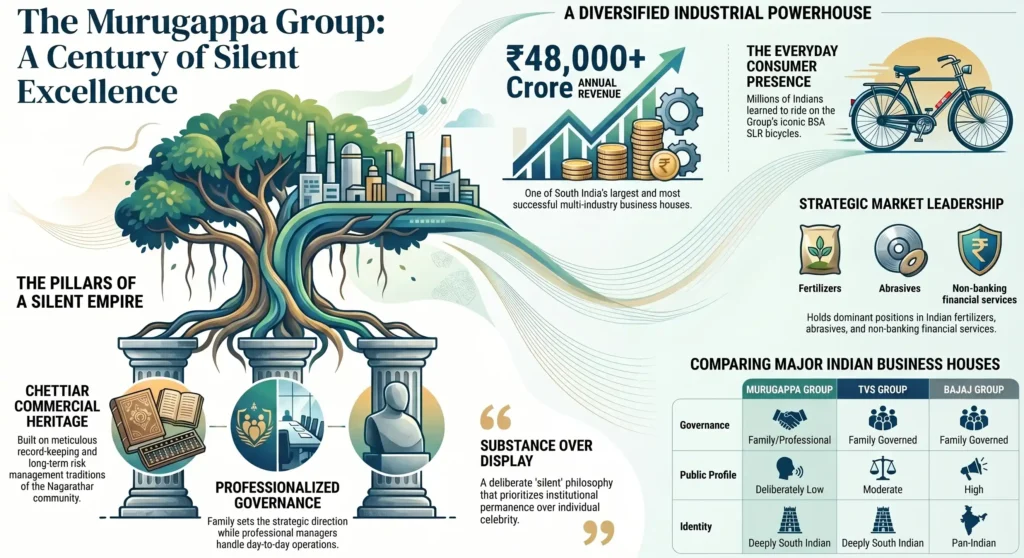
- The Group’s annual revenue exceeds 48,000 crore rupees, making it one of the largest business conglomerates in South India.
- TI Cycles, which manufactures BSA SLR bicycles, gave the Murugappa Group a consumer presence in the daily life of millions of South Indians.
- Coromandel International is one of India’s largest fertilizer and agrochemical companies and a major contributor to Indian agricultural productivity.
- The Murugappa Group’s commitment to professional management at the operational level, while maintaining family ownership and strategic direction, is considered a model of family business governance in India.
From Bicycles to Diversification
Later Murugappa companies would spread across many industries. Carborundum Universal (CUMI) became one of the largest manufacturers of abrasive products in Asia. Cholamandalam Investment and Finance Company, founded in 1978, reflected direct institutional continuity with the Nattukotai Chettiar banking tradition. E.I.D. Parry expanded into sugar and allied products. Coromandel International became one of India’s largest fertilizer and agrochemical companies, a major contributor to Indian agricultural productivity.
The Group’s annual revenue today exceeds 48,000 crore rupees, making it one of the largest business conglomerates in South India. Its diversification across abrasives, fertilizers, bicycles, financial services and sugar reflects the family’s early learning that a successful industrial conglomerate required multiple capabilities and multiple markets.
The Governance Model
The Murugappa Group is distinctive among large Indian family business groups for its consistent commitment to professional management at the operational level. While the family retains ownership and sets strategic direction, individual companies within the Group are managed by professional managers rather than exclusively by family members. This approach reflects a specific philosophy about the complementary roles of family ownership and professional capability in sustaining a large enterprise across generations.
The Group’s relative anonymity outside South India reflects a deliberate organizational preference for substance over public profile that is rooted in the Nattukotai Chettiar commercial tradition. The family has not cultivated the kind of media presence, founder mythology or public spectacle that characterizes the communication strategies of many comparable Indian business houses. The Murugappa Group’s confidence in its institutional identity does not require external validation.
The Essential Reinvention
A business born in Burma spent decades expanding through Southeast Asian finance and trade. War threatened that base. The family shifted assets to India, experimented with manufacturing and entered bicycles through a British technical partnership. By 1960, TI Cycles had made a million bicycles.
The hardest change had already happened: the group had learned how to survive the loss of the world in which it was born and to build a new enterprise in a different geography with different technologies and different markets. The relocation from Burma was not simply a geographic move. It was the catalyst for a fundamental transformation in what the family did, how it did it and where its future would be built.
Cowries, Coins, and Textile Memory of the Lambadi Tribe
If you think you have remembered everything about this topic take this QUIZ
Results


#1. In which year and location was the foundational enterprise of the Murugappa Group originally established by its founder?
#2. Which highly sophisticated Tamil banking and merchant community developed the core values that shape the Murugappa Group’s quiet corporate philosophy?
#3. Who originally founded the money-lending and trading operations that laid the groundwork for this massive South Indian industrial empire?
#4. Which iconic bicycle brand manufactured under the Tube Investments of India (TI Cycles) banner became a household staple for millions of Indian children?
#5. Which flagship enterprise within the Murugappa Group stands as one of India’s largest fertilizer and crop nutrition companies?
#6. Which non-banking financial services firm within the Group represents a direct institutional continuation of its community’s ancient financial roots?
#7. What is one of the most unique operational hallmarks of the Murugappa Group’s family business governance model in India?
#8. Which Murugappa enterprise operates as one of the largest manufacturers of industrial abrasive products anywhere in Asia?
What is the Murugappa Group and what industries does it operate in?
The Murugappa Group is one of South India’s largest and oldest business conglomerates, founded in 1900 and headquartered in Chennai. It operates across a diverse range of industries including abrasives through Carborundum Universal, fertilizers and agrochemicals through Coromandel International, financial services through Cholamandalam Investment and Finance Company, bicycles through TI Cycles, sugar and engineering products. Its annual revenue exceeds 48,000 crore rupees.
Who founded the Murugappa Group and what community does it come from?
The Murugappa Group was founded by Divan Bahadur A.M. Murugappa Chettiar in 1900. It comes from the Nattukotai Chettiar community, also known as the Nagarathar, a Tamil merchant community with centuries-old traditions of banking and trading across South Asia and Southeast Asia. The community’s commercial culture, which values institutional permanence, careful risk management and long-term relationship cultivation, is embedded in the Murugappa Group’s organizational identity.
What is distinctive about the Murugappa Group’s governance?
The Murugappa Group is distinctive among large Indian family business groups for its consistent commitment to professional management at the operational level. While the family retains ownership and sets strategic direction, individual companies within the Group are managed by professional managers rather than exclusively by family members. This approach reflects a specific philosophy about the complementary roles of family ownership and professional capability in sustaining a large enterprise across generations.
What is Coromandel International and why is it significant?
Coromandel International is one of India’s largest fertilizer and agrochemical companies and one of the most strategically significant enterprises within the Murugappa Group. Its significance lies in its role in Indian agricultural productivity, providing crop nutrition solutions tailored to Indian soil conditions and agricultural practices. The company’s development reflects the Murugappa Group’s identification of the agricultural sector as a long-term structural opportunity in the Indian economy and its patient commitment to building a major enterprise within it.
Why is the Murugappa Group relatively unknown outside South India despite its scale?
The Group’s relative anonymity outside South India reflects a deliberate organizational preference for substance over public profile that is rooted in the Nattukotai Chettiar commercial tradition. The family has not cultivated the kind of media presence, founder mythology or public spectacle that characterizes the communication strategies of many comparable Indian business houses. The Murugappa Group’s confidence in its institutional identity does not require external validation, and this has produced a conglomerate of considerable scale that is nonetheless known primarily within the region and the business community rather than to the broader Indian public.