Kamarupa, around 643 CE: the king of Assam’s first great kingdom wanted a Chinese monk so badly that he threatened Nalanda, defied an emperor, and then sailed up the Ganga with an army to hand him over
Around 642 CE, a letter arrived at Nalanda, the great Buddhist monastery-university in Bihar. It was addressed to the abbot, Shilabhadra, a man said to be well over a hundred years old. It came from the king of Kamarupa, far to the east, in the valley of the Brahmaputra.
The king wanted to meet the Chinese monk who was studying at Nalanda. His name was Xuanzang. He had walked from China over deserts and mountains to find Buddhist texts, and after more than a decade in India he was getting ready to go home.
Shilabhadra said no. The king wrote again. The abbot said no again.
The king wrote again. The abbot said no again.
Kumara
The king was Bhaskaravarman, the last and greatest of the Varman kings who had ruled Kamarupa for nearly three hundred years, from a line that traced itself back to the god Vishnu. His people called him Kumara, the prince, a name he kept even as an old man.
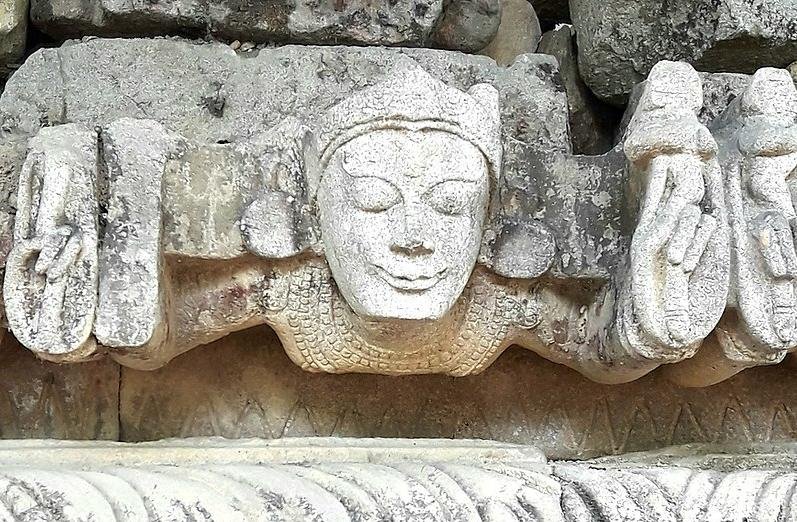
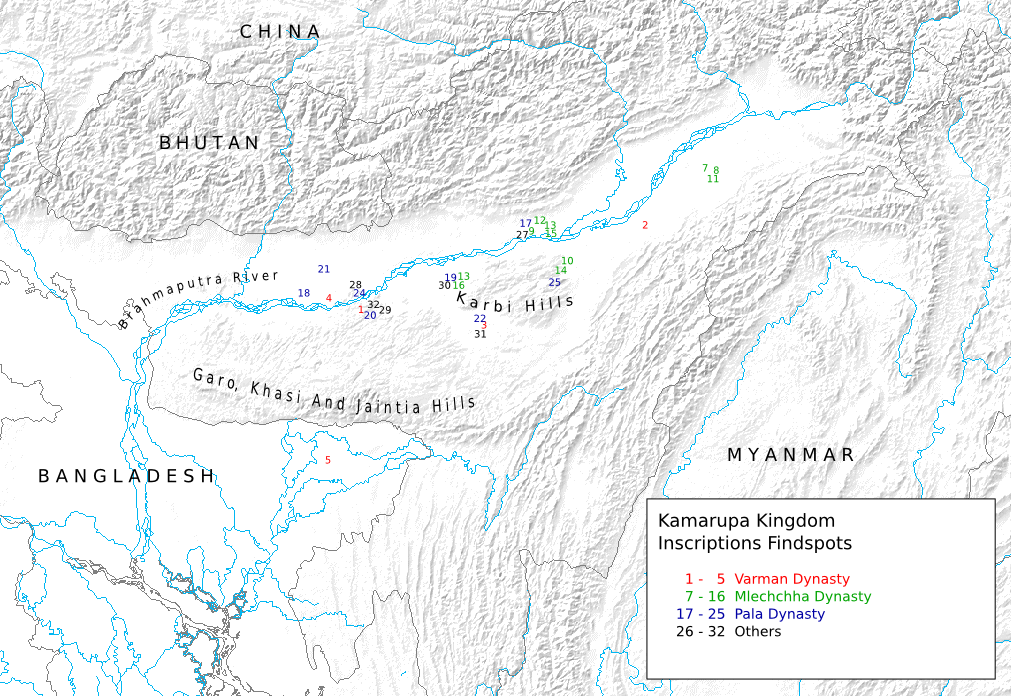
Kamarupa was the first great kingdom of what is now Assam. Its capital, Pragjyotishpura, stood near modern Guwahati. Its lands ran along the Brahmaputra, and, Xuanzang would later write, eastward to the hills beyond which lay the borders of China. It was rich in rivers, forests and elephants. And it was a kingdom with ambitions: when Harsha of Thanesar was avenging his murdered brother against Shashanka of Bengal, it was Bhaskaravarman who sent an envoy offering alliance, so that the two kings could squeeze Bengal between them.
Bhaskaravarman was not a Buddhist. By Xuanzang’s own account he was a Brahmin who worshipped the old gods. But he loved learning, and he wanted the famous foreigner at his court.
The threat
Then came a letter that was different. If Nalanda would not send the monk, he wrote, he would equip his army and elephants, and “like the clouds, sweep down on and trample to the very dust” the monastery.
The old abbot gave way. He asked Xuanzang to go, and Xuanzang went east.
In Kamarupa he was met by the king and his high officers and taken to the palace in state. Every day there were feasts and music, flowers and incense. According to Xuanzang’s account, the king even asked him about a song he had heard of, composed in China to celebrate the victories of a Chinese prince. News, and music, had travelled a long way along those eastern hills. More than a month passed like this.
News, and music, had travelled a long way along those eastern hills.
Mature Harappan Phase: When India Built the World’s First Planned Cities
10 Lessons from the Battle of Walong 1962 Mystery
The emperor’s message
Harsha heard where the monk had gone, and he was not pleased. He had asked for Xuanzang himself. He sent a message to Kamarupa ordering Bhaskaravarman to send the Chinese priest to him at once.
Bhaskaravarman sent back a reply that has come down to us in the monk’s biography. Harsha, he said, “can take my head but he can not take the Master of the Law yet.”
Harsha was furious. Kumara despises me, he told his attendants: how can he use such coarse language over a single priest? And he sent a second message to Kamarupa. Very well, it said. Send me the head.
Very well, said the emperor. Send me the head.
The Varman line ended with Bhaskaravarman. Other dynasties would rule Kamarupa after him, the Mlechchhas and then the Palas, for centuries more. But this is the moment the kingdom stepped fully onto the stage of Indian history: a king in the far east of the subcontinent who was willing to threaten Nalanda to get a visitor, to defy an emperor to keep him, and to sail up the Ganga with an army to give him back.
Gupta Empire: When India Led the World in Science and Culture
Vedic Period: From Nomadic Hymns to Iron Age Kingdoms
Up the Ganga
Bhaskaravarman had gone too far, and he knew it. Harsha was the most powerful king in northern India, and his ally.
So the king of Kamarupa did the only thing that could save his head and his dignity together. He did not send the monk. He brought him. According to the biography, he ordered twenty thousand elephants and thirty thousand boats to be made ready, and with Xuanzang beside him he travelled up the Ganga to Harsha’s camp, a king arriving with his guest rather than a vassal sending a prisoner.
The numbers are almost certainly inflated. The point is not.
At the great assembly Harsha held soon afterwards at Kannauj, when a golden image of the Buddha was carried in procession, Harsha walked dressed as Indra, king of the gods. At his side walked Bhaskaravarman, the old king of Kamarupa, dressed as Brahma.
Kamarupa
Xuanzang went home to China in 645, carrying hundreds of texts. His account of his travels is one of the most important sources for seventh-century India, and much of what we know about Kamarupa in its greatest days comes from the month he spent at Bhaskaravarman’s court: the size of the capital, the rivers, the king who was not a Buddhist but honoured Buddhist learning, the road to China.
The Integration of Princely States: The Making of a United India
If you think you have remembered everything about this topic take this QUIZ
Results


#1. Which of the following is considered the first historical kingdom of Assam?
#2. Who is mentioned in the Allahabad Pillar inscription of Samudragupta as a frontier ruler of Kamarupa?
#3. The rulers of the Kamarupa kingdom traditionally traced their lineage back to which mythological figure?
#4. Which famous Chinese traveler visited Kamarupa during the reign of Bhaskaravarman in the 7th century?
#5. What were the three major dynasties that ruled the Kamarupa kingdom in succession?
#6. Which city served as the capital of the Kamarupa kingdom during the Varman dynasty?
#7. What term was used in the Kamarupa administration to refer to a collection of villages?
#8. Which of the following was a unique architectural feature of Kamarupa as noted by historical records?
What was the Kamarupa Kingdom?
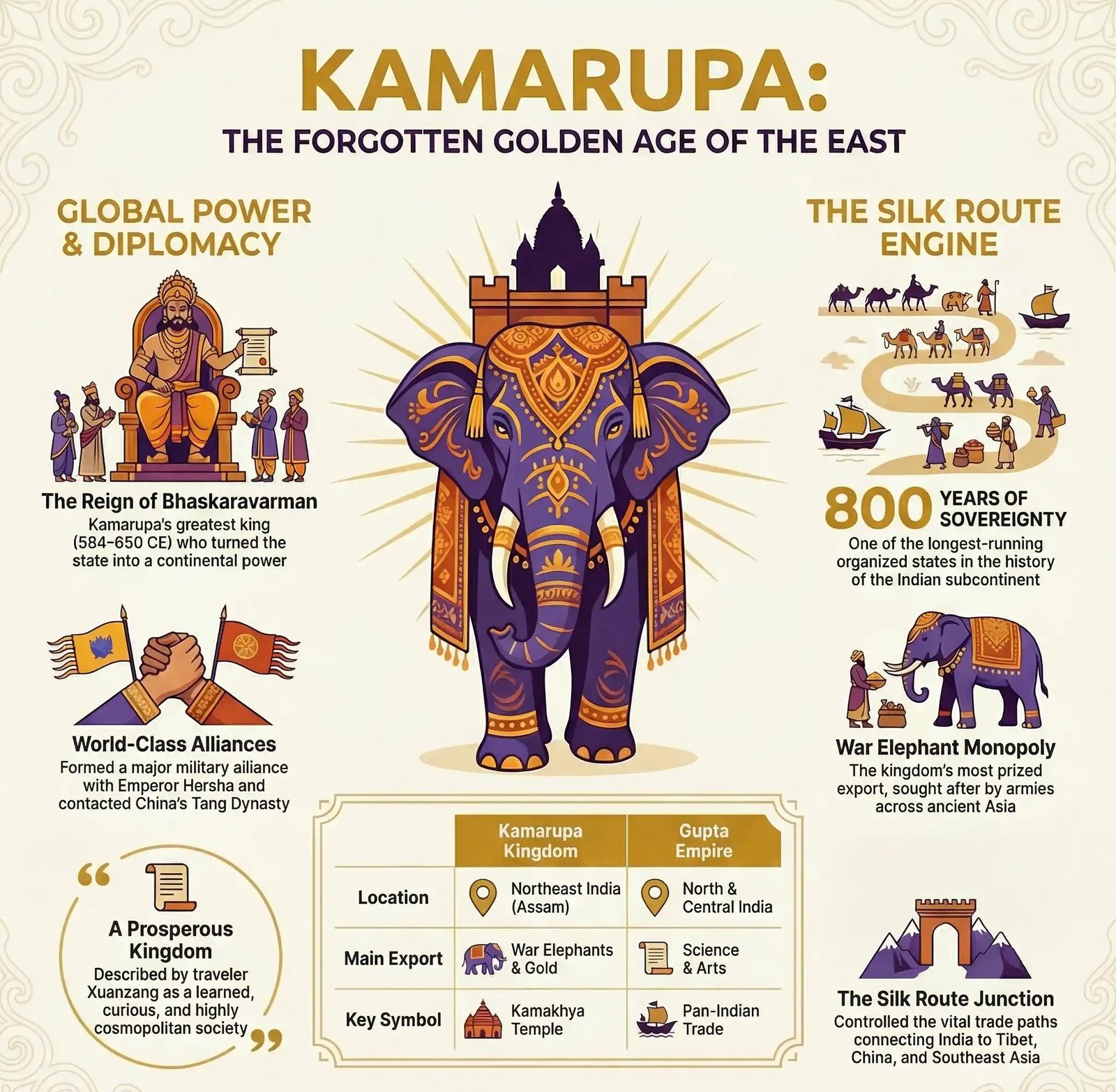
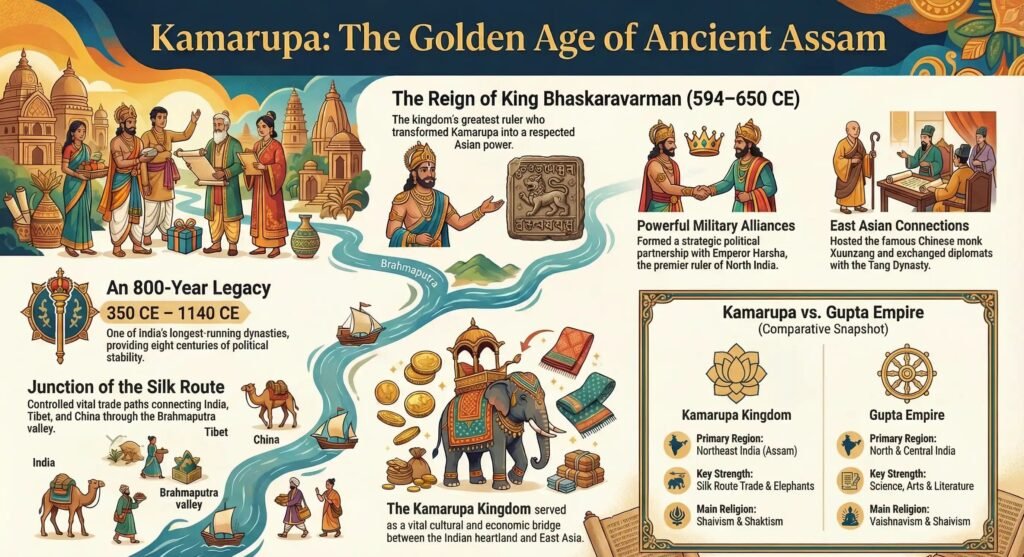
Kamarupa was the first major organised kingdom of Northeast India, ruling over most of present-day Assam and surrounding areas from around 350 CE to 1140 CE. It was founded by King Pushyavarman of the Varman dynasty.u003cbru003e
Who was the greatest king of Kamarupa?
King Bhaskaravarman, who ruled from approximately 594 CE to 650 CE, is considered the greatest king of Kamarupa. He formed an alliance with Emperor Harsha of North India, exchanged diplomatic letters with the Tang Emperor of China, and welcomed the Chinese traveller Xuanzang to his court.u003cbru003e
How was Kamarupa connected to the Silk Route?
Kamarupa sat at the junction of the southern branch of the Silk Route and the mountain trade routes leading to Tibet and China. The kingdom exported war elephants, gold, silk, and forest products, and imported horses, Chinese silk, and goods from across Asia.u003cbru003e
What is the connection between Kamarupa and the Kamakhya Temple?
The Kamakhya Temple on Nilachal Hill in Guwahati was the royal temple of the Kamarupa kings. They adopted the goddess Kamakhya, who was already worshipped by local communities, as their patron deity. This helped them unite the many different peoples of their kingdom under one shared religious identity.u003cbru003e
Why did the Kamarupa Kingdom end?
By the 11th and 12th centuries, Kamarupa faced growing pressure from powerful kingdoms in Bengal and increasing political fragmentation within the Brahmaputra valley. Around 1140 CE, the last ruler of the Kamarupa line was overthrown and the kingdom broke into smaller regional powers.u003cbru003e
Author


Exploring the Soul of Bharat through History, Science, Culture, and its Diversity
Our Mission
Curious Indian is a definitive knowledge portal dedicated to chronicling the events, personalities, and cultural shifts that defined the Indian subcontinent. From the ancient Vedic Period to the complexities of 21st-century politics, our goal is to provide deep-dive analysis that inspires.
Editorial Standards & E-E-A-T
Every article published under our brand undergoes a rigorous fact-checking process. We prioritize primary historical records, academic citations, and credible archives to ensure our readers receive accurate, high-authority information.
Historical Integrity Directly sourcing from ASI archives and academic journals.Topical Authority Comprehensive clustering of Indian Science, Biographies, and Wars.Managed by Paripurna Datta and TEAM | Dedicated to the Knowledge of India.