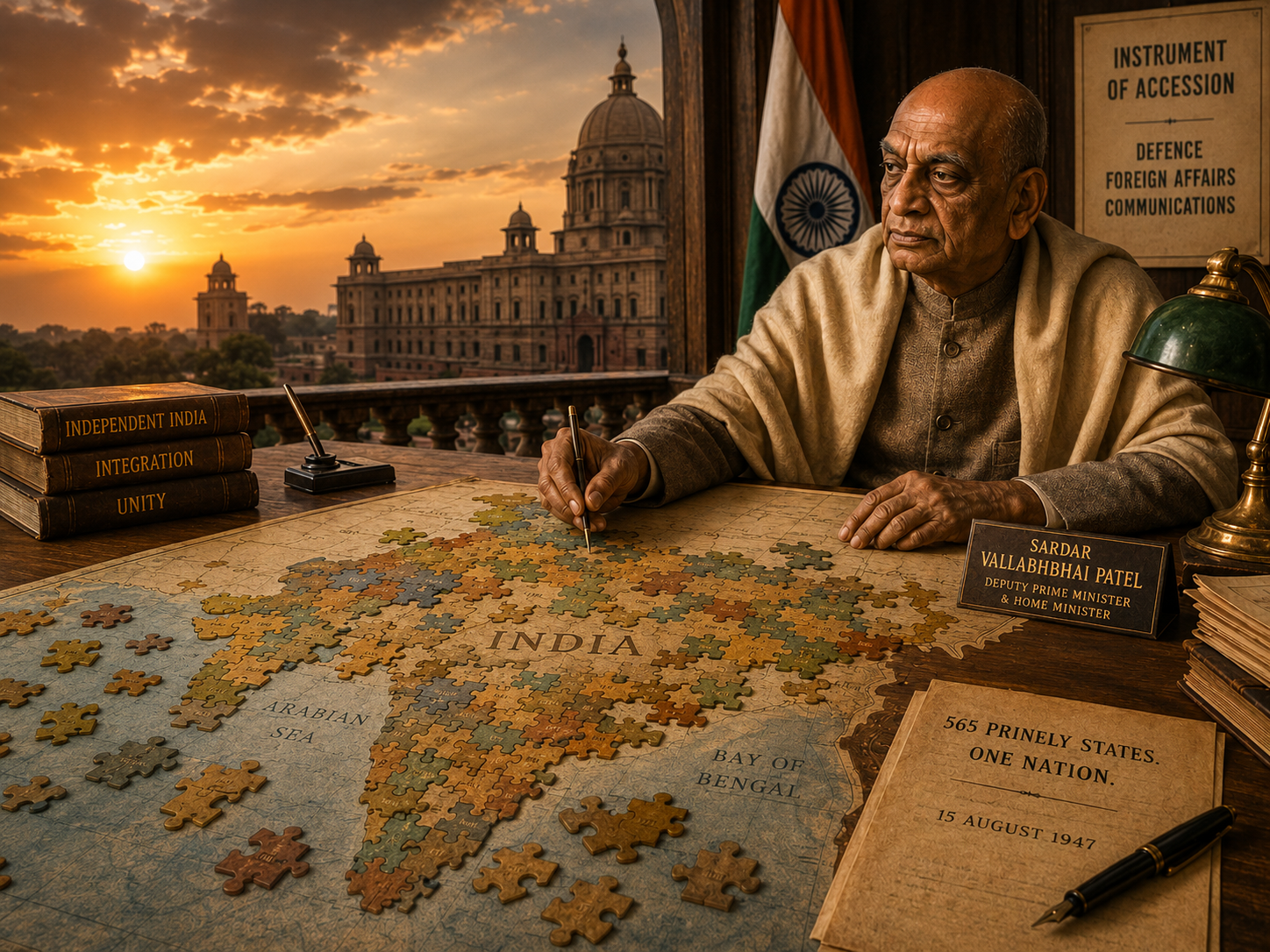
How Sardar Patel and V.P. Menon Assembled a Nation from 565 Kingdoms under Two Years
On the 15th of August 1947, India became free. But here is something most people forget: on that very day, India was not yet one country.
It was a patchwork of more than five hundred separate kingdoms, and in that moment, any one of them was free to walk away. The single, connected India we know today, one nation stretching from Kashmir in the north to the southern tip of the peninsula, very nearly never came to be at all. This is the story of how it was stitched together, in less than two years, mostly by patient persuasion and only occasionally by force.
A Map in Pieces
When the British ruled India, they did not actually rule all of it directly. Alongside the provinces they governed themselves, there were around 565 “princely states”: kingdoms large and small, each with its own ruler, that had long ago accepted British overlordship. Some were as big as European nations. Others were smaller than a single town. Altogether, they covered nearly half of India’s land.
When the British finally packed up and left, they let go of all these states at once. They told each ruler that he was now free to do exactly as he pleased: join the new India, join the new country of Pakistan, or try to stand alone as an independent kingdom.
It was a recipe for disaster.
If even a fraction of the 565 rulers had chosen to go their own way, the map of India could have shattered into hundreds of little pieces, like a dropped plate. There might never have been a single India at all.
The Tashkent Agreement 1966: Peace Treaty or Political Betrayal?
The Man with the Iron Will
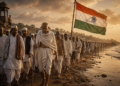
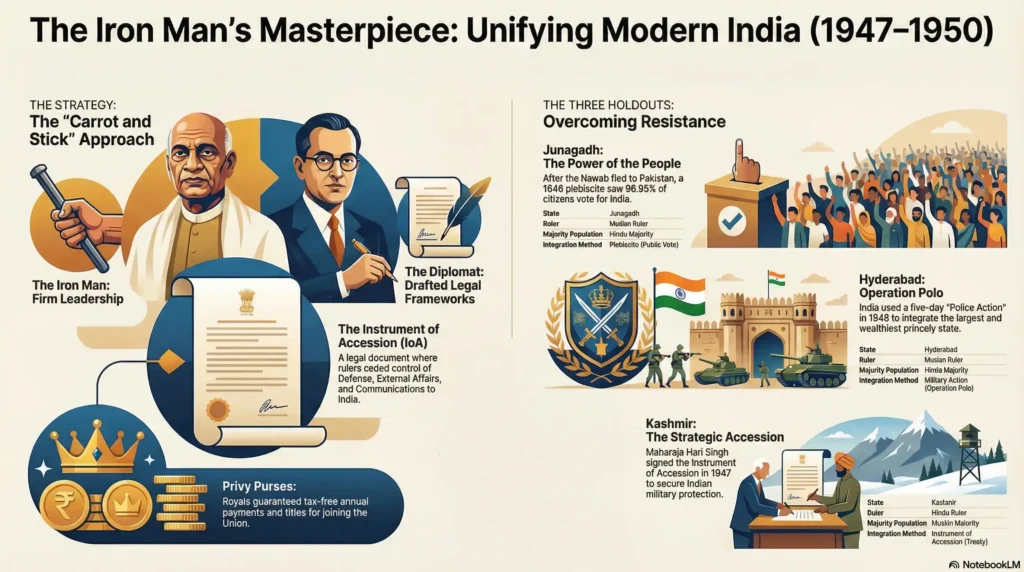
The enormous job of holding India together fell mainly to one deeply determined man: Sardar Vallabhbhai Patel, the new country’s Home Minister, remembered ever since as the “Iron Man of India.” Working hand in hand with his brilliant secretary, V.P. Menon, Patel set out to persuade 565 kings to quietly give up their crowns.
He used a careful mixture of warmth and steel, what people later called the “carrot and stick.” He appealed to the rulers’ love of their homeland. He offered them a fair and simple deal: sign one document, the Instrument of Accession, handing over just three things to India, its army, its dealings with other countries, and its communications, while keeping control of their own local affairs for the time being. He offered the princes generous yearly payments to step down from their thrones. And, just beneath the surface, he made it clear that anyone who refused would be standing against the will of his own people, and against a firm new government.
It worked astonishingly well. By the 15th of August, the great majority of the 565 states had already signed.
The Janata Party Experiment 1977-1980
Three that Would not Come Quietly
But three states held out, and each one became a difficult story of its own.
Junagadh: The State that Voted
Junagadh was a small state on the west coast, surrounded by Indian territory on nearly every side. Its ruler, the Nawab, was Muslim, while most of his people were Hindu, and he chose to join Pakistan, even though his little kingdom sat nowhere near it.
His people, unhappy with the choice, began to protest. India did not send in an army. Instead it cut off the state’s supplies and simply waited. Before long the Nawab fled the country, and India held a public vote, asking the people of Junagadh which nation they wished to belong to. They chose India, and by an overwhelming margin. Junagadh was settled by the ballot, not the bullet.
Reign of Chandragupta Maurya: The First Empire of India
Hyderabad: The Largest Holdout
Hyderabad was the biggest and richest princely state of them all, sitting right in the middle of southern India. Its ruler, the Nizam, was one of the wealthiest men in the entire world, and he wanted to remain fully independent.
As the talks dragged on month after month, an armed militia loyal to him, known as the Razakars, spread fear and violence across the region. In September 1948, after the negotiations finally broke down, the Indian government sent in its army in an operation it called a “police action.” Hyderabad’s forces gave way within about five days, and the state joined India. It was swift, but it was not painless: the fighting, and the bitter communal violence that surrounded it, cost a great many lives.
Kashmir: The Case still Unsettled
The hardest case of all was Kashmir, and its story is one that remains unfinished even now.
Kashmir was the mirror image of Hyderabad. Here the ruler, Maharaja Hari Singh, was Hindu, while most of his people were Muslim. Unsure which way to turn, he tried at first to stay independent, and put off making any decision. Then, in October 1947, armed tribesmen from across the new border with Pakistan poured into his kingdom. Facing an invasion he could not stop, the Maharaja turned to India for military help, and on the 26th of October 1947 he signed the Instrument of Accession, joining India. Indian troops were flown in, and the first war between India and Pakistan began. It ended in early 1949 with a ceasefire line that cut Kashmir in two, one part held by India and the other by Pakistan.
That division was never resolved. To this day, both India and Pakistan claim Kashmir in full, and it remains one of the most disputed territories in the world.
It is the one piece of the 1947 puzzle that was never quietly slotted into place, and the two countries have gone to war over it more than once since.
Reign of Chandragupta Maurya: The First Empire of India (Early unification of India)
The country that was made, not given
And yet, taken as a whole, something close to a miracle had been achieved. In less than two years, a shattered map of 565 kingdoms had been fused into a single nation. Rulers whose families had sat on thrones for centuries became ordinary citizens, and their old kingdoms became the states and districts of one vast democracy. For the most part, it was a remarkably peaceful revolution, won far more often with paperwork and patience than with soldiers. In a short time, Patel and Menon had done what even great emperors of the past had never fully managed: they had drawn a single, united map of India.
We tend to imagine the shape of India as a simple, natural fact, as fixed and permanent as its rivers and its mountains. It is worth remembering that it is nothing of the kind. That familiar outline was made, carefully and anxiously, by real people working against the clock in a few frantic months, and it could very easily have turned out completely different. The next time you look at a map of India, it is worth pausing to recall that the outline was not handed down from anywhere. It was put together, piece by piece and kingdom by kingdom, at the very last possible moment.
Reign of Emperor Ashoka: The Transformation of a Tyrant
If you think you have remembered everything about this topic take this QUIZ
Results


#1. Who was the civil servant and secretary who worked closely with Sardar Vallabhbhai Patel to integrate the princely states?
#2. Approximately how many Princely States existed in the Indian subcontinent when the British left in 1947?
#3. Under the initial integration plan, which three subjects were the princely states required to cede to the Dominion of India?
#4. How was the princely state of Junagadh ultimately integrated into the Indian Union?
#5. What was the code name for the military intervention (Police Action) ordered by Sardar Patel to integrate Hyderabad in September 1948?
#6. What was the name of the paramilitary force unleashed by the Nizam of Hyderabad to terrorize the local population?
#7. Which princely state’s ruler famously pulled a revolver on V.P. Menon during negotiations, shouting that he would not give in to dictation?
#8. On what date did Maharaja Hari Singh of Kashmir sign the Instrument of Accession, officially joining India?
Who is known as the Iron Man of India?
What was Operation Polo?
It was the code name for the “Police Action” (military operation) undertaken in September 1948 to integrate Hyderabad into India.
Which document did the princes sign to join India?
The Instrument of Accession.
How was Junagadh integrated into India?
Through a plebiscite (people’s vote) where the majority chose India.
Who was the Secretary of the Ministry of States who assisted Patel?
V.P. Menon.
Sources and References
- Legacy IAS and Testbook (integration of princely states) — the roughly 565 princely states covering nearly 40% of the land and 23% of the population, the lapse of British paramountcy under the Indian Independence Act 1947, and the resulting danger of “Balkanisation.”
- The Study IAS and Simran IAS — Sardar Patel and V.P. Menon leading the integration through the Instrument of Accession (ceding defence, foreign affairs and communications), privy purses, persuasion and the threat of force, with most states acceding by 15 August 1947.
- CrackTarget and BSSS Publications (on the difficult states) — Junagadh’s Muslim Nawab acceding to Pakistan despite a Hindu-majority population, India’s blockade, the Nawab’s flight, and the February 1948 plebiscite that chose India.
- Testbook and Legacy IAS (on Hyderabad) — the Nizam’s bid for independence, the Razakar militia’s violence, and Operation Polo in September 1948 ending with Hyderabad’s surrender on 17 September.
- CrackTarget and standard accounts (on Kashmir) — Maharaja Hari Singh’s delay, the Pakistan-backed tribal invasion of October 1947, the Instrument of Accession signed on 26 October 1947, the first India–Pakistan war, the 1949 ceasefire dividing the state, and the continuing dispute.
- Original Curious Indian article (“Political Integration of Princely States”) — the “carrot and stick” framing, the near-bloodless nature of the integration, and the comparison of Patel’s achievement to the unifying efforts of earlier rulers.
Author


Exploring the Soul of Bharat through History, Science, Culture, and its Diversity
Our Mission
Curious Indian is a definitive knowledge portal dedicated to chronicling the events, personalities, and cultural shifts that defined the Indian subcontinent. From the ancient Vedic Period to the complexities of 21st-century politics, our goal is to provide deep-dive analysis that inspires.
Editorial Standards & E-E-A-T
Every article published under our brand undergoes a rigorous fact-checking process. We prioritize primary historical records, academic citations, and credible archives to ensure our readers receive accurate, high-authority information.
Historical Integrity Directly sourcing from ASI archives and academic journals.Topical Authority Comprehensive clustering of Indian Science, Biographies, and Wars.Managed by Paripurna Datta and TEAM | Dedicated to the Knowledge of India.