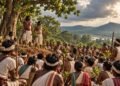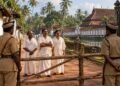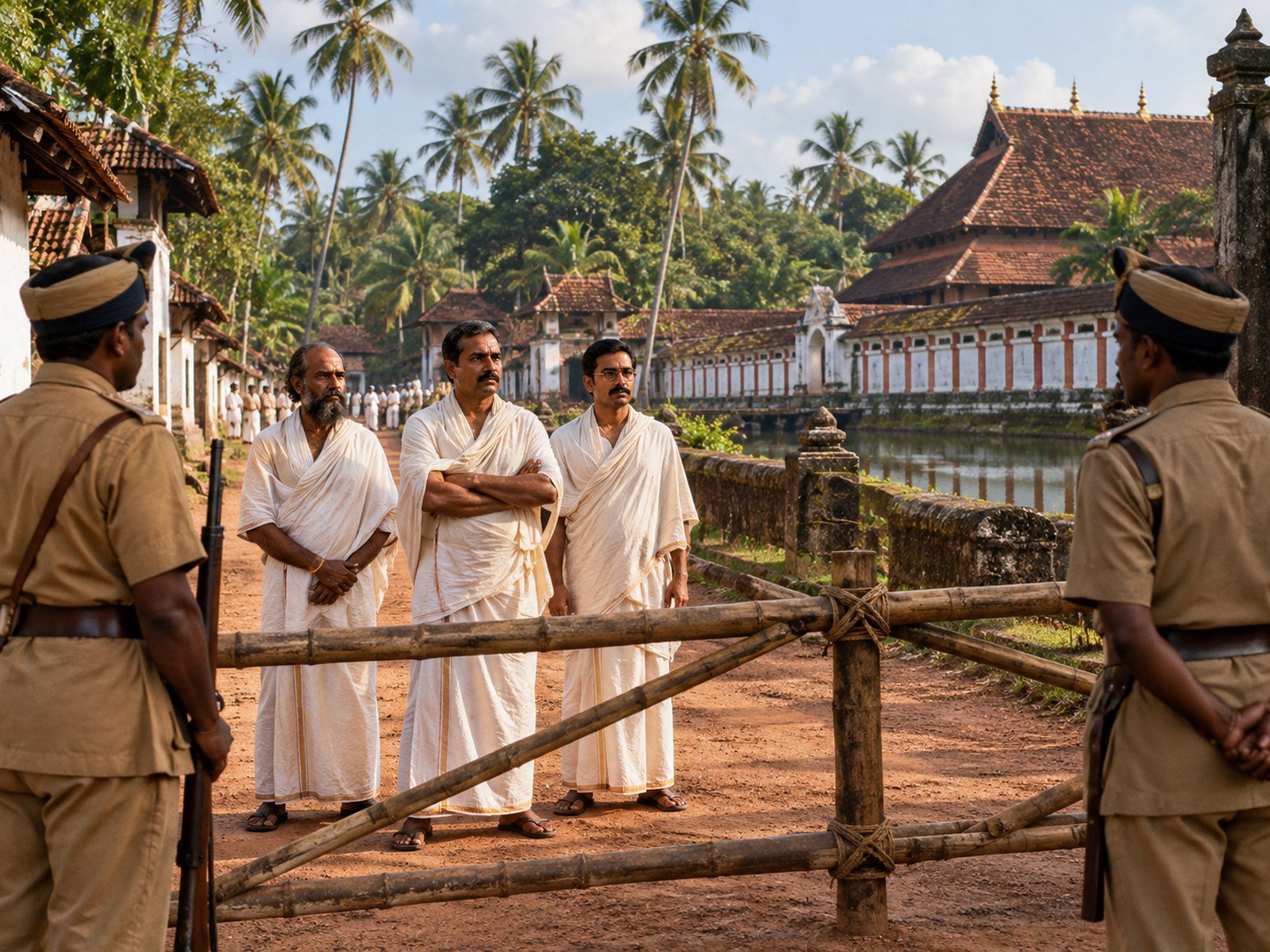
On the morning of 30 March 1924, three men wearing garlands walked up a road in the town of Vaikom, in the princely state of Travancore, toward a wooden signboard. Their names were Kunjappy, Bahuleyan and Govinda Panicker. A crowd of volunteers in khadi stopped about twenty yards behind them and watched.
The police were waiting at the board. Kunjappy was a Pulaya. Bahuleyan was an Ezhava. Govinda Panicker was a Nair. The police told Panicker he could go on. The other two could not.
Panicker said he would not walk the road unless all three could. So the three of them sat down where they were. An hour later they were arrested.
More volunteers came the next day.
A road, a board and a list of who could pass
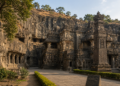
The road led to the Vaikom Mahadeva temple, one of the great Shiva temples of Kerala. Nobody on 30 March was asking to go inside it. The quarrel was about the four public roads that ran around its walls.
Boards stood on those roads. They announced that Ezhavas, Pulayas and other castes counted as polluting could go no further. The rule had nothing to do with being Hindu. Christians and Muslims used the roads freely. A Hindu toddy-tapper or farm labourer who walked the same stretch could be arrested. By one account, 200 Ezhavas had tried to break the ban as early as 1803.
The man who had worked longest to break the rule was T.K. Madhavan, an Ezhava newspaper editor and a follower of the reformer Sree Narayana Guru. He had written against the ban in his paper in 1917. In November 1920 he walked past the boards at Vaikom himself and then wrote to the district magistrate to say he had done it. In 1921 he went to see Gandhi at Tirunelveli and came away with a promise of support. At the Kakinada session of 1923 he got the Indian National Congress to commit itself against untouchability.
In January 1924 the Kerala Congress set up a committee under K. Kelappan to act on that. It chose Vaikom, and it chose 30 March.
Three at a time
The plan was simple. Each day a small group of volunteers, mixed by caste, would walk to the boards and be arrested. Then another group would come.
It worked until 10 April. Madhavan, Kelappan and K.P. Kesava Menon all went to jail. Then the Travancore police commissioner, W.H. Pitt, changed his tactics. After 10 April he stopped arresting anyone. He put bamboo barricades across the roads and posted constables behind them. The volunteers sat down in front of the barricades, spun yarn and sang. The police confiscated their spinning wheels and complained about the singing.
With the Hindu leaders in prison, the campaign passed for a time to George Joseph, a Syrian Christian barrister. Gandhi, who had been released from prison only that February and was following events from far away, wrote that this was a Hindu matter and that Hindus must do the suffering for it. Christians were to keep clear. A group of Akali Sikhs had come all the way from Amritsar and opened a free kitchen for the volunteers. Gandhi asked that it be closed, and it was.
Help from the Tamil country was harder to send home. E.V. Ramasamy, a Congress leader from Erode later known to everyone as Periyar, arrived in April at the invitation of Joseph and Kesava Menon. He was jailed twice. His wife Nagammai and his sister Kannammal came too, and brought women volunteers with them. Tamil writers still call him Vaikom Veerar, the hero of Vaikom.
Neck-deep
That year’s monsoon brought the worst floods Kerala had seen in living memory. The roads around the temple went under. The volunteers kept their places in front of the barricades, standing in three-hour shifts in water that came up to their necks. The police guarded the barricades from boats. One volunteer is reported to have died.
Not everyone on their side thought this was the way to do it. Narayana Guru is reported to have told a journalist that June that men standing in the rain outside a fence would achieve nothing, and that they should climb over it.
The march of the caste Hindus
In August 1924 the old Maharaja died. The Regent, Maharani Sethu Lakshmi Bayi, began by releasing the satyagraha prisoners.
Gandhi’s advice now was that the caste Hindus should speak for themselves. In November a procession of upper-caste men led by Mannathu Padmanabhan, the Nair leader, set out on foot from Vaikom for Trivandrum, about 200 kilometres to the south. A second column under Emperumal Naidu came up from Kottar. Together they handed the Regent a petition with some 25,000 signatures asking that the roads be opened "without distinction of caste or creed."
The matter went to the Travancore legislative council. N. Kumaran, an Ezhava member, moved that every road at Vaikom be opened to all castes. In February 1925 the vote was taken. The resolution lost, 22 to 21. The government’s own bloc had voted against it.
Gandhi comes to Vaikom
Gandhi arrived in March 1925. He spent three hours with the senior Brahmin guardians of the temple. He offered them a referendum among caste Hindus, or arbitration, or a ruling by learned pandits on what the scriptures required. They turned down all three.
He had more success with the policeman. Gandhi and Pitt agreed that the barricades and the constables would go, and that the volunteers in return would not step onto the closed roads. The satyagraha went on for another eight months as a line of people sitting beside an open road they had promised not to use.
What was won
It ended on 23 November 1925, after 603 days. The government opened the roads on three sides of the temple to everyone. The stretch on the eastern side stayed closed to the castes that had fought for it. It was now closed to Christians and Muslims as well. A new road was built so that everyone else could go around.
Periyar called the settlement a betrayal. The American scholar Mary Elizabeth King went looking in the state archives for the document that recorded its terms and could not find one. She describes the outcome as "an artful expedient." Her larger finding is uncomfortable for the story as it is usually told. Gandhi had hoped the suffering of the volunteers would change the hearts of the temple’s guardians. It did not. Not one of them gave way. The roads opened because the government came under political pressure it could no longer ignore.
In 1928 Travancore opened the roads around all its temples. On 12 November 1936 the young Maharaja, Chithira Thirunal, signed the Temple Entry Proclamation, and the doors of the temples themselves opened to every Hindu. The eastern road at Vaikom opened with them.
It was twelve years and seven months since Govinda Panicker had been told he could pass, and had sat down instead.
Test your knowledge
Answer 5 questions about the story.
What was the Vaikom Satyagraha?
A nonviolent protest from 1924 to 1925 seeking access to public roads around the Vaikom temple that were closed to people deemed lower caste.
When did the Vaikom Satyagraha begin?
The satyagraha began on 30 March 1924 in the princely state of Travancore.
Where is Vaikom located?
Vaikom is in present-day Kerala; during the protest it formed part of the princely state of Travancore.
Was temple entry itself granted immediately after the satyagraha?
No. The movement helped open access to several surrounding roads, but broader temple-entry change came later, notably with Travancore’s 1936 Temple Entry Proclamation.
How did Gandhi become involved in the Vaikom protest?
Gandhi visited Vaikom in 1925 and took part in discussions relating to the protest and caste-based road restrictions.
Sources and further reading
Mary Elizabeth King, Gandhian Nonviolent Struggle and Untouchability in South India: The 1924-25 Vykom Satyagraha and the Mechanisms of Change (Oxford University Press, 2015)
Michael Randle, "Gandhi and the myth of conversion: the Vykom satyagraha revisited", Waging Nonviolence: https://wagingnonviolence.org/2015/06/gandhi-myth-conversion-vykom-satyagraha-revisited/
"100 years on, remembering Vaikom Satyagraha as an anti-caste civil rights movement", The News Minute: https://www.thenewsminute.com/article/100-years-remembering-vaikom-satyagraha -anti-caste-civil-rights-movement-175802
Robin Jeffrey, "Temple-Entry Movement in Travancore, 1860-1940", Social Scientist, 1976
Dilip M. Menon, Caste, Nationalism and Communism in South India: Malabar 1900-1948 (Cambridge University Press, 1994)