Non-Cooperation Movement: Why Gandhi Stopped a Movement That Was Winning
The Non-Cooperation Movement of 1920 was a monumental moment in India's struggle against British colonial rule, marking the first mass-scale, nationwide act of peaceful resistance led by Mahatma Gandhi and the Indian National Congress.
How Gandhi’s first mass movement shook the Raj and ended at Chauri Chaura
By the start of 1922, the British Raj was rattled as it had not been since 1857.
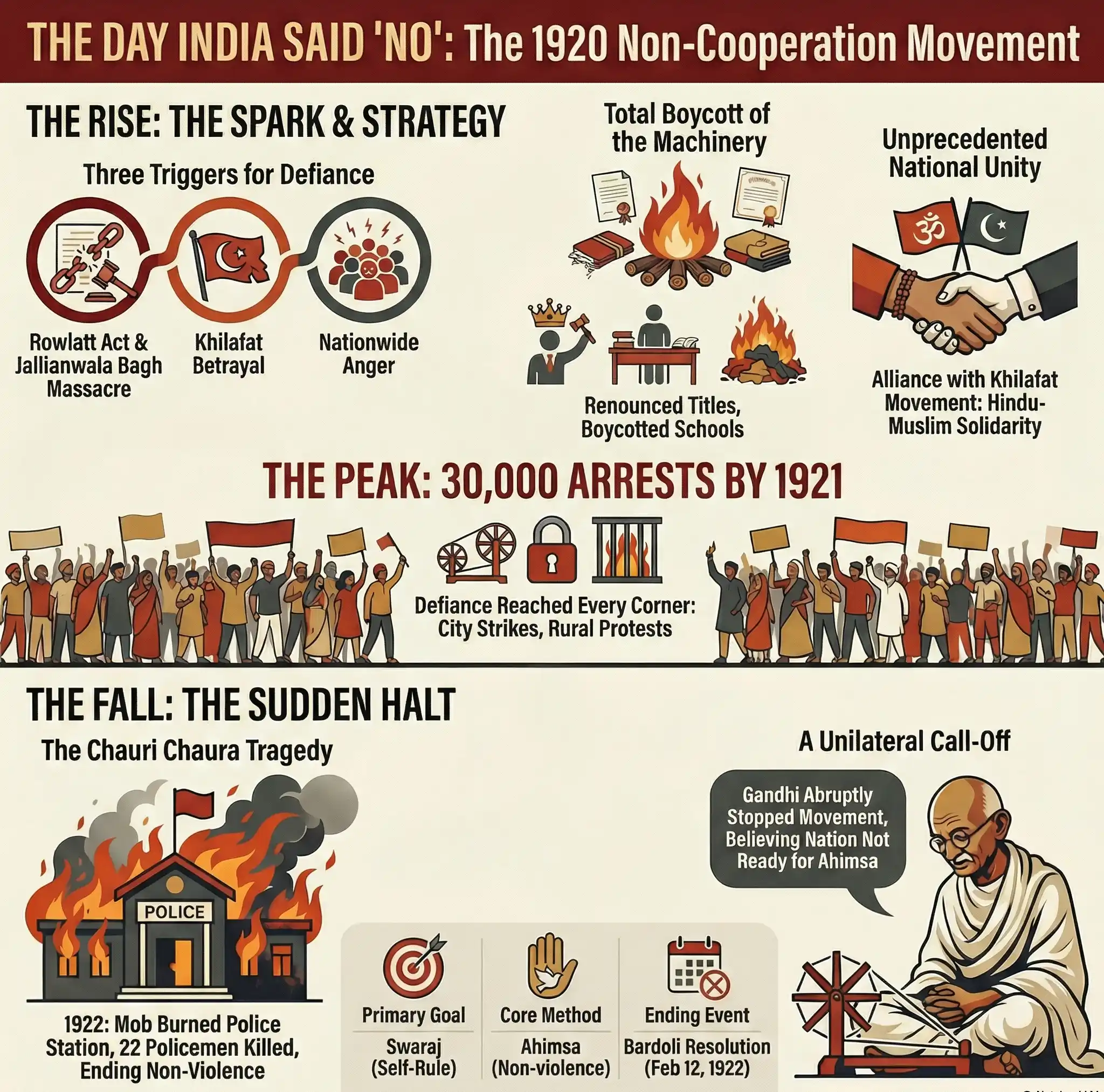
Across India, millions of people had simply stopped cooperating with their rulers. Students had walked out of government schools, lawyers had abandoned the colonial courts, and bonfires of foreign cloth burned in the streets. Tens of thousands of people were in prison and did not seem to mind. For the first time, the ordinary machinery of empire was seizing up, because the Indians who made it run had decided to stop.
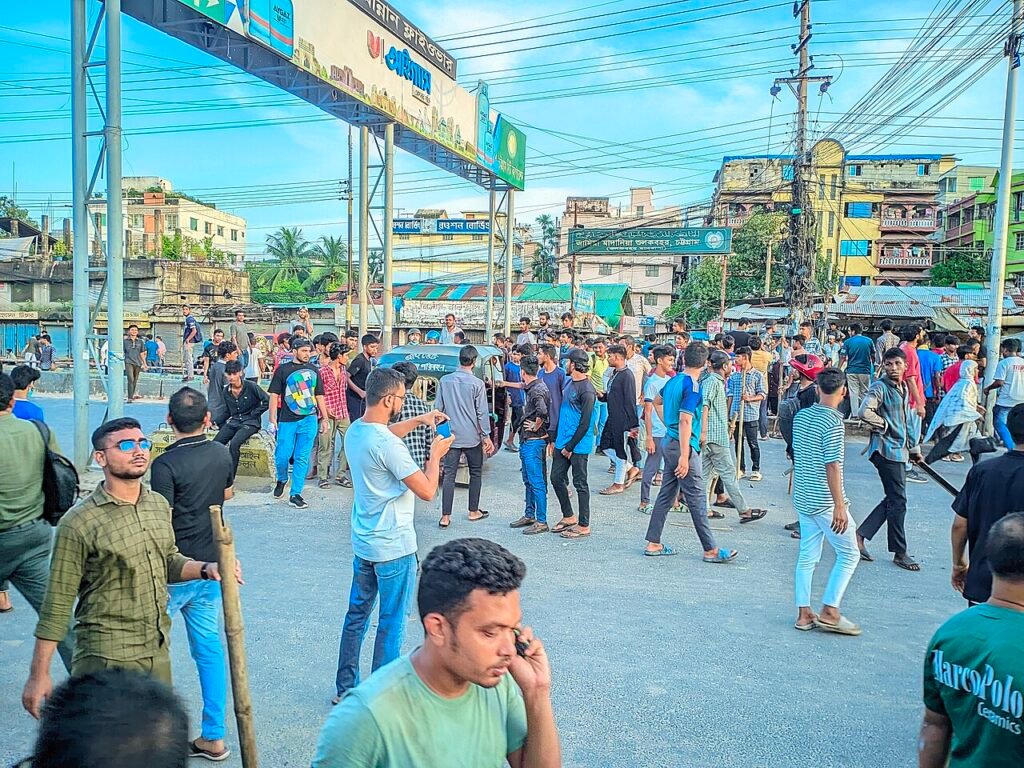
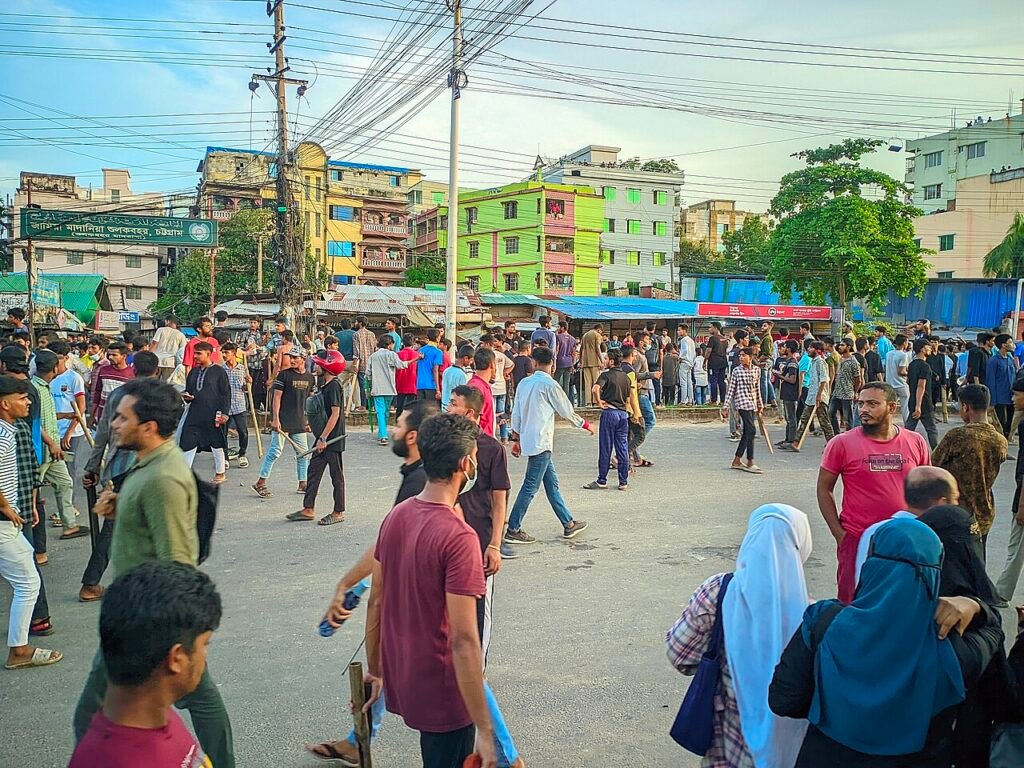
Day One of the Non-Cooperation Movement 2024 in Bahaddarhat, Chittagong 01.jpg Related to article: The Man Who Stopped a Winning Fight · Source: Wikimedia Commons · Owais Al Qarni · CC BY-SA 4.0
And then, at that exact moment, the man leading it all called the whole thing off.
He did not stop because he was losing. He stopped because of what a mob had done in one small village that most of the country had never heard of. The decision stunned his closest colleagues, and people still argue about it a hundred years later. This is the story of the Non-Cooperation Movement, and of the most puzzling and revealing choice Mahatma Gandhi ever made.
The perfect storm
By 1920, whatever faith Indians had once had in British fairness was gone.
Mitchell A New Map of Texas, Oregon, and California 1846 UTA.jpg Related to article: The Man Who Stopped a Winning Fight · Source: Wikimedia Commons · Samuel Augustus Mitchell · Public domain
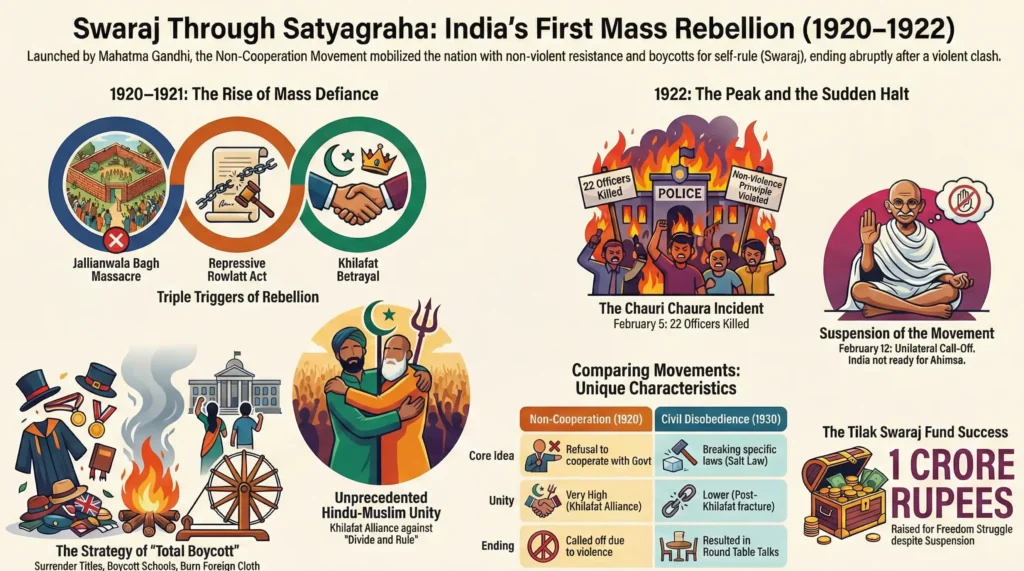
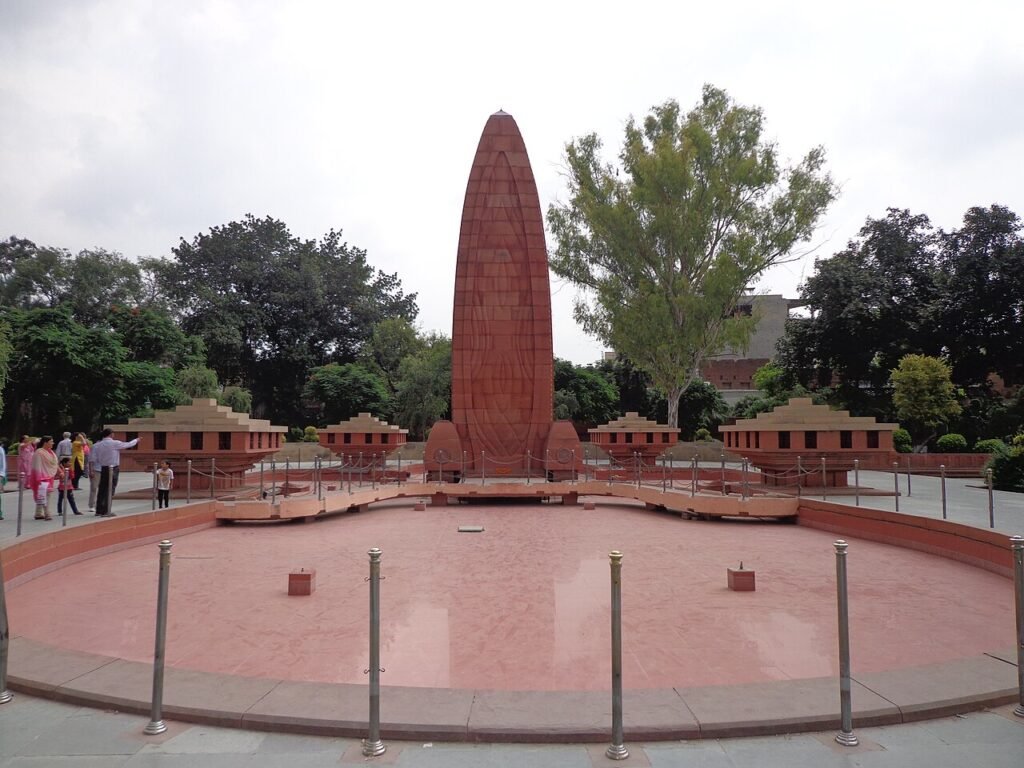
They had fought and died for Britain in the First World War, expecting a step toward self-rule as their reward. Instead they were handed the Rowlatt Act, which let the government jail people without trial. Then came the massacre at Jallianwala Bagh, where a British general fired on a trapped and peaceful crowd, and the shock of watching much of the British establishment defend him. On top of all this sat a fresh grievance among Indian Muslims, angry at Britain’s treatment of the Ottoman Caliph after the war.
It was a mountain of anger, and Gandhi, now the guiding force of the Congress, saw how to give it shape. He would gather all that fury into a single, disciplined, non-violent campaign.
Jaliyalwalabagh massacre memmorial monument.jpg Related to article: The Man Who Stopped a Winning Fight · Source: Wikimedia Commons · Prasanthnaduvath · CC BY-SA 4.0
Not fighting, but refusing
Gandhi’s idea was quietly revolutionary, and its power lay in a simple insight about how empires actually work.
An empire the size of British India could not be run by the handful of Britons who governed it. It ran on Indian hands: Indian clerks and policemen and soldiers, Indian students in its schools, Indian lawyers in its courts, Indian customers for its cloth. The whole vast structure depended on Indians agreeing to take part in it.
So Gandhi’s plan was not to attack the empire. It was to stop helping it run. An empire that insists on being obeyed cannot easily survive being calmly ignored.
Day One of the Non-Cooperation Movement 2024 in Bahaddarhat, Chittagong 02.jpg Related to article: The Man Who Stopped a Winning Fight · Source: Wikimedia Commons · Owais Al Qarni · CC BY-SA 4.0
The forms this took were everywhere. Gandhi handed back the medal the British had once given him. Students left government colleges, and Indians founded their own schools and universities to replace them. Eminent lawyers gave up rich practices to work for the cause. And above all, people boycotted British cloth, feeding their foreign clothes into great bonfires and taking up the spinning wheel and homespun khadi, with the plain white cap that became the uniform of the movement.
Hindu and Muslim, together
The most remarkable thing about those years was something the British had spent a century trying to prevent.
Gandhi joined hands with the leaders of the Muslim Khilafat cause, the brothers Shaukat and Mohammad Ali, and for a while the two great communities of India marched as one. Gandhi was made president of the Khilafat Conference. Hindu leaders spoke from the steps of mosques, Muslim leaders were welcomed into temples, and the cry of Hindu-Muslim brotherhood rang through the streets.
For one brief, shining stretch, Hindus and Muslims stood together against the Raj, in exactly the streets the British had always counted on keeping divided.
It frightened the colonial government more than any bomb could have, because it struck at the oldest weapon in the imperial armoury: the art of setting Indians against one another. It would not last. But while it lasted, it offered a glimpse of an India that might have been.
The movement spread further and faster than anyone had expected.
When the British sent the Prince of Wales to tour India in late 1921, hoping for loyal, cheering crowds, he was met instead by shuttered shops and silent, empty streets. The campaign reached deep into the countryside, to forest villagers and tea-garden workers who had never before felt part of a national struggle. By the end of 1921, some thirty thousand people were in jail, and more kept coming. A brilliant young man named Subhas Chandra Bose gave up a guaranteed place in the elite Indian Civil Service to throw himself into the fight.
It was, by any measure, working. And that is what makes what happened next so hard to explain.
Chauri Chaura
On 5 February 1922, in a village called Chauri Chaura in the north of India, a crowd of protesters clashed with the police.
The police opened fire. Enraged, the crowd surged back, chased the outnumbered policemen into their station, and set the building alight. Around twenty-two policemen died in the flames.
It was a small event in a faraway place. But for the movement, it was a catastrophe, because the one thing Gandhi had insisted on above all others, the thing that made the whole struggle what it was, had just been broken. The people had answered violence with violence.
When Gandhi heard the news, he was devastated, and his response astonished everyone.
He decided that India was not yet ready. If a crowd could turn to murder the moment it was provoked, then the discipline of non-violence that the whole movement rested on was not real, and to carry on would be to build something powerful on a rotten foundation. And so, with the Raj reeling and the country roused as never before, Gandhi called the entire national movement to a halt.
Almost every other leader was aghast. Men like Jawaharlal Nehru and Subhas Chandra Bose, some of them sitting in prison as they heard the news, felt he had thrown away a once-in-a-generation opportunity over a single riot hundreds of miles away. The momentum, they believed, would never come back. Gandhi would not be moved.
He would rather, he said in effect, stand alone with his conscience than march in a huge crowd that had turned to violence. For Gandhi, how you won decided what you won.
Was he right?
The argument has never really ended, and both sides of it are serious.
His critics have a strong case. The empire was shaken, the whole country was in motion, and it was all set aside because of what happened in one village that most Indians could not have found on a map. Perhaps a genuine chance to shake the Raj to pieces was lost, and would not come again for years.
But Gandhi’s reasoning ran deeper than tactics, and to understand it is to understand the man. For him, the point was never simply to get rid of the British. It was that the way you win decides what you end up with. A freedom seized by a burning mob would not be the peaceful, self-governing India he was trying to bring into being. It would just be a change of rulers, with the same old cruelty waiting underneath. He was not only fighting an empire. He was trying to teach a whole nation a new and difficult way to be strong, and he would not let that lesson be unlearned in a single afternoon of fire, even to win.
Whether that was moral greatness or a historic blunder, people still debate. But it revealed the thing that sat at the very centre of Gandhi: the belief that the means and the end are not two separate things, that the means are the end, slowly taking shape.
And here is the part the critics missed. Judged by its own promise, the movement failed. It did not win Swaraj in a year. Gandhi was arrested within weeks and sent to prison, and the great Hindu-Muslim unity soon frayed. And yet the movement changed India permanently, in the one way that mattered most. It reached the ordinary peasant, the weaver, the student, the clerk, and it took away their fear. The villager who had once trembled at the sight of a British policeman had stood in the street and defied an empire, and lived. That fear, once lost, never fully returned.
The movement was stopped. What it had started could not be. A people that has learned it is not afraid cannot, in the end, be ruled for long by force alone.
If you think you have remembered everything about this topic take this QUIZ
Results
QUIZ START
#1. The Non-Cooperation Movement was formally launched on which date?
Previous
Next
#2. Which violent incident caused Mahatma Gandhi to abruptly call off the movement in February 1922?
Previous
Next
#3. Who were the key allies of Mahatma Gandhi who led the Khilafat Movement?
Previous
Next
#4. What was the specific financial fund launched to support the movement, which collected over 1 Crore rupees?
Previous
Next
#5. Subhas Chandra Bose resigned from which prestigious service in 1921 to join the movement?
Previous
Next
#6. The “Gandhi Cap” (Topi) became a symbol of defiance during this movement. What color was it?
Previous
Next
#7. Which visiting British royal was greeted with empty streets and strikes (hartals) in November 1921?
Previous
Next
#8. What was the main method of protest adopted during the Non-Cooperation Movement?
Previous
Finish
Why was the Non-Cooperation Movement launched?
It was launched to protest against the Jallianwala Bagh Massacre, the Rowlatt Act, and the Khilafat injustice, with the ultimate goal of attaining Swaraj.
Why did Gandhi call off the movement?
Gandhi called it off after the Chauri Chaura incident (Feb 1922), where a mob burnt 22 policemen alive. He felt the movement had lost its non-violent character.
Who were the Ali Brothers?
Shaukat Ali and Mohammad Ali were the leaders of the Khilafat Movement who allied with Gandhi to forge Hindu-Muslim unity during the struggle.
What was the Chauri Chaura incident?
It was a violent clash in Gorakhpur, UP, where protestors set a police station on fire, killing 22 policemen. It directly led to the suspension of the Non-Cooperation Movement.
Did the movement achieve Swaraj?
No, it failed to achieve Swaraj within one year as promised, but it successfully transformed the Congress into a mass-based party.
Sources & References
Encyclopaedia Britannica (“Noncooperation movement” and “Mahatma Gandhi”) — the launch, the methods, and the course of the 1920 to 1922 movement.
Encyclopaedia Britannica (“Khilafat movement”) — the alliance that produced the Hindu-Muslim unity of these years.
Gorakhpur district administration (Chauri Chaura) — the incident of 5 February 1922 and its site.
Amrit Mahotsav, Government of India (the freedom struggle) — the national spread of the movement and its participants.