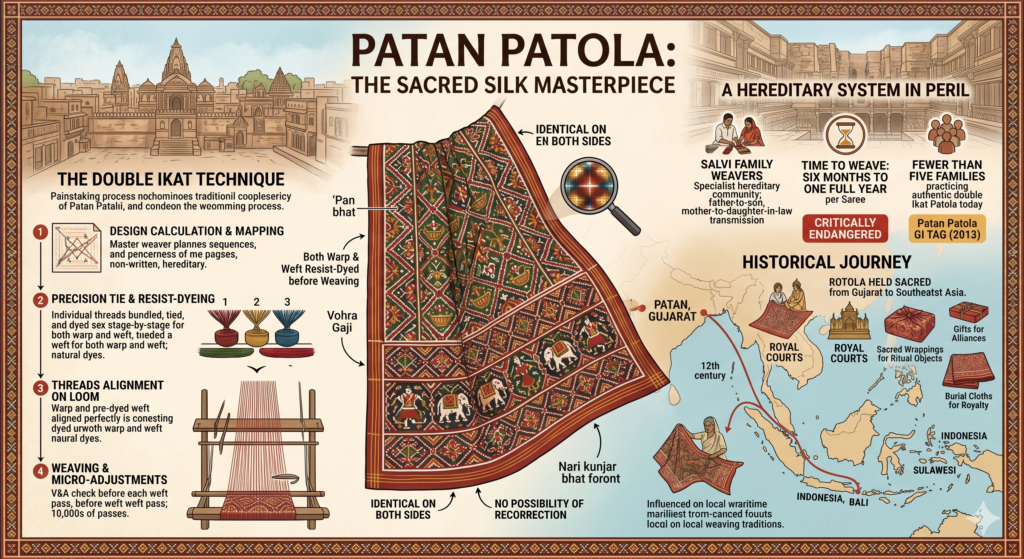
The Patola saree of Patan in Gujarat is produced through a technique called double Ikat, in which both the warp threads running lengthwise and the weft threads running crosswise are individually resist-dyed in precise sequences before a single pass of the loom takes place. The resulting design, which appears identical on both sides of the finished fabric, emerges only when pre-dyed threads align perfectly during weaving, with no possibility of correction once the loom begins moving. This process, applied across six meters of fine silk with designs containing thousands of individual color intersections, requires between six months and a full year of continuous work by an entire family of weavers. Fewer than five families in Patan currently practice authentic double Ikat Patola, making it one of the most critically endangered textile traditions on earth. The saree they produce was traded across maritime Southeast Asia from the twelfth century onward, held sacred by royal courts from Gujarat to Indonesia, and remains today one of the most expensive handwoven textiles produced anywhere in India.| Detail | Information |
| Textile Name | Patola (plural: Patolas), double Ikat silk saree |
| Origin | Patan, Gujarat, Northwest India |
| Weaving Community | Salvi family weavers, a small hereditary community |
| Technique | Double Ikat, both warp and weft threads resist-dyed before weaving |
| Time to Weave | Six months to one full year per saree |
| GI Tag | Patan Patola awarded GI tag in 2013 |
| Historical Patronage | Solanki dynasty, Mughal court, medieval Gujarati merchant class |
| Export History | Traded extensively to Southeast Asia from 12th century onward |
| Active Weaving Families | Fewer than five families practicing authentic double Ikat Patola today |
Why a Year of Work Happens Before the Weaving Begins
The Patola saree of Patan in Gujarat is produced through a technique called double Ikat, in which both the warp threads running lengthwise and the weft threads running crosswise are individually resist-dyed in precise sequences before a single pass of the loom takes place. The resulting design, which appears identical on both sides of the finished fabric, emerges only when pre-dyed threads align perfectly during weaving, with no possibility of correction once the loom begins moving. This process, applied across six meters of fine silk with designs containing thousands of individual color intersections, requires between six months and a full year of continuous work by an entire family of weavers. Fewer than five families in Patan currently practice authentic double Ikat Patola, making it one of the most critically endangered textile traditions on earth. The saree they produce was traded across maritime Southeast Asia from the twelfth century onward, held sacred by royal courts from Gujarat to Indonesia, and remains today one of the most expensive handwoven textiles produced anywhere in India.
How Azim Premji Turned Cooking Oil Into a Technology Empire
Before the Loom Moves
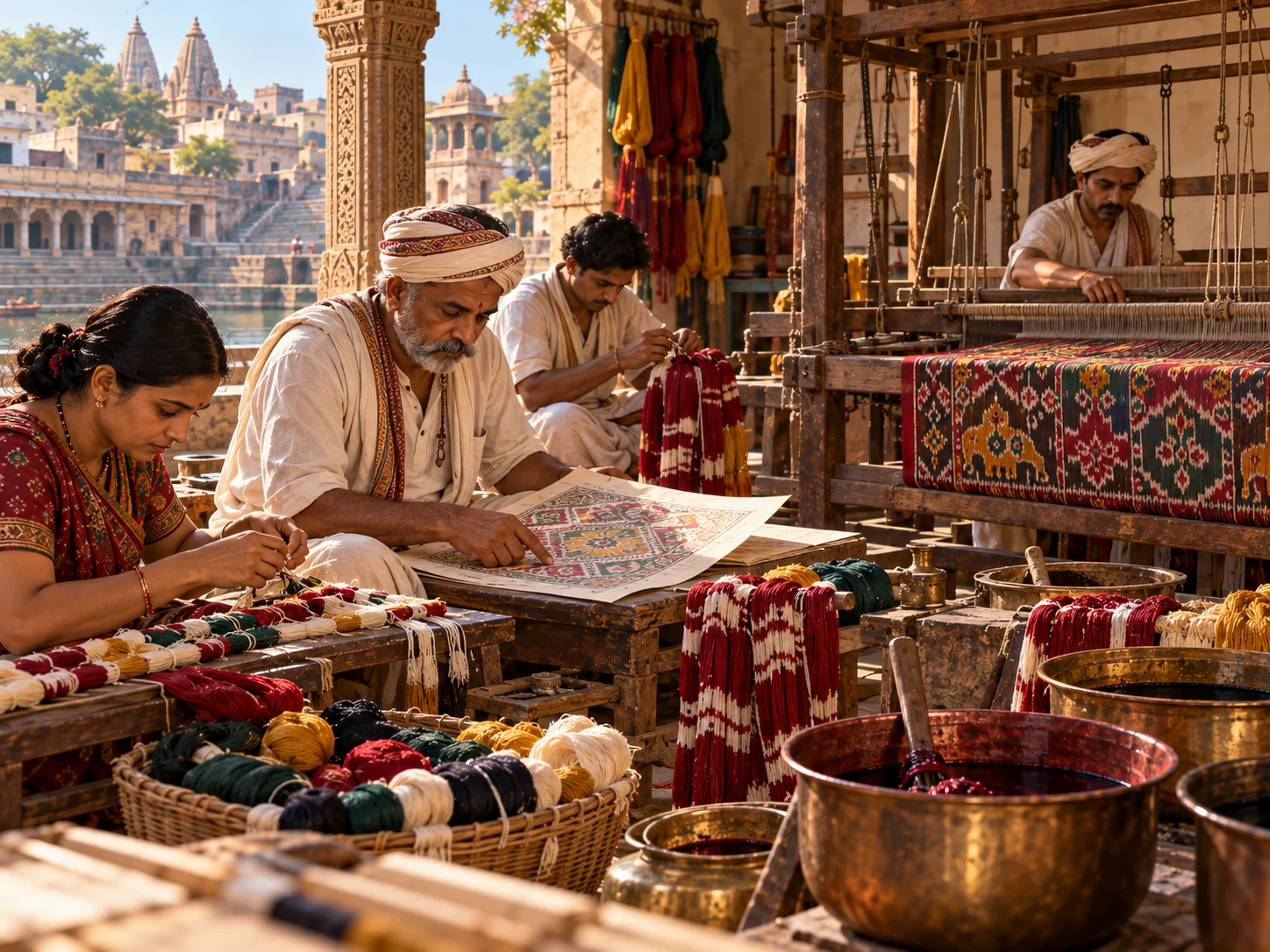
Before a Patan Patola reaches the loom, most of its difficult work has already happened. The flowers, elephants, parrots or geometric forms are not painted onto finished cloth. They are not embroidered afterwards either. The design has been divided across two separate sets of silk threads – the warp running lengthwise and the weft crossing it – and both have been tied and dyed before weaving begins.
At that stage, the saree does not exist. There are only bundles of coloured thread carrying fragments of a pattern. Then the loom starts. Every pass of the weft has to meet the dyed marks waiting in the warp. A tiny shift is visible immediately. The weaver adjusts the threads, checks the design and moves again. That is why a Patan Patola can take many months. The loom is only assembling a picture that had to be planned before there was any cloth.
One Pattern, Split in Two
Ikat begins with resist dyeing. Sections of yarn are tightly bound so that dye cannot reach them. The bindings are changed between colour baths, allowing different parts of the same thread to take different colours.
In single ikat, either the warp or the weft carries the resist-dyed pattern. Patan Patola uses double ikat: both carry it. That changes the problem completely. The maker has to predict where a coloured section of one thread will cross a coloured section of another. The finished motif depends on those two decisions meeting at the correct point.
The familiar pattern names include Ratan Chowk and Wagh Kunjar. A Patola pattern is prepared before there is a surface on which to see it.
Jamsetji Tata: The Steel City That Outlived Its Founder by a Century
The Graph Comes Before the Dye
The work begins with a design mapped onto a grid. That grid is effectively an instruction sheet for the yarn. Silk threads are arranged in bundles. Sections that must resist the first dye are tied. After dyeing, some bindings are removed, others are added, and the yarn goes into another colour. The sequence repeats until each bundle carries the colour changes required by the design.
Now imagine doing that twice: once for the warp and again for the weft. A mistake made during this preparation cannot simply be painted over when the saree is finished. The colour is already inside the thread system that will form the cloth. This long preparation explains why saying that a Patola ‘takes a year to weave’ is slightly misleading. The weaving is one stage of a much longer process of designing, tying, dyeing, arranging and repeatedly correcting alignment.
This calculation is not done on paper in any formalized notation system. It is held in the mind and hands of the master weaver, transmitted through the practice-based knowledge of the Salvi family tradition rather than through written documentation. According to research compiled by the Calico Museum of Textiles, attempts to document Patola pattern calculation systems in formal notation have repeatedly encountered the challenge that the knowledge is inherently embodied and contextual, resistant to the kind of abstraction that written documentation requires.
Once the design calculation is complete, the threads are bundled together and tied at the precise intervals required by the design, with resist material applied to prevent dye penetration at the tied points. Each color in the design requires a separate dyeing stage, with threads retied between stages to protect previously dyed sections while new color is applied. A Patola design using five colors in its warp threads requires five separate dyeing stages for the warp alone, and the same number for the weft, with each stage requiring precise retying of thousands of individual thread bundles.
The dyeing itself uses natural dyes in the most authentic traditional production, with colors derived from plant and mineral sources that have been part of the Salvi family’s material knowledge for generations. According to documentation held by the Crafts Council of India, the shift to synthetic dyes in some contemporary Patola production has been resisted by the most traditional Salvi practitioners specifically because the interaction between natural dye compounds and silk fiber produces a depth and luminosity that synthetic dyes cannot replicate, a quality that is immediately apparent in historical pieces and detectable even to untrained observers comparing authentic and synthetic-dyed examples side by side.
The Day the Loom Finally Moves
After months of planning, tying, dyeing, retying, and careful thread alignment, the moment when the Patola loom begins to move is not a release of tension. It is the beginning of a different kind of sustained concentration.
The weft thread, wound onto a shuttle, must pass through the warp threads at precisely the position calculated during the design stage. Before each pass, the weaver checks the alignment of the weft thread against the warp, adjusting individual threads by fractions of a millimeter if necessary to ensure that the color intersections will fall exactly where the design requires. This checking and micro-adjustment process happens before every single weft passes across the full width of the fabric, which is typically around forty-five to fifty centimeters for a Patola saree.
A Patola saree is six meters long. The weft thread passes across the width hundreds of times per centimeter of length. The total number of individual weft passes required to complete a full saree runs into the tens of thousands, each one preceded by the alignment check that ensures the design integrity is maintained. This is the reason Patola weaving is typically a family effort rather than an individual one, with different family members responsible for different stages of the checking and adjustment process simultaneously.
The finished textile, when it comes off the loom, is identical on both sides. This reversibility is not a byproduct of the double Ikat technique. It is a consequence of the fundamental principle that the design is created by the intersection of pre-dyed threads rather than by any surface application, meaning that the structure of the cloth is the design and the design is the structure, inseparable from each other in a way that makes the concept of a right side and a wrong side meaningless.
The Southeast Asian Journey of a Gujarati Silk
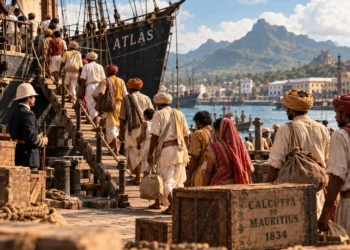
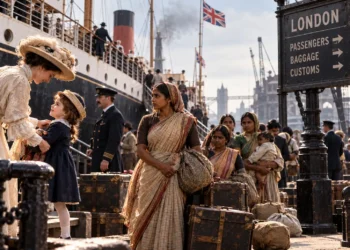
One of the most remarkable chapters in Patola history is its relationship with maritime Southeast Asia, a connection that transformed the saree from a luxury item of the Gujarati merchant class and royal court into a sacred textile of extraordinary religious and social significance across a vast arc of island cultures.
From at least the twelfth century onward, Gujarati merchants trading through the ports of the western Indian coast carried Patola sarees eastward as trade goods of the highest value. They reached the courts of Java, Bali, Sulawesi, Sumatra, and the Maluku islands, where they were received not simply as expensive cloth but as objects carrying supernatural power. In several island cultures of what is now Indonesia, Patola sarees were used as sacred wrappings for ritual objects, as gifts exchanged between royal families to seal political alliances, and as burial cloths for royalty, believed to ensure safe passage of the deceased into the ancestral realm.
The Victoria and Albert Museum in London holds documented examples of Patola pieces collected from Indonesian royal and ritual contexts, and scholars of Southeast Asian textile history have traced the influence of Patola geometric design vocabulary on local weaving traditions across the region, finding Patola-derived patterns woven into Indonesian textiles centuries after direct trade contact had diminished. The Patola had become so culturally embedded in these island traditions that local weavers began replicating its designs in their own materials, producing what textile historians call shadow Patolas, local interpretations that preserved the visual memory of the original Gujarati textile long after the original itself had become rare. The depth of this Southeast Asian connection is documented in research compiled by the National Museum of Indonesia in Jakarta, which holds significant collections of both original Patola trade pieces and the local textile traditions they influenced, providing one of the most complete records available of how a single Indian weaving tradition shaped aesthetic and ritual culture across an entire maritime civilization.
How the Murugappa Group Built a Silent Empire in Southern India
Quick Comparison Table
| Aspect | Double Ikat Patola | Single Ikat Textiles |
| Threads Dyed Before Weaving | Both warp and weft | Either warp or weft only |
| Design Edge Quality | Sharp, precise geometric intersections | Characteristic soft blurred edges |
| Error Correction During Weaving | None possible | Minor adjustments can be accommodated |
| Time to Complete | Six months to one full year | Days to weeks depending on complexity |
| Fabric Reversibility | Identical design on both sides | Typically has a distinct right and wrong side |
| Active Practitioners in Patan | Fewer than five families | Practiced by many communities across India |
| GI Tag | Yes, awarded 2013 | Varies by specific textile and region |
Curious Indian: Fast Facts
- The Rani ki Vav stepwell in Patan, built during the Solanki dynasty that first patronized Patola weaving, was designated a UNESCO World Heritage Site in 2014, placing Patan among India’s most historically significant cities.
- A genuine Patan Patola saree is identical on both sides because its design is created entirely by the intersection of pre-dyed threads rather than by any surface application or embroidery.
- Patola sarees were so sacred in certain Indonesian island cultures that they were used as burial wrappings for royalty and as ritual coverings for sacred objects, a use that elevated them far beyond the category of luxury textile.
- The word Patola is believed to derive from the Sanskrit word pattakulla, meaning fine silk cloth, reflecting the textile’s ancient roots in the Sanskrit literary and commercial vocabulary of Gujarat.
- In medieval Gujarat, Patola sarees were among the most expensive wedding gifts a family could give, with specific pattern types considered auspicious for specific occasions and communities.
- Local weavers in Indonesian islands where Patola trade goods arrived centuries ago began producing their own interpretations of Patola geometric designs, creating what textile historians call shadow Patolas that preserve the visual memory of the Gujarati original.
- The Calico Museum of Textiles in Ahmedabad holds one of the world’s most important collections of historical Patola pieces, including examples from different centuries that allow direct comparison of how the tradition evolved and maintained consistency across time.
The Five Families and What Comes Next
The most sobering fact about Patan Patola today is not the year it takes to make or the price it commands in the market. It is the number of families who can make it at all.
Authentic double Ikat Patola production in Patan is currently practiced by fewer than five families, all of them Salvi, all of them maintaining the hereditary knowledge system that the Solanki kings established in the twelfth century. The most prominent among them, the Salvi family whose workshop in Patan has been documented and visited by textile scholars, craft researchers, and museum curators from around the world, continues to produce Patola using traditional techniques and natural dyes, with pieces selling for amounts that reflect the extraordinary labor and skill invested in each one.
The Geographical Indications Registry framework awarded Patan Patola formal legal protection in 2013 to counter imitation marketing. Yet, international commercial frameworks cannot easily address the fundamental bottleneck of an endangered skill system structured entirely around hereditary line exclusivity. If the remaining Salvi families do not produce successors willing and able to carry the full technical knowledge forward, one of the world’s most technically demanding textile traditions will disappear within a generation. That transmission challenge is what textile preservation organizations have identified as the most critical long-term threat to the tradition’s survival.
The Rani ki Vav stepwell in Patan, built during the Solanki dynasty that first patronized Patola weaving, was designated a UNESCO World Heritage Site in 2014, placing Patan among India’s most historically significant cities, a monument to the cultural weight that this small town has carried across centuries.
Dr. Pratap Reddy and the Patient Death That Built Apollo Hospitals
If you think you have remembered everything about this topic take this QUIZ
Results


#1. Which medieval dynasty brought the Salvi weavers to Patan and established formal royal patronage for the Patola tradition?
#2. What structural feature defines a genuine Patan Patola saree, making the concept of a right and wrong side completely meaningless?
#3. What makes the double Ikat weaving technique of Patan Patola exceptionally high-risk with no margin for error?
#4. Which famous museum in Ahmedabad holds one of the world’s most significant collections of historical Patola pieces?
#5. How did royal courts and local weavers in maritime Southeast Asia historically treat the imported Gujarati Patola sarees?
#6. Approximately how many families in Patan currently maintain the hereditary knowledge system required to practice authentic double Ikat Patola?
#7. In which year was the Patan Patola officially awarded its Geographical Indication (GI) tag?
#8. Why do the most traditional Salvi practitioners strictly resist switching to synthetic dyes in contemporary Patola production?
What makes the Patola of Patan different from other Ikat textiles?
Patan Patola uses double Ikat technique, meaning both the warp and weft threads are individually resist-dyed before weaving begins. The design appears only when these pre-dyed threads align precisely during weaving. Most other Ikat textiles use single Ikat, where only one thread system is dyed before weaving, producing the characteristic soft-edged design quality. Double Ikat produces sharp geometric precision and a fabric that is identical on both sides, with no margin for alignment error during production.
Why does a Patola saree take up to a year to complete?
The year-long production time reflects the complexity of the preparation process rather than the weaving speed alone. Planning the precise dye sequence for thousands of individual threads across both warp and weft, tying and retying thread bundles through multiple dyeing stages for each color in the design, and then weaving with alignment checks before every single weft pass across the full six-meter length of the saree collectively account for the extraordinary time investment each piece requires.
How many families still make authentic double Ikat Patola?
Fewer than five families in Patan, all from the hereditary Salvi weaving community, currently practice authentic double Ikat Patola production. The knowledge has been maintained exclusively within Salvi family lineages since the tradition was established under Solanki royal patronage approximately in the twelfth century, and no institutional repository of the technical knowledge exists outside these family lineages.
Why were Patola sarees significant in Southeast Asian cultures?
Gujarati merchants carried Patola sarees to the island cultures of present-day Indonesia from at least the twelfth century onward. In several of these cultures, Patola were received as objects carrying supernatural power rather than simply as luxury textiles. They were used as sacred wrappings for ritual objects, as political gifts between royal families, and as burial cloths for royalty. Local weavers began producing their own interpretations of Patola designs, creating textile traditions that preserved the visual memory of the original Gujarati cloth across centuries.
What does the GI tag mean for Patan Patola?
The Geographical Indication tag awarded to Patan Patola in 2013 provides legal protection against misrepresentation of the textile, preventing producers outside the authentic tradition from marketing imitation products as genuine Patola. However, the GI tag cannot address the deeper challenge of knowledge transmission within the small hereditary community of Salvi weavers, and craft preservation organizations have identified this transmission challenge as the most critical long-term threat to the tradition’s survival.