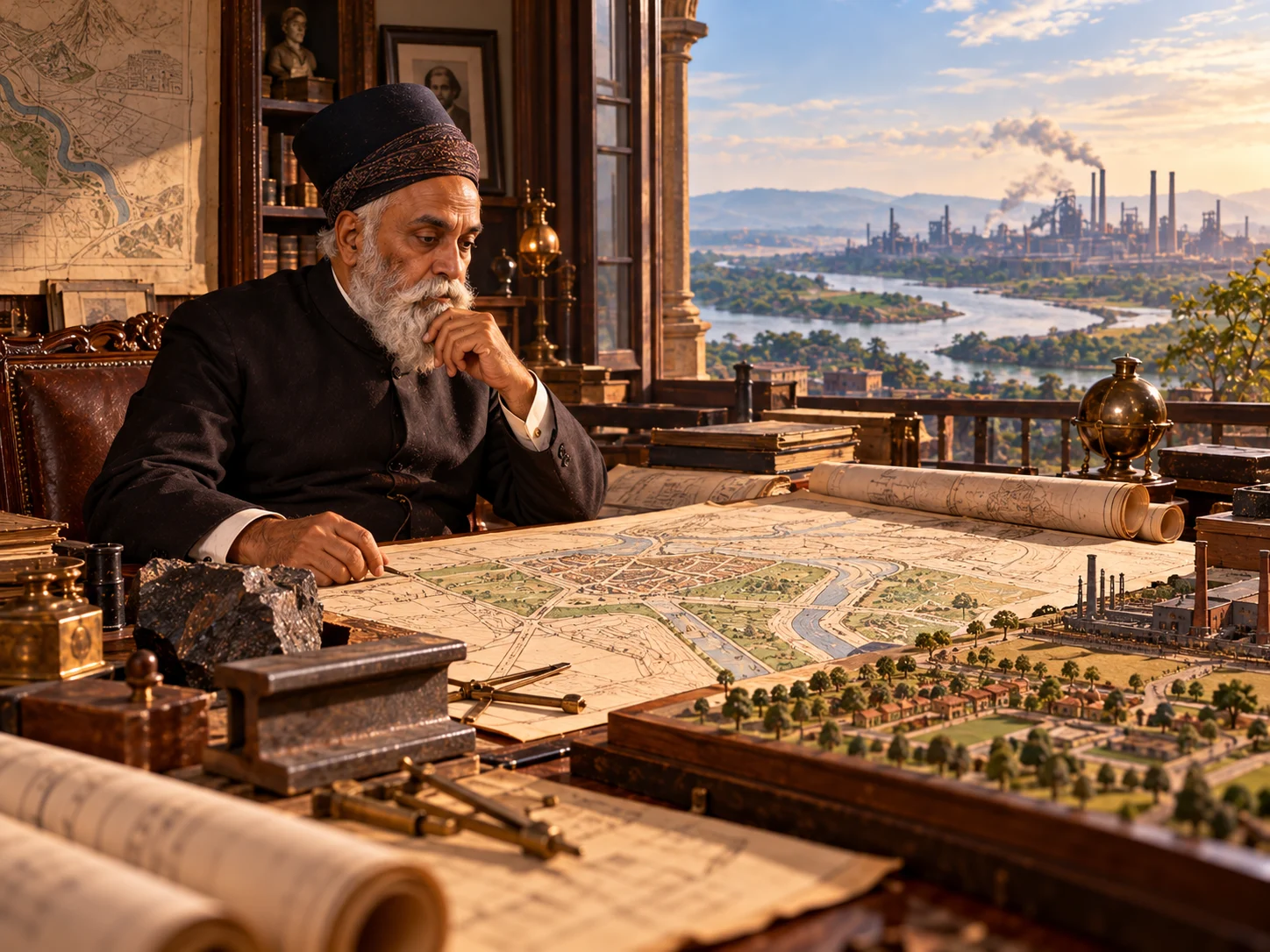
Jamsetji Tata spent years conducting geological surveys, consulting American metallurgical experts and navigating colonial administrative resistance to identify the site for an Indian owned steel plant that would prove India capable of the heavy industrial production that the colonial government insisted required British management and British capital. The site he chose, at the confluence of two rivers in what is now Jharkhand, became Jamshedpur, India's first planned industrial city. He died before it was built, but what he built in his planning and his persistence became the foundation of the Tata industrial empire and one of the most consequential acts of industrial nation building in Indian history.| Detail | Information |
| Subject | Jamsetji Tata and the founding of Jamshedpur |
| Full Name | Jamsetji Nusserwanji Tata |
| Born | 3 March 1839, Navsari, Gujarat, India |
| Died | 19 May 1904, Bad Nauheim, Germany |
| Industry | Steel, textiles, hydroelectric power |
| Key Project | Tata Iron and Steel Company, Jamshedpur |
| Site Selected | Confluence of Subarnarekha and Kharkai rivers, Bihar |
| Legacy | Father of Indian industry, founder of modern Jamshedpur |
A Steel Plant and a City Designed in Advance
Jamsetji Tata spent years conducting geological surveys, consulting American metallurgical experts and navigating colonial administrative resistance to identify the site for an Indian owned steel plant that would prove India capable of the heavy industrial production that the colonial government insisted required British management and British capital. The site he chose, at the confluence of two rivers in what is now Jharkhand, became Jamshedpur, India’s first planned industrial city. He died before it was built, but what he built in his planning and his persistence became the foundation of the Tata industrial empire and one of the most consequential acts of industrial nation building in Indian history. He was born on 3 March 1839 in Navsari, Gujarat, into a Parsi trading family, and died on 19 May 1904 in Bad Nauheim, Germany.
Why Steel Mattered
The idea of building a steel plant in India had been in Jamsetji Tata’s mind since at least the 1880s. The conviction behind it was simple: India had iron ore. India had coal. India had rivers capable of providing the water and the transport that a steel plant required. There was no technical reason why India needed to import steel from Britain at prices that made every Indian infrastructure project more expensive than it needed to be.
The colonial government had a different view. The prevailing colonial economic framework held, conveniently for British commercial interests, that Indians were capable of agricultural production and small scale trade but that heavy industrial production required European management, European capital and European technical expertise. An Indian owned steel company was not simply a commercial proposal in this context. It was a challenge to a foundational assumption of colonial economic ideology.
Steel in the late nineteenth century was not simply a commodity. It was the material from which railways were built, from which bridges were constructed, from which the physical infrastructure of industrial civilization was assembled. A country that could not produce its own steel was dependent on whoever could, and in India’s case that dependency was on Britain, which used it to maintain a commercial relationship that served British industrial interests rather than Indian developmental needs.
Jamsetji understood this dependency with a clarity that came from decades of watching the Indian economy function under colonial conditions. Breaking it required building something that the colonial government would have preferred not to be built. He made the challenge anyway, with the methodical patience of an engineer and the long term thinking of a man who understood that the project he was proposing would outlast his own life.
The Mythological World Woven Inside a Baluchari Saree
The Man and His Capital
Jamsetji Nusserwanji Tata was born in 1839 in Navsari in Gujarat into a Parsi trading family. His father Nusserwanji Tata had established a trading business in Bombay and Jamsetji joined the family business as a young man, demonstrating from early in his career the combination of commercial intelligence and industrial ambition that would eventually define his legacy.
His early business ventures were primarily in textiles. He established the Empress Mills in Nagpur in 1877, one of the most technically advanced textile mills in India at the time, and later the Swadeshi Mills in Bombay. These enterprises were successful and generated the capital that would eventually fund the steel project. But textiles were never Jamsetji’s ultimate ambition. He thought in the categories of national infrastructure, of the industries that a nation needed to be genuinely industrially independent, and steel was the most fundamental of those categories.
The Disputed and Fascinating Origins of Kashmiri Pashmina
The Systematic Search
The search for the right site for the steel plant began in earnest in the late 1890s. Jamsetji did not approach it casually or intuitively. He approached it as an engineering problem requiring systematic investigation, and he brought in the best technical expertise he could find.
He recruited Charles Page Perin, an American metallurgical engineer with extensive experience in steel plant design and site selection, to advise the project. Perin’s involvement was significant because it brought to the site selection process the kind of rigorous technical methodology that American steel industry development had evolved over decades of building plants across the diverse geography of the United States.
The criteria for the ideal site were demanding. The plant needed proximity to iron ore of sufficient quality and quantity to sustain decades of production. It needed access to coking coal, which was essential for the steelmaking process. It needed water in large quantities, both for the industrial processes themselves and for the worker population that would grow around the plant. It needed river or rail access to move raw materials in and finish steel out. And it needed sufficient flat land to accommodate the plant itself and the planned city that would surround it.
Perin conducted surveys across a significant portion of central and eastern India, and the geological surveys that supported his work drew on both British colonial geological records and independent investigation. The areas under consideration included parts of what are now Odisha, Jharkhand and Chhattisgarh, regions where the geological conditions that support iron ore and coal deposits were understood to be favorable.
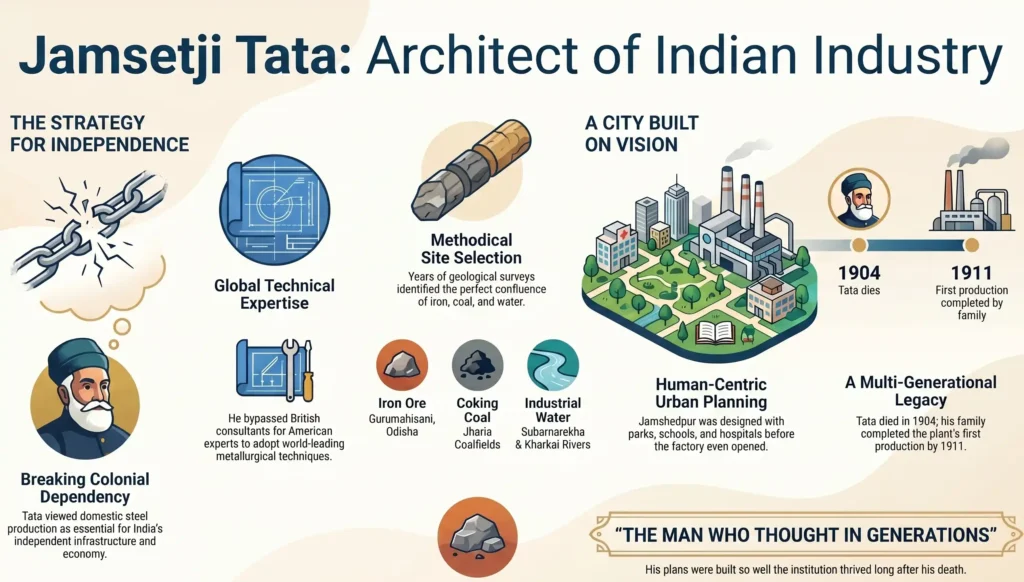
The process took years. The technical requirements were precise and no site satisfied all of them until the surveys identified the area near the confluence of the Subarnarekha and Kharkai rivers in what was then Bengal and is now Jharkhand. The site had iron ore at Gurumahisani in Odisha within practical transport distance. It had coal from the Jharia coalfields. It had the rivers. It had flat land. It was connected by rail to both the raw material sources and to the markets for finished steel.
How Azim Premji Turned Cooking Oil Into a Technology Empire
The Colonial Obstruction and How It Was Navigated
The colonial government’s response to Jamsetji’s steel project was not outright prohibition. It was something more subtle and in some ways more frustrating: bureaucratic obstruction conducted through the language of procedural requirements, land acquisition complications and the general slowness of official approval processes when the project being approved was one that the colonial commercial establishment would have preferred not to see succeed.
The land acquisition process for the Jamshedpur site involved negotiations with multiple parties including the colonial administration and local landholders. The bureaucratic requirements for establishing a manufacturing enterprise of this scale were extensive. The colonial government’s industrial policy did not actively support Indian owned heavy industrial ventures, and the passive resistance of administrative processes was a form of opposition that was difficult to confront directly because it never presented itself as opposition.
Jamsetji navigated these obstacles through the same combination of patience, technical preparation and willingness to engage systematically with official requirements that characterized his site selection process. He did not attempt to bypass the colonial administration. He worked through it, methodically and persistently, while maintaining the conviction that the project would eventually succeed. His ability to do this was supported by the Tata family’s established commercial reputation and by the financial resources that his textile business had generated. He was not an unknown entrepreneur making improbable proposals. He was one of the most respected businessmen in India, with a track record of successful enterprise that gave his proposals a credibility that the colonial administration could not easily dismiss.
The Vision of the Planned City
What distinguished Jamsetji Tata’s steel project from a purely commercial venture was the comprehensiveness of his vision for what would grow around the plant. He did not propose to build a factory. He proposed to build a city, planned from the beginning to provide the workers who would staff the plant with housing, healthcare, education and recreational facilities that were beyond what most Indian workers of the period could expect from any employer.
He wrote to his son Dorabji in 1902, two years before his death, describing what he envisioned for the city that would grow around the plant. The letter specified wide streets, parks and playing fields, a recreation club for the employees, and schools for the children of workers. It described a city that was designed around the welfare of its residents rather than purely around the efficiency of its industrial operations.
This vision was not simply philanthropy. It reflected a specific understanding of the relationship between worker welfare and industrial productivity that Jamsetji had developed through his years of managing the Empress Mills and through his study of industrial management practices in Europe and America. Workers who were housed decently, whose children were educated and whose health was maintained were more productive workers. The investment in the planned city was simultaneously an ethical commitment and a business strategy, and the two dimensions were not in tension in Jamsetji’s thinking.
The documentation of Jamsetji’s city planning vision has been preserved through the Tata Central Archives in Pune, which holds the correspondence, surveys and planning documents that record the founding vision in Jamsetji’s own words and in the technical reports of the consultants he engaged.
The American Model
Beyond Charles Page Perin, Jamsetji’s preparation for the steel project involved engagement with American steel industry expertise more broadly. He visited the United States and studied the American steel industry directly, observing the techniques and the organizational models that had made American steel the most productive in the world in the late nineteenth century.
The American steel industry of this period had developed manufacturing methods and plant organization that were significantly more efficient than British equivalents. Jamsetji’s decision to draw on American rather than British expertise for his steel project was not accidental. It reflected both the technical superiority of American practice and a deliberate choice to avoid the dependence on British expertise that would have created a different kind of colonial relationship within his own project.
The American consultants who worked on the Jamshedpur project brought with them not only technical knowledge but also a model of industrial organization that suited Jamsetji’s comprehensive vision for the planned city.
The Death Before Completion
Jamsetji Tata died in Bad Nauheim, Germany on 19 May 1904, while seeking treatment for a health condition. The Tata Iron and Steel Company was incorporated two years after his death, in 1907. The plant began production in 1911. The city of Jamshedpur grew around it and today houses hundreds of thousands of people in what remains one of India’s most significant planned industrial cities.
He never saw any of it. He saw the surveys, the plans, the correspondence with consultants and officials and potential investors. He wrote the letter to his son describing the city he imagined. He spent years of the last decade of his life on a project whose completion he understood he might not witness. The project was completed anyway, by his son Dorabji Tata and by the institution that Jamsetji had built well enough that it could continue without him.
Quick Comparison Table
| Feature | Jamsetji Tata | Andrew Carnegie | Krupp, Germany | Walchand Hirachand |
| Nationality | Indian | American | German | Indian |
| Primary Industry | Steel, textiles, power | Steel | Steel, armaments | Shipping, aviation |
| Period | Mid to late 19th century | Mid to late 19th century | 19th to 20th century | Early 20th century |
| National Context | Colonial India | Post Civil War America | Industrial Germany | Colonial India |
| Philanthropic Vision | Worker welfare, education, city building | Libraries, education endowments | Worker housing, social programs | Limited documented philanthropy |
| Legacy | Indian industrial foundation | American industrial foundation | German industrial foundation | Pioneer Indian industries |
Curious Indian: Fast Facts
- Jamsetji Tata died in 1904 without seeing the Tata Iron and Steel Company, which was incorporated in 1907 and began production in 1911.
- Charles Page Perin, an American metallurgical engineer, led the geological surveys that identified the Jamshedpur site as the optimal location for the steel plant.
- The site was chosen for its proximity to iron ore at Gurumahisani in Odisha, coal from the Jharia coalfields and the water resources of the Subarnarekha and Kharkai rivers.
- Jamsetji wrote to his son Dorabji in 1902 describing his vision for the planned city, including wide streets, parks, schools and healthcare facilities for workers.
- He deliberately chose American rather than British technical expertise for the steel project, drawing on the methods of the American steel industry rather than the British.
- The Tata Central Archives in Pune holds the correspondence, surveys and planning documents that record the founding vision in Jamsetji’s own words.
- Jamshedpur was one of India’s first planned industrial cities and remains a significant example of worker welfare based urban planning.
- Jamsetji was born in Navsari, Gujarat in 1839 into a Parsi trading family and built his initial fortune in the textile industry before pursuing his steel ambition.
The Work That Outlived Him
That continuity, the ability of an institution to carry forward the vision of its founder past the founder’s own death, is perhaps the most reliable measure of how well the founding was done. Jamsetji Tata spent years searching for the right place to build something he would never see completed. That is a particular kind of faith, not in a religious sense but in the institutional sense: the faith that a project well enough conceived and well enough prepared will outlast the person who conceived and prepared it.
The site he chose was right. The iron ore was there. The coal was there. The rivers were there. The city he imagined grew where he imagined it would grow, and it grew according to principles he had articulated in a letter to his son two years before his death. The workers he never met lived in the city he designed for them and their children were educated in the schools he had specified.
What makes Jamsetji Tata’s story different from the story of most founders is the distance between his personal participation and the ultimate realization of his vision. He did the geology. He did the finance. He wrote the plans. He bore the colonial obstruction with patience. And then he died, and the people he had prepared to carry the work forward carried it forward, and the steel plant was built, and the city grew, and India had the beginning of an indigenous heavy industrial capacity that the colonial government had insisted it did not need and could not build. He had known better. The years he spent searching for the right site were the proof of that knowledge.
How the Murugappa Group Built a Silent Empire in Southern India
If you think you have remembered everything about this topic take this QUIZ
Results


#1. In which year did the visionary industrialist Jamsetji Tata pass away in Germany, years before his dream steel plant began production?
#2. Which American metallurgical engineer did Jamsetji Tata recruit to lead the rigorous geological surveys for the steel plant site?
#3. The site chosen for Jamshedpur sat at the strategic confluence of which two major rivers?
#4. Jamsetji Tata built his initial commercial fortune in which primary industry before pursuing heavy steel manufacturing?
#5. Where are the historic letters, site surveys, and original city planning documents of Jamsetji Tata carefully preserved today?
#6. In which year was the historic Tata Iron and Steel Company officially incorporated, three years after Jamsetji’s death?
#7. Why did Jamsetji Tata deliberately select American engineering expertise over British consultants for his steel project?
#8. In his famous 1902 letter to his son Dorabji, what unique feature did Jamsetji insist be included in the planned industrial city?
Why did Jamsetji Tata want to build a steel plant in India?
Jamsetji understood that India’s dependence on imported British steel made every Indian infrastructure project more expensive and kept India industrially dependent on its colonial ruler. India had iron ore, coal and water resources sufficient to support steel production, and there was no technical reason why India could not produce its own steel. Building an Indian owned steel plant was both a commercial opportunity and a challenge to the colonial economic framework that insisted India was incapable of heavy industrial production.
How did Jamsetji Tata choose the site for Jamshedpur?
The site selection was conducted through systematic geological surveys led by Charles Page Perin, an American metallurgical engineer. The criteria included proximity to high quality iron ore, access to coking coal, adequate water resources, rail connectivity and sufficient flat land for the plant and the planned city. The site at the confluence of the Subarnarekha and Kharkai rivers in what is now Jharkhand satisfied all of these requirements and was identified after years of survey work across central and eastern India.
Why did Jamsetji choose American rather than British technical expertise?
The American steel industry of the late nineteenth century had developed manufacturing methods that were significantly more efficient than British equivalents. Jamsetji had visited the United States and studied the American industry directly. His choice of American expertise also reflected a deliberate decision to avoid dependence on British technical knowledge, which would have created a different form of colonial relationship within his own project.
What was Jamsetji’s vision for the city of Jamshedpur?
In a letter to his son Dorabji in 1902, Jamsetji described a planned city organized around worker welfare rather than purely industrial efficiency. He specified wide streets, parks and playing fields, schools for workers’ children and healthcare facilities. This vision reflected both his ethical commitment to worker welfare and his understanding that workers who were housed decently and whose families were cared for were more productive. Jamshedpur was designed from the beginning as a city rather than simply a factory compound.
Did Jamsetji Tata live to see the steel plant completed?
No. Jamsetji died in Germany in 1904 seeking treatment for a health condition. The Tata Iron and Steel Company was incorporated two years after his death in 1907 and began production in 1911. The city of Jamshedpur that grew around the plant was built according to the principles he had articulated, by his son Dorabji Tata and by the institution he had built well enough to continue without him.