Sultanganj, 1861: a railway engineer digging into a brick mound for ballast struck a copper foot. Two years later the Buddha it belonged to was on its way to Birmingham
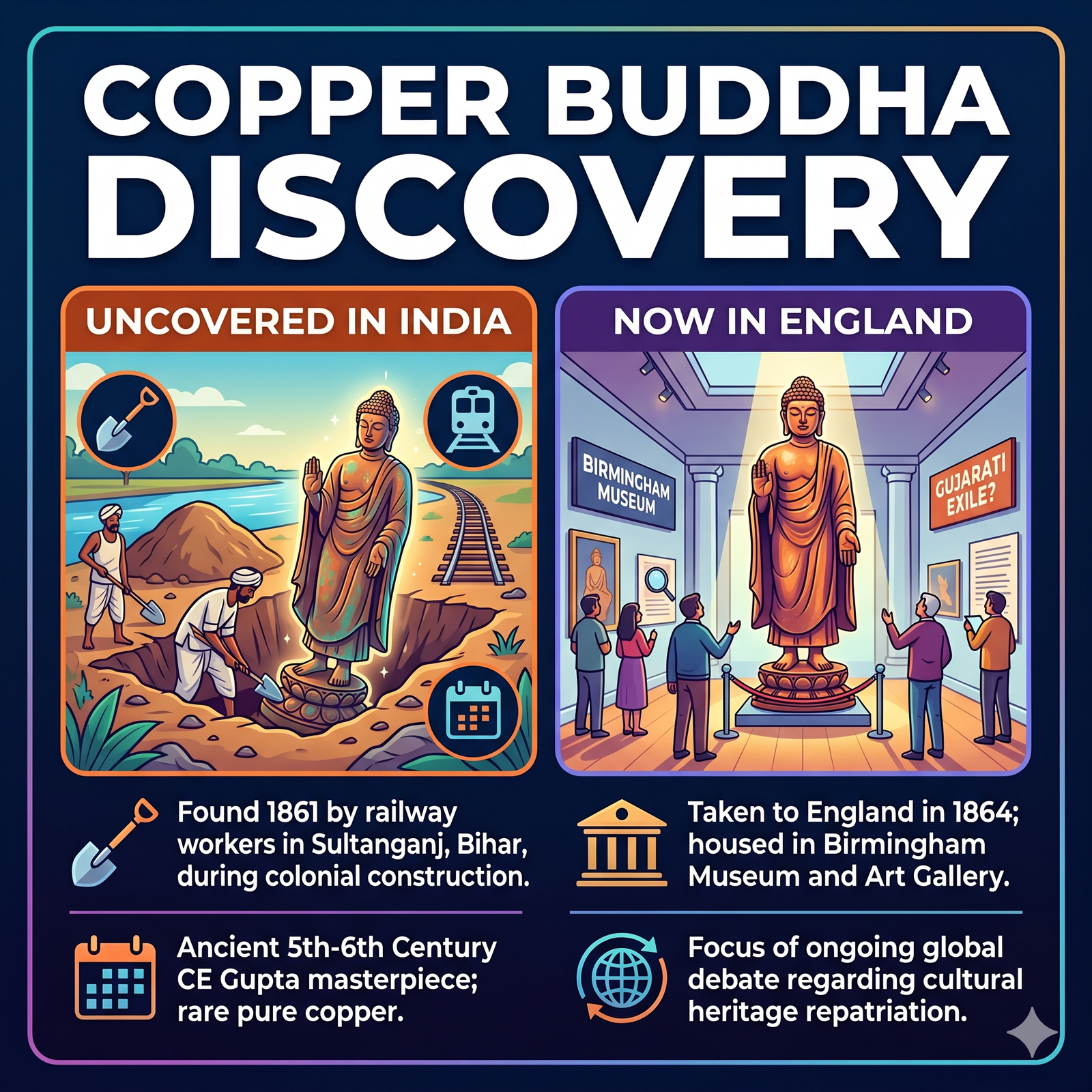
In 1861 the East Indian Railway was pushing its line along the south bank of the Ganga, through Bhagalpur district in Bihar. At Sultanganj, where the river turns and flows north, the resident engineer was a man called E. B. Harris, and he was building a station.
A railway needs ballast, the packed stone and rubble that holds the sleepers in place. Near the station site stood a large mound of old bricks. Harris set his workers to dig it out.
The mound turned out to be the ruins of a Buddhist monastery. The workers kept finding things: stone sculptures, a Buddha head, fragments. Then, about ten feet down, beneath a floor, they found a right foot made of copper.
About ten feet down, beneath a floor, they found a right foot made of copper.
The giant under the floor
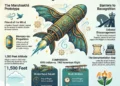
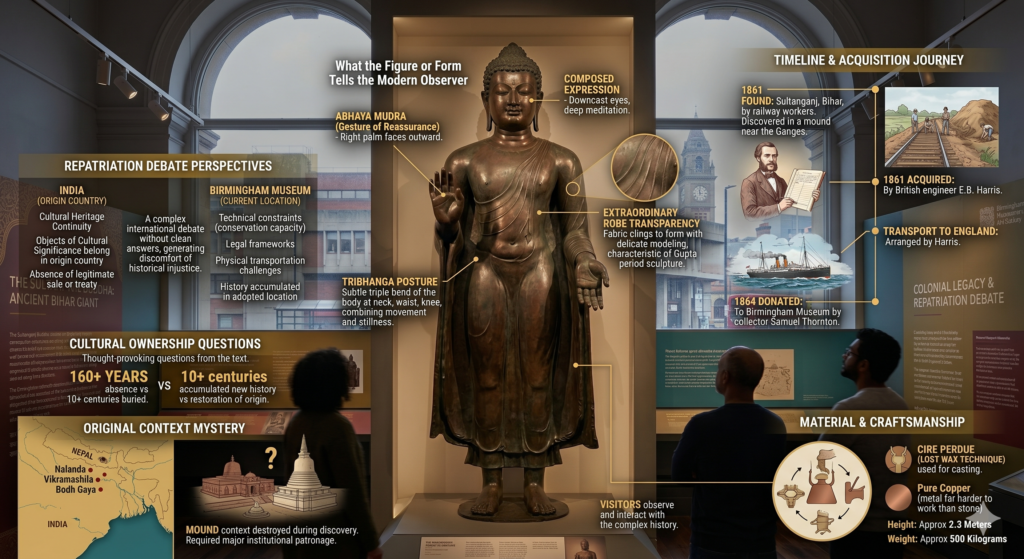
The foot belonged to a standing Buddha. When it was all dug out, it was about 2.3 metres tall and weighed more than 500 kilograms. The right hand is raised, palm out, in the gesture that means do not fear. The robe clings so closely to the body that it almost disappears, and only its hem and edges show.
It had been cast in copper by the lost-wax method. Nothing else of its size and age in metal has survived. It is the largest substantially complete copper Buddha of its period known anywhere.
Harris was sure it had not simply fallen. In the account he published in 1864, with a site plan and photographs, he worked out what had happened from the way it lay. The statue had once stood in the verandah on the west side of the monastery. Someone had thrown it off its pedestal into a hole cut partly into the floor. It lay upside down. Then a concrete floor had been laid over the spot, hiding every trace of it.
Alexander Cunningham, the government’s archaeological surveyor, read the evidence the same way. In a letter that Harris printed, he concluded that the monks had had just enough time to bury their great copper Buddha before they fled. Nearby, Harris found other images with their faces smashed.
The Real Story Of Ashoka’s Nine Unknown Men
The Mysterious Sinking Of PNS Ghazi
The crowd
The news spread overnight. By the next morning several thousand people had arrived, and more kept coming from every direction until late that night. Harris’s men had trouble keeping them back from the edge of the pit as the body was uncovered.
When the statue was out and cleaned a little, people were allowed to come close. Harris wrote that many of the women kissed it. The priests of the Hindu temple on the rock at Jahangira, out in the river, wanted it for their temple and offered to buy it. Harris would not sell. By his count about 10,000 people came to see it in the first eight days, and for months afterwards they kept coming.
Harris wrote that many of the women kissed it. The priests of the temple offered to buy it. Harris would not sell.
The ironmonger from Birmingham
Samuel Thornton was a Birmingham manufacturer whose main trade was railway ironmongery. He had been mayor of the town in 1848, and he took an interest in ancient India. He paid £200 to have the Buddha shipped to England, and it left in 1863. The deal probably went through George Turnbull, the Chief Engineer of the East Indian Railway, who was going home to England that year.
Birmingham in those years was proud of its metal trades, and it was planning an Art Museum that would show its craftsmen the best work in the world, to learn from. A copper figure more than a thousand years old, cast whole and over life-size, suited that purpose.
On the way, the statue was shown to the Asiatic Society in London, and a note in the Birmingham museum’s files says there were efforts to get it for the British Museum. They failed. In Birmingham the story grew in the telling, into British Museum curators trying to ambush it at the docks.
Touching the Past at the Bhimbetka Rock Shelters
The gift
On 7 October 1864, Thornton wrote to the Borough Council. He offered the colossal Buddha, and a large marble figure with it, to the town, for the Art Museum then being built. They were to be there, he wrote, “for the free inspection of the inhabitants of Birmingham.”
The local papers called it an idol, or an Indian god. At the council meeting one member suggested it had been brought over for the value of its metal, and the others laughed at him. The Buddha went on show in 1867, in a room of the Central Library that served as the Corporation Art Gallery, and moved into the new museum when it opened in 1885.
Birmingham’s museum often calls it the first object in its collections. It was the second. The first was a bust of the painter David Cox, accepted in 1863.
Mitra’s story
In Calcutta, the antiquarian Rajendralal Mitra took up the Buddha for a different purpose. He was arguing that India had had a classical age of its own, owing nothing to Greece, and a copper giant of this quality was exactly the kind of evidence he needed.
In his book Indo-Aryans, published in 1881, Mitra told a story: the British engineers who found the statue could not believe Indians had cast anything so fine, and decided it must have been made in Birmingham and sent out to India for sale. Nothing in the record supports it. Harris himself knew enough about Indian antiquities to know what he had found. But the story was too good to let go, and in time Birmingham’s own museum guidebook repeated it.
Mitra, for his part, got the city wrong. He wrote that the Buddha was in Manchester.
Thimithi Festival: How Tamil Devotion Walks Through Fire
The date
For a long time nobody agreed on how old the Buddha was. Vincent Smith, writing in 1911, put it around 400, in the Gupta period. Later scholars pushed it forward, some as late as 800. Inside the statue is a clay core mixed with rice husk, and radiocarbon dating of that core has suggested somewhere around 600 to 650. The museum’s label says 500 to 700.
Either way, it was made more than twelve centuries before Harris’s workers found its foot.
The claim
In July 1998, Roy Pinney, a Labour councillor who chaired Birmingham’s education committee, told The Independent that the city probably held objects acquired in embarrassing ways, and that the Buddha might go back to India. Earlier councillors had floated selling it to fill holes in the city’s budget.
That same year the museum gave the Buddha a gallery of its own, painted the orange of a monk’s robe. Since 2004 Buddhist groups from across the West Midlands have gathered in front of it every May for Buddha Day, chanting and sprinkling water, and leaving flowers in its half-open hand. Visitors touch it so often that parts of it have worn smooth and shiny. It has been judged too fragile to travel since the 1980s.
For a long time no formal request for its return came from India. That has now changed. In July 2026, Bihar’s Chief Minister Samrat Choudhary wrote to the Union Culture Minister, Gajendra Singh Shekhawat, asking the central government to begin the process of bringing it home. Officials in Patna have said it will be a long diplomatic process.
At Sultanganj, the railway still runs past the old mound. The trains use the line that Harris was building when his workers reached down for bricks and found a foot.
Why Jamini Roy abandoned oil painting for Kalighat roots
If you think you have remembered everything about this topic take this QUIZ
Results


#1. Which period and artistic school does the Sultanganj Buddha belong to?
#2. What unique material and casting technique were used to create the Sultanganj Buddha?
#3. In which year and Indian state was the Sultanganj Buddha discovered by railway workers?
#4. Who was the British railway engineer that acquired the statue immediately after its discovery?
#5. What is the approximate height and weight of the Sultanganj Buddha?
#6. In which international museum has the Sultanganj Buddha been located since the 1860s?
#7. What hand gesture (mudra) and physical posture are depicted in the Sultanganj Buddha sculpture?
#8. Why does the original monastic or institutional context of the Sultanganj Buddha remain unknown?
Where is the Sultanganj Buddha currently located and can it be visited?
The Sultanganj Buddha is housed in the Birmingham Museum and Art Gallery in Birmingham, England. It is one of the museum’s most significant and prominently displayed objects and can be visited during the museum regular opening hours. It occupies a dedicated space within the collection and is accompanied by interpretive material explaining its history and significance.
What makes the Sultanganj Buddha technically remarkable compared to other ancient Indian sculptures?
The primary distinction is its material. Most large scale ancient Indian sculpture that has survived from the Gupta period is stone. The Sultanganj Buddha is cast in almost pure copper, a far more technically demanding material at this scale and one that is significantly rarer in surviving examples. Its size, nearly 2.3 meters, combined with its copper construction makes it one of the most extraordinary surviving works of ancient Indian metalwork.
How did the Sultanganj Buddha end up in Birmingham?
It was discovered in 1861 by railway workers near Sultanganj in Bihar and acquired by British engineer E.B. Harris. Harris arranged for its transport to England, where it was purchased by Birmingham collector Samuel Thornton, who donated it to the Birmingham Museum and Art Gallery in 1864. There was no legal framework at the time governing the export of Indian antiquities, and the transaction occurred within the conditions of colonial administration.
Has India formally requested the return of the Sultanganj Buddha?
The repatriation of colonial era cultural property including the Sultanganj Buddha has been discussed in the context of broader negotiations between India and British cultural institutions. India has raised the question of return for a number of significant objects held abroad, and the Sultanganj Buddha is among the pieces whose status has been cited in this ongoing debate, though formal resolution has not been reached.
What style of Buddhist art does the Sultanganj Buddha represent?
The statue belongs to the Gupta school of Buddhist art, which flourished in northern India between the 4th and 6th centuries CE. Its characteristic features, the transparent robe treatment, the tribhanga posture, the composed meditative expression and the abhaya mudra, are all consistent with the refined classical language developed by Gupta period sculptors at sites including Sarnath and Mathura.
Sources & References
Wikipedia, “Sultanganj Buddha” — size and weight, the clay-and-rice-husk core, dating from Smith (1911) to radiocarbon results.
Birmingham Museums and Art Gallery blog, “The Sultanganj Buddha 1864–2014” (7 October 2014) — Thornton’s letter of 7 October 1864, the £200, display in 1867 in the Central Library.
Impart Encyclopedia of Art, “Sultanganj Buddha” — the defaced Bodhisattva and later debates over its return.
Christopher Wingfield, “Touching the Buddha: Encounters with a Charismatic Object” (DOI 10.4324/9780203523018-12) — quotes Harris (1864) and Cunningham on the burial and the crowds, Thornton’s letter, the 1863 shipment, the British Museum note, Mitra’s Indo-Aryans (1881), the David Cox bust, the 1998 councillor, Buddha Day and the museum files.
ETV Bharat, “Bihar Takes Steps To Bring Back Ancient ‘Sultanganj Buddha’ From Birmingham Museum” (11 August 2026) — the Chief Minister’s letter.
Victoria and Albert Museum collections, Head of the Buddha (IS 452-1950 and related records) — other sculptures from the Sultanganj railway excavation.
E. B. Harris, Description of Buddhist Remains Discovered at Sooltangunge, on the River Ganges, 1862–63 (London, 1864) — the primary account, quoted via Wingfield.