Calcutta, the 1920s: Jamini Roy had a steady living painting portraits in oil. He put the tubes away and started making his colours the way the village scroll painters did
In the early 1920s, Jamini Roy was making his living in Calcutta by painting portraits.
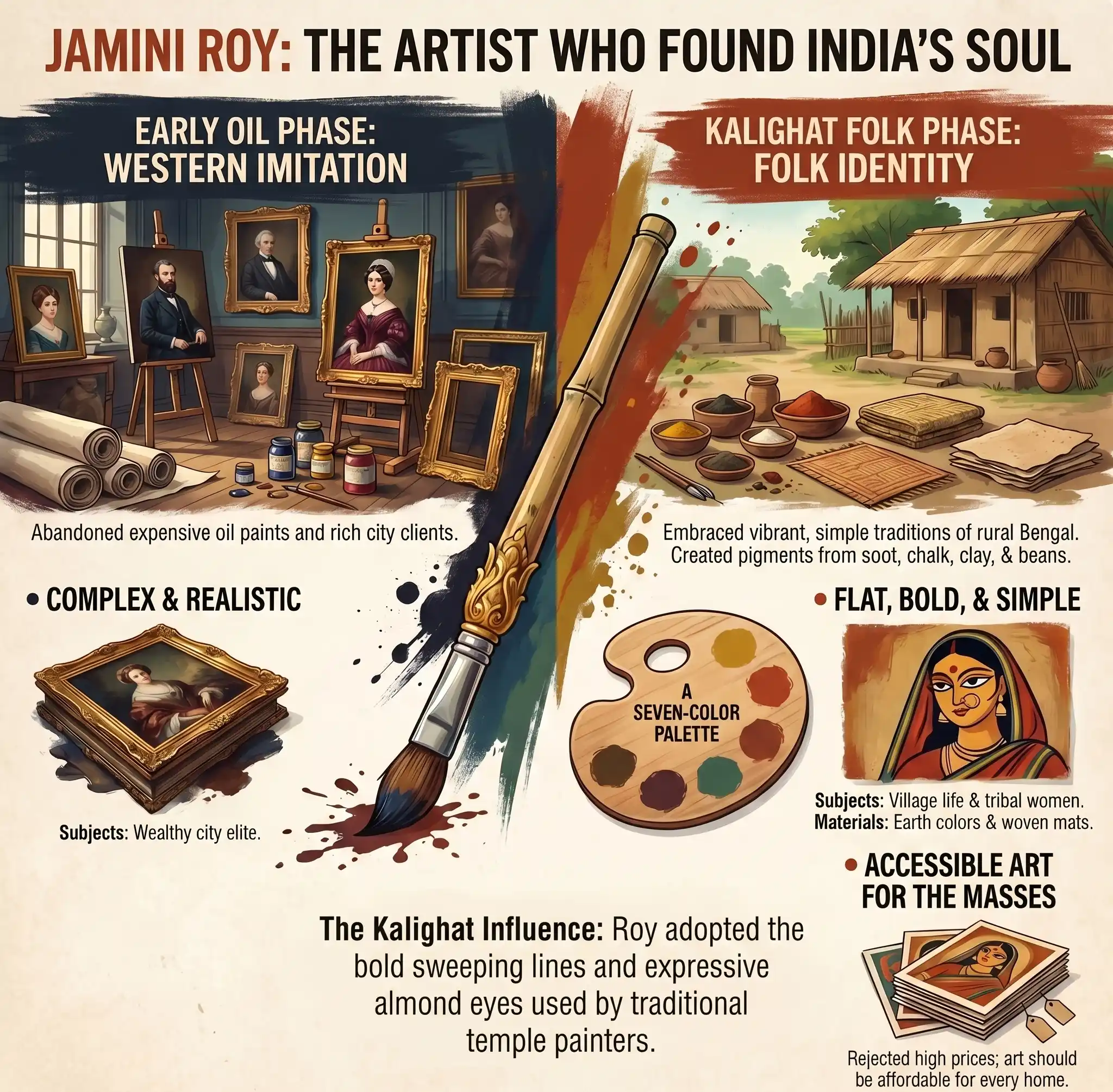
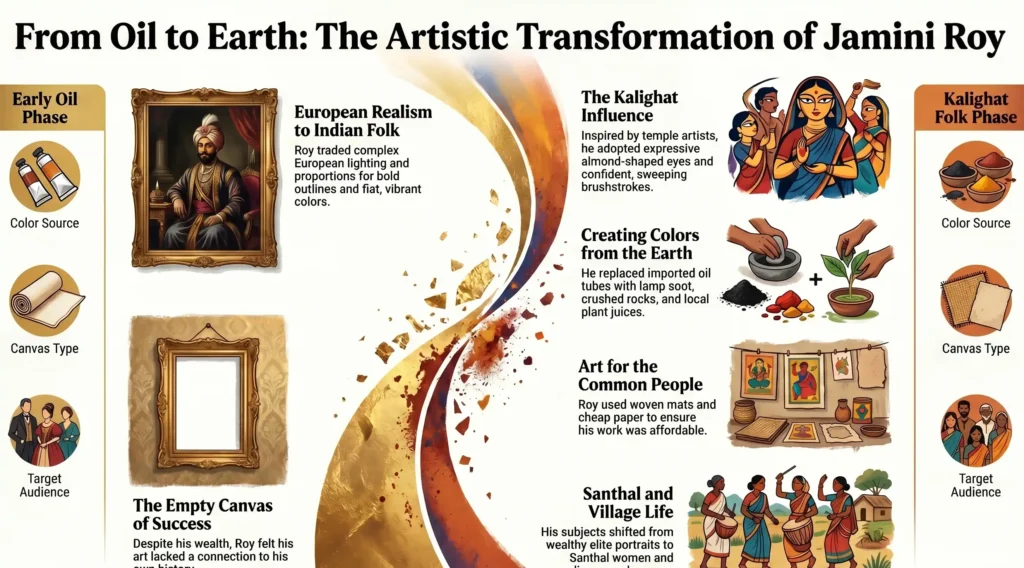
He had come to the city at sixteen from Beliatore, a village in Bankura district, to study at the Government School of Art. There he drew classical nudes and learned to paint in oils, and he took his diploma in 1908. After that, people paid him to paint them. His sitters were well-off Bengalis and some British patrons, and he painted them in the soft European manner he had been taught.
It was steady work. Then, fairly suddenly, he stopped taking it.
People paid him to paint them. Then, fairly suddenly, he stopped taking the work.
The bazaar pictures
Roy never gave a single tidy reason. The country around him was full of talk about turning back to Indian things. Gandhi was asking people to spin their own cloth, and Rabindranath Tagore was arguing that Indian art should grow out of Indian life. Roy was tired of copying Europe. He did not care much for the Bengal School’s answer either, with its delicate washes and its dreamy scenes from an ancient past.
He found what he was looking for in the cheapest pictures in the city.
Near the Kalighat temple, painters called patuas sold pictures on paper to pilgrims: goddesses, Krishna, a cat with a prawn in its mouth. They worked fast, with a few bold sweeping lines, flat colour and large almond-shaped eyes. The pictures cost almost nothing, and pilgrims took them home the way they took home flowers from the temple.
From about 1924, Roy’s own pictures began to change. The colour drained out of them. What was left was line, in black, white and soft grey, drawn with one confident stroke of the brush.
The pictures cost almost nothing, and pilgrims took them home the way they took home flowers from the temple.
Sarnath Buddha Sculpture: Where Mathematics Meets Divine
Unakoti Tripura: Jungle Sanctuary With a Million Stone Faces
Back to the village
The Kalighat pictures had a problem, though. By then many patuas had moved into the city and were painting whatever city buyers wanted. To Roy the tradition had drifted away from its roots.
So he went back to his own. He returned to Beliatore again and again, and to the village patuas, who painted long scrolls and sang the stories aloud as they unrolled them. What he took from them was the way they worked as much as the way their pictures looked.
The kitchen of colours
He stopped buying European paint and made his own, as the patuas did.
The outlines were drawn in lamp black, the soot from an oil lamp. The colours came from earth, stone and plants: Indian red, yellow ochre, vermilion, green, grey, blue and white. He kept mostly to those seven, and he ground and mixed them himself. The binders were just as homely, and one account lists tamarind seed among them.
The canvas went too. He painted on handmade paper, on woven mats, and on wood coated with lime. He painted on homespun cloth that he prepared with river mud and cow dung and then whitewashed, much as a village wall is prepared before it is painted.
The outlines were drawn in lamp black, the soot from an oil lamp.
Everything about the method was cheap, and that was part of the point.
The Cosmic Geometry Behind the Sun Temple Wheels of Konark
A picture for every house
Roy wanted his paintings to hang in ordinary homes, the way pats did. Like the village painters and potters, he used cheap local pigments so that people who were not rich could afford his work. He liked to call himself a patua.
He painted Santhal women and drummers, mothers with children, Baul singers, Krishna, and the Kalighat cat with its prawn. Later he painted Christ. He painted a great many pictures. One common estimate puts the total at around 20,000.
The new Jamini Roy was first shown in 1929, in a solo exhibition at the Government School of Art, the same school that had taught him oils. In 1938 his paintings went on show on British Indian Street in central Calcutta. The Calcutta journal Parichay printed appreciative pieces about him. In the 1940s, middle-class Bengalis and Europeans in the city began to buy his work. During the Second World War, American soldiers stationed in Calcutta bought his paintings as well, and paid more for them.
The tubes in the drawer
He did not throw away every tube of oil paint. The Victoria and Albert Museum in London has a Last Supper by him from around 1937 to 1940. It shows the twelve apostles in profile, with only Christ facing straight out, and it is painted in oil on cloth.
Even then, he was painting like a patua. The figures are flat, the outlines are bold, and the cloth is homespun.
Jamini Roy died in Calcutta in 1972. The man who had once been paid to paint the rich of the city in oils spent the rest of his life making pictures that everyone else could afford.
The Elephanta Trimurti and the Three Faces of an Infinite God
If you think you have remembered everything about this topic take this QUIZ
Results


#1. In which village and district of Bengal was Jamini Roy born in 1887?
#2. What major artistic style did Jamini Roy practice during his early career before his massive transformation?
#3. Around 1920, which group of traditional painters at a Calcutta temple inspired Jamini Roy to adopt folk traditions?
#4. What did Jamini Roy use to create a deep, rich black color for his folk-style paintings?
#5. Instead of expensive imported canvas, which materials did Jamini Roy choose to paint on to make his art affordable?
#6. Which tribal community served as an immense visual inspiration for Jamini Roy’s flat, bright, and bold paintings?
#7. In most of his folk art career, Jamini Roy severely restricted his color palette to how many basic earthy colors?
#8. Which national honor was bestowed upon Jamini Roy by the Indian government in the year 1954?
Where was the painter born?
He was born in a small village named Beliatore located in the Bankura district of Bengal.
Why did he stop painting oil portraits?
He felt his realistic portraits lacked a true connection to his Indian roots and simply copied foreign European styles.
What kind of materials did he use for his folk art?
He used natural earth pigments, soot, plant juices, chalk, and painted on cheap paper, cloth, and woven mats.
Who were the primary subjects of his later paintings?
He primarily painted ordinary village people, Santhal tribal women, mothers and children, and local Hindu deities.
Why are his paintings so important to India?
They represent a crucial return to native Indian folk traditions and helped establish a completely unique, modern Indian artistic identity.
Sources & References
Encyclopaedia Britannica, “Jamini Roy” — his move away from commissioned portraits, the nationalist and Tagorean influences, and the Kalighat motifs he adopted.
National Gallery of Modern Art, New Delhi, via Google Arts & Culture, “Jamini Roy” — the monochrome phase from 1924 and his turn to vegetable and mineral pigments.
Asia Research News, “How Jamini Roy’s Paintings Breathed New Life into India’s Traditional Art Forms” (2024) — his view of urban Kalighat painting, his returns to Beliatore, and the earth colours he mixed himself.
India Art Review, “Jamini Roy: A Rebel with a Cause” (2023) — his homespun cloth prepared with alluvial soil, cow dung and whitewash.
Victoria and Albert Museum, “The Last Supper,” Jamini Roy, c. 1937–40 — the object record, with notes on his lamp-black outlines and seven basic colours.
Banglapedia, “Roy, Jamini” — the 1938 British Indian Street exhibition, Parichay, wartime American buyers, and his use of cheap pigments.
Prinseps, “Jamini Roy: Life, Painting Style & Famous Works” — the 1929 solo exhibition at the Government School of Art.
National Gallery of Modern Art / Google Arts & Culture collection documentation on Jamini Roy — his use of earth, vegetable and mineral pigments and glue made from tamarind seeds or egg white.