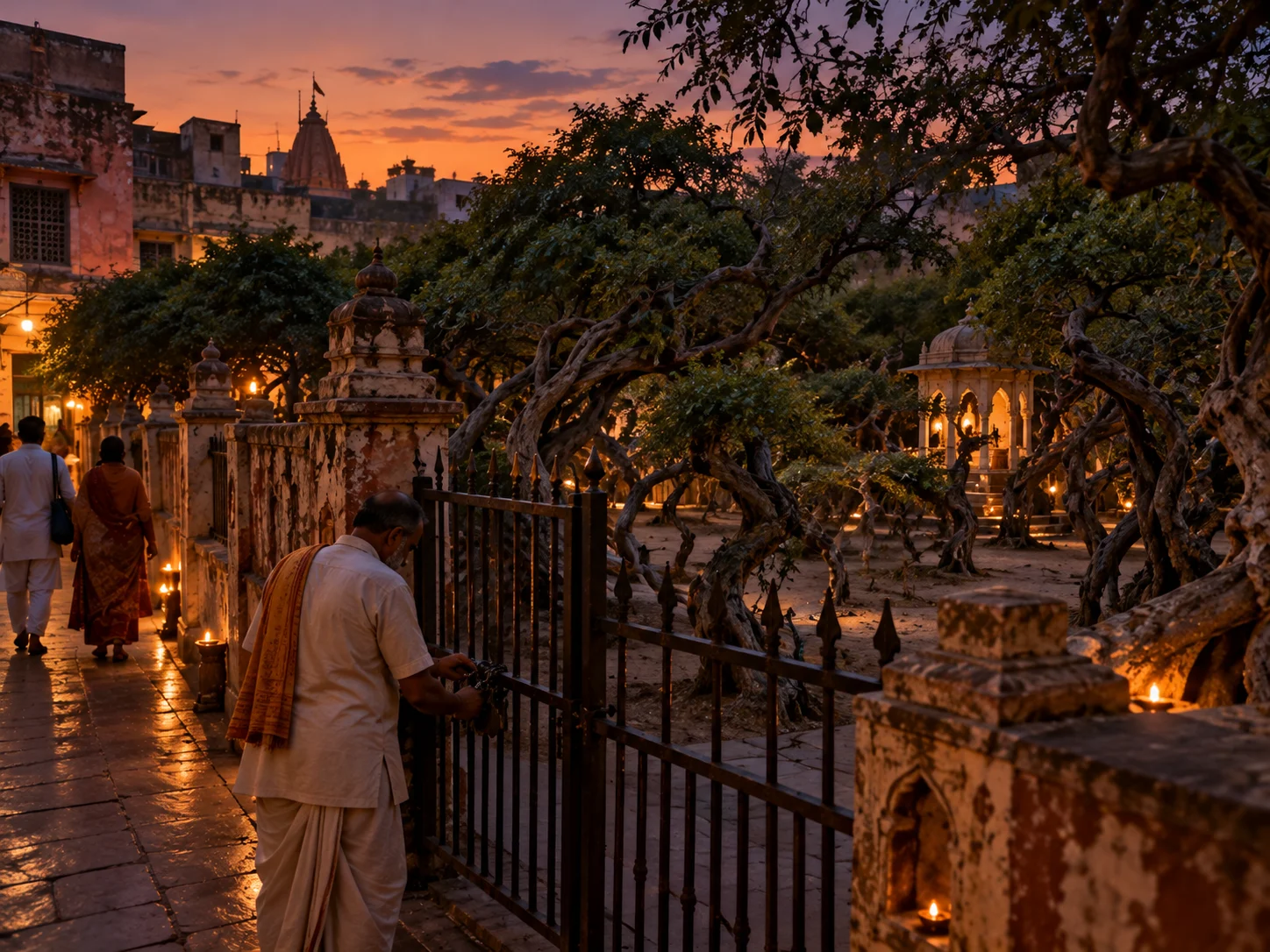
In Vrindavan there is a small grove that empties itself every evening. The pilgrims go, then the priests, and the gates are locked from the outside. The houses around it have no windows facing in
The evening aarti at Nidhivan is the signal.
When it ends, the visitors are asked to leave. Then the priests do what they do every day. In a small building inside the grove, the Rang Mahal, they make up a bed. Beside it they set a vessel of water, a prepared paan, neem twigs for cleaning the teeth, sweets, a sari, bangles.
Then they walk out, lock the doors of the Rang Mahal, lock the gates of the grove behind them, and go home.
Nobody stays. Not the priests, not the guards, not the shopkeepers, not the pilgrims who have come a thousand kilometres.
Nobody stays. Not the priests, not the guards, not the pilgrims who have come a thousand kilometres.
Why
The belief is simple and very old. Every night, in this grove, Krishna comes with Radha, and the raas leela is danced here as it was danced in the age of the Puranas. The grove belongs to that dance after dark. Human beings are not part of it.
It is said that anyone who hides in Nidhivan to watch loses their sight or their reason. Whether or not you believe it, the effect is visible in the architecture. The houses around the grove have no windows looking into it, or keep them shuttered, and the families who live in them do not look out at night.
That is the detail that stays with visitors. This is not a rule imposed for tourists. It is a discipline that the neighbourhood keeps for itself, and has kept for generations, whether or not anyone is watching.
The grove has a history as well as a belief. Tradition connects it with Swami Haridas, the sixteenth-century musician and saint of Vrindavan, whose samadhi stands within it, and from whose devotion the image of Banke Bihari is said to have appeared here before being installed in its own temple nearby.
The Mysterious Son Bhandar Caves Lost Gold Vault

Why The 2002 Muhnochwa Attacks Still Terrify Us
The morning
In the morning, the priests unlock the Rang Mahal.
What they report, and have reported for a very long time, is that the bed looks slept in. The water is gone or lowered. The neem twigs look used. The paan and sweets have been partly eaten. The bangles and clothes are disturbed and out of place.
This is testimony, offered by the people who serve there. There is no independent verification of it, and anyone who wants to be sceptical does not need help: the room is locked by the same institution that opens it, and the keys stay in the same hands.
Nidhivan, for its part, has never claimed to be conducting an experiment. It is a place of faith, and the nightly preparation is worship, not evidence.
The trees
The grove itself is unusual to look at, and this is not a matter of belief.
Its trees are low and dark, hollow in places, with trunks that twist and grow into one another in pairs, so that the whole thicket seems tangled together rather than planted in rows. They do not look like ordinary shade trees in a temple garden.
The belief attached to them follows naturally. Devotees say the trees are the gopis: that they stand in tree form through the day, and take their own form at night for the dance.
The trees are hollow and twisted in pairs, so that the grove looks tangled rather than planted.
The Flight Of Nana Saheb And The 1857 Uprising
What is actually remarkable
It is easy to reduce Nidhivan to the locked room: to argue about the bed, and about what could or could not get in through a door.
But the locked room is not the interesting part. The interesting part is the leaving.
Every single evening, in one of the most crowded pilgrimage towns in India, a valuable piece of ground in the middle of a busy neighbourhood is emptied of people and handed over. The shops nearby stay open. The lanes stay full. And the grove itself goes silent and dark, because everybody has agreed that after sunset it is not theirs.
Faith is usually visible as something added: a building, a flag, an offering, a crowd. At Nidhivan it is visible as an absence. Whatever you believe about what happens there at night, the discipline that keeps a whole town on the other side of a wall, every evening, is real, and you can watch it happen at dusk.
When A Rumor Created The Monkey Man Of Delhi
If you think you have remembered everything about this topic take this QUIZ
Results


#1. What is the literal meaning of the name “Nidhivan”?
#2. According to local legend, what do the short, twisted trees of Nidhivan transform into at night?
#3. What specific botanical mystery is mentioned regarding the trees in Nidhivan?
#4. Which items are placed inside the Rang Mahal temple every evening by the priests?
#5. What is believed to happen to humans who hide in the forest to witness the Raslila?
#6. What do the local residents living in houses overlooking Nidhivan do to avoid seeing the forest at night?
#7. How do the trees in Nidhivan behave during harsh droughts according to the “Fast Facts”?
#8. Which organization documented the deep oral traditions surrounding Nidhivan?
What exactly is the Nidhivan Enigma?
The Nidhivan Enigma refers to the deeply held belief that Lord Krishna performs his divine night dance (Raslila) in this specific Vrindavan forest, transforming the trees into Gopis after dark.
Can tourists visit Nidhivan?
Yes, it is open to the public every day, but absolutely everyone must leave the premises before the evening gates are locked tightly at sunset.
What happens if someone stays inside at night?
Local legends and numerous witness accounts strongly claim that trespassers are found dead, blind, or completely mentally unstable the very next day.
Why do the trees grow downwards?
While there is no universally confirmed scientific reason, devotees deeply believe the trees are bowing down in absolute respect to the sacred ground where Krishna walked.
Is Nidhivan mentioned in ancient texts?
Yes, the sacred grove is a highly significant part of the Braj Bhoomi literature and the various Puranas that beautifully describe Lord Krishna’s earthly life.
Sources & References
Wikipedia, “Nidhivan, Vrindavan” — the nightly preparation in the Rang Mahal, the items laid out, the locking of the doors and what the priests report finding in the morning.
Vrindavan Mathura, “Nidhivan Vrindavan: timings, mystery and raasleela story” (2026) — the low, hollow, paired trees, the belief that they are the gopis, the clearing of the grove after the evening aarti and the belief about loss of sight or sanity.
Vrindavan Tours and Packages, “Nidhivan Vrindavan” (2026) — the shuttered windows of the surrounding houses and the practice of the neighbourhood, described as testimony rather than proof.
District Mathura, Government of Uttar Pradesh, tourism documentation, together with Incredible India — Nidhivan’s place in Vrindavan’s devotional landscape and the traditions associated with the sacred grove. Visitor hours are treated as operational information that can change seasonally.