In the sweltering summer of two thousand and two, the rural villages of Uttar Pradesh were gripped by an absolutely terrifying mystery. With massive power cuts forcing people to sleep on their open roofs, terrifying reports began to emerge of a mysterious flying object that attacked people in the dark. Known locally as the Muhnochwa, or "face-scratcher," victims described it as a glowing orb of light that swooped down to claw at their faces, leaving deep burn marks and scratches. The phenomenon sparked widespread mass hysteria, causing entire villages to stay awake all night beating drums. As the panic escalated, resulting in several tragic deaths from mob violence and accidental falls, top scientists and police task forces had to step in to uncover the bizarre scientific truth behind the flying terror.| Feature | Details |
| Phenomenon Name | Muhnochwa (The Face-Scratcher) |
| Location | Rural Uttar Pradesh, India |
| Year of Panic | Summer of 2002 |
| Victim Accounts | Burn marks and deep scratches on the face |
| Likely Scientific Cause | Rare ball lightning combined with mass hysteria |
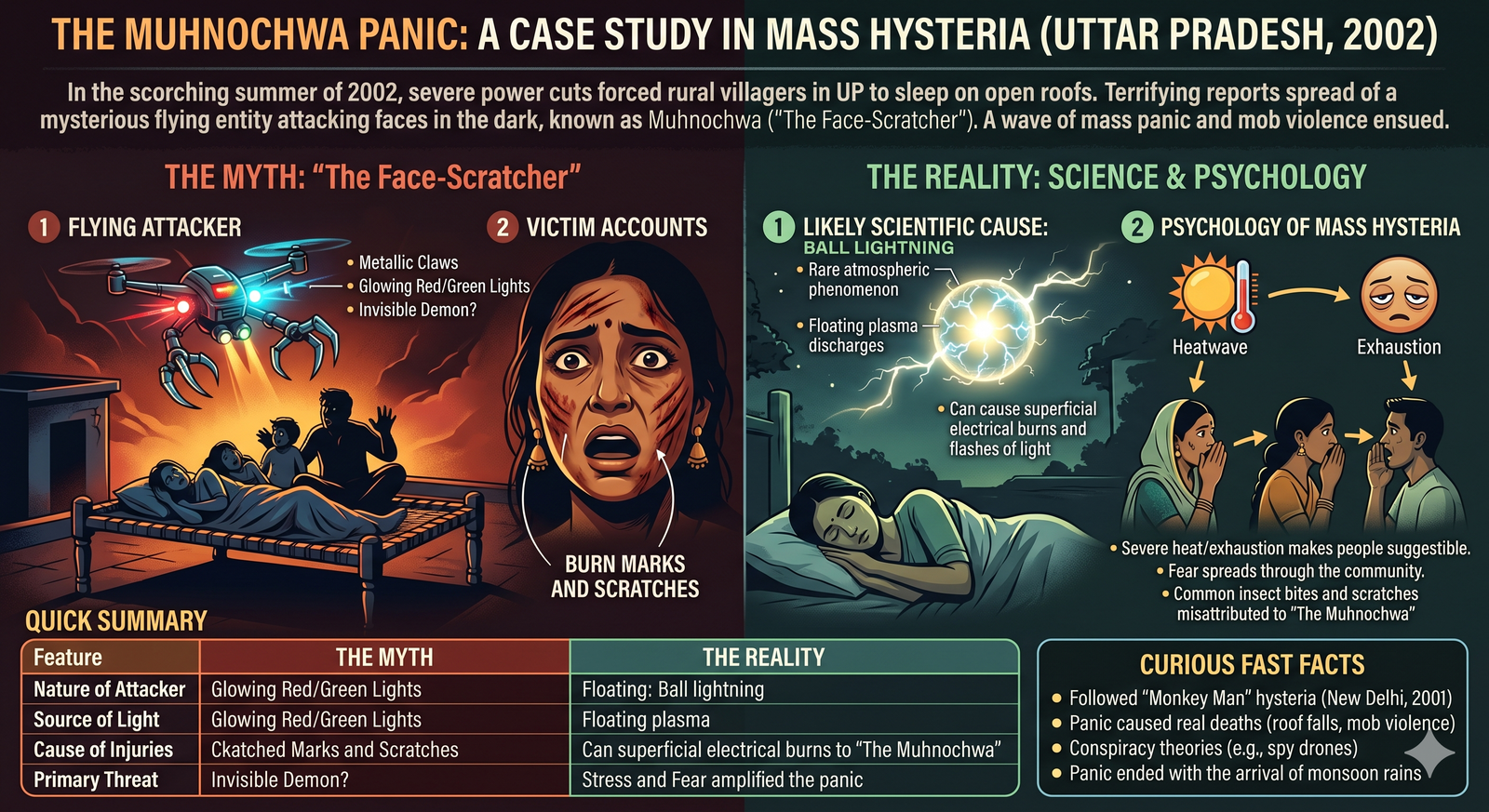
The summer of two thousand and two in Uttar Pradesh was incredibly brutal. A massive heatwave had dried up the rivers, and constant electrical power cuts left millions of rural villagers sweating in the absolute dark. To escape the suffocating heat inside their mud and brick houses, entire families moved their beds up to their open, flat roofs to catch the slight midnight breeze. But looking up at the dark, starry sky that summer did not bring peace. It brought absolute, paralyzing terror.
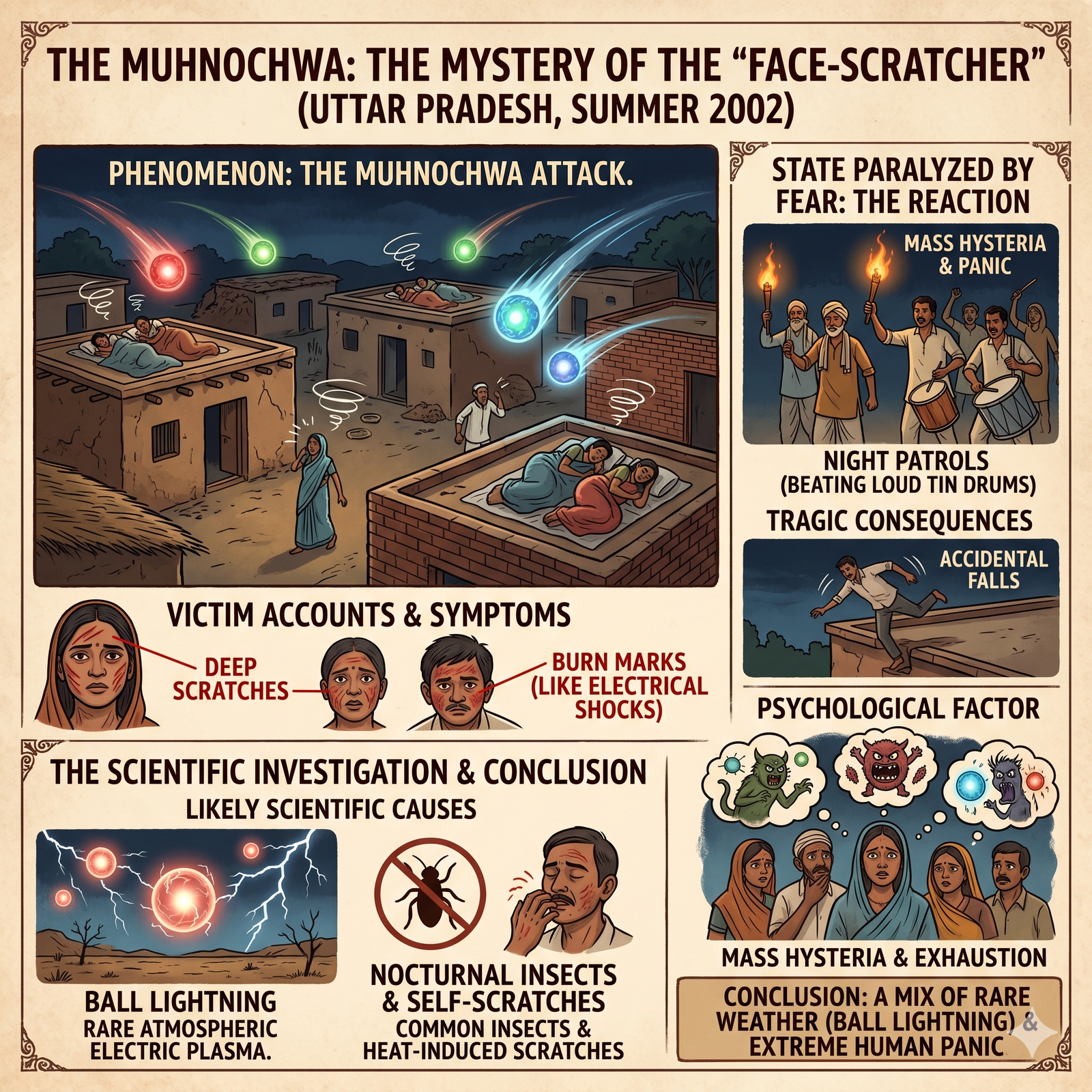
Out of the humid darkness emerged a mysterious attacker that defied all logical explanation. It did not strike like a normal thief or a wild animal. According to the terrified villagers, it flew through the air, glowed with bright red or green lights, and attacked their faces with sharp, metallic claws before vanishing completely into the night. They named it the Muhnochwa, a local term that roughly translates to the “face-scratcher.” The story of this bizarre attacker quickly spiraled into one of the most intense and deadly episodes of mass hysteria in modern Indian history.
Begum Hazrat Mahal: How She Held Awadh Together in 1857
The Face-Scratcher of the Night
The descriptions of the Muhnochwa varied wildly from village to village, which only added to the immense terror. Some victims swore it looked like a small flying saucer the size of a football that emitted flashing blue and red lights. Others claimed it was a remote-controlled mechanical drone equipped with sharp steel claws. A few even believed it was an invisible, supernatural demon sent to punish the villages.
Despite the varying descriptions, the injuries were incredibly real. Dozens of people went to local hospitals with deep, painful scratches on their faces, arms, and necks. Some victims had severe, unexplained burn marks that looked like electrical shocks. Because the attacker always struck completely in the dark and vanished within seconds, nobody could catch it or take a clear photograph. The fear spread through the rural districts like absolute wildfire.
The Romantic Soul of Kangra Miniature Paintings
A State Paralyzed by Fear
Within just a few weeks, the panic completely altered the daily lives of millions. Nobody dared to sleep in the dark. Entire villages formed heavily armed night patrols, marching through the streets banging loud tin drums and carrying burning torches to scare away the flying light.
Tragically, the fear of the Muhnochwa proved to be far deadlier than the mysterious entity itself. People sleeping on their roofs were so incredibly tense that if a stray cat jumped near their bed, they would wake up screaming in sheer terror. Several people died after accidentally running off the edges of their dark roofs in a blind panic. Worse still, the paranoia led to horrific mob violence. Innocent travelers and mentally ill wanderers were heavily beaten, and sometimes killed, by terrified village mobs who suspected them of operating the “Muhnochwa remote controls.”
The Scientific Investigation
The situation became so completely out of control that the state government was forced to intervene heavily. Thousands of police officers were deployed simply to calm the angry, frightened crowds. Seeking a rational explanation, the government called in expert scientists from the prestigious Indian Institute of Technology (IIT) Kanpur to investigate the strange burn marks and the flying lights.
The scientists spent weeks interviewing victims and analyzing the weather data. Their final conclusion was a brilliant mix of atmospheric science and human psychology. They deduced that the glowing, flying orbs were likely a highly rare natural phenomenon known as “ball lightning.” During severe droughts, incredibly dry, electromagnetically charged air can rarely create floating, glowing balls of electrical plasma. If one of these floating plasma balls drifted near a sleeping person and popped, it could easily cause a superficial electrical burn and a massive flash of blinding light.
The Psychology of Mass Hysteria
But ball lightning only explained a tiny fraction of the attacks. The scientists and psychiatrists concluded that the vast majority of the panic was driven entirely by mass hysteria. Humans are highly suggestible creatures. When people were deeply exhausted from the massive heatwave, highly stressed, and absolutely convinced that a monster was hunting them, their brains played massive tricks on them.
Many of the reported scratches were actually caused by common nocturnal insects, panicked stray animals, or even people unknowingly scratching their own faces in their sleep due to the severe, sweaty heat. Once the media sensationalized the early reports, every single unexplained shadow or tiny bug bite was immediately blamed on the Muhnochwa. The psychological fear was highly contagious, spreading from village to village faster than any physical disease.
Savitribai Phule: School That Changed India’s History
Quick Comparison Table
| Feature | The Muhnochwa Myth | The Scientific Reality |
| Nature of Attacker | A mechanical drone or flying demon | Rare ball lightning and common insects |
| Source of Light | High-tech LED lights or glowing eyes | Electromagnetically charged atmospheric plasma |
| Cause of Injuries | Metallic claws and deliberate shocks | Superficial plasma burns and self-inflicted sleep scratches |
| Primary Threat | The flying entity itself | Panic-induced falls and dangerous mob violence |
Curious Indian Fast Facts
- The Muhnochwa panic happened exactly one year after the famous “Monkey Man” mass hysteria gripped the capital city of New Delhi in 2001.
- Over a dozen people lost their lives during the two-month panic, almost entirely due to jumping off roofs or being attacked by paranoid mobs.
- Some local conspiracy theories wildly suggested the orbs were secret spy drones sent by hostile neighboring countries.
- The state police were so desperate to restore calm that they offered a massive cash reward to anyone who could capture the entity dead or alive.
- The panic naturally died down entirely on its own once the heavy monsoon rains finally arrived, cooling the temperatures and ending the drought.
Conclusion
The terrifying summer of the Muhnochwa is one of the most fascinating psychological case studies in modern history. It perfectly highlights how incredibly fragile human rationality can be when faced with extreme weather, deep exhaustion, and massive societal fear. The face-scratcher was not a sci-fi drone or an ancient monster; it was a perfect, deadly storm of a rare weather phenomenon mixed with the absolute raw power of the human imagination.
When we look back at the chaotic events in Uttar Pradesh, we learn a very humbling lesson about the nature of fear. The true danger did not come from the glowing lights in the sky, but from the incredible panic it planted directly into the minds of the people. By understanding the science and psychology behind the Muhnochwa, we are better prepared to fight the darkness with logic and calm reason, ensuring that invisible monsters never hold such massive power over our communities again.
The Dark Ink Masks of Rabindranath Tagore
If you think you have remembered everything about this topic take this QUIZ
Results


#1. In which year did the Muhnochwa phenomenon cause widespread panic in rural Uttar Pradesh?
#2. What does the local term “Muhnochwa” roughly translate to in English?
#3. What environmental conditions contributed to people sleeping on their roofs during the panic?
#4. According to victim accounts, what colors of light did the Muhnochwa reportedly emit?
#5. Which prestigious institution was called in to investigate the scientific truth behind the attacks?
#6. What rare natural phenomenon did scientists identify as the likely cause of the glowing flying orbs?
#7. What was the primary cause of death during the Muhnochwa mass hysteria?
#8. What event finally caused the panic to die down naturally?
What exactly was the Muhnochwa?
The Muhnochwa, meaning “face-scratcher,” was a mysterious flying entity that reportedly emitted light and scratched sleeping villagers’ faces in Uttar Pradesh in 2002.
Did people actually die from the attacks?
While many suffered scratches and minor burns, the recorded deaths were not directly caused by the entity. They were tragic results of panic, such as people accidentally falling off roofs or being beaten by paranoid mobs.
What did scientists conclude the glowing orbs were?
Scientists from IIT Kanpur concluded that the glowing, floating lights were likely rare atmospheric “ball lightning” caused by the extremely dry, highly charged air of the severe drought.
How were the scratch marks explained?
Experts explained that most scratches were caused by nocturnal insects, panicked animals, or villagers accidentally scratching themselves in their sleep while suffering from massive heat and stress-induced hysteria.
Why did the attacks suddenly stop?
The attacks and the widespread panic naturally stopped when the heavy monsoon rains finally broke the severe summer drought, cooling the environment and preventing the formation of ball lightning.