How India defeated famine, and what the victory cost the land
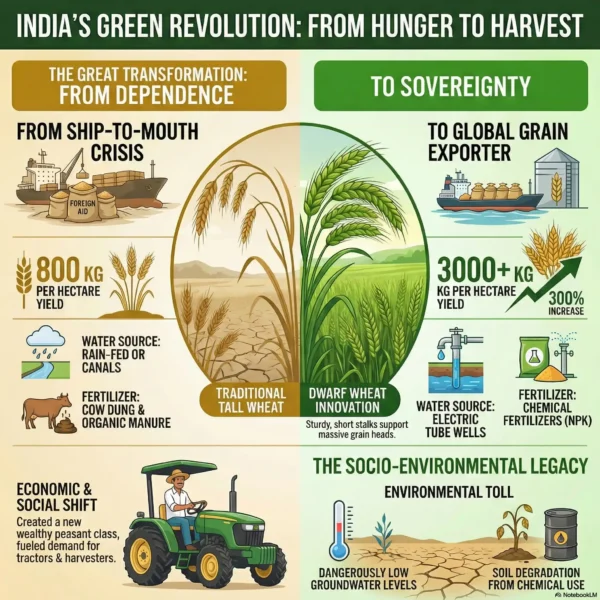
In the middle of the 1960s, India was starving, and staying alive only on grain shipped in from America.
Within a single decade, that same India was growing so much food that it could feed itself, fill its granaries to overflowing, and even sell the surplus abroad. It is one of the greatest victories over hunger in human history, and it saved untold millions of lives that would otherwise have been lost.
It is also the reason that, sixty years later, the soil and the water beneath the fields of Punjab are slowly dying.
This is the story of the Green Revolution. And it is not, as it is usually told, a simple tale of heroes and science beating famine. It is the harder, more grown-up story of a miracle that was completely real, and a bill that is still coming due, and of how the two turned out to be not separate stories at all, but one.
Ship to mouth
To feel the size of what happened, you first have to feel the fear that came before it.
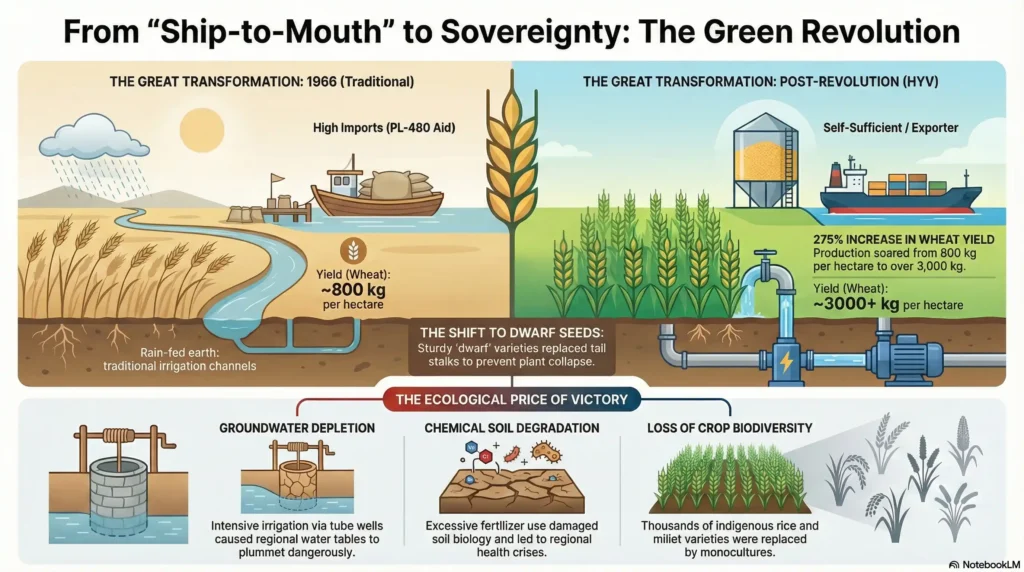
By the mid-1960s, India was in a desperate corner. Two wars, against China in 1962 and Pakistan in 1965, and two brutal back-to-back droughts had emptied the nation’s granaries. There was simply not enough food. To keep its people alive, India had to rely on wheat shipped in from the United States under a food-aid programme, and the dependence was total and humiliating.
People called it a “ship-to-mouth” existence. Food arrived by sea and went almost straight into hungry mouths, and if the ships ever stopped coming, the country would starve. Worse, the aid came with strings: the United States used the grain as a lever, leaning on India over its foreign policy. A proud, newly free nation had been reduced to a begging bowl.
India lived ship to mouth, one convoy away from famine, its dignity mortgaged to the grain ships of a foreign power. If they stopped, the country starved.
The prime minister, Lal Bahadur Shastri, asked his people to skip one meal a week to stretch the country’s food. Before he asked it of the nation, he tested it quietly on his own family, to be sure ordinary people could bear it. But appeals to eat less were only a way to survive the crisis, not to end it. India had to learn, and fast, how to grow enough to feed itself.
Nationalization of Banks 1969: The Midnight Move That Changed India
The Mexican gamble
The answer was waiting in a research station in far-off Mexico.
There, an American agronomist named Norman Borlaug had bred a strange new kind of wheat. Ordinary tall wheat, when you fed it heavily to boost its grain, grew top-heavy and toppled over, ruining the crop. Borlaug’s wheat was a dwarf: short, thick, sturdy stalks that could carry a huge head of grain without falling. Feed it well, and it did not collapse. It simply produced.
An Indian geneticist, M.S. Swaminathan, saw at once what this could mean for his hungry country. He persuaded the agriculture minister, C. Subramaniam, to take an enormous risk. Against the fierce warnings of traditionalists, who feared foreign pests, foreign dependence and outright ruin, Subramaniam ordered the import of eighteen thousand tonnes of the Mexican seed, the largest shipment of seed the world had ever seen.
They bet the future of a starving nation on eighteen thousand tonnes of foreign seed, against every cautious voice warning of disaster. It was one of the great gambles of the century.
The miracle in the fields
The gamble paid off almost beyond belief.
The new seeds went mainly to Punjab, Haryana and western Uttar Pradesh, where the farmers were skilled and, crucially, water was plentiful. The government backed the seeds with a full package: fertiliser, irrigation, pesticides and cheap credit, all at once. And the land answered.
The harvests were so enormous that the country did not know what to do with them. In 1968 the wheat crop was so huge that the existing granaries simply could not hold it, and in Punjab schools and cinema halls were pressed into service as emergency stores for the overflowing grain. A little later, a “miracle rice” from the Philippines did the same for the rice-growing regions. Norman Borlaug was given the Nobel Peace Prize for his work, and his reason was simple and true: you cannot build a peaceful world, he said, on empty stomachs.
Within a few short years, a country that had been begging the world for grain was so buried in wheat that it had to store the harvest in schoolrooms and cinemas.
Let there be no mistake about what this meant. It meant that people who would have died did not die. It gave a young, doubting nation the priceless dignity of feeding its own children. Judged on its own terms, it was one of the finest things independent India ever did.
The Indo-Pakistani War of 1971: A Victory of Humanity and Strategy
The bill comes due
But the same miracle was quietly writing a bill, and the bill would not arrive for years.
The wonderful new crops were thirsty, far thirstier than the old ones. To water them, farmers across Punjab and Haryana drilled millions of tube wells and began pumping up the water hidden deep underground. Year after year, that buried water table sank lower and lower, toward a crisis that now threatens the whole region’s future.
The heavy doses of chemical fertiliser and pesticide that made the giant yields possible slowly did their own damage, poisoning the soil and seeping into the water. Today a train that runs out of that same prosperous farm belt carries a grim nickname, the “cancer train,” for the many sick passengers it is said to carry to distant hospitals, their illnesses widely blamed on decades of chemical exposure.
And in racing to plant a handful of super-productive crops, India let thousands of its old, tough, native varieties of rice and millet quietly vanish, narrowing the nation’s food down to a few thirsty champions and leaving it more fragile than before. The miracle had also been uneven. It blessed a few well-watered states and largely passed others by, widening the gulf between a rich farming heartland and a poorer countryside elsewhere.
The very things that ended the famine, the thirsty seed, the chemicals, the single crop, are the same things now draining the land dry. The miracle and the reckoning grew from one seed.
Two harvests
It is tempting to tell the Green Revolution as a pure hero story, science slaying the dragon of hunger. It is just as tempting, standing in a dying Punjabi field today, to tell it as a warning, a cautionary tale of nature abused. Both of those stories are too simple, and the truth is harder, and far more useful, than either.
It was both at once. The triumph and the cost did not come from different places. They came from the very same seed.
Millions of people are alive today, and lived long and full lives, because of the Green Revolution. That is not a small-print detail; it is the entire point of the thing. And the aquifers of Punjab are running dry because of the Green Revolution. That is not anti-national grumbling; it is simply the bill. A mature nation, like a mature person, has to be able to hold both of those truths in the same hand at the same time: to be deeply grateful for a gift and clear-eyed about its cost, without letting either one erase the other.
There is a deeper lesson buried in it, and the man who did more than anyone to bring the miracle understood it best. In his later years, M.S. Swaminathan began calling for what he named an “evergreen revolution,” a way to keep the land richly productive forever without bleeding it white. He, of all people, knew that the first Green Revolution had won its great battle partly by borrowing against the future.
That is what our most dazzling victories over nature so often do. They solve today’s emergency by quietly signing a cheque that some later generation has to cash. The Green Revolution fed a starving India and handed it the dignity of never having to beg for bread again. Now the children who grew up with full plates because of it have inherited the harder task: to keep the country fed while healing the land that fed it, and to relearn the oldest truth known to any farmer, older than any miracle seed. You cannot take from the earth forever without, in the end, giving something back.
India’s First Nuclear Test: The Story of Smiling Buddha
The Emergency: When India’s Democracy Was Put in Chains
If you think you have remembered everything about this topic take this QUIZ
Results


#1. Which scientist is credited as the key architect of the Green Revolution in India?
#2. Before the Green Revolution, India was heavily dependent on food aid from the US under which program?
#3. What was the specific characteristic of the Mexican wheat seeds developed by Norman Borlaug?
#4. Which Indian Prime Minister asked the nation to skip one meal a week (Shastri Vrat) during the food crisis?
#5. The Green Revolution was primarily centered in which Indian states?
#6. Which “Miracle Rice” variety was introduced in 1968 to spread the revolution to rice-growing areas?
#7. The “Cancer Train” running from Bathinda to Bikaner is a grim reminder of which negative impact of the revolution?
#8. In which year was the Green Revolution officially launched in India?
Who is known as the Father of the Green Revolution in India?
Dr. M.S. Swaminathan is considered the Father of the Green Revolution in India for his leadership in introducing and adapting HYV seeds.
Which crops were the main focus of the Green Revolution?
The revolution primarily focused on Wheat and Rice. Other crops like pulses and oilseeds were largely left behind initially.
Why was 1966 the turning point?
In 1966, following severe droughts, India made the critical policy decision to import 18,000 tonnes of Mexican wheat seeds, launching the High-Yielding Varieties Programme (HYVP).
Which states benefited most from the Green Revolution?
Punjab, Haryana, and Western Uttar Pradesh benefited the most due to their existing irrigation infrastructure and adaptable farming communities.
What are the negative impacts of the Green Revolution?
Major negative impacts include groundwater depletion, soil degradation due to chemical overuse, and the loss of indigenous crop biodiversity.
Sources & References
- The Nobel Prize (Norman Borlaug) — the dwarf wheat and the science behind the Green Revolution.
- Office of the Historian, US Department of State (the PL-480 food aid programme) — India’s dependence on American grain in the 1960s.
- International Rice Research Institute (IR8, “miracle rice”) — the high-yielding rice that carried the revolution to the rice regions.
- Encyclopaedia Britannica (“Green Revolution” and “M.S. Swaminathan”) — the transformation of Indian agriculture, its architects, and its long-term costs.
Author


Exploring the Soul of Bharat through History, Science, Culture, and its Diversity
Our Mission
Curious Indian is a definitive knowledge portal dedicated to chronicling the events, personalities, and cultural shifts that defined the Indian subcontinent. From the ancient Vedic Period to the complexities of 21st-century politics, our goal is to provide deep-dive analysis that inspires.
Editorial Standards & E-E-A-T
Every article published under our brand undergoes a rigorous fact-checking process. We prioritize primary historical records, academic citations, and credible archives to ensure our readers receive accurate, high-authority information.
Historical Integrity Directly sourcing from ASI archives and academic journals.Topical Authority Comprehensive clustering of Indian Science, Biographies, and Wars.Managed by Paripurna Datta and TEAM | Dedicated to the Knowledge of India.