How two princes who gave up everything took the divine out of the priests’ hands
We left the Vedic world at the very moment it had closed. It had hardened into rigid caste, into unquestioned kings, and into a religion of costly sacrifices locked away behind a wall of priests and a language, Sanskrit, that ordinary people could not even understand. Faith itself had become a kind of business, with a gatekeeper standing at the door.
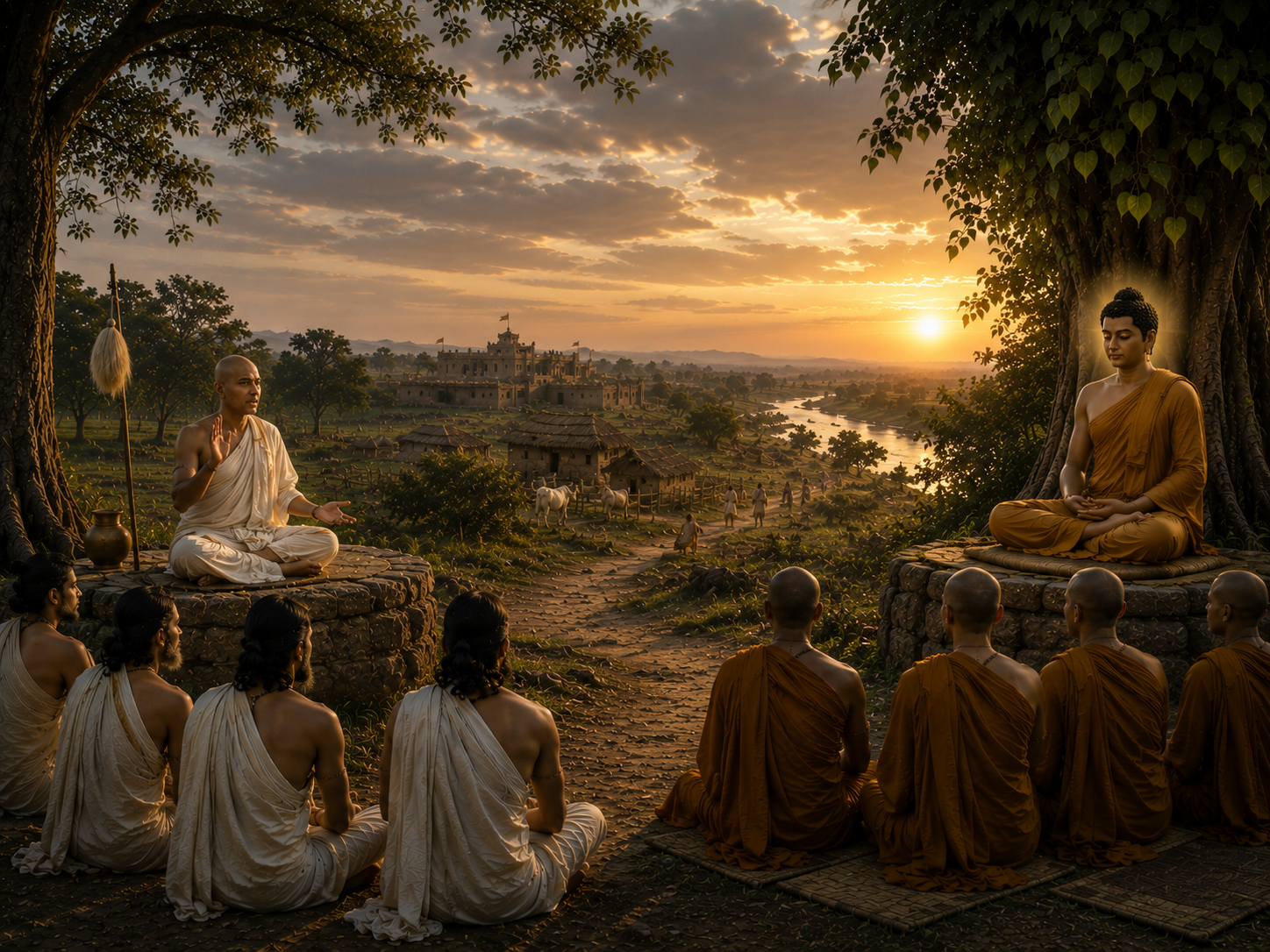
And then, in one truly extraordinary century, two young men did something that would change India, and much of the wider world, forever. Both were princes, born into wealth and comfort in the same corner of northern India. Both looked long and hard at the world around them, and found it strangely hollow. And both, one after the other, simply walked out of their palaces to go and search for a truth that could belong to everyone. One would come to be known as Mahavira. The other would come to be known as the Buddha.
A century of great questions
The century these two lived in, around five hundred years before the birth of Christ, was one of the most remarkable in all of human history.
For reasons that no one has ever fully explained, all across the world at almost the very same moment, people began asking the deepest possible questions about how to live and what is truly real. In China there was Confucius. In Persia, Zoroaster. In Greece, the first great philosophers. And in India, a whole restless wave of seekers, called the shramanas, “the strivers,” turned their backs on ordinary life to go and find the truth for themselves.
They were tired of being told that only priests could reach the gods, and only through expensive rituals, in a language they did not even speak. They wanted to find the truth directly, on their own, with their own hearts and minds. And out of this great wave of questioning came two of the living religions of the world.
Life of Buddha c. 563-483 BCE: The Journey to Enlightenment
The first prince: the conqueror
The first was a prince named Vardhamana, born into a noble warrior family near the city of Vaishali, in what is now the state of Bihar. He had everything a young man could possibly want. And at the age of thirty, he gave the whole of it away, and walked into the forest with nothing at all, to seek the truth.
For twelve long years he wandered, meditating and denying himself every comfort, enduring hunger and cold and pain without a word of complaint, until at last he broke through into a state of perfect knowledge. His followers gave him a new name to capture what he had done.
They called him Mahavira, “the great hero,” and a Jina, meaning a “conqueror.” Not because he had conquered any land or any army, but because he had conquered himself, his own desires and his own fears.
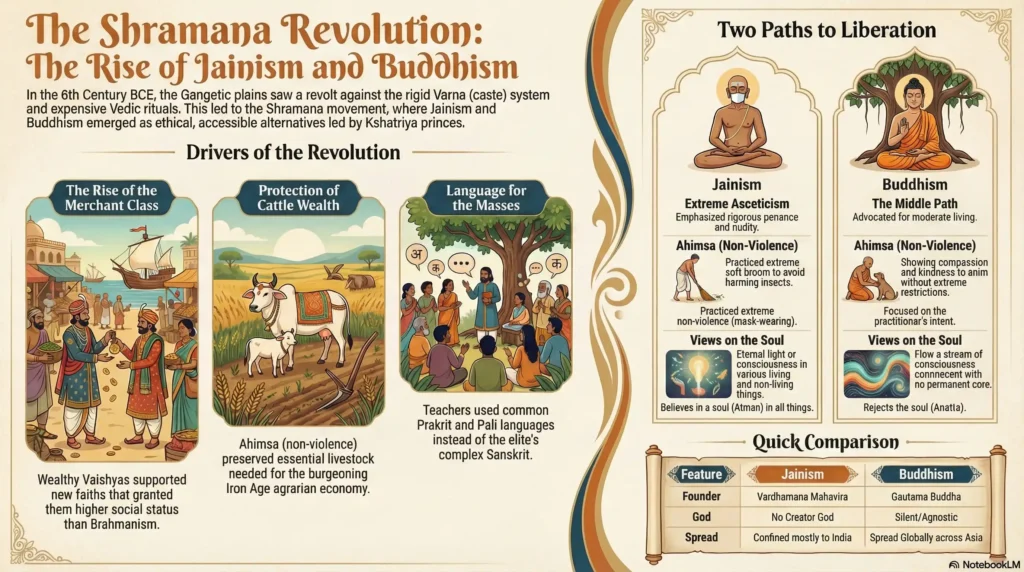
It is from that word Jina that his followers came to be called the Jains. And his path was one of extraordinary gentleness. At its very heart lay ahimsa, non-violence, but carried further than almost anyone before or since had ever taken it. Mahavira taught a deep reverence for every single living thing, down to the smallest insect and the tiniest creature living in a single drop of water. To this very day, the strictest Jain monks sweep the ground before they step on it, and cover their mouths, so as not to harm even the small lives they cannot see.
The second prince: the awakened one
The second prince is one of the most famous human beings who ever lived. His name was Siddhartha Gautama, and he was raised in such deep luxury that, the old story tells us, his father kept all suffering carefully hidden from him behind the high palace walls.
But one day the young prince went out beyond those walls, and for the first time in his sheltered life he saw the things that every human being must one day face. He saw an old man, bent and frail with age. He saw a sick man, shaking with illness. He saw a dead man being carried away to his funeral. And then, last of all, he saw a calm, wandering holy man who, in the very midst of all this suffering, somehow seemed deeply at peace. Those four sights broke his heart wide open, and he found he could never un-see them. So, at the age of twenty-nine, he too walked away, from his palace, his riches, and even his wife and his baby son, to find out why we suffer, and whether we might ever be free of it.
At first he tried the harsh, starving path of the extreme ascetics, and very nearly died upon it. But he found that it simply did not bring him the answer he sought. So he chose instead what he came to call the Middle Way, a path of gentle balance between too much comfort on one side and too much hardship on the other. And sitting one night in deep meditation beneath a great spreading tree, he at last understood. He became the Buddha, a name that simply means “the one who woke up.”
What the Buddha had woken up to needed no priest to explain it, no sacrifice to earn it, and no noble birth to deserve it. It was open to absolutely anyone.
He taught it in four simple truths: that life contains suffering; that our suffering is caused by our own endless wanting and craving; that this craving can, in fact, be let go of; and that there is a clear and steady path that anyone at all can walk to let it go and find real peace.
Reign of Ashoka: The Emperor Who Chose Peace
Two paths from the same door
It is a genuinely striking thing, how alike these two men were. Both were princes who gave up everything they had. Both lived at the same time, in the same region of India. Both turned their backs on the priests, the costly sacrifices, and the hard walls of caste. And both chose to teach in the plain, everyday language of the people, rather than the priests’ Sanskrit, so that a farmer or a servant could understand every single word. Both offered freedom to anyone willing to walk the path, no matter what family they had been born into.
But they were not the same. Mahavira’s way was the way of the extreme, of the very harshest self-denial and the most absolute non-violence imaginable. The Buddha’s way was the way of the middle, of balance and moderation, far gentler on the body. Two different doors, you might say, opening off the very same courtyard.
In time, Mahavira’s Jainism would stay mostly within India, a small but utterly unbroken community that has kept its gentle faith alive for two and a half thousand years. The Buddha’s teaching, meanwhile, would travel very much further, carried on foot and by ship across mountains and seas, until it had reached almost every land in Asia and grown into one of the great religions of the whole world.
Later Vedic Period c. 1000-600 BCE: The Age of Iron and Kingdoms
What the two princes changed
Look at what these two young men set into motion, simply by walking away from their comfortable lives.
They cracked open a world that had closed. They took the great questions of life and death out of the priests’ locked temple and handed them straight back to ordinary people, in their own language, free of any charge. They planted deep in the soil of Indian thought the idea of ahimsa, of not harming any living thing, an idea that would keep growing for thousands of years, and that would one day help a man named Gandhi free an entire nation without a war. And the movement that they began would go on to fill the land with quiet monasteries, and to carve some of the most breathtaking caves and shrines the world has ever seen.
All of it flowed from one simple and radical act. Two men who had been handed everything the world could possibly offer looked at all of it honestly, decided that it was somehow not enough, and set the whole of it down, in order to go and ask the very questions they had been told never to ask. And the answers they carried back are still quietly changing lives, all over the earth, to this day.
Reign of Chandragupta Maurya 321-297 BCE: The First Empire of India
If you think you have remembered everything about this topic take this QUIZ
What are the main causes for the rise of Jainism and Buddhism?
The main causes were the rigidity of the Varna (caste) system, the dominance of Brahmins, expensive Vedic rituals involving animal sacrifice, and the rise of the merchant class (Vaishyas) who wanted a higher social status.
What is the main difference between Jainism and Buddhism regarding the soul?
Jainism believes in the existence of an eternal soul (Jiva) in every living and non-living thing. Buddhism does not believe in a permanent self or soul (Anatta).
Which languages did Mahavira and Buddha use to teach?
Mahavira used Prakrit, and Buddha used Pali.
What is the “Middle Path” in Buddhism?
It is a life of moderation, avoiding both extreme indulgence in senses and extreme self-mortification (starvation/pain).
Who was the 24th Tirthankara of Jainism?
Vardhamana Mahavira.
Sources and references
- Vedantu and EkamIAS (“Jainism and Buddhism”) — the 6th-century BCE ferment and its parallels worldwide (Confucius, Zoroaster, the Greek philosophers), and the religious, social, economic and political causes, including opposition to costly sacrifices, caste discontent, merchant support and Kshatriya resentment of Brahmin dominance.
- INFLIBNET and TOne Academy — both Mahavira and the Buddha as Kshatriyas who rejected Vedic ritual and authority, Mahavira as the 24th Tirthankara who revitalised rather than founded Jainism, and the shared features (non-theism, renunciation, monastic orders) alongside the difference between Jain asceticism and Buddhist non-self.
- Curious Indian’s own overview and Unacademy — Mahavira born near Vaishali, renouncing at thirty, twelve years of penance, attaining Kevala Jnana and becoming a Jina, and the Jain use of Prakrit rather than Sanskrit.
- World-history sources on the Buddha — Siddhartha Gautama’s sheltered upbringing, the four sights, the Great Renunciation, the rejection of extreme asceticism for the Middle Way, enlightenment at Bodh Gaya, and the Four Noble Truths and Eightfold Path.
- Educational research on ancient Indian religions — the shramana reaction against Vedic ritualism and varna hierarchy, the spread of Buddhism across Asia versus Jainism’s continuity within India, and the lasting influence of ahimsa on Indian civilisation.
Author


Exploring the Soul of Bharat through History, Science, Culture, and its Diversity
Our Mission
Curious Indian is a definitive knowledge portal dedicated to chronicling the events, personalities, and cultural shifts that defined the Indian subcontinent. From the ancient Vedic Period to the complexities of 21st-century politics, our goal is to provide deep-dive analysis that inspires.
Editorial Standards & E-E-A-T
Every article published under our brand undergoes a rigorous fact-checking process. We prioritize primary historical records, academic citations, and credible archives to ensure our readers receive accurate, high-authority information.
Historical Integrity Directly sourcing from ASI archives and academic journals.Topical Authority Comprehensive clustering of Indian Science, Biographies, and Wars.Managed by Paripurna Datta and TEAM | Dedicated to the Knowledge of India.