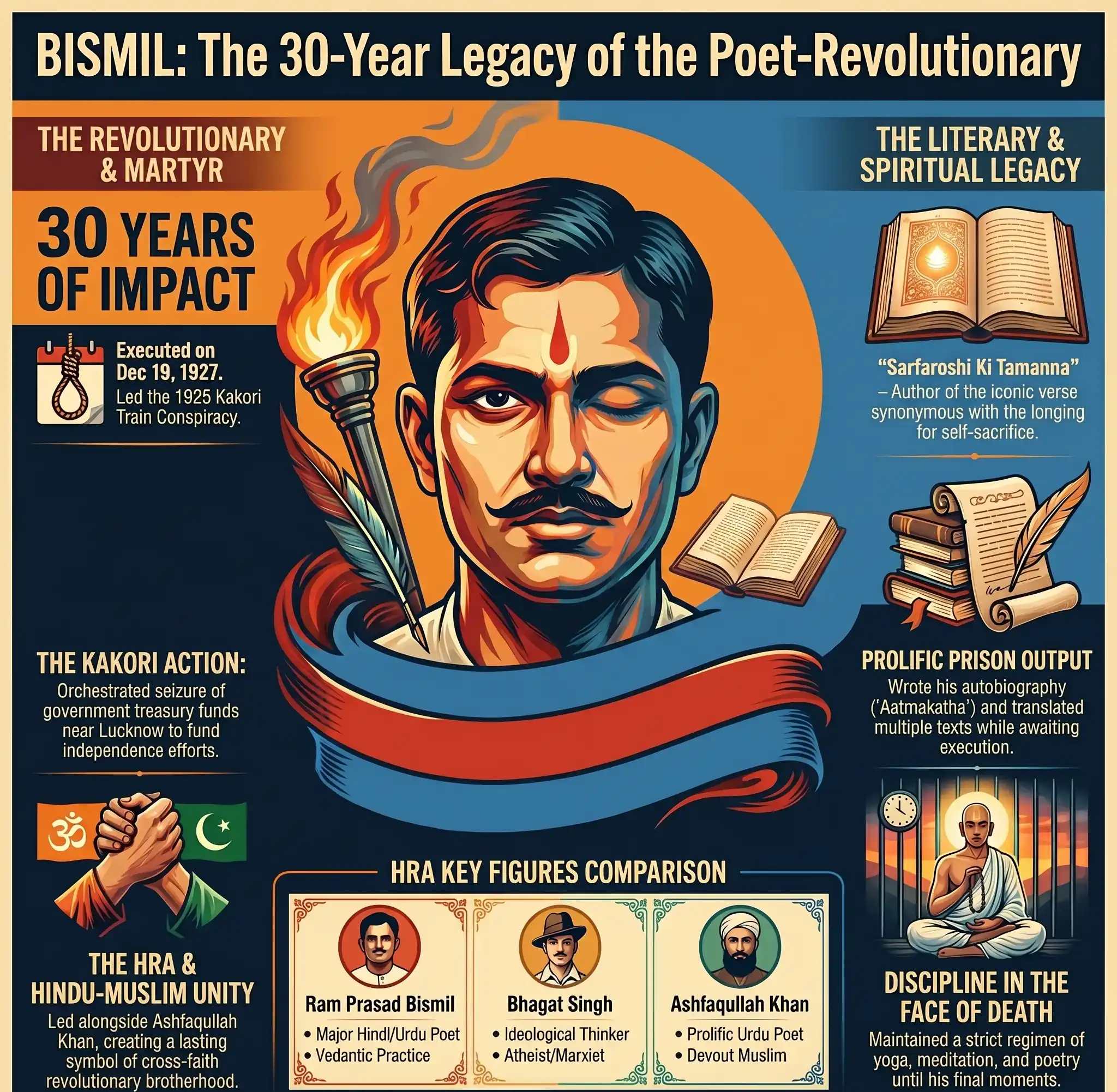
Ram Prasad Bismil was a Hindi and Urdu poet, revolutionary, and founding member of the Hindustan Republican Association whose leadership of the Kakori Train Conspiracy in 1925 led to his arrest, trial, and execution by the British colonial government at the age of thirty. Born in Shahjahanpur in 1897 and shaped by Arya Samaj values and a fierce commitment to Indian independence, he spent his final two years in Gorakhpur Central Jail writing some of the most powerful revolutionary poetry in the Hindi literary tradition, completing his autobiography, translating texts from Urdu and Bengali, and maintaining a spiritual discipline that astonished his jailers. His execution on 19 December 1927, alongside Ashfaqullah Khan, Roshan Singh, and Rajendra Lahiri, transformed four young men into permanent symbols of sacrificial courage in the Indian imagination. His poem Sarfaroshi Ki Tamanna remains one of the most recited verses of the Indian freedom movement.| Detail | Information |
| Full Name | Ram Prasad Bismil |
| Born | 11 June 1897, Shahjahanpur, United Provinces, British India |
| Died | 19 December 1927, Gorakhpur Central Jail, United Provinces |
| Age at Death | 30 years |
| Revolutionary Organisation | Hindustan Republican Association |
| Most Famous Action | Kakori Train Conspiracy, 9 August 1925 |
| Literary Identity | Poet, writer, translator, publisher |
| Pen Names | Bismil, Ram, Aryendra |
| Languages Written In | Hindi, Urdu |
| Spiritual Affiliation | Arya Samaj, later deeply personal Vedantic practice |
| Most Famous Poem | Sarfaroshi Ki Tamanna |
| Co-conspirators | Ashfaqullah Khan, Roshan Singh, Rajendra Lahiri |
| Trial | Kakori Conspiracy Case, Sessions Court Lucknow, 1926 |
| Sentence | Death by hanging |
| Autobiography | Aatmakatha, written in prison |
Ram Prasad Bismil and the Mysterious Final Days of a Poet Revolutionary
There is a particular quality of attention that a person develops when they know their time is limited and have decided not to waste any of it on fear. You can see this quality in the accounts left by those who observed Ram Prasad Bismil during his final two years in Gorakhpur Central Jail. The prison guards, the jailers, the British officials who processed his case, and the Indian political prisoners who shared his incarceration all noted the same thing, separately and consistently. He was not merely calm. He was present in a way that made the people around him feel that they, not he, were the ones who did not fully understand what was happening.
He rose before dawn and performed his prayers. He wrote through the morning. He translated through the afternoon. He composed poetry in the evenings. He discussed philosophy, literature, and revolutionary strategy with whoever would engage. He maintained a physical discipline through yoga and exercise. And through all of it, he carried a quality of deliberate, unhurried purposefulness that was, under the circumstances, not entirely explicable by ordinary human psychology.
This is the mystery at the centre of Ram Prasad Bismil’s final days, not the mystery of what the British colonial government did to him, which is documented with painful clarity, but the mystery of who he was inside those circumstances and how he came to be that person.
The Making of a Revolutionary
Ram Prasad Bismil was born on 11 June 1897 in Shahjahanpur, a town in the United Provinces of British India that is now in Uttar Pradesh. His family was middle-class and socially conservative, and his early years gave little obvious indication of the direction his life would take. His father, Murlidhar, was a municipal employee whose primary ambition for his son was a respectable government position, a prospect that the young Ram Prasad found increasingly impossible to imagine accepting.
The transformation began with the Arya Samaj. Founded by Swami Dayananda Saraswati in 1875, the Arya Samaj was a reformist Hindu movement that rejected idol worship, caste hierarchy, and the accretions of medieval religious practice in favour of a return to Vedic principles. It was also, in the early twentieth century, one of the primary intellectual nurseries of Indian nationalism, providing young men from the Hindi-speaking heartland with a framework that connected personal spiritual reform to political liberation from colonial rule.
Bismil encountered the Arya Samaj in his adolescence and it reshaped him completely. The Vedic texts he now read with serious attention gave him both a spiritual grounding and an intellectual confidence in the value of Indian civilisation that made colonial subordination feel not merely politically unjust but spiritually intolerable. A man who has been taught that he comes from a tradition of profound philosophical achievement does not easily accept being governed by those who tell him his civilisation has nothing to teach the world.
His political radicalisation proceeded through a series of encounters with the literature of Indian nationalism and with the practical realities of colonial administration in the United Provinces. The Jallianwala Bagh massacre of 1919, in which British troops under General Reginald Dyer opened fire on an unarmed crowd in Amritsar, killing hundreds of men, women, and children, was for Bismil’s generation the moment that made constitutional gradualism feel permanently inadequate as a response to colonial violence.
He joined the revolutionary underground. He found his people.
How Swami Vivekananda Brought Vedanta to the Modern World
Sarfaroshi Ki Tamanna and the Poet Who Meant Every Word
Before the Kakori conspiracy, before the trial, before the gallows, Ram Prasad Bismil was already a poet of significant reputation in the Hindi and Urdu literary circles of the United Provinces. He wrote under the pen names Bismil, which means wounded in Urdu, Ram, and Aryendra, and his verses circulated through the underground networks of the revolutionary movement as both artistic expression and political fuel.
The poem most completely identified with him is Sarfaroshi Ki Tamanna, which translates roughly as the desire for self-sacrifice or the longing to offer one’s head. The poem’s opening lines, Sarfaroshi ki tamanna ab hamare dil mein hai, dekhna hai zor kitna baazu-e-qaatil mein hai, meaning the desire for self-sacrifice now burns in our hearts, let us see how much strength lies in the arm of the executioner, are among the most famous lines in the Hindi revolutionary literary tradition.
What makes Sarfaroshi Ki Tamanna extraordinary is not its emotional intensity, which is considerable, but the relationship between its language and the life of the man who composed it. Bismil did not write about self-sacrifice as a rhetorical gesture. He was writing about something he had already decided to do, and the poem’s power comes partly from this quality of absolute sincerity. When a person writes about offering their life and then offers their life, the poem acquires a retrospective authority that no amount of literary skill alone can produce.
There has been scholarly debate about the exact attribution of Sarfaroshi Ki Tamanna, with some researchers suggesting that portions of the poem draw on verses by the Urdu poet Bismal Azimabadi. The consensus among contemporary scholars of Hindi revolutionary literature is that the poem as it became known and is recited today is substantially Bismil’s work, shaped and charged by his particular voice and his particular life.
The poem was sung by Indian National Army soldiers, recited at independence movement meetings, carried into demonstrations, and is today sung at national commemorations. It has outlasted the colonial administration it was written to oppose by more than seven decades and shows no signs of diminishing in its power to move the people who hear it.
The Kakori Conspiracy
On 9 August 1925, a group of young revolutionaries associated with the Hindustan Republican Association stopped a train near Kakori, a small town between Lucknow and Shahjahanpur in the United Provinces, and seized the government treasury it was carrying. The action was intended to fund the revolutionary movement’s activities and to demonstrate, publicly and dramatically, that the British colonial government’s authority in India was neither absolute nor uncontested.
The planning was meticulous. The execution was largely successful. The consequences were catastrophic for those involved.
Ram Prasad Bismil was the primary organiser of the Kakori action. Ashfaqullah Khan, his closest friend and fellow revolutionary, a Muslim man whose friendship with the Hindu Bismil was itself a statement about what the revolutionary movement believed India should be, participated alongside him. Roshan Singh, Rajendra Lahiri, and several others were also involved.
The British colonial government’s response was swift, thorough, and deliberately exemplary. The Kakori Conspiracy Case, as it was termed in the colonial legal system, became one of the most extensively prosecuted political trials in the history of the United Provinces. The Sessions Court in Lucknow heard the case through 1926, with the colonial prosecution presenting evidence assembled with the full resources of the Intelligence Branch of the United Provinces Police.
The trial records, which were extensive and are partially preserved in the archives of the Uttar Pradesh State Archives, reveal a prosecution that was determined not only to convict the accused but to use the trial as a public demonstration of the costs of revolutionary activity.
Bismil conducted himself during the trial with the same composure that would define his prison years. He did not deny his involvement. He argued, instead, that his actions were justified by the justice of the cause and that the court before which he stood had no moral legitimacy over a people it had subjected by force. The argument was not accepted. The sentence was death.
The Friendship That History Remembers
No account of Ram Prasad Bismil’s life is complete without sustained attention to his friendship with Ashfaqullah Khan, because that friendship is one of the most moving and most historically significant human relationships in the story of India’s freedom movement.
Bismil was a Hindu, shaped by Arya Samaj values and deeply grounded in Vedic spiritual practice. Ashfaqullah Khan was a Muslim, equally devout in his faith and equally committed to the revolutionary cause. In the political atmosphere of the 1920s, when the Hindu-Muslim tensions that would eventually fracture the subcontinent were already visible and already being exploited by colonial authorities through the systematic application of divide-and-rule policy, a friendship of this depth and seriousness between a Hindu revolutionary and a Muslim revolutionary was not incidental. It was a political position expressed through personal loyalty.
The two men had met through the revolutionary underground and their friendship had grown through shared intellectual interests, Ashfaqullah was a poet in Urdu of genuine ability, shared physical courage, and a shared willingness to stake everything on the belief that India’s freedom mattered more than any other consideration. When the Kakori case broke, Ashfaqullah Khan initially escaped and could have fled the country. He chose to return and face the trial alongside his comrades. The reason he gave, in testimony and in the letters he wrote from prison, was that he could not abandon those who were standing on his behalf.
He was executed on 19 December 1927, on the same day as Bismil, in Faizabad jail, while Bismil went to the gallows in Gorakhpur. They died in different cities, on the same morning, having spent their final years in separate prisons writing letters to each other that the colonial authorities sometimes allowed through and sometimes did not.
The historical significance of the Bismil and Ashfaqullah friendship, and what it represented about the vision of India that the Hindustan Republican Association held, has been examined by historians including Shiv Verma, whose memoir-history of the Kakori revolutionaries provides one of the most intimate and authoritative accounts of these lives from someone who knew them personally.
The Compassionate Teachings of Sant Tukaram in Maharashtra
The Prison Years and the Extraordinary Mind
When Bismil arrived in Gorakhpur Central Jail to await execution, he had two years. He did not waste them.
The body of work he produced in Gorakhpur jail in those two years is, by any measure, remarkable. He completed his autobiography, called Aatmakatha, which remains one of the most extraordinary first-person documents of the Indian freedom movement, a text that is simultaneously a spiritual memoir, a political history of the revolutionary underground, and a meditation on the relationship between personal conviction and collective action. The Aatmakatha was written in Hindi in a prison cell under conditions of surveillance and physical restriction, and its prose has the quality of a mind that has decided to hold nothing back because there is no longer any reason to.
He translated Bauldev Upadhyay’s Bolshevik Di Dhoka from Bengali into Hindi, evidence of the intellectual breadth that characterised his prison reading. He translated Catherine from Urdu. He continued to compose poetry. He wrote letters, many of which survive in archives, to his family, to his comrades, to political leaders including some associated with the Indian National Congress, and to Ashfaqullah Khan in Faizabad.
The letters reveal a mind of extraordinary range and discipline. He writes about Sanskrit grammar and Urdu poetry and the organisation of revolutionary cells and the proper way to perform pranayama breathing exercises with equal seriousness and equal attention. He worries about his mother. He worries about whether the revolutionary movement will maintain its ideological clarity after his death. He asks, in one letter, whether anyone has arranged for the publication of his collected poems.
This last detail is characteristic and somewhat heartbreaking. A man facing a government-sanctioned death is concerned about his literary legacy, not from vanity but from the same commitment to the cause that led him to Kakori. The poems were weapons. He wanted them to reach their targets.
The spiritual dimension of his prison years deserves particular attention. Bismil’s Arya Samaj formation had given him a rigorous Vedantic philosophical framework, and in prison he deepened this practice considerably. He meditated. He performed yoga. He studied the Upanishads with the focused attention of someone for whom these texts had ceased to be intellectual exercises and had become practical guides to meeting death with composure.
His description of this practice in the Aatmakatha is one of the most honest and specific accounts of spiritual preparation for death in any language of the Indian tradition. He writes about the difficulty of maintaining concentration, about the moments when fear breaks through the discipline, and about the way a consistent practice gradually changes the character of those moments until they become, not absences of fear, but presences of something larger than fear that makes fear manageable.
This is not the language of someone performing courage for an audience. It is the language of someone actually doing the work.
What the British Feared
The British colonial government’s decision to execute Bismil, Ashfaqullah Khan, Roshan Singh, and Rajendra Lahiri was not legally inevitable. The Kakori action had resulted in one death, a passenger accidentally killed during the train seizure, and the treasury that was taken was recovered largely intact. By the standards of the era’s revolutionary violence across the empire, the Kakori action was a relatively contained incident.
The severity of the response, four executions and long prison sentences for the other convicted conspirators, reflected the colonial government’s assessment of what these men represented rather than simply what they had done. Bismil in particular was understood by the Intelligence Branch of the United Provinces Police as one of the most capable organisers and the most effective propagandists in the revolutionary underground. His poetry circulated. His organisational skills had built the Hindustan Republican Association into a functioning revolutionary network. His public presence, in the courtroom and in the accounts that filtered through the press, was creating exactly the kind of martyrdom narrative that colonial authorities understood to be more dangerous than any single act of revolutionary violence.
The execution was intended to end the narrative. It had precisely the opposite effect.
The clemency campaigns that emerged during the period between sentencing and execution drew support from across the Indian political spectrum. Mohandas Gandhi, whose commitment to nonviolence placed him in principled opposition to the methods of the Kakori revolutionaries, nonetheless acknowledged the courage of the condemned men. Jawaharlal Nehru, who visited the condemned men in prison, wrote about the experience in terms that were deeply personal in their emotional register.
Madan Mohan Malaviya, the founder of Banaras Hindu University, presented a mercy petition to the Viceroy on behalf of the condemned men. The petition was rejected. The executions proceeded on schedule.
The Morning of 19 December 1927
The accounts of Bismil’s final hours in Gorakhpur Central Jail come from multiple sources, including prison officials, Indian witnesses, and the indirect testimony of those who spoke with people present on that morning. They are consistent in their essential details and collectively constitute one of the most documented final hours of any figure in the Indian freedom movement.
He rose before dawn, as he had every day of his imprisonment. He completed his morning prayers and meditation. He ate the simple meal that was offered. When the time came, he dressed carefully in the white cotton that he had prepared. He walked to the place of execution without being led or assisted.
He recited verses from the Vedas. He sang lines from Sarfaroshi Ki Tamanna. Prison officials who were present later told Indian journalists that his composure was not the numbness of a man who had dissociated from what was happening but the deliberate, clear-eyed presence of a man who knew exactly what was happening and had made his peace with it in advance.
His final recorded words, according to multiple accounts, were from a verse of his own composition. The exact formulation varies slightly across sources, which is typical of oral transmission in the hours after such an event. The substance is consistent. He expressed his willingness, his readiness, his lack of regret.
He was thirty years old.
In Faizabad, on the same morning, Ashfaqullah Khan went to his own gallows. In Allahabad, the same morning, Roshan Singh was hanged. Rajendra Lahiri had been executed two days earlier in Gonda, on 17 December, the colonial government apparently unwilling to risk the symbolic power of all four executions falling on a single day.
The news of the executions reached the broader Indian public through the press over the following days, and the response was the one that the colonial government had tried to prevent through the severity of the punishment. These were not forgotten men. They were martyrs, and martyrdom, as the British colonial administration had learned repeatedly across the empire, generates more revolutionary energy than it extinguishes.
The Poetry That Outlived the Empire
Ram Prasad Bismil has been dead for nearly a century. The British Empire that executed him has been dead for more than seventy five years. Sarfaroshi Ki Tamanna is still being recited.
This is the most straightforward measure of what he accomplished. The poem has outlasted the political system it was written to oppose. It has been recited by politicians and students and soldiers and ordinary citizens at moments of national significance from 1947 to the present. It has been set to music in multiple arrangements. It has appeared in films, in school textbooks, in public speeches, and in the private conversations of people who learned it as children and find it rising to their lips in moments of difficulty.
How Bulleh Shah’s Poetry Transformed the Sufi World of Punjab
The broader body of his Hindi and Urdu poetry, collected and published through several editions since his death, reveals a writer of genuine literary seriousness whose revolutionary commitments were expressions of artistic sensibility as much as political conviction. He was not a propagandist who happened to write verse. He was a poet who happened to be a revolutionary, and the distinction matters because it explains why his work has survived the political context that produced it.
The literary scholar Namwar Singh, one of the most important critics of Hindi literature in the twentieth century, placed Bismil’s poetry within the broader tradition of Hindi progressive literature in terms that acknowledged both its political significance and its genuine artistic achievement. This kind of critical recognition from within the literary establishment rather than merely the political establishment is an important marker of the poetry’s actual quality as opposed to its historical significance.
The Unfinished Questions
The life of Ram Prasad Bismil raises questions that his death left open and that the subsequent history of India has not entirely resolved.
He believed in an India that was free, secular in the sense of being hospitable to all its communities, and organised on principles of social justice that went beyond the mere removal of British rule. His friendship with Ashfaqullah Khan was a personal expression of this political vision. The Hindustan Republican Association’s founding documents, which Bismil helped draft, articulated a vision of Indian freedom that was explicitly inclusive of all religious communities.
The India that emerged from 1947, and the India that has developed since, has had a complicated relationship with this vision. The partition that accompanied independence, the communal violence that preceded and followed it, and the continuing tensions around religious identity in Indian public life are all things that Bismil’s vision did not accommodate and that his life implicitly argued against.
Whether the India he died for is the India that exists today is a question that his poetry keeps alive, because the poem does not ask for a specific political outcome. It asks only for the quality of commitment that is willing to give everything. That question is always current. It does not expire with the political context that first asked it.
Ram Prasad Bismil was thirty years old when he died. He had done enough. He had written poems that would outlast the empire. He had organised a conspiracy that forced the colonial government into a response that generated more opposition than it suppressed. He had lived a friendship that made an argument about what India should be. He had written an autobiography that gives his interior life to anyone willing to read it. He had walked to the gallows singing.
There is a particular kind of life that is measured not by its length but by the completeness with which it was lived within whatever length it had. By that measure, thirty years was sufficient. Just barely, and not without enormous cost, but sufficient.
Quick Comparison Table
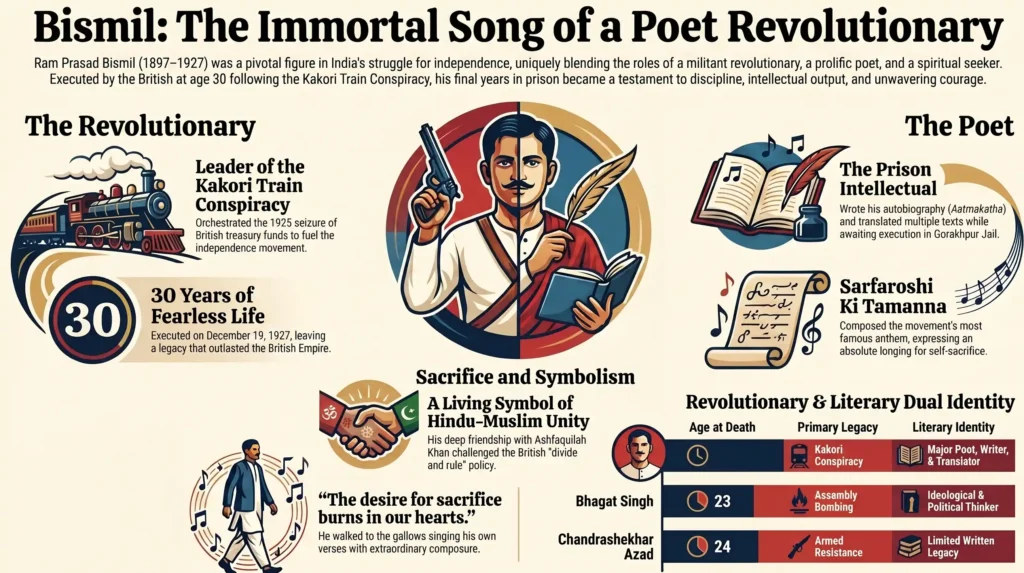
| Dimension | Ram Prasad Bismil | Bhagat Singh | Chandrashekhar Azad | Sukhdev Thapar |
| Born | 1897, Shahjahanpur, UP | 1097, Lyallpur, Punjab | 1906, Bhabra, MP | 1907, Lyallpur, Punjab |
| Age at Death | 30 | 23 | 24 | 23 |
| Revolutionary Organisation | Hindustan Republican Association | Hindustan Socialist Republican Association | Hindustan Socialist Republican Association | Hindustan Socialist Republican Association |
| Most Famous Action | Kakori Train Conspiracy, 1925 | Assembly Bombing, Lahore Conspiracy, 1929 | Armed encounter, Allahabad, 1931 | Lahore Conspiracy Case, 1929 |
| Literary Identity | Major poet and writer, Hindi and Urdu | Prolific writer and ideological thinker | Limited written legacy | Limited written legacy |
| Spiritual Identity | Arya Samaj, Vedantic practice | Atheist, influenced by Marxism | Arya Samaj formation | Socialist, atheist |
| Manner of Death | Executed by hanging, Gorakhpur, 1927 | Executed by hanging, Lahore, 1931 | Died in armed encounter, Allahabad, 1931 | Executed by hanging, Lahore, 1931 |
| Most Famous Legacy | Sarfaroshi Ki Tamanna | Inquilab Zindabad | Symbol of armed resistance | Ideological writings on socialism |
Curious Indian: Fast Facts
- Ram Prasad Bismil was born on 11 June 1897 in Shahjahanpur and was executed at exactly thirty years of age, having compressed into those three decades a literary output, a revolutionary career, and a spiritual development that most people would not achieve in twice the time.
- His pen name Bismil means wounded in Urdu, a name he chose for its dual resonance, the wounded poet and the wounded revolutionary, both seeking their particular form of release.
- The Kakori Train Conspiracy of 9 August 1925 targeted a train carrying government treasury funds on the Shahjahanpur to Lucknow route, and the date was chosen deliberately to coincide with the anniversary of the Congress’s Nagpur session as a demonstration of the revolutionary movement’s parallel existence alongside the mainstream nationalist movement.
- Bismil’s autobiography, Aatmakatha, was written entirely in Gorakhpur Central Jail during his final two years of imprisonment and is considered one of the most important first-person documents of India’s revolutionary freedom movement, combining spiritual memoir, political history, and literary reflection in a single sustained text.
- His closest comrade Ashfaqullah Khan was a Muslim poet in Urdu whose friendship with the Hindu Arya Samaji Bismil was described by both men in their prison writings as the personal proof of the kind of India they were fighting to create.
- The clemency petition presented to the Viceroy on behalf of the condemned Kakori revolutionaries was signed by Madan Mohan Malaviya among others, and was rejected by the colonial government, which was determined that the executions proceed as a deterrent to further revolutionary activity.
- Bismil translated several texts during his imprisonment including a Bengali revolutionary text into Hindi, demonstrating the linguistic range of a man who was simultaneously a Hindi poet, an Urdu verse writer, and a reader of Bengali political literature.
- Rajendra Lahiri, the fourth Kakori revolutionary executed alongside Bismil and his comrades, was hanged two days earlier on 17 December 1927 in Gonda jail, apparently to prevent all four executions falling on the same day and creating a single powerful martyrdom moment in public consciousness.
- Sarfaroshi Ki Tamanna has been sung by Indian National Army soldiers, recited by Jawaharlal Nehru at political meetings, included in school curricula across Hindi-speaking states, and featured in multiple Hindi films, making it one of the most widely disseminated poems in the history of Indian political literature.
- Ram Prasad Bismil’s birth anniversary on 11 June is observed in Shahjahanpur and across Uttar Pradesh as a day of remembrance, with public recitations of his poetry and political gatherings that continue to draw his verses into contemporary conversations about the meaning of the freedom he died for.
Conclusion
Ram Prasad Bismil died at thirty. He had been alive for exactly the right amount of time to do what he needed to do, and not a day more.
This is not a comfortable observation. It is not meant to be. A man of his intelligence, his literary gifts, his organisational capacity, and his spiritual depth, given another thirty or forty years, might have done things we cannot now imagine. The India of the 1930s and 1940s and beyond was shaped in part by what it lost when it lost him and Ashfaqullah Khan and Roshan Singh and Rajendra Lahiri on those December mornings in 1927.
But the mystery of his final days, the quality that makes those two years in Gorakhpur jail so worth examining, is precisely the absence of that kind of calculation from the way he lived them. He did not spend his prison years mourning what he would not see or lamenting the curtailment of what he might have become. He spent them being as completely what he already was as the circumstances allowed. He wrote. He prayed. He translated. He exercised. He sang. He corresponded with the people he loved. He prepared himself, with the specific tools that his Vedantic practice gave him, to meet the morning of 19 December without flinching.
The Fearless Verses of Kabir That Challenged Orthodox Society
He sang Sarfaroshi Ki Tamanna on the way to the gallows. The desire for self-sacrifice burns in our hearts. Let us see how much strength lies in the arm of the executioner.
He had already seen. He already knew. The arm of the executioner had exactly as much strength as it had always had. And he walked toward it anyway, singing, because the alternative was to be something less than he had spent thirty years becoming.
That is the full mystery of Ram Prasad Bismil. He was not fearless. He was something considerably more interesting than fearless. He was a man who had looked at fear and decided, through a combination of spiritual practice, political conviction, and sheer human will, that it would not be the thing that defined him.
It was not.
The poem remains. The empire is gone. The thirty years were enough.
If you think you have remembered everything about this topic take this QUIZ
Results


#1. Ram Prasad Bismil was a founding member of which prominent revolutionary organization?
#2. Which famous anti-colonial direct action did Ram Prasad Bismil meticulously plan and organize on August 9, 1925?
#3. Which reformist Hindu movement, founded by Swami Dayananda Saraswati, deeply reshaped Bismil’s spiritual and nationalistic outlook during his adolescence?
#4. What does the Urdu pen name Bismil, which he chose for his literary and poetic works, literally mean?
#5. Which iconic poem of self-sacrifice, heavily utilized as political fuel during the freedom struggle, is most completely identified with him?
#6. Who was Ram Prasad Bismil’s closest friend, poet, and fellow revolutionary who was executed on the same morning in Faizabad jail?
#7. What is the title of the profound autobiography and spiritual memoir that Bismil wrote entirely inside his cell in Gorakhpur Central Jail?
#8. On what date was Ram Prasad Bismil executed by hanging at the young age of thirty in Gorakhpur Central Jail?
Who was Ram Prasad Bismil and why is he significant to India’s freedom movement?
Ram Prasad Bismil was a Hindi and Urdu poet, revolutionary organiser, and founding member of the Hindustan Republican Association who led the Kakori Train Conspiracy of 1925, one of the most significant acts of armed resistance against British colonial rule in the United Provinces. He is significant not only for his revolutionary activities but for his literary legacy, particularly the poem Sarfaroshi Ki Tamanna, which became one of the most powerful and enduring verses of the Indian freedom movement. His execution at thirty years of age alongside Ashfaqullah Khan, Roshan Singh, and Rajendra Lahiri made him one of the defining martyrs of India’s revolutionary nationalist tradition.
What was the Kakori Train Conspiracy and what were its consequences?
The Kakori Train Conspiracy was a revolutionary action carried out on 9 August 1925 by members of the Hindustan Republican Association, led by Ram Prasad Bismil, in which a train carrying government treasury funds near Kakori in the United Provinces was stopped and its treasury seized. The action was intended to fund the revolutionary movement and publicly demonstrate the vulnerability of colonial authority. The British colonial government responded with an extensive prosecution, the Kakori Conspiracy Case, which resulted in the death sentences of Bismil, Ashfaqullah Khan, Roshan Singh, and Rajendra Lahiri and long prison terms for other conspirators.
What did Bismil write during his final years in Gorakhpur jail?
During his two years in Gorakhpur Central Jail awaiting execution, Bismil produced a remarkable body of work including his autobiography Aatmakatha, considered one of the most important first-person documents of India’s revolutionary freedom movement. He also translated several texts including a Bengali revolutionary work into Hindi, continued composing poetry, wrote extensive letters to family, comrades, and political leaders, and maintained a rigorous programme of Vedantic spiritual study and physical discipline through yoga and meditation.
What was the significance of Bismil’s friendship with Ashfaqullah Khan?
The friendship between Ram Prasad Bismil, a Hindu Arya Samaji, and Ashfaqullah Khan, a devout Muslim, was one of the most significant personal relationships in India’s revolutionary freedom movement. In a political atmosphere already marked by Hindu-Muslim tensions being deliberately exploited by colonial divide-and-rule policies, their friendship was a lived argument for the kind of inclusive India that the Hindustan Republican Association’s founding documents articulated. Ashfaqullah Khan chose to return and face trial alongside his comrades when he could have escaped abroad, a decision he explained as a refusal to abandon those standing on his behalf. Both men were executed on the same morning of 19 December 1927, in different cities.
How did the British colonial government respond to the Kakori Conspiracy and why were the executions considered disproportionate?
The British colonial government’s decision to execute four men for the Kakori action, which resulted in one accidental death and a largely recovered treasury, was considered disproportionate by many observers including Indian political leaders who signed clemency petitions. The severity of the response reflected the colonial Intelligence Branch’s assessment of what Bismil and his comrades represented as organisers, propagandists, and symbols rather than simply what they had done in a single action. The executions were intended as a deterrent but had the opposite effect, transforming the four men into martyrs whose deaths generated significantly more revolutionary energy and nationalist sympathy than the Kakori action itself had produced.