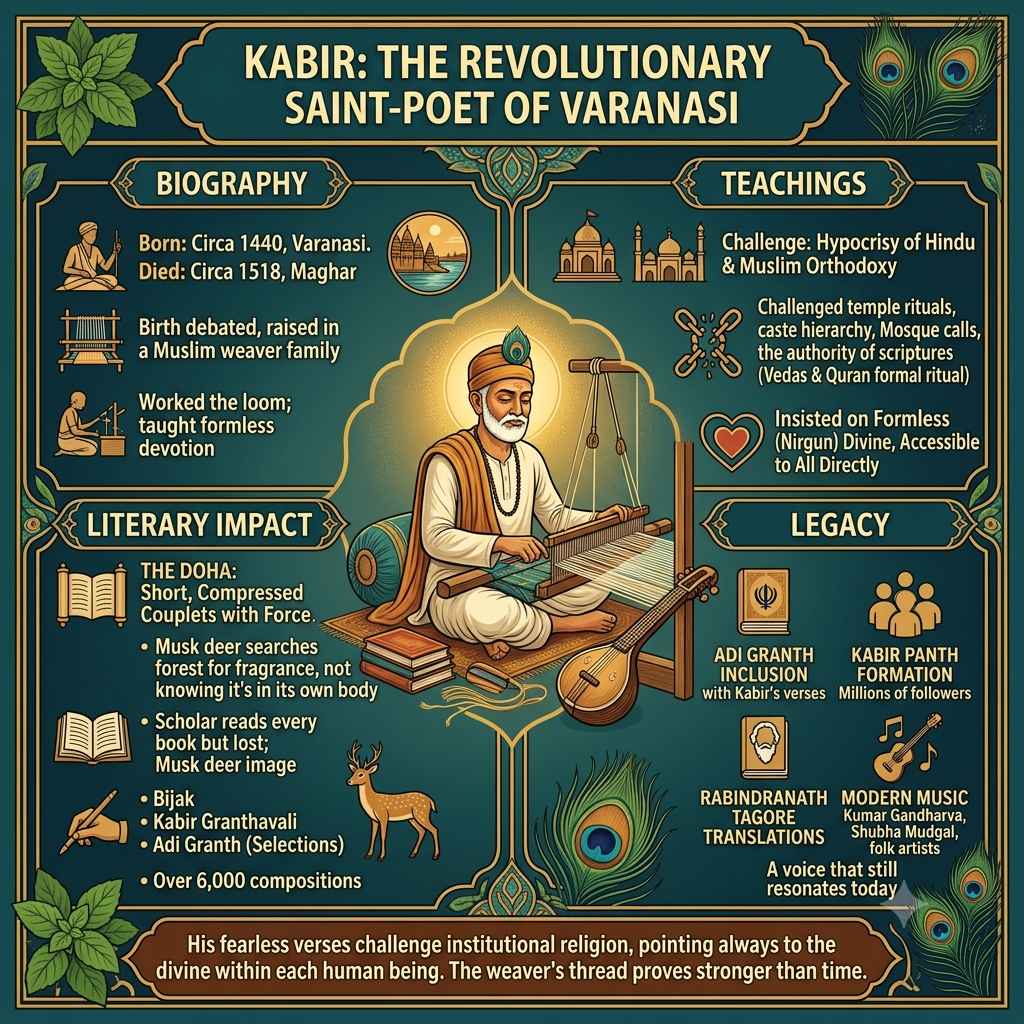
Kabir was a fifteenth-century saint-poet from Varanasi whose dohas, short two-line couplets of extraordinary compression and force, became one of the most disruptive and enduring voices in Indian spiritual and literary history. Born into a Muslim weaver family but claiming no religion as his exclusive home, he composed verses that challenged the hypocrisy of both Hindu Brahminical orthodoxy and Islamic religious formalism with equal fearlessness and equal wit. His insistence on the formless, universal divine accessible directly to every human being without the mediation of priest, ritual, or scripture placed him at the center of the Nirgun Bhakti tradition and made him one of the most quoted, most argued-about, and most genuinely dangerous poets that India has ever produced.| Detail | Information |
| Full Name | Kabir Das |
| Born | Circa 1440, Varanasi (Benares), Uttar Pradesh, India |
| Died | Circa 1518, Maghar, Uttar Pradesh, India |
| Caste Background | Raised in a Muslim weaver family, birth origin disputed |
| Spiritual Guru | Ramananda (disputed but widely accepted in tradition) |
| Deity | Formless divine, Ram as universal consciousness |
| Literary Forms | Doha (couplet), Bhajan, Sakhi, Ramaini |
| Languages | Hindi, Awadhi, Braj Bhasha, Punjabi |
| Collected Works | Bijak, Kabir Granthavali, Adi Granth (selections) |
| Estimated Compositions | Over 6,000 attributed verses |
| Spiritual Tradition | Nirgun Bhakti, Sant Mat |
| Contemporary Of | Mirabai, Guru Nanak, Sikandar Lodi |
The Weaver Who Would Not Be Quiet
Varanasi in the fifteenth century was one of the most intellectually and spiritually charged cities in the world. It was a city of Sanskrit scholars and Brahmin priests, of ancient temples and sacred ghats where the Ganga received the dead with the impartiality that only a river can manage. It was also a city with a large and established Muslim population, and it sat within a political landscape increasingly shaped by the Sultanate in Delhi. The two great religious traditions of the subcontinent lived alongside each other in Varanasi in conditions of occasional violence, more frequent mutual incomprehension, and sometimes, in the margins of official life, genuine exchange.
Kabir was born into this city and its complexity around 1440. The exact circumstances of his birth are disputed and have been disputed since his own lifetime, with different traditions claiming different origins for him, some placing him in a Brahmin family whose infant was adopted by a Muslim weaver couple, others simply accepting him as the child of weavers. Kabir himself seemed largely uninterested in resolving the question, and with good reason. The argument about his birth origin was always really an argument about who owned him, which tradition could legitimately claim him, which community’s hero he was. And that was precisely the kind of argument he spent his life dismantling.
What is established is that he grew up in a family of weavers, that he worked at the loom, that he married and had at least two children, and that he spent his life in Varanasi composing verses and teaching a small but intensely devoted community of followers. He was not a renunciant. He did not go to the forest or the mountain. He stayed at the loom, in the city, in the middle of the world he was describing, and that choice mattered enormously to everything he said.
The Guru Who Should Not Have Taken Him
One of the foundational stories of Kabir’s spiritual formation involves his discipleship under Ramananda, a Brahmin Vaishnava saint who ran an ashram in Varanasi and whose spiritual lineage traced back through the Bhakti tradition. Ramananda was a reformer within his own tradition, but he operated within a framework that had its own social boundaries, and a Muslim weaver presenting himself as a student was not within those boundaries.
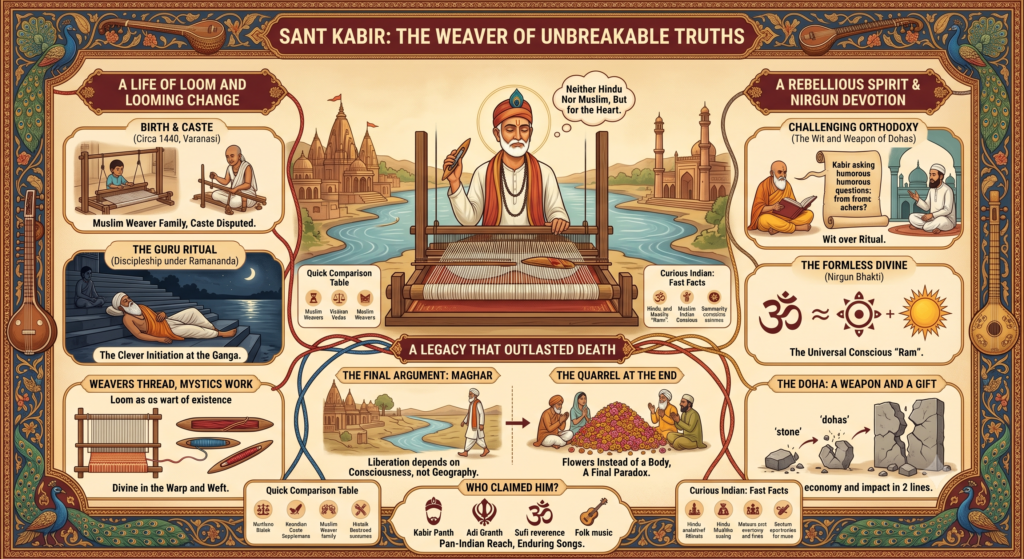
The account that has survived across multiple sources describes Kabir devising a strategy of considerable ingenuity. Knowing that Ramananda descended to the Ganga ghats every morning before dawn for his ritual bath, Kabir went ahead of him in the darkness and lay down on the steps leading to the water. Ramananda, making his way down in the dark, stepped on the body lying across the steps, startled, and instinctively cried out the name of Ram. Kabir rose, touched his feet, and declared that he had received his initiation. He had been given the name of Ram by his guru, which was all he had come for.
Whether this account is historically precise or has been shaped by the tradition’s need for a founding story, it communicates something true about Kabir’s method. He was not interested in receiving what the system was prepared to give. He was interested in the thing the system was supposedly in service of, the direct encounter with the divine, and he was prepared to obtain it by whatever means were available to him, including strategies that the system itself would not have approved.
Ramananda is said to have accepted the discipleship. The Brahmin establishment of Varanasi is said to have been considerably less accepting.
The Deep Melancholia Behind the Comic Genius of Mehmood
Neither Hindu Nor Muslim: The Radical Center
The most consistently shocking thing about Kabir, to both the Hindu and Muslim communities of his time, was his refusal to belong to either of them. He was raised in a Muslim household and was therefore, by the social logic of the time, a Muslim. But he rejected the externalized forms of Islamic practice, the pilgrimage to Mecca, the Friday prayers, the claim that god lived in a particular direction to face during worship, with the same directness he brought to his rejection of Hindu ritual, temple worship, caste hierarchy, and the authority of the Vedas as a complete and sufficient account of the divine.
He composed dohas on both fronts with an equality of wit that left neither tradition a comfortable escape route. He asked the mullah who cried out from the mosque whether god was deaf that he needed to be shouted at. He asked the Brahmin who bathed ritually in the Ganga every morning whether a frog who lived in the river all its life had therefore achieved liberation. He asked the pilgrim who walked to Mecca what had become of the god who was supposed to be right there in the heart. He asked the man who refused to eat with people of other castes whether god had consulted him when deciding which body each soul would be born into.
None of these were gentle questions. They were formulated with the precision of someone who had studied both traditions deeply enough to know exactly where the gap between their stated principles and their practiced realities was widest, and who had decided that pointing at that gap as directly as possible was the most honest service he could offer.
The Nirgun Tradition and the Formless God
Kabir’s theology, if it can be called that, was rooted in the Nirgun Bhakti tradition, the stream of Indian devotional thought that directed its love toward a divine without form, without attributes, without the personal qualities of the gods of the Hindu pantheon or the specific revelatory content of the Quranic god. The divine that Kabir addressed in his verses was not Krishna playing the flute or Allah dictating to a prophet. It was a presence that could be encountered only in the interior of human consciousness, prior to all the names and forms that the traditions had placed upon it.
He called this presence Ram, but he was careful to distinguish his Ram from the Ram of the Ramayana. His Ram was not a king or a warrior or a character in a narrative. His Ram was the name of the nameless, the form of the formless, the most honest word he could find for the reality that existed before words. When he said Ram he meant the ground of being, and he used the name because it was available and familiar, not because it contained an exclusive claim on the divine.
This distinction was important and Kabir made it repeatedly in his compositions, because he knew that his use of Ram could be misread as a Hindu sectarian allegiance, and he was not interested in being claimed by any sectarian position. He belonged, as he said in one of his most famous dohas, to neither the temple nor the mosque. He had located himself in a place that neither institution had a key to, which was precisely the point.
Why the Poetry of Faiz Ahmad Faiz Still Resonates in Modern Protests
The Doha as a Weapon and a Gift
The doha, the two-line couplet that was Kabir’s primary literary form, is one of the most compressed and demanding forms in Indian literature. Each doha must complete a thought, establish a tension, and resolve or deliberately fail to resolve it, in two lines of sixteen and fourteen syllables respectively. The form demands an economy of the highest order. There is no room for qualification, no space for the elaborate contextualizing that more expansive forms permit. Every word must earn its place.
Kabir used the doha with a mastery that has never been exceeded in the Hindi literary tradition. His couplets have the quality of a well-placed stone, small, precisely weighted, and capable of cracking open a much larger structure. They operate through paradox, through unexpected juxtaposition, through the confrontation of the elevated with the ordinary, and through a directness of address that closes the distance between the poet and the reader to almost nothing.
Consider his doha in which he observes that the man who says he knows god has never known god, while the man who says nothing has found him. Or his couplet about the scholar who has read every book but remains as lost as the musk deer that searches the forest for the source of its own fragrance, not knowing that what it seeks is in its own body. These are not decorative observations. They are precise instruments of disruption, designed to dislodge the reader from whatever comfortable position they have settled into regarding their own spiritual life.
The couplets traveled through the oral culture of North India with a speed and penetration that written literature could not have matched. They were short enough to memorize in a single hearing, vivid enough to stay in the memory without effort, and troubling enough to keep working on the mind long after the initial encounter. Kabir understood that the form was itself part of the message. A two-line poem cannot be argued with at length. It can only be sat with, turned over, and eventually either accepted or refused.
The Weavers Thread and the Mystics Work
There is a dimension of Kabir’s life that receives less attention than his theological provocations but that is equally important to understanding him. He was a working man. He wove cloth at a loom every day of his adult life, sold it in the market, fed his family, and lived within the ordinary economic rhythms of a craftsman’s household in a medieval Indian city. He was not supported by patrons or sustained by an institution. His spiritual life and his working life occupied the same body on the same days.
This is reflected in his poetry in ways that go beyond mere metaphor. The loom appears in his verses as a sustained image for the structure of existence, the warp and weft of action and consequence, the shuttle moving back and forth as consciousness moves through experience. The thread appears as the individual soul finding its way through the fabric of the world. The market appears as the space of human transactions where genuine value and false value are constantly being confused. These images are not decorative. They are drawn from the actual texture of the life Kabir was living while he wrote, and they give his verses a material specificity that abstract theological language could never have achieved.
He was saying, through this consistent rootedness in the working world, that the spiritual life was not somewhere else. It was here, in this body, at this loom, in this market, in this city, in this moment. The divine was not waiting at the end of a pilgrimage or behind the door of a properly performed ritual. It was present in the immediate texture of existence, available to anyone who knew how to look.
Why Ismat Chughtai Faced a Trial for Her Fearless Storytelling
The Quarrel at the End: Maghar and the Final Argument
Kabir spent most of his life in Varanasi, but he chose to die in Maghar, a town in eastern Uttar Pradesh, and this choice was itself one of his most pointed acts of theological argument. The belief prevalent in Varanasi in his time, and to some extent continuing into the present, was that dying in the holy city of Varanasi guaranteed liberation, while dying in Maghar resulted in rebirth as a donkey. The belief was used by the religious establishment as a further argument for the superiority of the sacred geography they controlled.
Kabir went to Maghar to die. He composed verses explaining the decision with his characteristic directness. He said that if Varanasi’s geography could liberate and Maghar’s could condemn, then god was in the real estate business, and he wanted no part of a god that operated on those terms. The liberation that was worth having, he argued, had nothing to do with where the body happened to be when it stopped working. It depended entirely on the state of the consciousness inside that body, and no city could substitute for that.
He died in Maghar around 1518. The story that followed his death has become one of the most beloved and frequently told accounts in Indian spiritual literature. His Hindu and Muslim followers fell into immediate dispute over his body, each community claiming the right to perform the last rites according to their own tradition. When they lifted the shroud that had been placed over him, they found not a body but a heap of flowers, which they then divided and buried and cremated according to their respective customs.
Whether received as miracle, legend, or the oral tradition’s way of saying that a man who had refused to belong to either community in life could not be claimed by either in death, the story is perfect. It is exactly the kind of ending Kabir would have written for himself if endings were something a person got to compose.
Who Claimed Him and Who Could Not
The most telling measure of Kabir’s impact is the breadth of the communities that have claimed him across five centuries. His verses appear in the Adi Granth, the sacred scripture of the Sikh tradition, where Guru Arjan Dev included his compositions alongside those of the Sikh Gurus, recognizing in Kabir’s Nirgun theology a direct consonance with Sikhism’s own understanding of the divine. The Kabir Panth, a religious community that formed after his death around his teachings, continues to exist across North India with several million followers. Muslim communities in parts of Uttar Pradesh have maintained traditions of veneration for him as a Sufi-adjacent figure. Hindu communities across the Hindi belt have absorbed his dohas into the fabric of everyday speech, quoting him without always knowing they are quoting him.
No single community has successfully owned him, which is exactly consistent with everything he said. He spent his life arguing that the divine could not be enclosed within any institutional structure, and the subsequent history of attempts to enclose him within one has simply provided further evidence for his position.
The fearless verses are still doing their work. They have not worn out. They have not been answered. They remain, five centuries after a weaver in Varanasi sat down between the warp and the weft and decided that someone needed to say this plainly, as fresh and as awkward and as necessary as the day they were composed.
How R.K. Narayan Built Malgudi From Real Memories
Quick Comparison Table
| Aspect | Kabir | Ravidas | Tukaram |
| Era | 15th to 16th century | 15th to 16th century | 17th century |
| Region | Varanasi, Uttar Pradesh | Varanasi, Uttar Pradesh | Dehu, Maharashtra |
| Caste Background | Muslim weaver family | Chamar community (cobbler caste) | Kunbi Shudra trader |
| Primary Form | Doha, Sakhi, Bhajan | Pad, Bhajan | Abhanga |
| Language | Hindi, Awadhi, Braj Bhasha | Braj Bhasha, Hindi | Marathi |
| Theological Approach | Nirgun, formless divine | Nirgun with social justice emphasis | Sagun, personal Vitthal devotion |
| Primary Challenge | Both Hindu and Muslim orthodoxy equally | Caste untouchability and Brahminical exclusion | Caste in devotional access, orthodox Brahmin authority |
| Institutional Legacy | Kabir Panth, Adi Granth, oral tradition | Ravidasi tradition, Dera Sachkhand | Varkari sampradaya, Gatha of Tukaram |
Curious Indian: Fast Facts
- Kabir’s name is an Arabic word meaning the great one, an irony he would almost certainly have appreciated given his lifelong suspicion of any claim to greatness, including his own.
- His compositions appear in the Adi Granth, the sacred scripture of the Sikh tradition, making him one of the very few non-Sikh saints whose verses are included in Sikhism’s most sacred text.
- The Bijak, the primary collection of Kabir’s verses maintained by the Kabir Panth, is considered one of the oldest surviving manuscripts of his work and is treated as a sacred object within the Panth’s devotional practice.
- Kabir’s decision to die in Maghar rather than Varanasi was a deliberate act of theological argument against the belief that liberation depended on the geography of death rather than the quality of consciousness in life.
- The story of his disappearing body at death, replaced by flowers that his Hindu and Muslim followers divided between them, has been told continuously for five centuries and appears in sources from multiple independent traditions, suggesting it reflects early and widespread belief rather than a later invention.
- Hazari Prasad Dwivedi, one of the greatest scholars of Hindi literature in the twentieth century, described Kabir as the most original and the most dangerous mind in the entire tradition of Hindi Bhakti poetry.
- Guru Nanak, the founder of Sikhism, is believed to have been significantly influenced by Kabir’s Nirgun theology, and scholars have identified direct conceptual connections between Kabir’s understanding of the formless divine and the foundational theology of the Sikh faith.
- Rabindranath Tagore translated one hundred of Kabir’s poems into English in 1915, published by Macmillan with an introduction by Evelyn Underhill, introducing the weaver from Varanasi to a global literary audience for the first time.
- The Indian musicologist and scholar Purushottam Das Tandon documented in the early twentieth century that Kabir’s dohas were among the most widely memorized and quoted literary texts in rural North India, present in the speech of people who had never attended a school or read a book.
- Contemporary musicians including Kumar Gandharva in classical Hindustani music and more recently Shubha Mudgal and various folk artists have kept Kabir’s compositions in active performance, ensuring that his verses continue to circulate as living music rather than archival texts.
Conclusion
Kabir’s fearlessness was not the fearlessness of someone who had nothing to lose. He had a family, a livelihood, a community, and a city that could turn hostile. He had religious establishments on both sides of him that had demonstrated across centuries their capacity for managing difficult people. He was not protected by royal patronage or institutional authority. He had, as far as the social world around him was concerned, very little standing from which to say what he was saying.
He said it anyway, and he said it in the sharpest possible form, which was the two-line couplet that gave you no room to misunderstand and no comfortable middle ground to stand on while you decided how to respond. You either accepted what he was pointing at or you refused it, but you could not pretend you had not heard it, and you could not claim it was too complicated to follow.
That particular combination, complete clarity of vision, complete economy of expression, and complete indifference to the social consequences of saying the thing plainly, is what separates Kabir from most of the other voices in the tradition he inhabited. He was not the most theologically systematic. He was not the most institutionally productive. He left no organization, no formal lineage, no ashram. He left verses.
Those verses have been doing the work he set them to do for five centuries and show no signs of stopping. They have outlasted the religious establishments he challenged, the political structures that surrounded him, and the social conventions he refused. They have been claimed by Hindus, Muslims, and Sikhs, quoted by reformers, saints, and ordinary people in the middle of ordinary conversations, and translated into dozens of languages for audiences that have never heard of Varanasi or the looms of the fifteenth century.
The weaver’s thread, it turns out, was stronger than anyone at the time had reason to expect.
How Baba Farid Wove Spiritual Truths Into Early Punjabi Literature
If you think you have remembered everything about this topic take this QUIZ
This quiz no longer existsWho was Kabir and what tradition does he belong to?
Kabir was a fifteenth-century saint-poet born around 1440 in Varanasi who belongs to the Nirgun Bhakti tradition of North Indian devotional poetry. Nirgun means without qualities or attributes, referring to the theological position that the divine is formless and cannot be captured by any specific image, narrative, or institutional structure. Within this broader tradition, Kabir is the central and most radical voice, the one who pursued the implications of Nirgun theology most consistently and most fearlessly into their social and institutional consequences. He is claimed by multiple religious communities including the Kabir Panth, which formed around his teachings after his death, the Sikh tradition, which includes his compositions in the Adi Granth, and various streams of North Indian folk religious life that have preserved and transmitted his verses through oral performance across five centuries.
How did Kabir challenge both Hindu and Muslim religious orthodoxy?
Kabir challenged Hindu orthodoxy by rejecting caste hierarchy as spiritually valid, mocking the ritual practices of Brahminical religion including idol worship, pilgrimage, and sacred bathing, denying the authority of the Vedas and the Puranas as sufficient guides to the divine, and insisting that the god worshipped in temples was no more present there than anywhere else. He challenged Muslim orthodoxy with equal directness by rejecting the special authority of the mosque and the mullah, questioning the spiritual logic of pilgrimage to Mecca, and arguing that the god described in the Quran was not contained within any book or any direction of prayer. He applied the same standard to both traditions, asking whether the stated purpose of each, the encounter with the divine, was actually being achieved by the practices each prescribed, and consistently finding the answer to be no.
What makes Kabir’s dohas so effective as a literary and spiritual form?
The doha’s effectiveness in Kabir’s hands comes from the combination of extreme compression with extreme directness. A doha contains two lines, each metrically precise, and must complete a thought within that space without qualification or elaboration. This compression means that every word carries maximum weight and that the poem cannot hide behind complexity or contextual qualification. Kabir used this formal constraint to create verses that operated as precise instruments of disruption, designed to dislodge the reader from comfortable positions regarding religion, caste, spiritual practice, and the nature of the self. The doha’s brevity also made it memorizable in a single hearing, which allowed Kabir’s ideas to travel through the largely oral culture of fifteenth-century North India with a speed and penetration that longer written works could not have achieved.
What is the significance of Kabir’s death in Maghar?
Kabir’s decision to die in Maghar rather than Varanasi was a deliberate act of theological argument against one of the most deeply held religious beliefs of his time and place. The belief that dying in Varanasi guaranteed liberation while dying elsewhere, and specifically in Maghar, resulted in unfavorable rebirth was used by the religious establishment to reinforce the sacred status of the city and, by extension, their own authority as custodians of its sacred geography. By choosing to die in Maghar, Kabir was making the argument in the most unambiguous way available to him that liberation was a matter of the quality of consciousness rather than the geography of death, and that a god who operated on the basis of real estate was not a god worth taking seriously. The story of the flowers found beneath his shroud after his followers’ dispute over his body completed the argument by suggesting that a man who had refused to be owned by any community in life could not be owned by any in death.
How has Kabir’s legacy survived and evolved across five centuries?
Kabir’s legacy has survived through multiple channels simultaneously, which is itself a reflection of his refusal to belong exclusively to any single tradition. His verses entered the Adi Granth during the compilation by Guru Arjan Dev in 1604, ensuring their preservation within the Sikh scriptural tradition and their continued use in Sikh devotional practice. The Kabir Panth, formed after his death around his teaching community, has maintained a continuous institutional presence across North India with several million followers who treat his compositions as sacred texts. His dohas entered the oral tradition of North Indian folk culture and have been transmitted through everyday speech for centuries, present in the language of people who may not know they are quoting him. In the twentieth century, scholarly attention from figures like Hazari Prasad Dwivedi and international attention through Rabindranath Tagore’s English translations brought him into the modern literary canon. And his verses continue to circulate through contemporary music in classical, folk, and fusion performances that introduce him to new audiences in forms appropriate to each era.