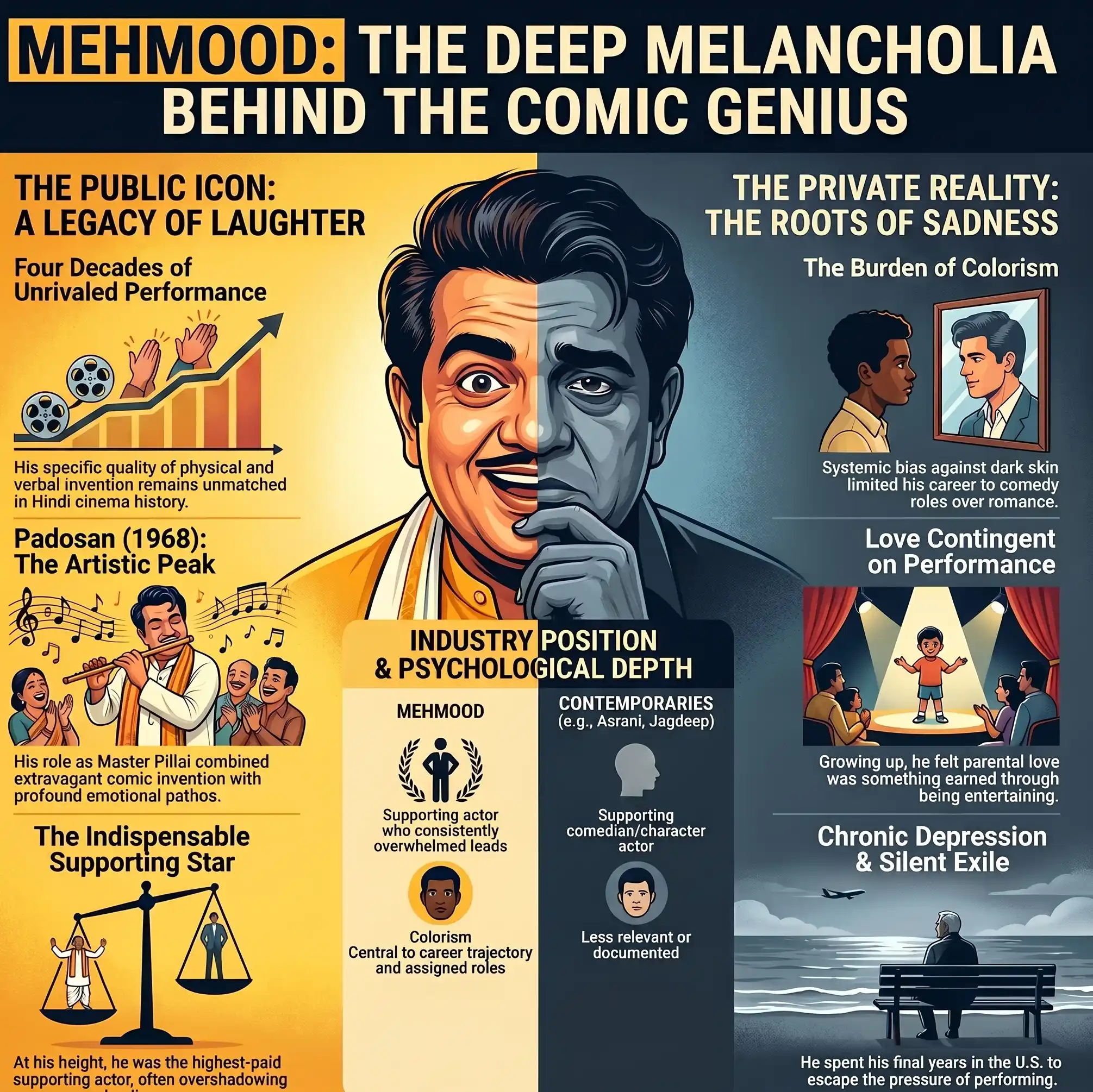
Mehmood Ali, known simply as Mehmood, was the most celebrated comedian in the history of Hindi cinema, whose four decades of film work produced a body of comic performance that has never been equalled in the tradition. Born in 1932 into a family of performers, he experienced genuine poverty, racial anxiety about his dark complexion in a film industry that prized fair skin, a complex relationship with his enormously talented father, and a lifelong psychological fragility that expressed itself through depression, compulsive generosity, self-destructive professional decisions, and an eventual self-imposed exile to the United States where he died in 2004. The melancholia that ran beneath his comic surface was not separate from his genius but constitutive of it, the specific emotional depth that his comedy drew on and that gave his best performances their quality of feeling simultaneously funny and genuinely sad. His story is the story of what the entertainment industry does to the people who make it possible, and what it costs a human being to spend a lifetime making other people laugh.| Detail | Information |
| Full Name | Mehmood Ali |
| Born | 29 September 1932, Mumbai, Bombay Presidency, British India |
| Died | 23 July 2004, Pennsauken, New Jersey, United States |
| Nationality | Indian |
| Profession | Actor, comedian, director, producer, singer |
| Active Years | 1943 to 2000 |
| Most Famous Films | Padosan 1968, Gumnaam 1965, Bombay to Goa 1972, Pyar Kiye Jaa 1966, Do Phool 1974 |
| Father | Mumtaz Ali, comedian and dancer |
| Siblings | Anwar Ali, comedian, and others |
| Known Associates | Kishore Kumar, Sunil Dutt, Rajendra Kumar |
| Awards | Filmfare Award for Best Supporting Actor multiple times |
| Directorial Work | Bhoot Bangla 1965, Kunwara Baap 1974 |
| Personal Struggles | Documented depression, health issues, self-imposed exile to United States in later years |
| Legacy | Considered the greatest comedian in Hindi film history |
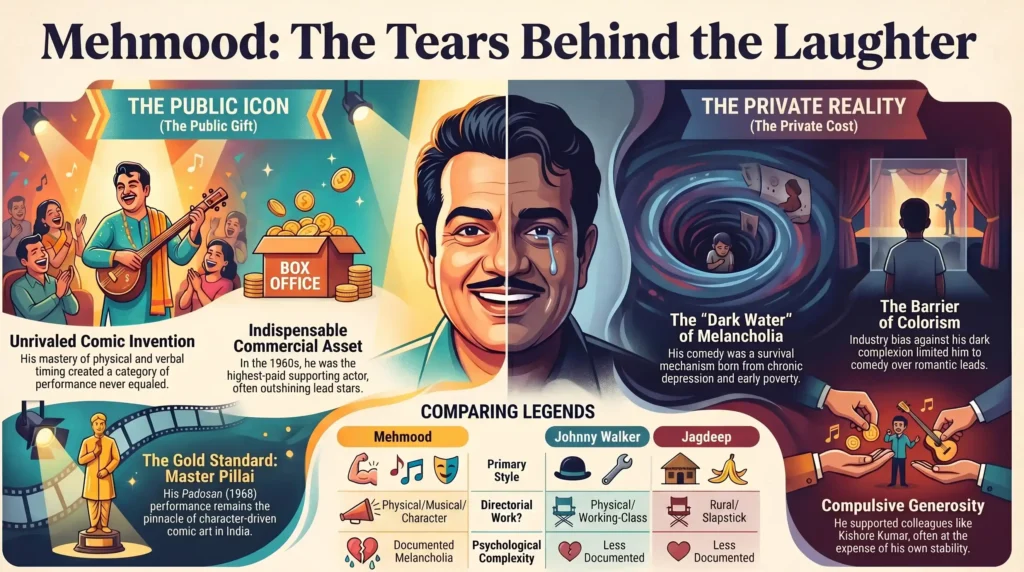
The Deep Melancholia Behind the Comic Genius of Mehmood
The greatest joke that Mehmood ever told was his career. Not because his career was a joke, but because the entire arc of it, the poverty, the struggle, the sudden astonishing success, the generosity that gave everything away, the depression that no amount of success could reach, and the final exile to a country where nobody knew his name and nobody needed him to be funny anymore, followed the structure of the best comedy: the setup that goes on too long, the punchline that arrives when you are no longer expecting it, and the aftertaste that is not quite what you thought you were going to feel.
He was born on 29 September 1932 in Bombay into a family that performed for a living and frequently did not eat as a result. His father, Mumtaz Ali, was a comedian and dancer of some reputation in the film industry of the 1930s and 1940s, a man of genuine talent who could never quite convert talent into stability, whose career moved in the unpredictable rhythms of an industry that has always treated its creative workers as interchangeable and disposable. The household that Mehmood grew up in was one where art was the primary currency and material security was a recurring absence.
This combination, the presence of art and the absence of security, does something specific to the children who grow up inside it. It teaches them that performance is the medium through which love and survival are connected, that being entertaining is not a choice or a profession but a necessity, that the gap between making people laugh and being fed is uncomfortably narrow. Mehmood absorbed this lesson so completely that it became invisible to him as a lesson and simply became the way things were.
He spent the rest of his life performing to fill that gap. The audiences who laughed never knew they were also feeding him.
The Fearless Verses of Kabir That Challenged Orthodox Society
The Dark Skin in the Fair Industry
There is a specific humiliation available in the Hindi film industry of the 1950s and 1960s that Mehmood experienced with a consistency and a depth that shaped his psychological life in ways that his comedy both expressed and obscured.
He was dark. In an industry that prized fair skin with a thoroughness that reflected and reinforced the broader colorism of Indian society, and that reserved its leading roles, its romantic narratives, and its primary emotional investments for actors whose complexion placed them closer to a colonial aesthetic of desirability that the post-independence film industry had inherited without examination, Mehmood’s dark complexion marked him from the beginning as someone for whom certain possibilities were not available.
The comedy roles that became his primary currency in the industry were not simply professional choices. They were also the specific territory that the industry assigned to dark-skinned performers, the territory where appearance could be used for laughs rather than for romantic aspiration, where the body that did not conform to the industry’s dominant aesthetic could be deployed for entertainment rather than desire.
Mehmood understood this. He understood it with the clarity that people who experience systemic discrimination understand it, not as an abstract analysis but as the lived texture of daily professional experience, of the roles offered and the roles withheld, of the way that his talent was acknowledged and simultaneously contained within the category that his appearance had been assigned to.
What he did with this understanding was complicated and brilliant and ultimately tragic. He took the category that the industry had assigned him and he made it so completely his own, so extraordinary in its execution, so far beyond what anyone had previously imagined the category could contain, that the industry found itself in the position of depending on him in a way it had never intended to depend on a dark-skinned performer in a comedy role.
He became indispensable. And he remained underpaid, underrespected, and ultimately discardable in the way that the industry has always discarded the people it cannot do without until it finds it can.
The genius was real. The melancholia was also real. And the connection between them was the specific psychological wound of a man who had been told, in the most concrete professional terms available, that his particular kind of being in the world was funny rather than beautiful, entertaining rather than desirable, useful rather than valued.
The Father Question
No account of the melancholia behind Mehmood’s comic genius is honest without confronting the relationship between Mehmood and his father, Mumtaz Ali, because that relationship is the origin point of almost everything that followed in Mehmood’s psychological and professional life.
Mumtaz Ali was a talented man who did not achieve what his talent warranted, and the gap between his talent and his achievement was one that he carried with a weight that expressed itself, as such weights often do, through his relationships with his children. Mehmood was simultaneously his father’s son, in the most literal professional sense, inheriting the performance tradition and the industry connections that his father’s career had established, and his father’s rival, growing into a talent and eventually a success that exceeded his father’s own achievements in ways that the relationship between them never fully metabolised.
The accounts of Mehmood’s childhood that survive in the biographical record, including the accounts he gave in his own interviews and the recollections of family members and colleagues documented in various sources, describe a household in which love and its withdrawal were connected to performance and its reception in ways that left Mehmood perpetually uncertain about the relationship between being entertaining and being loved.
If his father’s approval was contingent on his performance, if love in his childhood household was something that had to be earned through being funny or talented or useful rather than simply being present as a given, then the need to perform for approval would have been established so deeply and so early that no amount of subsequent professional success could dislodge it. The applause that the film industry gave him was the applause he had been seeking from his father, and the film industry’s applause, like his father’s approval, was always conditional, always potentially withheld, always dependent on the next performance being as good as or better than the last.
This is the psychological structure of certain forms of depression that express themselves through performance, in which the performer is compelled to generate the approval of audiences as a substitute for a more fundamental approval that was never securely established, and in which the applause is never quite enough because it is being asked to fill a space that applause was not designed to fill.
Mehmood was a great comedian. He was also a man who needed his audiences in a way that great comedians sometimes do and that is both the source of their greatness and the source of their suffering. The need to make people laugh was, for him, not simply a professional orientation. It was an existential requirement. And existential requirements, when they are met through professional performance, are permanently precarious, because the performance can always fail, the audience can always withhold its laughter, and when it does, there is nothing behind the performance to fall back on.
The Body That Performed
Mehmood’s comedy was primarily physical in a way that distinguished him from most of his contemporaries in Hindi cinema and that requires specific attention because the body he performed with was doing several things simultaneously.
The physical comedy of Mehmood, his rubber-faced expressiveness, his extraordinary command of gesture and posture, his ability to transform his entire body into the instrument of a single comic idea with a completeness that made the transformation look effortless, was in the technical sense the product of years of training, observation, and the specific kind of intelligence that finds its primary expression through the body rather than through language.
It was also, in a psychological sense, the deployment of a body that had been told it was not beautiful in the industry’s dominant aesthetic as a tool for producing a different kind of value than beauty produces. The dark complexion, the features that did not conform to the Bollywood romantic hero template, the specific physical presence that the industry had assigned to the comedy category, were the raw material from which Mehmood constructed his art.
There is a particular kind of creative transformation in which a person takes the features of their life that have been presented to them as limitations or deficiencies and converts them, through the alchemy of genuine talent, into the specific source of their power. Mehmood did this with his body. The face that the industry’s colorism told him was not a romantic hero’s face became the face that could express more comic range than any face in Hindi cinema before or since. The body that was not a leading man’s body became the body that could carry a film on its own, generate more audience response than any leading man sharing the screen with it, and leave an impression that outlasted the film’s storyline in the memory of everyone who saw it.
This transformation is genuinely extraordinary. It is also the specific kind of transformation that costs something, that requires a person to find a way to love and use the aspects of themselves that the world has told them are deficiencies, and that always carries within it the knowledge that the deficiency was named by others rather than discovered as a fact.
The laughter that Mehmood generated was real. The wound from which it came was also real. The two were not separate phenomena. They were the same phenomenon seen from different angles.
The Compassionate Teachings of Sant Tukaram in Maharashtra
Padosan and the Peak
If there is a single film that captures Mehmood at the full height of his powers, it is Padosan from 1968, directed by Jyoti Swaroop, in which Mehmood plays Master Pillai, a South Indian music teacher who becomes the rival of the film’s protagonist for the affections of the girl next door. The performance is one of the finest comic performances in the history of Hindi cinema by any objective measure, a sustained demonstration of physical, verbal, and musical invention that shows every dimension of Mehmood’s talent at its most refined and most assured.
What is less frequently noted about the Padosan performance is what it contains beneath its surface comedy. Master Pillai is a figure of considerable pathos, a man of genuine talent and genuine love whose structural position in the film’s narrative ensures that his love cannot be reciprocated and that his talent, while acknowledged, will always be in the service of someone else’s story rather than his own. He is the supporting character who is more interesting than the protagonist, the comic figure who is more emotionally alive than the romantic lead, the dark-skinned South Indian in a film whose romantic conclusion belongs to the fair-skinned North Indian hero.
The film does not make this subtext explicit. It does not need to, because the subtext is the lived experience of the man performing it, and the performance carries it in every frame without announcing it. The specific quality of Mehmood’s Padosan performance, its combination of extravagant comic invention and something underneath the comedy that feels like genuine feeling contained within the comedy rather than separate from it, is the quality that separates it from mere skilled comic acting and places it in the category of art.
Great comedy always contains pathos. The funniest moments are the ones that are also slightly sad. The audience’s laughter at Mehmood’s Master Pillai is inseparable from an awareness, not always conscious, that the figure they are laughing at is also somehow more alive, more real, more fully present in the film than the figures they are supposed to be rooting for. That awareness is the specific gift of a performer who is not pretending to feel something but drawing on what he actually feels and converting it, through the alchemy of his craft, into something that everyone in the audience can recognise without having to understand where it came from.
The Kishore Kumar Friendship
The relationship between Mehmood and Kishore Kumar is one of the great friendships in the history of Hindi cinema, and it illuminates something important about both men that neither fully expressed in their public personas.
Kishore Kumar was, like Mehmood, a performer of enormous natural gifts who was simultaneously celebrated and undervalued by the industry, who used his considerable talent as a defence against the world as much as an offering to it, and who had a complex and often difficult relationship with the mainstream of the industry that employed him. Like Mehmood, he had a private interior life that was considerably more troubled than his public persona as an irrepressible eccentric suggested.
The two men recognised in each other something that their respective public performances obscured, the specific combination of exceptional talent, genuine psychological fragility, and a relationship with performance that was both vocation and defence. Their friendship was one of those rare connections between people who do not need to explain themselves to each other because they are already understood, and it provided both of them with a kind of private space for authentic expression that their professional lives, with their constant demands for performance and approval, did not offer.
Mehmood’s relationship with Kishore Kumar also had a professional dimension that revealed something important about Mehmood’s generosity and its psychological roots. He was instrumental in the revival of Kishore Kumar’s singing career at a point when Kishore had been largely sidelined by the industry, using his own influence to insist that Kishore’s voice be used for songs in films that he was associated with. This generosity was genuine. It was also the generosity of a man who understood from his own experience what it means to have talent that the industry is not interested in using, and who had the specific kind of empathy that comes from shared experience rather than from abstract compassion.
Mehmood’s generosity was legendary in the film industry and was simultaneously one of his most admirable qualities and one of the sources of his eventual financial difficulty. He gave money, roles, opportunities, and personal support to a degree that was not sustainable and that reflected the psychological dynamic of a man for whom generosity was connected to the need for approval in ways that made it difficult to distinguish between genuine gift and unconscious purchase of affection.
The Depression Nobody Talked About
The Hindi film industry of the 1950s, 1960s, and 1970s did not have a vocabulary for mental health. It had success and failure, sobriety and drinking, health and breakdown, but the specific language of depression, of the chronic low-grade sadness that does not prevent functioning but colours everything it touches with a quality of pointlessness that no amount of external success can dispel, was not available in the cultural vocabulary of the industry or of the broader Indian society that produced it.
Mehmood was depressed. Not occasionally, not as a response to specific setbacks, but chronically, in the manner of people whose psychological landscape has a persistent weather pattern of grey that brightens temporarily under certain conditions and then returns when those conditions pass. The accounts of those who were close to him across different periods of his life describe a man who was wonderful company when he was up, when his considerable charm and warmth and intelligence and generosity were fully available, and who was genuinely difficult to be around when the depression was active, withdrawing into a silence and an irritability that contrasted sharply with the public persona and that left those around him uncertain about what they were supposed to do.
The depression expressed itself through several patterns that are recognisable in retrospect. The compulsive generosity that gave away more than he could afford was partly a symptom, the need to purchase the warmth of others through material gesture when the interior flatness of the depressive state made genuine connection feel impossible. The self-destructive professional decisions, the missed opportunities, the films turned down and the films accepted for reasons that did not serve his career, were partly the expression of a man whose sense of his own worth was not reliably stable enough to make consistently good decisions in his own interest.
The health issues that increasingly troubled his later career were both causes and symptoms of the psychological difficulties, the body expressing what the public performance could not. And the eventual decision to leave India entirely, to go to the United States where he was not Mehmood the great comedian but simply a private individual who did not owe anyone a performance, was the most direct expression of the exhaustion that the lifetime of performing had produced.
He had made India laugh for forty years. He was tired. He went somewhere nobody expected him to be funny. He died there in 2004, at the age of seventy-one, of heart failure, which is one way of describing what happened and not the most complete way.
How Bulleh Shah’s Poetry Transformed the Sufi World of Punjab
The Industry That Used Him
The Hindi film industry’s relationship with Mehmood was one of the more honest illustrations of how the entertainment industry relates to its most talented performers, which is to say with a combination of genuine appreciation, systematic exploitation, and the particular amnesia that commercial industries develop toward those who have served their purpose.
At the height of his career in the 1960s, Mehmood was simultaneously the highest-paid supporting actor in Hindi cinema and significantly underpaid relative to the value he was generating for the films he appeared in. His presence in a film was a significant commercial asset, capable of drawing audiences whose primary interest was seeing him rather than the nominal stars of the production, and this value was acknowledged in the industry’s discourse about him while being systematically underreflected in the compensation he received.
The specific dynamic through which talented performers from marginalised positions within an industry find themselves generating more value than they receive is not unique to Mehmood or to Hindi cinema. It is a structural feature of commercial entertainment industries that is connected to the same colorism and class dynamics that shaped Mehmood’s early career. The performers who are assigned to the category of support rather than lead, who are told their role is to enhance the films of others rather than to be the primary object of the audience’s investment, are consistently compensated at a level that reflects their assigned category rather than their actual contribution.
Mehmood challenged this categorisation, not through explicit protest but through the sheer quality of his performances, which consistently overwhelmed the category they were placed in. The problem with overwhelmingly the category rather than explicitly challenging it is that the industry can acknowledge the performance while maintaining the category, can applaud the comedian while keeping the comedian in the comedy slot, can use the talent while denying the talent the conditions that would allow it to fully define its own terms.
He directed films. Bhoot Bangla in 1965 demonstrated a directorial sensibility of genuine originality. Kunwara Baap in 1974 showed a filmmaker capable of combining comedy with genuine emotional depth in ways that the critical discourse of the time was not adequately equipped to appreciate. These directorial efforts were acknowledged without being fully valued, received without being fully understood, and ultimately absorbed into the category of Mehmood the comedian without expanding the industry’s or the critical discourse’s understanding of what Mehmood was capable of.
The Comedy That Came From Somewhere Real
There is a question that the best comedy always raises and that is almost never asked directly: where does this come from? Not in the biographical sense of what experiences produced this performer, but in the more immediate and more difficult sense of what interior resource is being accessed in the moment when the comedy is happening.
For performers whose comedy is primarily technical, the answer is craft and intelligence, the accumulated knowledge of what works and the ability to deploy it with precision. This is genuine and valuable, but it is not what explains the specific quality of Mehmood’s best performances.
What explains the specific quality of Mehmood’s best performances is the access they demonstrate to genuine feeling, not feeling performed or feeling implied but feeling actually present in the performance in a way that gives the comedy its specific weight. The reason that the audience laughs at Mehmood in a way that is slightly different from the way they laugh at a purely technical comedian is that they are recognising something real in what he is showing them, something that corresponds to their own experience of the world in ways that the technically excellent but emotionally thin performance does not quite reach.
That something real was melancholia. The depression. The specific experience of a man who had spent his life performing to fill a gap that performance could not fill, who had learned to be funny as a survival mechanism before he understood it as a vocation, who carried within his comedy a genuine knowledge of what it feels like to need approval, to fear withdrawal of love, to navigate a world that assigns your worth by your appearance and then claims to value you for your talent.
This knowledge gave his comedy a specific texture, a quality of recognition that the audience experienced without always being able to articulate what they were recognising. It is the texture of comedy that knows what it is making light of, that holds the darkness it is illuminating within the illumination itself, that laughs without pretending there is nothing to cry about.
The genuinely funny comedian is always also the person who understands why the situation is not funny, whose comedy is the specific response to a specific pain, whose laughter is not the absence of sadness but its transformation into something that can be shared and therefore made, temporarily, bearable.
Mehmood understood this better than anyone who has worked in Hindi cinema before or since. He understood it because he lived it. Every performance was a conversion of private sadness into public laughter, a transformation that enriched everyone who witnessed it and cost the person who performed it in ways that accumulated across forty years into the exhaustion that eventually sent him to New Jersey to die among people who had no idea he was supposed to be funny.
The Exile and the Silence
The decision to leave India in his later years and live in the United States was not announced as a breakdown or a retreat or a giving up. It was presented, to the extent that it was presented at all, as a private choice by a private individual who had given what he had to give and was entitled to live out his remaining years in whatever manner he chose.
This framing was accurate and insufficient simultaneously. It was accurate because Mehmood was indeed entitled to whatever peace he could find. It was insufficient because it did not acknowledge what the choice represented: the exhaustion of a performer who had spent four decades giving his most intimate and most painful psychological material to an audience that had consumed it gratefully without understanding what it was consuming, and who had reached the point where the giving was no longer possible.
The silence of the final years in America was not the silence of contentment. It was the silence of a man who had performed his entire life and had finally stopped, not because the performance was complete but because the performer was done. The distinction matters. A performance that is complete leaves its audience feeling that something has been finished, resolved, brought to its proper conclusion. A performer who is done leaves a different feeling, the feeling of something interrupted, of a conversation that stopped before it reached the thing it was most trying to say.
Mehmood did not get to say the thing he was most trying to say. Hindi cinema, which owed him an attention and a seriousness that it never provided, did not create the conditions in which that thing could be said. He was the comedian. The comedian makes you laugh. The laughter was real. What was underneath it was real too. The industry was only interested in the laughter.
He died on 23 July 2004 in Pennsauken, New Jersey. He was seventy-one years old. The heart that had made India laugh for forty years had run out of whatever it was running on.
The obituaries were warm. They celebrated the comedian. They described the performances. They quoted the laughter.
They did not say what the laughter was hiding. They did not know, because he had hidden it so well and for so long that the hiding had become the performance and the performance had become the man and the man had become the laughter until there was nothing left that was not performing.
Except at the end, in New Jersey, when there was no audience and no camera and no one waiting for the next funny thing, there was whatever was left when the performance finally stopped. Whether that was peace or simply absence is a question that the historical record cannot answer and that Mehmood, characteristically, did not answer for anyone before he left.
The Musical Revolution of Chaitanya Mahaprabhu in Medieval India
What Hindi Cinema Lost and What It Never Understood
The loss of Mehmood to Hindi cinema was not primarily the loss of a performer, though that loss was real and has not been adequately filled in the two decades since his death. The loss was the failure of the opportunity he represented, the opportunity to understand what the greatest comic performer in the tradition’s history was actually doing and why, and to build on that understanding rather than simply consuming the performances and moving on.
Hindi cinema has produced competent comedians since Mehmood. It has produced performers who can make audiences laugh with efficiency and skill. It has not produced another performer who can make an audience laugh in the specific way that Mehmood made them laugh, with the quality of genuine feeling beneath the comedy that gave his performances their specific and irreplaceable weight.
The reason it has not is partly that the specific combination of talent, training, and psychological experience that produced Mehmood is unlikely to be replicated in exactly that form. But it is also partly because the industry did not understand what it had when it had it and therefore could not understand what it was looking for when it was gone.
The melancholia behind the comic genius was not a biographical detail about a performer. It was the source of the genre’s highest achievement in the Hindi cinema tradition. Understanding it as such would require the industry and its critics to take seriously the proposition that the greatest comedy comes from genuine pain, that making people laugh is one of the most psychologically demanding and personally costly things a human being can do, and that the performers who do it best deserve something considerably more than the applause they get and the exploitation that follows.
Mehmood deserved that understanding. He did not receive it. He received the applause, the exploitation, and the amnesia. He received the laughter of the nation he had spent his life entertaining, and he gave back the performances that the laughter demanded, and he did this for forty years and then he stopped, and India barely noticed when he stopped because it had already moved on to whatever the next funny thing was.
He was the funniest person Hindi cinema has ever produced. He was also one of the saddest. The two facts are not separate. They are the same. Understanding that is the beginning of understanding what Mehmood actually was and what he actually gave, and what it cost him to give it.
Quick Comparison Table
| Dimension | Mehmood | Johnny Walker | Asrani | Jagdeep |
| Birth Year | 1932 | 1926 | 1941 | 1939 |
| Primary Style | Physical, verbal, musical, character comedy | Physical comedy, working-class characters | Comic villain, slapstick, character roles | Rural character comedy, slapstick |
| Industry Position | Supporting actor who consistently overwhelmed leads | Supporting comedian, occasional lead | Supporting comedian, character actor | Supporting comedian, character actor |
| Most Famous Film | Padosan 1968 | Pyaasa 1957 as comic relief | Sholay 1975 as Jailer | Sholay 1975 as Soorma Bhopali |
| Directorial Work | Yes, Bhoot Bangla 1965, Kunwara Baap 1974 | No | No | No |
| Colorism Experience | Documented, central to career trajectory | Present, less documented | Less relevant | Less relevant |
| Psychological Complexity | Documented depression, documented melancholia | Less documented | Less documented | Less documented |
| Legacy Status | Considered greatest Hindi film comedian | Celebrated, less studied | Celebrated character actor | Celebrated character actor |
Curious Indian: Fast Facts
- Mehmood was born on 29 September 1932 in Bombay into a family of performers, his father Mumtaz Ali being a comedian and dancer in the Hindi film industry of the 1930s, making him a second-generation film industry figure who inherited both the professional connections and the economic precarity of his father’s career.
- He began his film career as a child actor, appearing in films as early as 1943, before the age of eleven, in small roles that gave him his earliest experience of performing for audiences and of the specific relationship between performance and belonging that would define his psychological life.
- At the height of his career in the 1960s, Mehmood was simultaneously the most popular supporting actor in Hindi cinema and frequently received higher billing and more audience attention than the nominal leading actors of the films he appeared in, a situation that illuminated the gap between his assigned professional category and his actual commercial and creative contribution.
- His performance as Master Pillai in Padosan in 1968 is considered by film scholars and critics including those whose work is published through journals covering South Asian cinema to be among the finest individual comic performances in the history of Hindi cinema, demonstrating a range of physical, verbal, and musical invention that has not been equalled in the tradition.
- Mehmood was instrumental in the revival of Kishore Kumar’s singing career at a crucial point when the industry had largely sidelined Kumar, using his own influence and professional relationships to insist on Kumar’s voice being used for songs in productions he was associated with, a gesture of generosity that reflected both genuine friendship and the empathy of a man who understood marginalisation from the inside.
- He directed Bhoot Bangla in 1965 and Kunwara Baap in 1974, two films that demonstrated a directorial sensibility of genuine originality and that showed a filmmaker capable of working in the space between comedy and genuine emotional complexity in ways that the critical discourse of the time was not adequately equipped to appreciate.
- The compulsive generosity that characterised Mehmood’s personal and professional relationships, his willingness to give money, roles, and support to an extent that significantly exceeded what was financially sustainable for him, was understood by those close to him as connected to his psychological difficulties, the specific pattern of a man who used generosity as a mechanism for managing the anxiety of uncertain belonging.
- His decision to leave India in his later years and live in the United States, where he was an unknown private individual rather than the country’s most celebrated comedian, was described by those who knew him as an expression of exhaustion rather than contentment, the response of a man who had performed for audiences his entire life and had finally reached the point where the performance was no longer possible.
- Mehmood died on 23 July 2004 in Pennsauken, New Jersey, at the age of seventy-one, of heart failure, with a relatively modest public response in India that contrasted sharply with the scale of his contribution to Hindi cinema and reflected the specific amnesia that the industry develops toward those who have ceased to be currently useful.
- The colorism that shaped Mehmood’s early career, directing him away from romantic leading roles and toward comedy on the basis of his dark complexion, was never explicitly acknowledged by the industry as a structural discrimination but was understood by Mehmood and by those close to him as one of the primary forces shaping the professional category into which his extraordinary talent was channelled.
Conclusion
Mehmood made India laugh. This is what the historical record preserves most clearly and most completely, and it is true and it matters. The laughter he generated across four decades of film work was real, was given freely, was received gratefully, and produced a body of comic performance that stands as the highest achievement of the genre in Hindi cinema’s history.
But the laughter was not the whole story. It was the part of the story that the audience could see and the industry could use and the historical record could preserve without difficulty. The rest of the story, the poverty, the colorism, the father question, the depression, the compulsive generosity, the exile, the silence, was the part that the audience did not see and the industry did not acknowledge and the historical record has largely failed to preserve.
The rest of the story is where the genius came from. The laughter was the product. The melancholia was the factory. And understanding Mehmood properly means understanding both, not as separate facts about the same person but as the same fact seen from different angles, the public face and the private cost of a gift that India consumed without ever quite understanding what it was consuming.
How Swami Vivekananda Brought Vedanta to the Modern World
He deserved better. Not in the sentimental sense of that phrase, the sense in which it means he should have been paid more and treated more kindly, though both of those things are also true. He deserved better in the more demanding sense: he deserved to be understood. He deserved audiences and critics and an industry capable of recognising that what he was doing was not simply making them laugh but converting his own most private and most painful experience into something that could be shared, and that this conversion was a form of art of the highest order, and that art of the highest order demands from its witnesses something more than consumption.
It demands understanding. It demands the willingness to ask where this came from and what it cost and why it matters.
He asked for nothing. He performed. He gave everything that the performance required. He left when there was nothing left to give.
The laughter remains, preserved in the films, available to anyone willing to watch. The melancholia that produced it is what this article has tried to make visible, because visible is all that it can be made now, and visible is better than nothing, and nothing is what he received for it while he was alive.
India’s greatest comedian deserved, at minimum, to be understood. This is a small and belated beginning.
If you think you have remembered everything about this topic take this QUIZ
Results


#1. In which year was Mehmood Ali, considered the greatest comedian in Hindi film history, born in Mumbai?
#2. Which prominent structural discrimination in the film industry directed Mehmood away from romantic leading roles and toward comedy?
#3. Who was Mehmood’s father, a well-known comedian and dancer of the 1930s and 1940s whose complex relationship deeply shaped Mehmood’s psychological life?
#4. Which 1968 landmark movie features Mehmood’s legendary, multi-layered comic performance as the South Indian music teacher Master Pillai?
#5. Mehmood was instrumental in reviving the sidelined singing career of which iconic Indian performer and close personal friend?
#6. Which original 1974 film directed by Mehmood showcased his unique ability to seamlessly blend comedy with profound emotional complexity?
#7. To which country did an exhausted Mehmood eventually enter into self-imposed exile during his later years, where he passed away in 2004?
#8. According to the Quick Comparison Table, what unique professional attribute distinguished Mehmood’s career arc from Johnny Walker, Asrani, and Jagdeep?
Why is Mehmood considered the greatest comedian in Hindi cinema history?
Mehmood is considered the greatest comedian in Hindi cinema history because of the specific combination of qualities that his best performances demonstrate: extraordinary physical expressiveness, precise comic timing, genuine musical talent, an ability to generate more audience engagement than any leading actor sharing his screen, and a quality of genuine feeling beneath the comedy that gave his performances an emotional weight that purely technical comedy does not achieve. His performance as Master Pillai in Padosan in 1968 is widely regarded as the finest individual comic performance in the Hindi film tradition. Unlike most comedians, he consistently overwhelmed the films he appeared in rather than simply supporting them, demonstrating a talent that exceeded the category it was assigned to.
What was the connection between Mehmood’s dark complexion and his comic career?
Mehmood’s dark complexion, in the context of an industry that prized fair skin and reserved romantic leading roles for actors whose appearance conformed to a colonial aesthetic of desirability, directed him from the beginning of his career toward comedy roles, the specific territory that the industry assigned to dark-skinned performers. This was not an explicit or formally articulated policy but a structural reality of the industry that shaped which roles were offered and which were withheld. Mehmood understood this dynamic clearly and responded by making the comedy category so completely his own, through the sheer quality of his performances, that the industry found itself depending on him in ways it had never intended to depend on a dark-skinned performer in a supporting comedy role.
Why did Mehmood leave India for the United States in his later years?
Mehmood’s decision to leave India and live in the United States in his later years is understood by those who knew him as an expression of exhaustion rather than contentment. After four decades of performing for audiences in an industry that acknowledged his talent while systematically underpaying and eventually discarding him, he reached a point where the performance was no longer possible. The United States offered him anonymity, the specific relief of being in a place where nobody expected him to be funny, nobody needed him to be entertaining, and nobody knew what he was supposed to be. He died there in 2004, in a country where he was a private individual rather than the nation’s most celebrated comedian.
What was the significance of Mehmood’s friendship with Kishore Kumar?
The friendship between Mehmood and Kishore Kumar was significant because both men recognised in each other the specific combination of exceptional talent, genuine psychological fragility, and a relationship with performance that was simultaneously vocation and defence. Their friendship provided both of them with a private space for authentic expression that their professional lives, with their constant demands for performance and approval, did not offer. Professionally, Mehmood was instrumental in reviving Kishore Kumar’s singing career at a crucial point, using his influence to insist on Kumar’s voice being used in productions he was associated with, a gesture of genuine empathy rooted in shared experience of marginalisation rather than abstract generosity.
What was the nature of Mehmood’s depression and how did it connect to his comic genius?
Mehmood’s depression was chronic rather than episodic, a persistent low-grade sadness that coloured his interior life while his public persona remained extravagantly entertaining. Those close to him across different periods of his life describe a man who was wonderful company when his natural warmth and intelligence were available and genuinely difficult to be around when the depression was active. The connection to his comic genius lies in the specific quality that his performances contain beneath their surface comedy, a quality of genuine feeling, of recognisable human experience, that gives his best work its particular emotional weight. The melancholia was the source material from which the comedy was constructed, the private reality that the public performance converted into something shareable and therefore valuable.