Saturday, September 26, 2026
Curious Indian
  • Indian History
  • Modern India
  • Art & Culture
  • Science & Discovery
  • Festivals of India
  • Mysteries
  • River of Time
No Result
View All Result
  • Indian History
  • Modern India
  • Art & Culture
  • Science & Discovery
  • Festivals of India
  • Mysteries
  • River of Time
No Result
View All Result
Curious Indian
No Result
View All Result
Home Arts & Culture

He Kept Saying He Would Go Home

The Enigmatic Maestro’s Journey from Humble Beginnings to Immortal Legend

Curious Indian by Curious Indian
in Arts & Culture, Biography, Dance & Music, Entertainment Personalities
Reading Time: 7 mins read
0 0
A A
Kishore Kumar

Kishore Kumar

Share on FacebookShare on Twitter

Table of Contents

Toggle
  • Kishore Kumar spent forty years in an industry he did not want to be in, promising to move back to Khandwa
    • The town
    • He wanted a different job
    • The walls
    • 13 October 1987
    • Doodh jalebi
  • If you think you have remembered everything about this topic take this QUIZ
  • Results
    • #1. What was Kishore Kumar’s real birth name?
    • #2. Kishore Kumar holds the record for winning the most Filmfare Awards for Best Male Playback Singer. How many did he win?
    • #3. Which 1969 film is considered the turning point in his career, featuring hits like “Mere Sapno Ki Rani”?
    • #4. Kishore Kumar was known for introducing which unique singing style to Indian cinema?
    • #5. What was a unique aspect of Kishore Kumar’s musical training?
    • #6. Why were Kishore Kumar’s songs banned from All India Radio during the Emergency in 1975?
    • #7. In which film did Kishore Kumar sing both the male and female parts for the song “Aake Seedhi Lagi”?
    • #8. Despite his fame in Mumbai, Kishore Kumar always longed to return to his birthplace, which was:
    • What was Kishore Kumar’s real name?
    • How many Filmfare Awards did Kishore Kumar win?
    • Was Kishore Kumar a trained singer?
    • Who were Kishore Kumar’s wives?
    • Why was Kishore Kumar banned from All India Radio?
      • Sources & References
  • Author
    • Our Mission
    • Editorial Standards & E-E-A-T

Kishore Kumar spent forty years in an industry he did not want to be in, promising to move back to Khandwa

He said it so often that people in Khandwa can still quote it back.

Doodh jalebi khayenge, Khandwa mein bas jayenge. We will have milk and jalebi, and we will settle down in Khandwa. He repeated it for decades, to interviewers, to colleagues, to anyone who asked what he wanted.

He never did it. He stayed in Bombay until he died there, and Khandwa got him back as ashes.

Eternal Code of Panini Sanskrit Grammar

Kishore Kumar

The town

Khandwa is a market town in the Nimar country of Madhya Pradesh, and the family was not from there.

READ MORE:  He Fought the Same Fight Twice

His father, Kunjalal Ganguly, was a Bengali lawyer brought to Khandwa by a local family who wanted an attorney of their own. Abhas Kumar Ganguly was born there in 1929, the youngest of four. The eldest, Ashok, went to Bombay and became a film star, which is the only reason anybody in this story ended up in the film industry at all.

He followed his brother to Bombay in the 1940s. That is the whole mechanism, and it is worth noticing how little intention there is in it. There was no ambition to be a playback singer, because at the time there was barely such a career to want.

The Logical Revolution of Nagarjuna Sunyata

He wanted a different job

What he actually wanted was to be funny on screen.

He acted, and he was very good at it. Chalti Ka Naam Gaadi, Half Ticket, Padosan. He directed Door Gagan Ki Chhaon Mein and produced films that nobody asked him to produce. The comedy was not a sideline he indulged between recordings; it was the part he cared about.

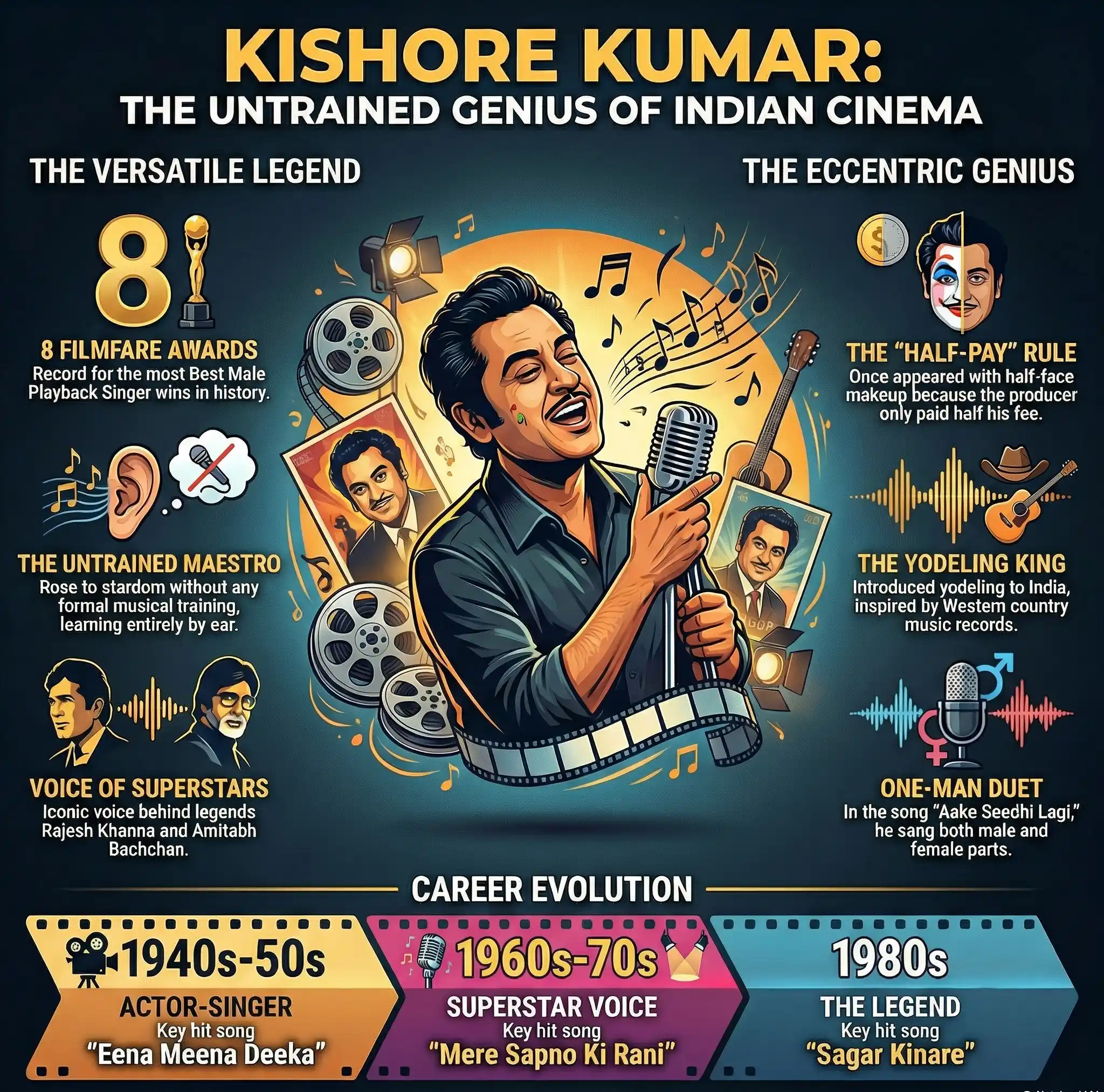
The singing took over anyway. Aradhana in 1969 made him the dominant male voice in Hindi cinema, and he held that position for most of two decades, singing for Rajesh Khanna and Dev Anand and Amitabh Bachchan and collecting eight Filmfare awards while he was at it.

The singing, which is the thing he is remembered for, he was never trained to do. No classical grounding, no gharana, none of the apprenticeship that everyone around him had served. He yodelled, which is not a Hindustani technique, and he built the most imitated male voice in the country out of instinct and nerve.

The walls

The stories about his behaviour are usually told as comedy, and they are better understood as defence.

He insisted on being paid before he sang and would walk out if he was not. He was said to keep a sign outside his house warning visitors off. He made no effort to be charming to people who could give him work, which in that business is close to professional suicide.

READ MORE:  The Film India Did Not Send

It was consistent rather than mad. When the government leaned on the film industry during the Emergency and asked him to perform for it, he refused, and his songs were taken off All India Radio and Doordarshan through most of 1976. He would not be handled by producers and he would not be handled by ministers.

The Celestial Genius of Varahamihira Astronomy Revealed

13 October 1987

He died of a heart attack in Bombay, at fifty-eight.

It was Ashok Kumar’s seventy-sixth birthday, the brother whose move to Bombay had put him in films in the first place. He had been in a studio the previous day, recording a duet with Asha Bhosle for a film released after his death.

His wife Leena Chandavarkar described an entirely unremarkable afternoon. Meetings at the house, a plan to watch a film that evening, and then a noise from the next room and a man on the bed saying he felt weak.

His body was taken to Khandwa and cremated there. It is the only version of the promise he ever kept, and he was not conscious for it.

Doodh jalebi

There is a memorial in Khandwa now, and every year on 4 August people go to it.

They take milk and jalebi and leave it there. The mayor turns up, and the collector, and fans who were not born when he died, and somebody usually sings.

Madhya Pradesh named a national award after him in 1997, which is the official form of remembering, and considerably less interesting than the milk.

He spent forty years telling India he was going to come home and eat that, and then did not, and a town he had left as a young man has been holding up its end of the arrangement ever since.

The Pingala Binary System and Ancient Math

If you think you have remembered everything about this topic take this QUIZ


Results

Share your score!
Tweet your score!
Tweet your score!
Share to other
QUIZ START

#1. What was Kishore Kumar’s real birth name?

Previous
Next

#2. Kishore Kumar holds the record for winning the most Filmfare Awards for Best Male Playback Singer. How many did he win?

Previous
Next

#3. Which 1969 film is considered the turning point in his career, featuring hits like “Mere Sapno Ki Rani”?

Previous
Next

#4. Kishore Kumar was known for introducing which unique singing style to Indian cinema?

Previous
Next

#5. What was a unique aspect of Kishore Kumar’s musical training?

Previous
Next

#6. Why were Kishore Kumar’s songs banned from All India Radio during the Emergency in 1975?

Previous
Next

#7. In which film did Kishore Kumar sing both the male and female parts for the song “Aake Seedhi Lagi”?

Previous
Next

#8. Despite his fame in Mumbai, Kishore Kumar always longed to return to his birthplace, which was:

Previous
Finish

Mastering Political Power Through the Lens of Chanakya Neeti

READ MORE:  How Bulleh Shah's Poetry Transformed the Sufi World of Punjab

What was Kishore Kumar’s real name?

His birth name was Abhas Kumar Ganguly.

How many Filmfare Awards did Kishore Kumar win?

He won 8 Filmfare Awards for Best Male Playback Singer, a record that still stands.

Was Kishore Kumar a trained singer?

No, he had no formal training in music and was entirely self-taught.

Who were Kishore Kumar’s wives?

He was married four times: to Ruma Guha Thakurta, Madhubala, Yogeeta Bali, and Leena Chandavarkar.

Why was Kishore Kumar banned from All India Radio?

He was banned during the Emergency in 1975 because he refused to sing at a government rally organized by Sanjay Gandhi.

Sources & References

Encyclopaedia Britannica (“Kishore Kumar”) — his career as singer, actor and director, and his place in Hindi film music.

Encyclopaedia Britannica (“Ashok Kumar”) — the family, and the older brother’s route into Bombay films.

Press Trust of India, reports from Khandwa — the annual observances at his memorial and the offerings of doodh jalebi.

Government of Madhya Pradesh — the National Kishore Kumar Samman, instituted in his name in 1997.

Author

  • Curious Indian
    Curious Indian

    Curious Indian

    Exploring the Soul of Bharat through History, Science, Culture, and its Diversity

    Our Mission

    Curious Indian is a definitive knowledge portal dedicated to chronicling the events, personalities, and cultural shifts that defined the Indian subcontinent. From the ancient Vedic Period to the complexities of 21st-century politics, our goal is to provide deep-dive analysis that inspires.

    Editorial Standards & E-E-A-T

    Every article published under our brand undergoes a rigorous fact-checking process. We prioritize primary historical records, academic citations, and credible archives to ensure our readers receive accurate, high-authority information.

    Historical Integrity Directly sourcing from ASI archives and academic journals.
    Topical Authority Comprehensive clustering of Indian Science, Biographies, and Wars.

    Managed by Paripurna Datta and TEAM  |  Dedicated to the Knowledge of India.

Tags: Bollywood legendIndian cinema
ShareTweetPin
Curious Indian

Curious Indian

[wpcode id="20346"]

Related Posts

History of Tea in India
Arts & Culture

The Cup that was Sold to Us before We Loved it

August 13, 2026
Vande Mataram: An Idea
Arts & Culture

The Song We Love and Fight Over

August 13, 2026
First Feminist of India: Tarabai Shinde
Arts & Culture

The First Feminist nobody Read

August 13, 2026
No Result
View All Result

Stay Updated

  • Trending
  • Latest
Gupta Empire

A Boat on the River

September 21, 2026
Shivkar Bapuji Talpade

Pretending to Fly

September 21, 2026
Indian rock-cut architecture

The Temples that were Dug, not Built

August 27, 2026
Padmanabhaswamy Temple Treasure

Wait and See

September 20, 2026
Gour and Ramkeli: A Living Symbol of Unity in Diversity

Gour and Ramkeli: A Living Symbol of Unity in Diversity

September 22, 2026
Age of Consent Act 1891

The Death that Forced a Law

August 15, 2026
Dandi March

The Pinch of Salt That Broke an Empire

August 13, 2026
Swadeshi Movement through Matchbox

A small Flame of Swadeshi

August 27, 2026

Widget Title

Facebook Instagram
Curious Indian Logo

Explore the soul of India, that is Bharat with Curious Indian. A definitive guide to Indian history, arts, culture, biographies, and the events that defined our present.

Follow us on social media:

Recent Articles

  • Gour and Ramkeli: A Living Symbol of Unity in Diversity
  • The Death that Forced a Law
  • The Pinch of Salt That Broke an Empire

Legal Policies

  • Contact Us
  • Disclaimer
  • About Us
  • Privacy Policy
  • Editorial Policy & Standards: Curious Indian

© 2026 Curious Indian- Everything about India

Welcome Back!

Login to your account below

Forgotten Password?

Retrieve your password

Please enter your username or email address to reset your password.

Log In

Add New Playlist

No Result
View All Result
  • Indian History
  • Modern India
  • Art & Culture
  • Science & Discovery
  • Festivals of India
  • Mysteries
  • River of Time

© 2026 Curious Indian- Everything about India

This website uses cookies. By continuing to use this website you are giving consent to cookies being used. Visit our Privacy and Cookie Policy.
Not enough quota to unlock this post
Unlock left : 0
Are you sure want to cancel subscription?
×