How a Furious 1882 Essay on the Double Standard was Buried for a Century
Ask most people to name a hero of India’s social reform, and they will reach for the men. Raja Ram Mohan Roy. Jyotirao Phule. Ishwar Chandra Vidyasagar. Good and brave names, all of them.
Now ask who wrote India’s first modern feminist book. The room usually goes quiet.
She existed. Her name was Tarabai Shinde. In 1882 she wrote one short, furious book that was far ahead of its time. And then India lost her for almost a hundred years. This is the story of the first feminist nobody read.
Kanaklata Barua: Assam’s Youngest Martyr of the Quit India Movement
The case that lit the fire
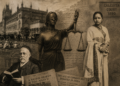
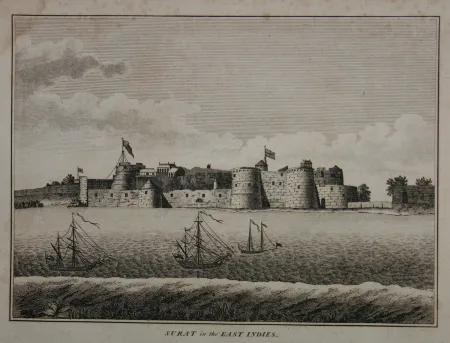
In 1881, in the city of Surat, a young Brahmin widow named Vijayalakshmi became pregnant.
To understand her terror, you have to know the rules of that world. A Hindu widow was forbidden to remarry. She was expected to live a bare, punished life for the rest of her days. A widow who was found pregnant faced total ruin and disgrace. Trapped and afraid, Vijayalakshmi ended the life of her child. She was caught and sentenced to death, a sentence later changed to exile for life.
Then the newspapers went to work. An orthodox Pune paper, the Pune Vaibhav, did not stop at attacking her. It attacked women in general, calling them loose and immoral. Far away in Berar, a woman read those articles and grew angry enough to answer back in writing.
Who she was
Tarabai Shinde was born around 1850 in Buldhana, in the Berar region of what is now Maharashtra. Her family was Maratha and fairly comfortable. Her father, Bapuji Hari Shinde, was a senior clerk in a government revenue office.
Two things made Tarabai unusual for a woman of her time. First, she was taught to read and write, in Marathi and with some Sanskrit and English, when most girls were kept from books entirely. Second, her father belonged to Jyotirao Phule’s Satyashodhak Samaj , the “Truth-Seekers’ Society,” which fought against caste and for the rights of women and the poor.
So Tarabai grew up near the Phules’ work for widows and for girls’ schooling. She had a sharp mind, a rare education, and a front-row view of how cruelly women were treated. When the Vijayalakshmi case broke, she had both the words and the fury to respond.
Sunayani Devi: The Unsung Female Pioneer of the Bengal School of Art
The little book with a big roar
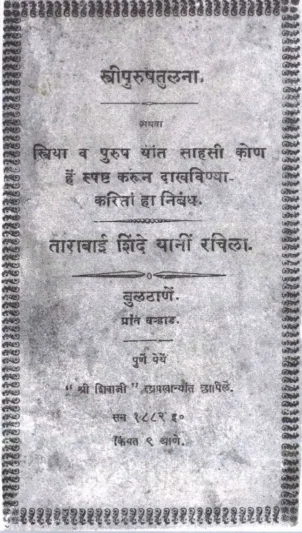
In 1882 she published her answer. It was called Stri Purush Tulana, which means “A Comparison Between Women and Men.” It was written in Marathi and ran to only about forty pages. She addressed it straight at men.
Her argument, put simply, was this. Men lie, cheat, drink, gamble, abandon their families and treat women cruelly, and society shrugs. A woman who makes one mistake is called a sinner and ruined for life. The same act made a man respected and a woman destroyed.
She did not stop at attacking men. She questioned the holy books, the customs, and even the gods themselves for the way they were used to cage women. She defended widows and the misery forced on them, their heads shaved, their jewellery taken, their lives shut away. She attacked the belief that a wife must obey her husband without a single question. For 1882, this was almost unthinkably bold.
A single forty-page Marathi pamphlet, written by a woman working largely on her own, is now widely called India’s first modern feminist text.
case took place. Source: Wikimedia Commons
The punishment for speaking
The reply from society was harsh and fast.
Orthodox groups were outraged that a woman had dared to write such things. Newspapers mocked her. Most painfully, even some of the men in Phule’s own reform circle turned against her. Only Jyotirao Phule stood up for her in public. In his journal, he wrote that the men attacking her had not even read her book with any care.
After that storm, Tarabai Shinde published nothing more. One book, and then silence for the rest of her life. Whether she wrote more and it was lost, or whether the cruelty simply shut her up, no one can say for certain. Either way, the country heard from her only once.
Matangini Hazra: The Widow Who Walked Into Gunfire
Lost for a hundred years
The book barely sold. It slipped quietly out of memory, and for close to a century almost no one knew it existed. India’s first feminist argument sat forgotten on a dusty shelf.
Then, in 1975, a Marathi scholar named S.G. Malshe came across it and printed it again. In 1994, the historian Rosalind O’Hanlon translated it into English so the wider world could finally read it. Only then did people realise what had been written, and buried, back in 1882.
Written in 1882. Rediscovered in 1975. For almost a hundred years, nobody read the first feminist.
Why her erasure matters
It is worth sitting with what happened here. The male reformers of her age are in the textbooks. The woman who argued as sharply as any of them, and earlier than most, became a footnote.
Her disappearance was not simple bad luck with a small print run. Again and again, women who spoke too plainly were pushed out of the record, while the men around them were remembered. Bringing Tarabai back is not just adding one more name to a list. It is admitting that a woman said these things first, was punished for saying them, and was then quietly erased.
India. Source: Wikimedia Commons
The voice that came back
Her one small book waited a hundred years to find its readers. Now, at last, it has them.
In 1882, Tarabai Shinde asked why the very same act could leave a man respected and a woman ruined. India still has not fully answered her question. But the first feminist nobody read is finally being read, in classrooms and in books, more than a century after she picked up her pen in anger.
That is a small justice, arriving very late. And it begins with something simple: saying her name out loud, so the next person you ask will not have to fall silent.
Kamaladevi Chattopadhyay Saved India’s Artisan Heritage
If you think you have remembered everything about this topic take this QUIZ
Results


#1. When and where was Tarabai Shinde born?
#2. Which reformist organization did Tarabai’s father belong to?
#3. What 1881 incident prompted Tarabai Shinde to write her famous book?
#4. What is the title of Tarabai Shinde’s 1882 text?
#5. Which prominent social reformer was the only one to publicly defend her book?
#6. In what language was Stri Purush Tulana originally written?
#7. In what year was her forgotten book rediscovered and reprinted?
#8. Who translated Stri Purush Tulana into English in 1994?
Who is considered India’s first modern feminist?
Tarabai Shinde is widely considered the author of India’s first modern feminist text. In 1882, she
published a furious, forty-page pamphlet challenging the severe double standards placed on
women and criticizing the patriarchal structures of her time.
What does Stri Purush Tulana mean?
Stri Purush Tulana translates to “A Comparison Between Women and Men.” Written in Marathi, the
text explicitly points out that society ruins a woman for a single mistake while excusing or
respecting men for far worse behavior.
Why did Tarabai Shinde write her book?
She was provoked by the 1881 case of Vijayalakshmi, a young Brahmin widow in Surat who was
sentenced to life in exile for ending her pregnancy. When orthodox newspapers used the case to
attack the morals of all women, Tarabai wrote her book as a direct, angry response.
How was Tarabai Shinde’s book received?
The response from 19th-century society was incredibly hostile. Orthodox groups were outraged,
newspapers mocked her, and even some male reformers turned against her, with only Jyotirao
Phule standing up to defend her in public.
What happened to Tarabai Shinde’s work?
After facing intense backlash, she never published again. Stri Purush Tulana slipped out of public
memory and was lost for nearly a century until a Marathi scholar named S.G. Malshe rediscovered
and republished it in 1975.
Sources and references
- Wikipedia (“Tarabai Shinde” and “Stri Purush Tulana”) — her birth around 1850 in Buldhana, Berar, her membership of the Satyashodhak Samaj alongside the Phules, the 1882 Marathi publication, the essay being considered India’s first modern feminist text, the 1881 Vijayalakshmi case in Surat that provoked it, and the 1975 republication by S.G. Malshe.
- Amar Chitra Katha (“Tarabai Shinde: The Story of Feminism”) — the Pune Vaibhav articles denouncing women’s morals, the hostile reception and suppression of the book, the male reform colleagues who condemned her, Jyotirao Phule’s public defence in his journal Satsar, and Rosalind O’Hanlon’s 1994 English translation.
- LSR Department of History (“Tarabai Shinde: A Pioneer Feminist”) — her father Bapuji Hari Shinde, her involvement with the Phules’ widow shelter (1854) and girls’ school, the roughly forty-page length of the essay, and its origin as a response to the Vijayalakshmi case.
- Google Arts & Culture (Zubaan feature) — her birth in Buldhana, her father’s post as head clerk in the Deputy Commissioner of Revenue’s office, and her critique of patriarchy in Hindu scripture.
- Indian Liberals (“The Unwavering Feminism of Tarabai Shinde”) and Tharu & Lalita, “Women Writing in India” — the detail that Stri Purush Tulana was her only known work, her focus on the plight of widows and the idea of pativrata, and the assessment of it as the first full-fledged feminist argument after the Bhakti-period poets.