Every morning in 1938 a man of forty stood at Madras Central station and waited for the trains. He was looking for first-class passengers. When he found one he offered a room at his new hotel, a former palace of the Raja of Ramnad in Royapettah, which had 45 rooms at five rupees a day and very few guests. His name was Kadandale Krishna Rao. Sixteen years earlier he had been grinding idli batter in somebody else’s kitchen. The Chennai historian V. Sriram has pieced together what happened in between, and it is as good a way as any into the question of why a small temple town on the Karnataka coast has its name on restaurant boards from Matunga to Karol Bagh.
A town with more cooks than land
Udupi sits on the coast of what used to be South Kanara district. At its centre is a Krishna temple founded in the thirteenth century by the philosopher Madhvacharya, and the temple has always fed people. A reporter who visited in 2017 was told it serves about 5,000 pilgrims on a quiet day. The cooking was done by the Shivalli Brahmins who served the temple and the eight monasteries around it. They were a small community in a district where the farmland mostly belonged to others. The anthropologist Stig Toft Madsen and the writer Geoffrey Gardella, who studied the Udupi hotel trade, put it this way: when poverty pushed these families out, "they had to depend on their main cultural capital, that is, pleasing the mass by feeding rice." The historian of migration Chinmay Tumbe adds a date. In 1923 a flood hit the Udupi area hard, and many men left for the cities. The cities, as it happened, were filling up with clerks, students and mill hands who lived alone in rented rooms and needed somewhere cheap and clean to eat.
The batter grinder
Krishna Rao was born in 1898 in the village of Kadandale. His father was a priest with a little land who also practised ayurveda. As a boy Krishna Rao worked at the Puthige monastery in Udupi. Around 1922 he went to Madras and was taken on as a kitchen boy at the Sharada Vilas Brahmins Hotel in George Town. Sriram lists the jobs he did there: dishwasher, waiter, flour-grinder. In 1925 his employer offered to sell him a restaurant for 700 rupees, to be paid off month by month. He took it. A year or two later he opened Udupi Sri Krishna Vilas on Mount Road, the European shopping street that Madsen and Gardella call "the land of the Sahibs". It was the first restaurant in Madras to put the name of the town on its board. Others copied it quickly. Then came the palace. A Bangalore contractor had bought the Ramnad estate, Woodlands, to run as a hotel and could not make it pay. Krishna Rao took it on a sub-lease in 1938 and went to the station to find his customers. In 1952 he moved to a building of his own in Mylapore and called it New Woodlands. Ten years after that he opened a drive-in on Cathedral Road where a family could eat a masala dosa in the car. Branches followed in Bangalore, Delhi and Bombay, and then in London, New York and Singapore. He died in 1990.
Mysore, Bangalore, Matunga
He was one of several. K. Seetharama Rao, born in 1899 in the village of Kuthethoor, gave up a low-paid salaried job in Mangalore in 1921 to join his brothers in a tiffin business in Mysore. That business became Dasaprakash, and in 1954 it opened an art-deco hotel in Madras where Jawaharlal Nehru and the Maharaja of Mysore both stayed. In Bangalore two brothers from Kota, near Udupi, who had worked as cooks, opened the Brahmins’ Coffee Club in 1924. It was later renamed after its neighbourhood: Mavalli Tiffin Rooms, or MTR. In Bombay the name on the door was A. Rama Nayak. He was from a village near Mangalore, had lost his father, and came to the city by boat as a boy of eleven to support his mother and sister. He worked as a cook’s helper in a mess for bachelors, then as a cook in a vegetarian hotel in the Fort. In 1942 he rented the first floor of a chawl outside Matunga station and opened Udipi Shri Krishna Boar ding. It was the Bombay of the war years, two summers before the dock explosion. The social reformer Sane Guruji came to inaugurate it. A meal cost two annas, and Rama Nayak called the people who ate it
guests. "When my grandfather came here, there were no Udupis," his grandson Shashank told the magazine Roads & Kingdoms in 2017. The place is still on the first floor and still serves meals on a plantain leaf.
Who sat where
The early Udupi hotels were Brahmin kitchens, and for a long time they were Brahmin dining rooms as well. Sriram writes that some Madras eating houses of the period made customers show the sacred thread at the door. Madsen and Gardella found that many Udupi hotels had a hall reserved for Brahmins, that some refused Muslims until 1947, and that many turned Dalits away or served them outside. Udupi Sri Krishna Vilas and New Woodlands kept a separate Brahmin section until the late 1960s. This was a fight about who could use a public place, the same question that had been asked on a temple road during the Vaikom Satyagraha. E.V. Ramaswami Naicker, Periyar, who had gone to Vaikom in 1924, picketed Brahmin hotels in Madras and once painted out the word "Brahmin" on a restaurant signboard himself. In 1957 his followers ran a campaign to have it removed from hotel name-boards across the state. The courts were busy too. Through the 1950s and 1960s, cases about shops and restaurants made up most of the prosecutions under the laws against untouchability. Business pushed the same way. A restaurant that wants to fill its tables at lunchtime in a big city cannot be choosy for long. The partitions came down. Madsen and Gardella’s conclusion is that the Udupi hotel, which began as a way of keeping caste rules intact away from home, ended up as one of the places where those rules wore out.
The name without the town
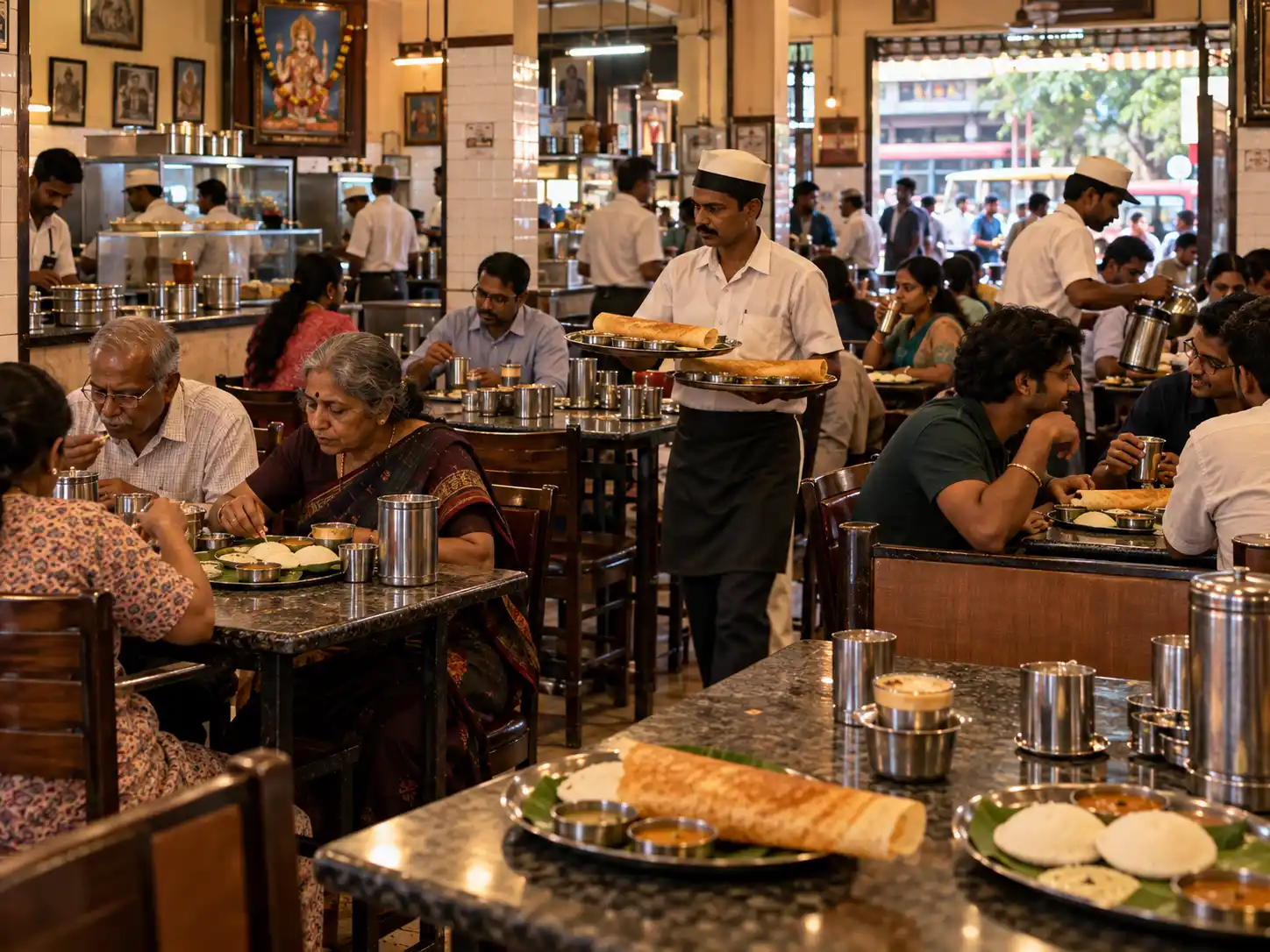
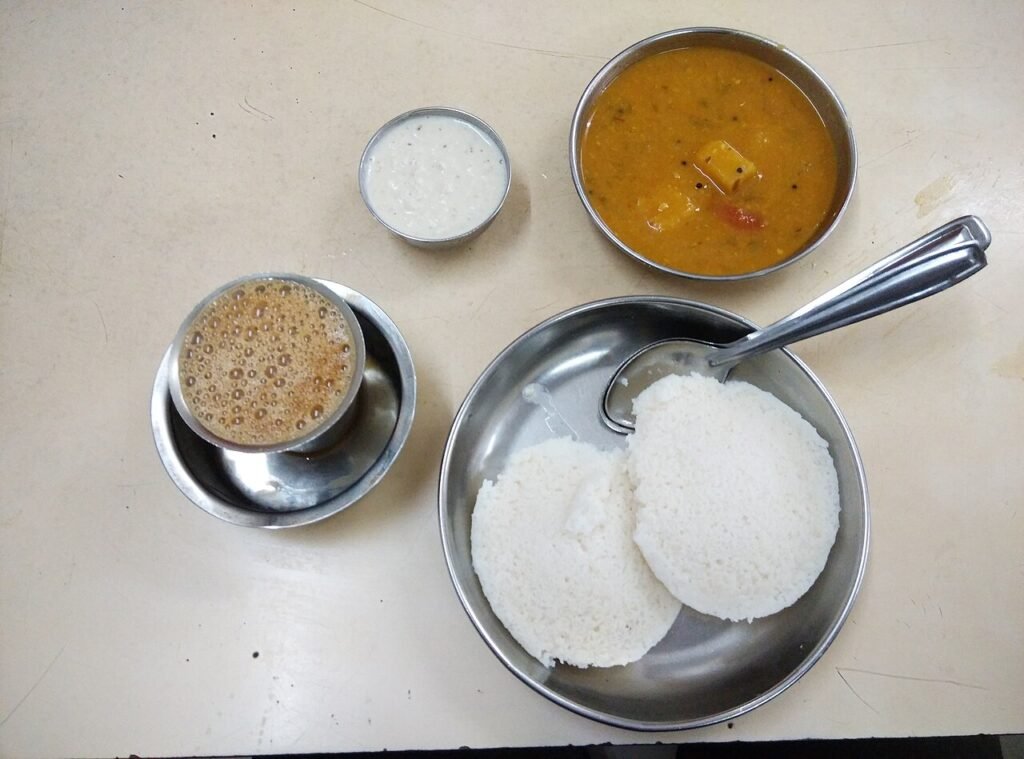
By the end of the century "Udupi" on a board had stopped meaning that the owner came from Udupi. It meant idli, dosa, filter coffee, a steel tumbler, quick service and a bill you could afford. "Almost every street in Mumbai has one," the Deccan Herald wrote in May 2020. The paper was reporting on the lockdown. The restaurants were shut, and the cooks and waiters from the coast were paying 4,300 rupees a seat for buses home. Shivanand Shetty, president of the city’s hotel and restaurant association, expected about a third of the restaurants never to reopen. Krishna Rao’s first restaurant on Mount Road is gone. So is the drive-in, which closed in 2008 when the government took the land back for a park. New Woodlands is still open in Mylapore, and the hotel in the raja’s palace still takes guests.
Test your knowledge
Answer 5 questions about the story.
Why are South Indian restaurants called Udupi restaurants?
Many of the first ones were opened in the 1920s and 1930s by cooks from Udupi, a temple town in coastal Karnataka. The name later became a general label for inexpensive vegetarian South Indian restaurants.
Who started the Woodlands chain of Udupi hotels?
K. Krishna Rao (1898-1990), who came to Madras from a village near Udupi and worked as a kitchen boy before opening Udupi Sri Krishna Vilas on Mount Road in 1926-27. He leased the Woodlands property in 1938 and built New Woodlands in 1952.
What is the link between Udupi food and the Krishna temple?
The Krishna temple at Udupi, founded in the thirteenth century by Madhvacharya, has a long tradition of feeding pilgrims. The Shivalli Brahmin cooks who served the temple and its monasteries carried that vegetarian cooking to the cities.
Which is the oldest Udupi restaurant in Mumbai’s Matunga?
A. Rama Nayak’s Udipi Shri Krishna Boarding opened in 1942 on the first floor of a building outside Matunga station and is still run by his family.
Did Udupi restaurants practise caste segregation?
Many early ones did. Researchers Stig Toft Madsen and Geoffrey Gardella found that separate Brahmin dining sections lasted in some well-known hotels until the late 1960s, and that protest, court cases and commerce gradually ended the practice.
Sources and further reading
- Stig Toft Madsen and Geoffrey Gardella, "Udupi Hotels: Entrepreneurship, Reform and Revival", in Curried Cultures, ed. Krishnendu Ray and Tulasi Srinivas (Aleph, 2017). Excerpt: https://scroll.in/magazine/853913/
- V. Sriram, "Old Woodlands Hotel", Madras Heritage and Carnatic Music, 21 July 2014: https://sriramv.com/2014/07/21/old-woodlands-hotel/
- V. Sriram, Chennai: A Biography (Aleph, 2021). Excerpt: https://scroll.in/article/1012644/dosas-at-dasaprakash-woodlands-ramakrishna-lunch-home-how-eating-out-flourished-in-chennai
- S. Balakrishnan, "A Rama Nayak’s Legacy", The Free Press Journal, 19 July 2024: https://www.freepressjournal.in/amp/lifestyle/a-rama-nayaks-legacy-and-the-prince-of-payasam-in-mumbais-iconic-udipi-restaurants
- "The Famed Udupi Hotels of Mumbai", Roads & Kingdoms, 2017: https://roadsandkingdoms.com/2017/the-famed-udupi-hotels-of-mumbai/
- Chinmay Tumbe, India Moving: A History of Migration (Penguin Viking, 2018)