How the Taj Mahal’s builder became a prisoner in his own empire
Picture an old man at a small window, high in a fort of red stone.
Across the river below him, pale and perfect in the distance, stands a white marble dome. It is a tomb, the most beautiful building in the world, and he is the one who built it, for the wife he loved and lost. He can see it, but he can no longer walk to it. He is a prisoner in these few rooms, and the man who put him here is his own son.
Not long before, this same old man had been the richest and most powerful person on earth. His title said so. It meant, quite simply, “King of the World.”
His name was Shah Jahan, and his story holds almost every extreme a life can contain: dazzling beauty and terrible suffering, vast power and utter helplessness, deep love and deep loss. This is how the man who gave India the Taj Mahal came to spend his last days gazing at it through a prison window.
The prince who loved to build
He was born a prince named Khurram, a grandson of the great Akbar, and when he took the throne in 1628 he chose the grand title Shah Jahan.
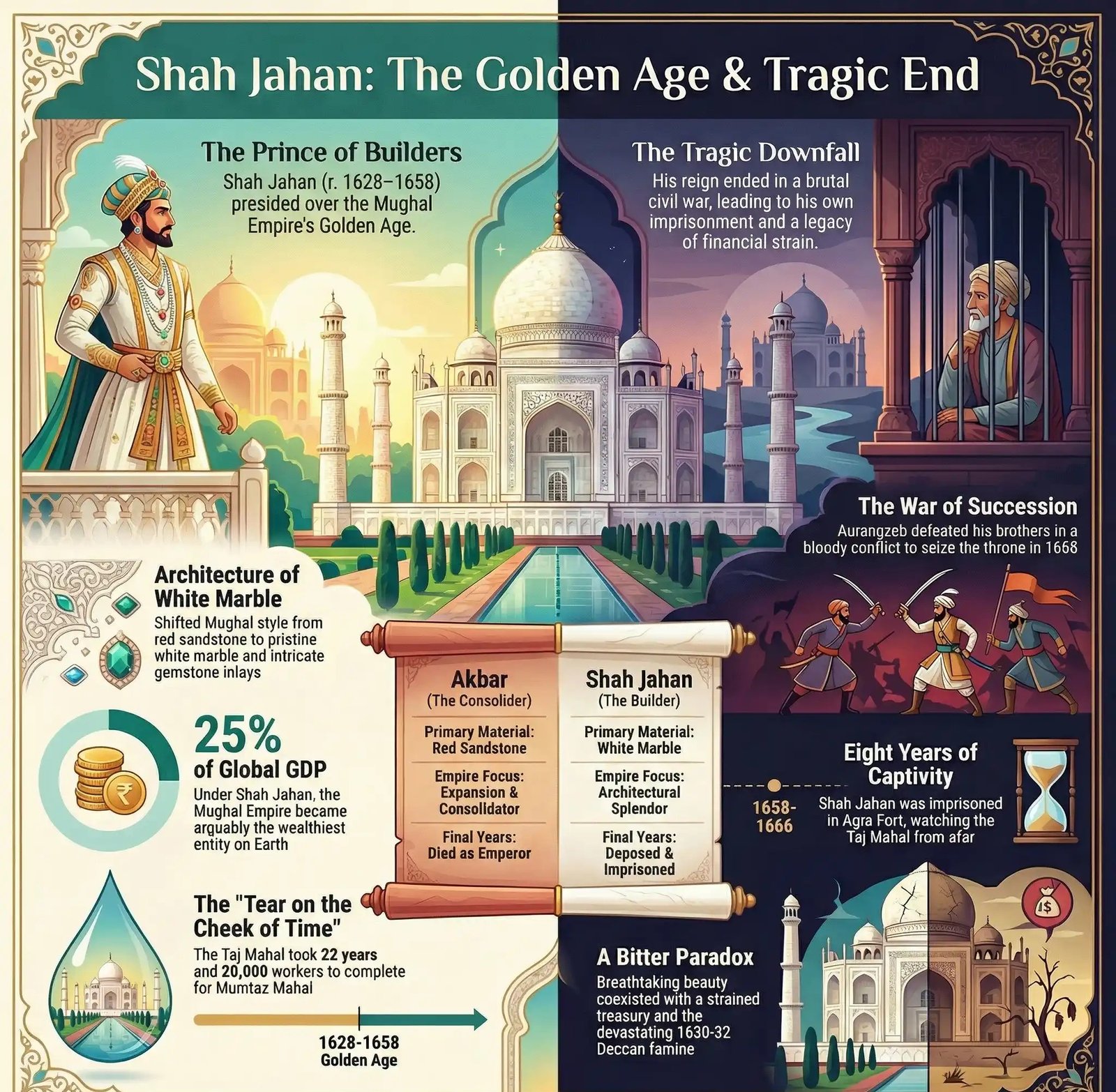
Most emperors are remembered for what they conquered. Shah Jahan is remembered for what he made. Where his forefathers had built in warm red sandstone, he fell in love with white marble, and under him Mughal architecture reached a delicacy the world had never seen. Gardens, palaces, mosques and tombs rose across his empire, cool and gleaming and exact.
He was, above everything else, a builder. And his greatest work grew out of the deepest sorrow of his life.
Establishment of the British Raj 1858: The Dawn of Imperial India
A tomb for a queen
Shah Jahan’s beloved wife was Mumtaz Mahal. By every account theirs was a real and tender love, and she was his constant companion, at court and even on his military campaigns.
In 1631 she died giving birth to their fourteenth child. The emperor was said to be shattered by the loss. And out of that grief, he began to build.
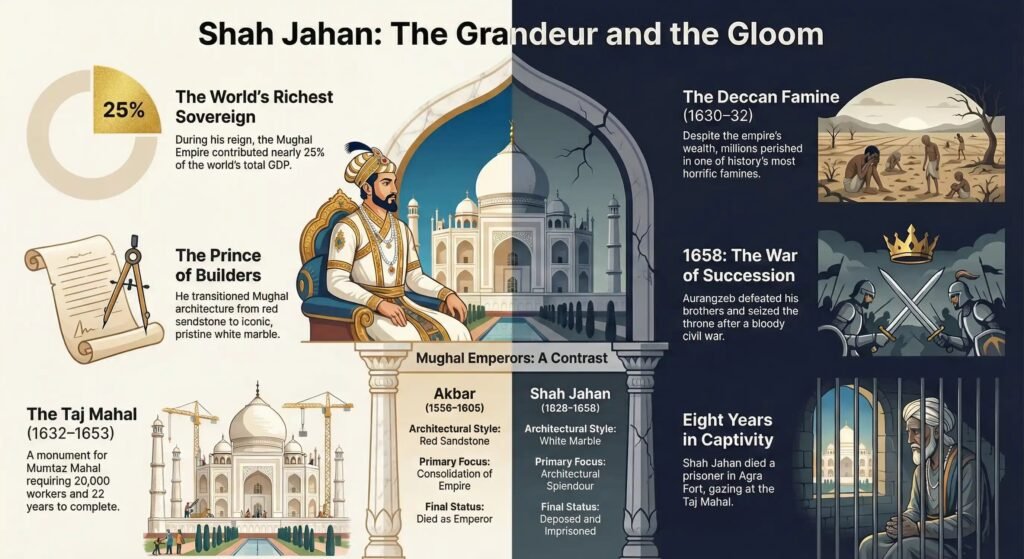
He raised the most beautiful building on earth, the Taj Mahal, as a tomb for a single woman. It took more than twenty years and some twenty thousand workers to complete.
The result was so lovely that, centuries later, the poet Rabindranath Tagore would call it a teardrop on the cheek of time. There is something quietly moving in realising that the monument millions now cross the world to admire began as one man’s way of mourning his wife.
The King of the World
Grief did not slow the empire. In these same years, Shah Jahan’s power climbed to its peak.
He moved his capital to Delhi and raised a whole new walled city there, Shahjahanabad, the place we now call Old Delhi, crowned by the great Red Fort and the Jama Masjid. He sat upon the fabled Peacock Throne, a seat dripping with rubies and diamonds, among them the legendary Koh-i-Noor. His armies pushed deep into the Deccan, folding Ahmednagar into the empire and forcing the southern sultans of Bijapur and Golconda to bow.
By some estimates his empire produced close to a quarter of the entire world’s wealth. Shah Jahan may well have been the richest man alive.
For a while, the title fit. He truly was something close to a king of the world.
Battle of Plassey 1757: The Betrayal That Changed India’s Destiny
The other side of the gold
But there is a second story running beneath the marble, and honesty asks us to tell it too.
In the very years the emperor’s monuments were rising, a terrible famine struck the Deccan. Between 1630 and 1632 it killed people in their millions, and the accounts that survive describe scenes of unimaginable desperation.
While white marble was being carried to Agra for the glory of the empire, a famine in the south was wiping out its people by the million.
Shah Jahan did open free kitchens and forgive some taxes, but against a disaster of that scale, his help fell far short. It is a hard thing to hold beside the beauty of the Taj, and yet both are true at once. His was an age of breathtaking splendour set in a land of great suffering.
Four sons and a throne
The reckoning, when it came, came from inside his own family.
In 1657 the emperor fell seriously ill, and at once his four sons began to circle the throne. The eldest and his father’s favourite was Dara Shikoh, a thoughtful, open-minded man who loved learning and had even translated Hindu scriptures into Persian. Against him stood a very different brother: Aurangzeb, the governor of the Deccan, stern, devout and a gifted soldier.
Shah Jahan wanted Dara to follow him. War decided otherwise. At the Battle of Samugarh in 1658, Aurangzeb crushed Dara’s army. He then had Dara killed, dealt ruthlessly with his other brothers, and seized the throne for himself.
The King of the World, who could summon marble and command armies, could not keep the peace among his own children.
Reign of Aurangzeb 1658-1707: The Zenith and Decline of the Mughals
A window and a river
Aurangzeb did not kill his father. He did something quieter. He shut him away.
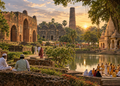
For the last eight years of his life, Shah Jahan was held under guard in the Agra Fort, in a suite of rooms called the Musamman Burj, cared for by his loyal daughter Jahanara. From its windows, across the river Yamuna, he could see the white dome of the Taj Mahal, the tomb of the wife he had lost so many years before.
The man once called King of the World spent his final years as his own son’s prisoner, gazing at the monument he had built out of love.
He died in captivity in 1666, and was carried at last across the river, to be buried quietly beside Mumtaz Mahal in the tomb he had raised for her.
The wheel turns
Shah Jahan’s reign is often called the golden age of the Mughals, and standing before the Taj, it is easy to see why. But the fuller truth is a paradox. He gave the world lasting beauty and left his treasury dangerously drained, a splendour his heirs would struggle to pay for.
It is worth clearing away one old story while we are here. You may have heard that Shah Jahan cut off the hands of the workers who built the Taj, so that they could never make anything so beautiful again. There is no historical record of it. It is a myth, and many of those same craftsmen went on to build other monuments afterwards.
What is true needs no exaggeration. A man who ruled a quarter of the world, who turned his grief into the most famous building on earth, ended his days as a captive at a window, watching a white dome across a river. Even the grandest emperor, in the end, is turned by the same wheel as everyone else.
Nadir Shah’s Invasion of Delhi 1739: The Massacre That Emptied India
If you think you have remembered everything about this topic take this QUIZ
Results


#1. During the devastating Deccan Famine of 1630–1632, what was a primary criticism of Shah Jahan’s relief efforts?
#2. Which of Shah Jahan’s sons was known as a liberal intellectual who translated the Upanishads into Persian?
#3. What does the source material conclude regarding the myth that Shah Jahan cut off the hands of the Taj Mahal workers?
#4. Who was the mother of Prince Khurram, the future Emperor Shah Jahan?
#5. What happened to the Peacock Throne, the jewel-encrusted seat of power created during Shah Jahan’s reign?
#6. In 1639, Shah Jahan decided to shift the imperial capital from Agra to which newly built city?
#7. Which kingdom was finally annexed by the Mughal Empire in 1633 after decades of resistance?
#8. Who attended to Shah Jahan during his final eight years of imprisonment in the Agra Fort?
What is the period of Shah Jahan’s reign?
Shah Jahan ruled from 1628 to 1658.
Why is his reign called the Golden Age of Architecture?
Because of the massive construction of masterpieces like the Taj Mahal, Red Fort, and Jama Masjid, using white marble and intricate pietra dura inlay work.
Who succeeded Shah Jahan?
His third son, Aurangzeb, succeeded him after defeating his brothers in a war of succession.
Where was Shah Jahan imprisoned?
He was imprisoned in the Agra Fort (Musamman Burj) by his son Aurangzeb.
What was Shah Jahan’s childhood name?
His name was Prince Khurram.
Sources & References
- Encyclopaedia Britannica (“Shah Jahan”) — his reign from 1628 to 1658, the Deccan conquests, the war of succession, and his imprisonment and death.
- UNESCO World Heritage Centre (Taj Mahal, and the Red Fort Complex) — the building of the Taj Mahal for Mumtaz Mahal and the Red Fort at Shahjahanabad.
- The Metropolitan Museum of Art (Mughal art and architecture) — the turn to white marble and the artistic character of his reign.
- Victoria and Albert Museum (the Mughal court) — the wealth and craftsmanship of the imperial court, including the Peacock Throne.
Author


Exploring the Soul of Bharat through History, Science, Culture, and its Diversity
Our Mission
Curious Indian is a definitive knowledge portal dedicated to chronicling the events, personalities, and cultural shifts that defined the Indian subcontinent. From the ancient Vedic Period to the complexities of 21st-century politics, our goal is to provide deep-dive analysis that inspires.
Editorial Standards & E-E-A-T
Every article published under our brand undergoes a rigorous fact-checking process. We prioritize primary historical records, academic citations, and credible archives to ensure our readers receive accurate, high-authority information.
Historical Integrity Directly sourcing from ASI archives and academic journals.Topical Authority Comprehensive clustering of Indian Science, Biographies, and Wars.Managed by Paripurna Datta and TEAM | Dedicated to the Knowledge of India.