The Day the Peacock Throne Left India
How Nadir Shah’s invasion of Delhi in 1739 broke the Mughal Empire in a single day
In the summer of 1739, a vast caravan crawled out of Delhi and turned west, toward Persia.
It was loaded with the plundered wealth of India: gold, silver and jewels heaped onto the backs of a thousand elephants and thousands of camels. Somewhere in that long train, taken to pieces for the journey, rode the Peacock Throne, the jewelled seat of the Mughal emperors, and the great diamond called the Koh-i-Noor.
A century earlier, the empire those things belonged to had been the richest and most powerful on earth. Now a foreign king was carting its treasures away, and its capital lay behind him, burned and grieving and stripped of tens of thousands of its people.
The king’s name was Nadir Shah, and in the space of a few weeks he had shown the whole world a secret the Mughals had spent decades trying to hide: that their mighty empire was already hollow. This is the story of the day the mask came off.

Battle of Plassey 1757: The Betrayal That Changed India’s Destiny
A hollow crown
By 1739, the Mughal Empire looked grand and was quietly rotting.
Its emperor was Muhammad Shah, remembered by the nickname Rangeela, “the colourful,” for his love of music, poetry, painting and pleasure. He was a gentle patron of the arts and a poor guardian of a kingdom. While he enjoyed his court, his borders went unwatched and his nobles schemed against one another.
The empire still looked rich, and in truth it was. But it had grown soft and divided, its armies bloated and out of practice. It was a treasure house with a broken lock, and to the north there was a man who had noticed.
The conqueror from Persia
Nadir Shah had risen from humble beginnings to seize the throne of Persia through sheer military brilliance and force of will. He was one of the finest generals of his age, and one of the most ruthless.
He also had a problem. His wars had emptied his treasury, and an army that is not paid does not stay an army for long. He looked east, toward the legendary wealth of Hindustan, and saw the answer to all his troubles. Using a border dispute as his excuse, he marched on India.
Battle of Buxar 1764: The Victory That Made British Rule Inevitable
Three hours at Karnal
The two armies met near the town of Karnal, north of Delhi, on 24 February 1739.
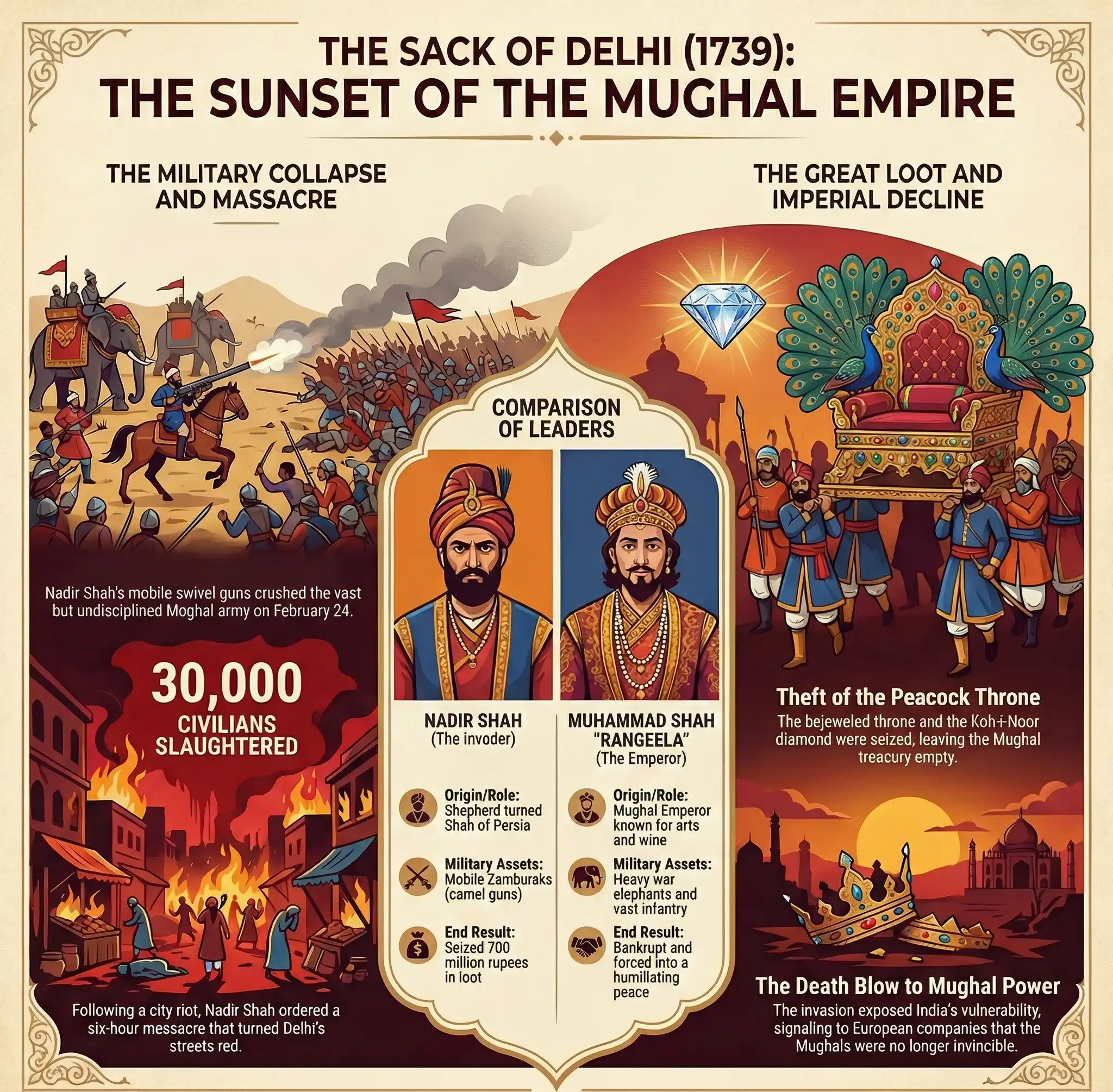
On paper it should have been no contest, and it was not, though not in the way anyone expected. The Mughal army was enormous, but it was clumsy and old-fashioned, still leaning on great war elephants. Nadir Shah’s force was far smaller, but it was fast, disciplined and modern, its horsemen and camel-mounted guns tearing the huge Mughal host apart.
In about three hours it was over. The largest army in India had been shattered by a fraction of its number.
Muhammad Shah surrendered. In a bitter humiliation, the defeated emperor now had to welcome his conqueror into Delhi as an honoured “guest.”
The rumour and the sword
At first, the occupation was quiet. Nadir Shah settled into the Red Fort, and an uneasy calm held over the city.
Then, on the night of 21 March, a rumour raced through Delhi that Nadir Shah was dead, killed inside the fort. The people of the city, humiliated and angry, seized the moment and turned on the Persian soldiers in their streets, killing several hundred of them before the night was out.
The rumour was false. And in the morning, Nadir Shah answered it.
He rode to a mosque in the heart of Chandni Chowk, looked out over the bodies of his men, and drew his sword. To his army, that single gesture was an order, and its meaning was terrible.
One day in Delhi
Third Battle of Panipat 1761: The Day the Maratha Dream Died
What followed was one of the darkest days in the long history of Delhi.
For hours, Nadir Shah’s soldiers were let loose on the city. Tens of thousands of its people were killed, by many accounts as many as thirty thousand, and whole quarters were put to the torch. There is no gentle way to describe it, and no need to dwell on the worst of it. A great city was, for one day, given over to slaughter.
It ended almost as suddenly as it had begun. Muhammad Shah and his nobles came before the Persian king and begged him, for the love of God, to stop.
The emperor is said to have pleaded with him to sheathe his sword, “for there is no one left to kill.”
Nadir Shah listened. He put his sword away, and the discipline of his men was such that the killing stopped almost at once. The city fell silent, and it was his.
Everything of value
Then came the stripping of Delhi.
Nadir Shah took, quite simply, everything worth taking. He seized the imperial treasury, the jewels and gold of the nobles, and the savings of ordinary citizens. He took the Peacock Throne, the dazzling jewelled seat that Shah Jahan had built at the height of Mughal glory, and had it broken down for the road to Persia. He took the two most famous diamonds in the world, the Koh-i-Noor and the Darya-i-Noor.
He carried off so much treasure that when he reached home, he cancelled all taxes across Persia for three years.
The story is told that he won the Koh-i-Noor by a trick. Knowing the beaten emperor had hidden the great diamond in the folds of his turban, Nadir Shah warmly proposed that the two of them exchange turbans as a token of friendship, and Muhammad Shah could not refuse. Whether or not it happened quite that way, the jewel went west, and it would not come back.
What one day revealed
An empire does not truly fall in a single day. The Mughal dynasty would go on wearing its crown for another hundred years after Nadir Shah rode home.
But a single day can show the world what has already happened. Before 1739, the Mughal emperor was still, in the eyes of India and beyond, a figure of awe. After it, everyone knew the truth. The great Mughal could be beaten in an afternoon and robbed in a day. He was a hollow crown.
The lesson was not lost on anyone watching. India’s rising regional powers, above all the Marathas, pressed harder against a centre that could no longer hold. And far away in their trading posts, the merchants of the French and British East India Companies took careful note that the emperor who had once overawed them was, after all, only a man who could be broken.
As for Nadir Shah, all the treasure of India bought him no peace. He grew cruel and suspicious in his final years, until in 1747 his own officers killed him. The wealth he had torn out of Delhi scattered, but the wound he left in India did not close. The road that led, in the end, to colonial rule ran through the rubble of that ruined city.
Death of Tipu Sultan: The Fall of the Tiger of Mysore
If you think you have remembered everything about this topic take this QUIZ
Who was the Mughal Emperor during Nadir Shah’s invasion?
Muhammad Shah “Rangeela” was the emperor.
What was the Battle of Karnal?
It was the decisive battle fought on February 24, 1739, where Nadir Shah defeated the Mughal army in just three hours.
Which famous diamond did Nadir Shah take from India?
He took the Koh-i-Noor diamond, along with the Darya-i-Noor.
Where did Nadir Shah order the massacre from?
He sat at the Sunehri Masjid (Golden Mosque) in Chandni Chowk while overseeing the massacre.
What was the result of the invasion?
It bankrupted the Mughal Empire, decentralized power to regional governors, and paved the way for European colonization.
Sources & References
- Encyclopaedia Britannica (“Nadir Shah”) — his rise, the 1739 invasion of India, and the sack of Delhi.
- Encyclopaedia Iranica (“Battle of Karnal”) — the battle of 24 February 1739 and the collapse of the Mughal army.
- Royal Collection Trust (the Koh-i-Noor diamond) — the seizure of the Koh-i-Noor and its later history.
- Victoria and Albert Museum (the Mughal court) — the Peacock Throne of Shah Jahan and the treasures of the imperial court.
Author


Exploring the Soul of Bharat through History, Science, Culture, and its Diversity
Our Mission
Curious Indian is a definitive knowledge portal dedicated to chronicling the events, personalities, and cultural shifts that defined the Indian subcontinent. From the ancient Vedic Period to the complexities of 21st-century politics, our goal is to provide deep-dive analysis that inspires.
Editorial Standards & E-E-A-T
Every article published under our brand undergoes a rigorous fact-checking process. We prioritize primary historical records, academic citations, and credible archives to ensure our readers receive accurate, high-authority information.
Historical Integrity Directly sourcing from ASI archives and academic journals.Topical Authority Comprehensive clustering of Indian Science, Biographies, and Wars.Managed by Paripurna Datta and TEAM | Dedicated to the Knowledge of India.