How the Tiger of Mysore chose to die a lion
By the end of the eighteenth century, most of India’s kings had learned how to survive the British. You gave in.
You signed one of their treaties, handed over your army and your foreign policy, accepted a British “resident” at your court, and in return you were allowed to keep your palace, your title and a comfortable pension. You kept the throne, and you lost the power. Prince after prince made that bargain.
One man refused to make it. And on 4 May 1799, sword in hand in the breach of his own burning fortress, he became the only Indian ruler of his age to die on the battlefield fighting the British, rather than live on their terms.
His name was Tipu Sultan, the Tiger of Mysore. This is the story of his last day.
The one who would not sign
Tipu was, to the British, the most dangerous man in India, and they were not wrong to think so.
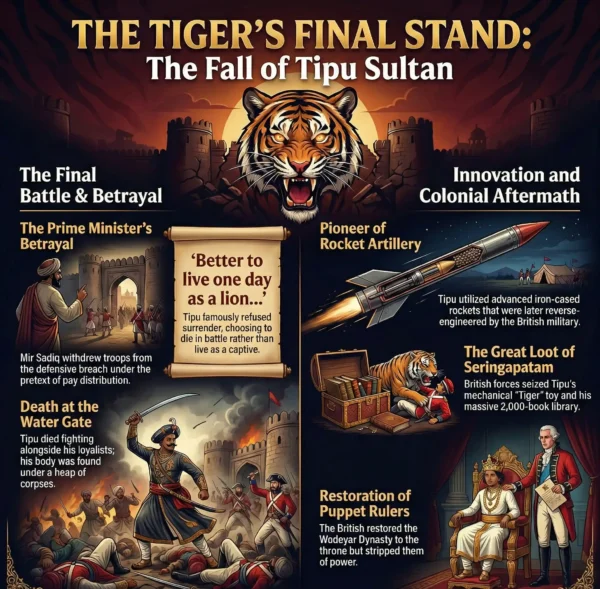
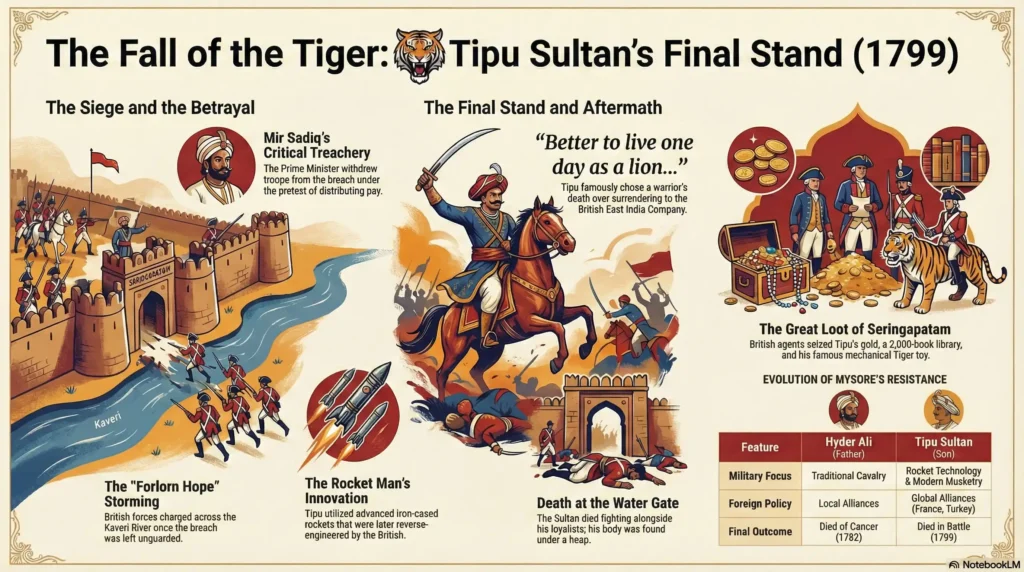
Where other rulers bent, he built. He modernised his army along European lines and pioneered the use of iron-cased war rockets, weapons so effective that the British would later study them and develop rockets of their own. More alarming still, he looked beyond India for help. He sought alliances with France, with the Ottomans, with Afghanistan, anyone who might help him drive the British out. Napoleon himself, campaigning in Egypt, wrote Tipu a letter promising aid, though the British intercepted it before it arrived.
To the Governor-General, Lord Wellesley, all this made Tipu intolerable: a single powerful ruler who would neither submit nor sit still. Wellesley decided he had to be destroyed. He gathered a huge coalition army, British troops alongside the forces of the Nizam of Hyderabad and the Marathas, and marched on Tipu’s island capital, Seringapatam.
Jallianwala Bagh Massacre 1919: The Day the British Raj Lost its Soul
The island fortress
The siege began in April 1799.
Seringapatam was a genuinely formidable place, a fortress ringed by the waters of the Kaveri river. For weeks the British guns hammered its walls, working slowly to open a breach wide enough to storm. It was hard, patient, violent work.
But the wall that mattered most was not made of stone. Inside the fortress, the British had been busy in a quieter way, reaching out with bribes and promises to men close to the Sultan. As so often in this age, the deadliest weapon aimed at an Indian ruler was the disloyalty of his own court.
The betrayal at the breach
The story that has come down to us lays the blame on one man above all: Mir Sadiq, Tipu’s own minister.
On the afternoon of 4 May, at the hour when the guards might expect to be relieved, Sadiq is said to have pulled the soldiers away from the weakened breach, on the pretext of marching them off to be paid. Whatever the exact truth of it, the crucial gap in the wall was left thinly held at the very moment the enemy was ready to pour through.
It is the same grim note that runs through so much of this period. Plassey, Panipat, and now Seringapatam were all decided as much by betrayal from within as by the strength of the enemy without.
The Midnight of August 15: Freedom, Partition, and the Blood on the Map
The last hour
When the British storming party rushed the breach, Tipu was at his midday meal.
He did not finish it. Hearing the alarm, he took up his musket and hurried to the wall, into the very worst of the fighting. This was not a king who watched his fall from a safe tower. He fought in person, in the crush of bodies at the breach, firing on the attackers with his own hands as his guards fell around him.
When it became clear the fort was lost, those near him urged him to surrender. He would not. A British soldier, seeing the jewelled belt at his waist, grabbed at it, and Tipu struck at the man with his sword. Moments later another soldier raised his musket and shot the Sultan dead.
He seems to have meant quite literally the saying that has always been attached to his name: it is better to live one day as a lion than a hundred years as a jackal.
Found by torchlight
For hours afterwards, in the chaos of the captured city, no one knew what had become of the Sultan.
That evening, General David Baird, who years earlier had himself been a prisoner of Tipu, went out with torches to search the breach. Among the mounds of the dead they turned the bodies until they found him, near the gate they called the Water Gate, lying beneath a heap of the loyal soldiers who had died around their king. His body was still warm and his eyes were open, so that for a moment the searchers thought he might yet be alive.
He was not. The Tiger of Mysore was dead, and he had died exactly as he had always said he wished to.
Indian Rebellion of 1857: The First War of Independence
The stripping of Mysore
What the British did next was uglier than the fighting.
The victorious army gave itself over to a systematic plunder of Seringapatam. The Sultan’s treasury of gold and jewels was carried off. His personal curiosities were shipped to Britain, among them the strange and famous mechanical toy known as Tipu’s Tiger, a carved tiger shown mauling a British soldier, which sits to this day in a museum in London. His great library was broken up and scattered to English colleges. His sword and ring were taken as trophies of war.
With Tipu gone, the British no longer needed to conquer Mysore openly. They set the old Wodeyar family back on its throne as obedient clients, exiled Tipu’s sons, and folded the kingdom quietly into their growing empire. The last ruler in the south with both the will and the means to fight them was dead, and the road to British supremacy across the peninsula lay open.
How to remember a tiger
Tipu Sultan is not a simple figure to sum up, and it would be dishonest to pretend otherwise.
He remains, even now, one of the most argued-over rulers in Indian history. To many he is a hero, an early fighter against colonial rule, a bold moderniser, a king who died for his country’s freedom. To others his record is darker, and his treatment of some communities during his campaigns has left wounds and controversies that are still debated hotly today. Both the admiration and the criticism rest on real history, and this is not the place to settle a quarrel that serious historians have not settled either.
But there is one thing about Tipu Sultan that almost no one disputes, admirer and critic alike, and it is the thing his death made plain. He was not a man who knew how to surrender. In an age when the surest way to keep a crown was to kneel, he chose instead to stand in the breach of his own fort and fight until a musket ball ended him. He was the only Indian king of his time to die that way, on the battlefield, weapon in hand, against the British.
Whatever else the arguments decide, they will not change how he fell. He lived a hard, proud, contested life. And in the end, true to his word, he died a lion.
Establishment of the British Raj 1858: The Dawn of Imperial India
Annexation of Punjab 1849: The Fall of the Sikh Empire
If you think you have remembered everything about this topic take this QUIZ
Results


#1. On which date did Tipu Sultan die, marking the end of the Fourth Anglo-Mysore War?
#2. Who was the treacherous minister who betrayed Tipu Sultan by withdrawing troops from the breach?
#3. Tipu Sultan is famous for which defiant quote regarding his philosophy of life?
#4. Tipu Sultan is considered a pioneer of which military technology that was later reverse-engineered by the British?
#5. Which famous mechanical artifact, depicting a tiger mauling a British soldier, was looted and is now in the Victoria and Albert Museum?
#6. Which French leader wrote a letter to Tipu Sultan promising aid, which was intercepted by the British?
#7. After Tipu Sultan’s death, which dynasty was restored to the throne of Mysore by the British?
#8. Tipu Sultan’s body was found near which specific location in the fortress of Seringapatam?
How did Tipu Sultan die?
Tipu Sultan was shot in the head by a British soldier near the Water Gate of Seringapatam while defending his capital on May 4, 1799.
Who betrayed Tipu Sultan?
His Prime Minister, Mir Sadiq, betrayed him by withdrawing troops from the breach in the fort walls to allow the British to enter.
What happened to Tipu Sultan’s sword?
It was taken as a war trophy to Britain. It changed hands many times and was eventually bought by Vijay Mallya at an auction in 2004 and brought back to India.
What is “Tipu’s Tiger”?
It is a famous mechanical organ shaped like a tiger mauling a European soldier. It produces roaring sounds and the soldier’s cries. It is currently displayed at the V&A Museum in London.
Which war ended with Tipu’s death?
The Fourth Anglo-Mysore War (1799) ended with his death.
Sources & References
- Encyclopaedia Britannica (“Tipu Sultan” and “Anglo-Mysore Wars”) — his reign, the wars with the Company, and his death at Seringapatam in 1799.
- Archaeological Survey of India (Srirangapatna) — the island fortress, the siege, and the site of his death.
- The Science Museum, London (Mysorean rockets) — Tipu’s pioneering iron-cased war rockets and their influence on later British rocketry.
- Victoria and Albert Museum (“Tipu’s Tiger”) — the mechanical tiger looted from Seringapatam and the plunder of the city.
Author


Exploring the Soul of Bharat through History, Science, Culture, and its Diversity
Our Mission
Curious Indian is a definitive knowledge portal dedicated to chronicling the events, personalities, and cultural shifts that defined the Indian subcontinent. From the ancient Vedic Period to the complexities of 21st-century politics, our goal is to provide deep-dive analysis that inspires.
Editorial Standards & E-E-A-T
Every article published under our brand undergoes a rigorous fact-checking process. We prioritize primary historical records, academic citations, and credible archives to ensure our readers receive accurate, high-authority information.
Historical Integrity Directly sourcing from ASI archives and academic journals.Topical Authority Comprehensive clustering of Indian Science, Biographies, and Wars.Managed by Paripurna Datta and TEAM | Dedicated to the Knowledge of India.