How the massacre at Amritsar shattered India’s faith in the British
It was Baisakhi, the spring festival, on 13 April 1919, and the walled garden in Amritsar was full of ordinary people.
Villagers had come into the city for the holiday and for the Golden Temple, and many had drifted into Jallianwala Bagh to rest on the open ground. There were men talking politics, women with children, pilgrims sitting in the shade. It was a public space, enclosed on every side by high walls and houses, with a single narrow lane for a gate.
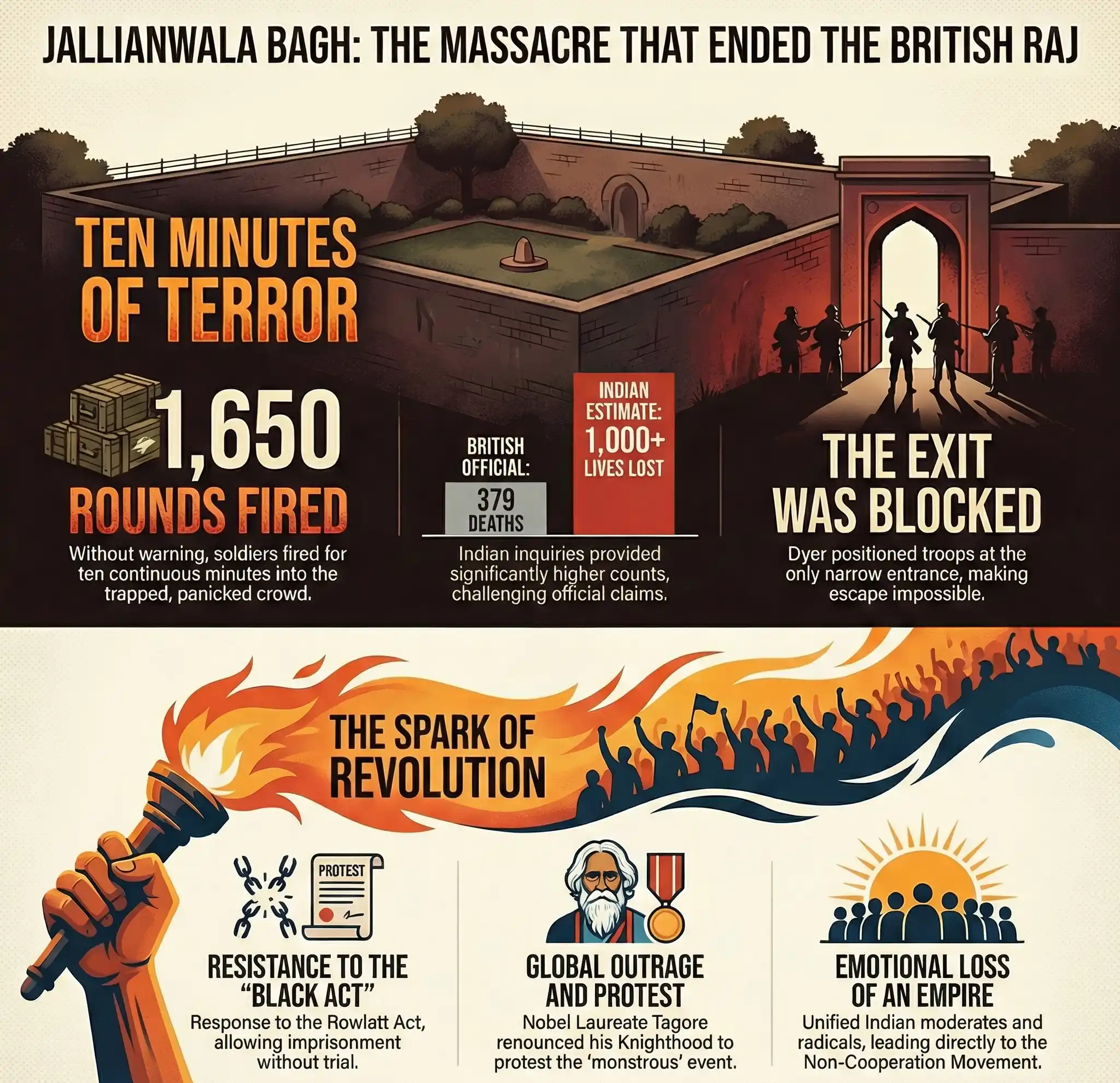
Within the hour, a British general would march his soldiers to that one gate, block it, and order them to fire into the trapped crowd. The shooting lasted about ten minutes.
The British Empire in India would take far longer to recover, and in a real sense it never did. Because the deepest horror of that day was not only the killing. It was what the empire did afterwards, when it looked at what it had done and, instead of feeling shame, called it duty. This is the story of the garden with one gate.
A city on edge
To understand the massacre, you first have to understand how angry Punjab already was.
Earlier in 1919 the British had pushed through the Rowlatt Act, a law so harsh that Indians called it the Black Act. It let the government arrest and jail people without trial, a slap in the face to a country that had just sent its sons to fight and die for Britain in the First World War, expecting greater freedom in return, not less.
Amritsar seethed. When two popular local leaders were secretly arrested and deported, protests broke out, and some turned violent, with attacks on banks and the beating of an English missionary. Alarmed, the authorities handed the city over to Brigadier-General Reginald Dyer, a soldier who believed Indians understood nothing but force. He banned all public meetings. But the order was barely publicised, and the thousands of country people pouring in for the festival had no idea it existed.

Non-Cooperation Movement 1920-1922: The Day India Said “No” to the British
Baisakhi in the Bagh
So on the afternoon of the thirteenth, the crowd that gathered in Jallianwala Bagh was not a rebel army. It was a festival crowd.
Some had come to protest the Rowlatt Act peacefully. Many more were simply there, resting, talking, minding children, with no notion that being in that garden was now a crime. Estimates put the number in the thousands, packed into an enclosed space they believed was perfectly safe.
They were wrong about the safety, and they were trapped by the very thing that made the garden pleasant: its high walls, and its single, narrow way out.
Ten minutes
General Dyer arrived at about five o’clock with around ninety soldiers. He had brought armoured cars too, but the gate was too narrow for them, so he left them in the lane behind him.
He gave no warning. He did not order the crowd to break up and go home. He simply placed his men on a raised bank and told them to open fire, aiming into the thickest parts of the crowd.
There was only one gate, and it was where the soldiers stood. The high walls that ringed the garden, meant to keep it quiet and enclosed, now made it a place with no way out.
People ran, and there was almost nowhere to run to. Some threw themselves into a well in the garden in a desperate attempt to escape the bullets. The firing stopped only when the soldiers had nearly used up their ammunition, around 1,650 rounds in all.
Then Dyer marched his men away, and here the cruelty deepened. A curfew was in force, so no one could come to help the wounded. Hundreds of injured people were left lying in the garden through the cold night, beyond the reach of any aid.
Salt Satyagraha 1930: Inside Mahatma Gandhi’s Historic Dandi March
The toll and the crawling
How many died has never been settled. The official British figure was 379. Indian inquiries put it at more than a thousand. Either way, a great number of unarmed men, women and children were shot dead in a public garden in the space of ten minutes.
And still the punishment of the city was not finished. In the lane where the English missionary had been attacked, Dyer issued what became known as the Crawling Order: any Indian who wished to pass through it had to do so on his hands and knees, crawling in the dirt. Public floggings were carried out. The intent was plain. The authorities meant not merely to kill, but to humiliate an entire people into submission.
No remorse
When word of the massacre finally escaped past the censors, it caused an uproar, and the British were forced to hold an inquiry, the Hunter Commission. It was Dyer’s own evidence to that inquiry that revealed the true nature of what had happened.
He was not sorry. He explained, calmly, that he had not fired in a panic. He had fired on purpose, to produce what he called a moral effect, a lesson for the whole of Punjab. He admitted he might have been able to scatter the crowd without firing at all, but had chosen not to, because then, he felt, the people would simply have come back and laughed at him.
He had trapped a crowd and shot it, and he told the inquiry, without apology, that he had meant to.
Dyer was quietly relieved of his command. But then came the thing that did more damage to British rule than the massacre itself. A large part of the British establishment rose to defend him. In the House of Lords and in the conservative press he was hailed as the Saviour of the Punjab, and admirers raised an enormous sum of money as a gift to him.
An empire had massacred its own unarmed subjects, and a great many of its rulers had decided to reward the man who did it.
The Quit India Movement: How a Leaderless Nation Fought for Freedom
The reckoning
That decision, more than the bullets, is what lost Britain the moral argument in India, and in the end India itself.
The great poet Rabindranath Tagore gave back the knighthood the British had granted him, writing that he no longer wished to wear an honour from a government capable of such things. Even Winston Churchill, no friend of Indian freedom, condemned the massacre as a monstrous event that stood alone in its horror. But the most important change happened in the heart of moderate India.
Until Amritsar, leaders like Gandhi had genuinely believed in British fair play, in the idea that the empire, for all its faults, could be reasoned with and reformed. After Amritsar, that faith was gone. Within a year Gandhi launched the Non-Cooperation Movement, and the polite requests of an earlier age gave way to a mass struggle to be rid of the Raj altogether.
The wound did not close for a long time. More than twenty years later, a young man named Udham Singh, whose life had been scarred by that day, walked into a hall in London and shot dead Michael O’Dwyer, the official who as governor of Punjab had backed Dyer to the hilt. At his trial he gave his name as Ram Mohammad Singh Azad, a Hindu name, a Muslim name and a Sikh name joined into one, a last act of defiance in the name of the united India the empire had tried so hard to divide.
The wall that remembers
Here, in the end, is the hard lesson of Jallianwala Bagh, and it is not only about a general with a cruel heart.
Terrible things are sometimes done in the name of every state and every flag. What decides whether a nation can live with itself afterwards is not that the horror never happened, but whether the nation is ashamed when it does. A crime you are ashamed of can, perhaps, be forgiven. A crime you are proud of is something else entirely.
In 1919, offered a clear look at its own worst face, the British Empire chose to admire it. It called a massacre a duty and pinned a purse to the chest of the man who ordered it. In that moment it told India, and told itself, exactly what its rule had become. And a power that can no longer feel shame for what it does to the people it governs has already, whether it knows it or not, begun to fall.
The bullet-scarred walls of the garden still stand in Amritsar today, the marks ringed in white so that no visitor can miss them. They are a memorial to the hundreds who died there. They are also a quiet warning, set in brick and old lead, about what becomes of any power that forgets how to be ashamed.
The Final Walk: The Conspiracy Behind Mahatma Gandhi’s Death
If you think you have remembered everything about this topic take this QUIZ
Results


#1. The Jallianwala Bagh Massacre took place on April 13, 1919, which coincided with which major festival?
#2. Who was the British officer known as “The Butcher of Amritsar” who ordered the soldiers to fire on the crowd?
#3. The crowd had gathered at Jallianwala Bagh to protest the arrest of leaders and which repressive legislation?
#4. Which Nobel Laureate renounced his Knighthood in a stinging letter to the Viceroy after the massacre?
#5. Who assassinated Michael O’Dwyer in London in 1940 to avenge the massacre?
#6. Which infamous order required Indians to crawl on their bellies in the street where a missionary was attacked?
#7. Which commission was set up by the British government to investigate the massacre?
#8. The massacre is often cited as the catalyst for which major movement launched by Gandhi in 1920?
Why did General Dyer order the firing?
General Dyer claimed he wanted to punish the people for disobeying his ban on public meetings and to create a “moral effect” to prevent a wider rebellion in Punjab.
How many people died in the Jallianwala Bagh Massacre?
The official British figure was 379 dead, but the Indian National Congress inquiry estimated the death toll at over 1,000.
What was the Hunter Commission?
It was a committee appointed by the British government to investigate the massacre. While it censored Dyer for his actions, it failed to impose any significant punishment.
Who took revenge for the massacre?
Udham Singh assassinated Michael O’Dwyer (the Governor of Punjab at the time of the massacre) in London in 1940.
Did General Dyer regret his actions?
No. Until his death in 1927, Dyer maintained that he did his duty to save India from anarchy and never expressed public remorse.
Sources & References
- Encyclopaedia Britannica (“Jallianwala Bagh Massacre” and “Rowlatt Acts”) — the massacre of 13 April 1919, its context, and the disputed death toll.
- UK Parliament, Hansard (the 1920 Commons debate on General Dyer) — Dyer’s own account, the Hunter Commission, and the divided British reaction.
- Jallianwala Bagh National Memorial — the site, the Martyrs’ Well, and the preserved bullet-marked walls.
- Amrit Mahotsav, Government of India (Udham Singh) — the man who avenged the massacre in 1940.
Author


Exploring the Soul of Bharat through History, Science, Culture, and its Diversity
Our Mission
Curious Indian is a definitive knowledge portal dedicated to chronicling the events, personalities, and cultural shifts that defined the Indian subcontinent. From the ancient Vedic Period to the complexities of 21st-century politics, our goal is to provide deep-dive analysis that inspires.
Editorial Standards & E-E-A-T
Every article published under our brand undergoes a rigorous fact-checking process. We prioritize primary historical records, academic citations, and credible archives to ensure our readers receive accurate, high-authority information.
Historical Integrity Directly sourcing from ASI archives and academic journals.Topical Authority Comprehensive clustering of Indian Science, Biographies, and Wars.Managed by Paripurna Datta and TEAM | Dedicated to the Knowledge of India.