How a sheltered prince faced the suffering we all hide from, and diagnosed its cure
A king was once warned that his newborn son might grow up to walk away from the throne and become a wandering holy man. The king, who badly wanted an heir and not a monk, decided to make quite sure his son would never have a single reason to leave.
So he built the boy a world with no sadness in it. He filled the palace with music and beauty and endless pleasure, and he hid away, safely behind the high walls, every ugly and painful thing in life. The boy, Prince Siddhartha, grew up having never once seen a sick person, an old person, or a dead body. He did not even know that such suffering existed. And that, strangely enough, would turn out to be the very thing that set him free. This is the story of how that sheltered prince became the Buddha, “the one who woke up.”
The four things he was never meant to see
For twenty-nine years, the king’s plan worked beautifully. Siddhartha lived inside a warm bubble of comfort. He married, he had a baby son, and he wanted for absolutely nothing. But slowly he grew curious about the world beyond those walls, and one day at last he rode out into the city.
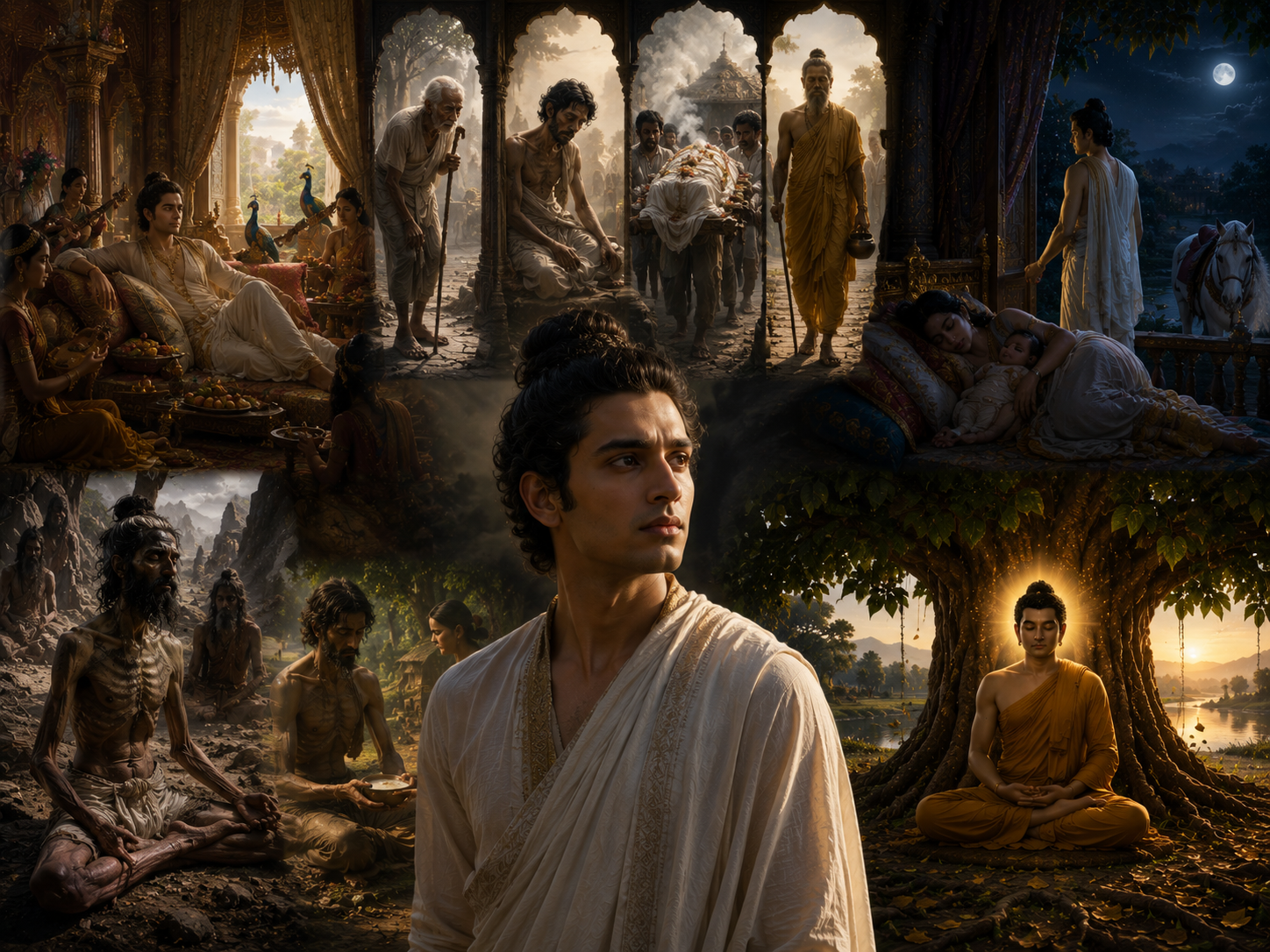
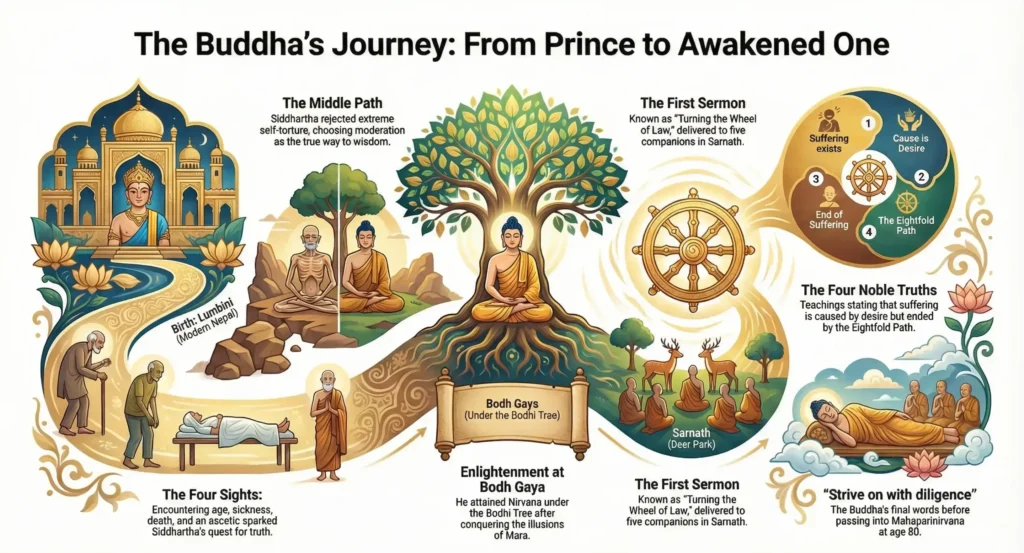
And there, for the very first time in his whole life, he saw the four things his father had so carefully hidden from him. He saw an old man, bent and trembling with age. He saw a sick man, burning with fever. And he saw a dead body, being carried away to the fire.
In a single afternoon outside the palace walls, the prince saw an old man, a sick man, and a corpse. The whole beautiful illusion shattered at once: this is what waits for everyone.
Siddhartha understood, all in a rush, that this was what lay in wait for every single person, for him, for his wife, and for his beloved baby son. All the youth and the beauty and the pleasure inside his palace was, one day, going to end in aging, in sickness, and in death. There was no escaping any of it.
And then he saw a fourth thing. He saw a wandering holy man, who owned nothing at all, and who was yet somehow calm and deeply at peace in the middle of this suffering world. And Siddhartha thought to himself: perhaps, then, there is a way to be free of all this. And perhaps I could find it.
Reign of Harshavardhana 606-647 CE: The Empire of Benevolence
Walking out
That night, the truth he had seen would not let him rest. He looked around at his sleeping palace, at the dancers who had entertained him now snoring and sprawled in the dark, all their careful beauty gone slack in sleep, and it only deepened what he now knew in his bones: that everything lovely fades away.
So he made the hardest choice of his entire life. He took one last, long look at his sleeping wife and his baby son, and then he left. At the age of twenty-nine, the prince walked quietly out of his palace, cut off his hair, put on the plain robe of a beggar, and went out into the wide world with nothing at all, to find the answer to the one question that now burned inside him: why do we suffer, and can that suffering ever truly be brought to an end?
The Dead end of pain
At first, he did exactly what the serious spiritual seekers of his day did. He set out to punish his body.
He joined a band of ascetics, and for six long years he starved and strained and denied himself almost to the point of death, firmly believing that if only he could conquer the body, then he would set the soul free. He grew so terribly thin, the old accounts say, that when he pressed his stomach he could feel his own spine. And then, worn down to the very edge of death, he had a realization that would change everything.
This was not working.
For six years he starved and punished his body, certain that pain would free him. But near death he understood a strange truth: the answer to suffering was not more suffering.
A starving, exhausted, half-dead body did not carry within it a clear and peaceful mind. It carried only a starving, exhausted body. Torturing himself, he saw, was simply a different kind of trap. The way out of suffering could not possibly be still more suffering.
Reign of Chandragupta Maurya 321-297 BCE: The First Empire of India
The middle way and the waking
So he did a very simple and a very wise thing. When a kind village girl offered him a bowl of milk and rice, he accepted it and ate, and felt his strength slowly flow back into him. He would no longer swing wildly between the two extremes he had already tried, the endless pleasure of the palace on the one side, and the endless pain of the ascetics on the other. He would instead walk a gentle, balanced path right between them, a path he came to call the Middle Way.
Then he sat himself down beneath a great fig tree near a place called Bodh Gaya, and he made one quiet, unshakeable vow: he would not get up again until he had finally understood. For days and for nights he sat there, going deeper and deeper into the quiet workings of his own mind, until at last, on one full-moon night, everything came perfectly clear. He saw, fully and completely, what suffering truly is, where it comes from, and how it can be brought to an end.
He had woken up. And that is precisely what his new name would come to mean. They called him the Buddha, which simply means “the awakened one”, the one who woke up, while all the rest of the world slept on.
The Diagnosis
What the Buddha came to understand beneath that tree, he later set out in four plain statements. And the remarkable thing about them is that they are arranged not like a grand sermon at all, but like a careful doctor’s diagnosis.
First, he named the illness. Life, he said, is shot right through with suffering. Not only the great sharp pains of sickness and loss and death, but also a low, constant dissatisfaction, a quiet sense that things are somehow never quite enough. Second, he found its cause. We suffer, he said, because we crave and we cling. We thirst endlessly for things to be other than they are, we grasp tightly at whatever we like and shove away whatever we don’t, and we can never truly hold on to any of it, because everything, always, is changing.
Third, and this was the good news, he declared that the illness could be cured. If craving is the thing that causes our suffering, then learning to loosen and let go of that craving can bring the suffering to an end. There genuinely is a way out.
The Buddha’s four truths are really a physician’s diagnosis: here is the sickness, which is suffering; here is its cause, which is craving; here is the cure, which is letting go; and here is the treatment, a way of living that anyone at all can follow.
And fourth, he wrote out the prescription: a practical, down-to-earth path of living wisely, kindly, and with great attention, a set of simple guidelines for how to think, speak, act, and pay attention, that absolutely anyone could follow to loosen the grip of craving and find some peace. And notice carefully what is not anywhere in that prescription. There is no god to beg, and no priest to pay. There is no costly sacrifice, no magic ritual, and no need whatsoever to have been born into the right caste. The cure was open to every single person, and each of them carried it out themselves, quietly, inside their own mind.
Kalinga War c. 261 BCE: The Battle That Changed Ashoka Forever
The Teacher
For the next forty-five years, the Buddha walked the long dusty roads of northern India, patiently teaching this path to anyone at all who would stop and listen. Kings and beggars, great scholars and humble servants, men and women, all of them were welcome, and all of them stood equal before the truth. He gathered his followers into a community, called the Sangha, which has lasted right down to the present day.
And when he finally died, a very old man of around eighty, he left his followers one last, very characteristic instruction. He told them not to worship him, but simply to keep working, steadily and patiently, on the freeing of their own minds.
The one who woke up
From that one man, sitting quietly beneath a tree, an entire river of history came flowing out. His teaching spread far beyond India and across the whole of Asia, up over the Himalayas into Tibet and China, and across the seas to Sri Lanka and Japan and far beyond, until the quiet insight of one sheltered prince had grown into one of the great religions of the world, followed by many hundreds of millions of people.
But strip away all of that, and what the Buddha truly offered was something very simple, and very brave indeed. He refused to look away from the hardest truth there is, that we grow old, that we fall sick, that we lose the things we love, and that we die. He looked straight at it, without once flinching, and then, instead of collapsing into despair, he asked, as calmly as any good doctor: now, what exactly can be done about this? The answer that he found is still quietly helping people, all over the earth, to suffer just a little bit less. That is what it truly means that they called him the one who woke up. He opened his eyes to the very thing that the rest of us would so much rather sleep through, and then he spent all the years he had left gently, patiently trying to wake the rest of us up as well.
Reign of Emperor Ashoka: The Transformation of a Tyrant
If you think you have remembered everything about this topic take this QUIZ
Where was Gautama Buddha born?
He was born in Lumbini, Nepal.
What are the Four Noble Truths?
They are: Life is suffering; Suffering has a cause (desire); Suffering can cease; The path to end suffering is the Eightfold Path.
Where did Buddha attain Enlightenment?
He attained Enlightenment under the Bodhi Tree in Bodh Gaya.
What is the “Middle Path”?
It is the Buddhist practice of avoiding the extremes of sensual indulgence and self-mortification.
Where did Buddha deliver his first sermon?
He delivered his first sermon at Sarnath (Deer Park).
Sources and references
- Vedanta and Acclaimed Figures (“Buddha biography”) — Siddhartha Gautama born around the 6th century BCE at Lumbini to King Suddhodana and Queen Maya of the Shakya clan, raised in luxury at Kapilavastu, married to Yashodhara with a son Rahula, and the Four Sights at 29 leading to the Great Renunciation.
- Wikipedia and Study.com (“Four sights”) — the sheltering of the prince by his father to prevent his renunciation, the encounter with an old man, a sick man, a corpse and an ascetic, and the sight of the sleeping dancing girls deepening his resolve.
- Universal Buddhism and Acclaimed Figures — the six years of extreme austerity nearly ending in death, the realization that self-denial was not the path, Sujata’s offering of milk-rice, the Middle Way, and enlightenment at 35 under the Bodhi tree after 49 days.
- Vedanta and general Buddhist sources — the first sermon at Sarnath teaching the Four Noble Truths and the Eightfold Path, the founding of the Sangha, 45 years of teaching, and the spread of Buddhism across Asia.
- Curious Indian’s own overview (“Life of Buddha”) — the diagnosis-style structure of the Four Noble Truths, the rejection of ritualism and caste, the emphasis on compassion and self-effort, and the death (mahaparinirvana) at Kushinagar around age 80.
Author


Exploring the Soul of Bharat through History, Science, Culture, and its Diversity
Our Mission
Curious Indian is a definitive knowledge portal dedicated to chronicling the events, personalities, and cultural shifts that defined the Indian subcontinent. From the ancient Vedic Period to the complexities of 21st-century politics, our goal is to provide deep-dive analysis that inspires.
Editorial Standards & E-E-A-T
Every article published under our brand undergoes a rigorous fact-checking process. We prioritize primary historical records, academic citations, and credible archives to ensure our readers receive accurate, high-authority information.
Historical Integrity Directly sourcing from ASI archives and academic journals.Topical Authority Comprehensive clustering of Indian Science, Biographies, and Wars.Managed by Paripurna Datta and TEAM | Dedicated to the Knowledge of India.