The conqueror, playwright and giving-king who briefly relit the golden age before it went dark
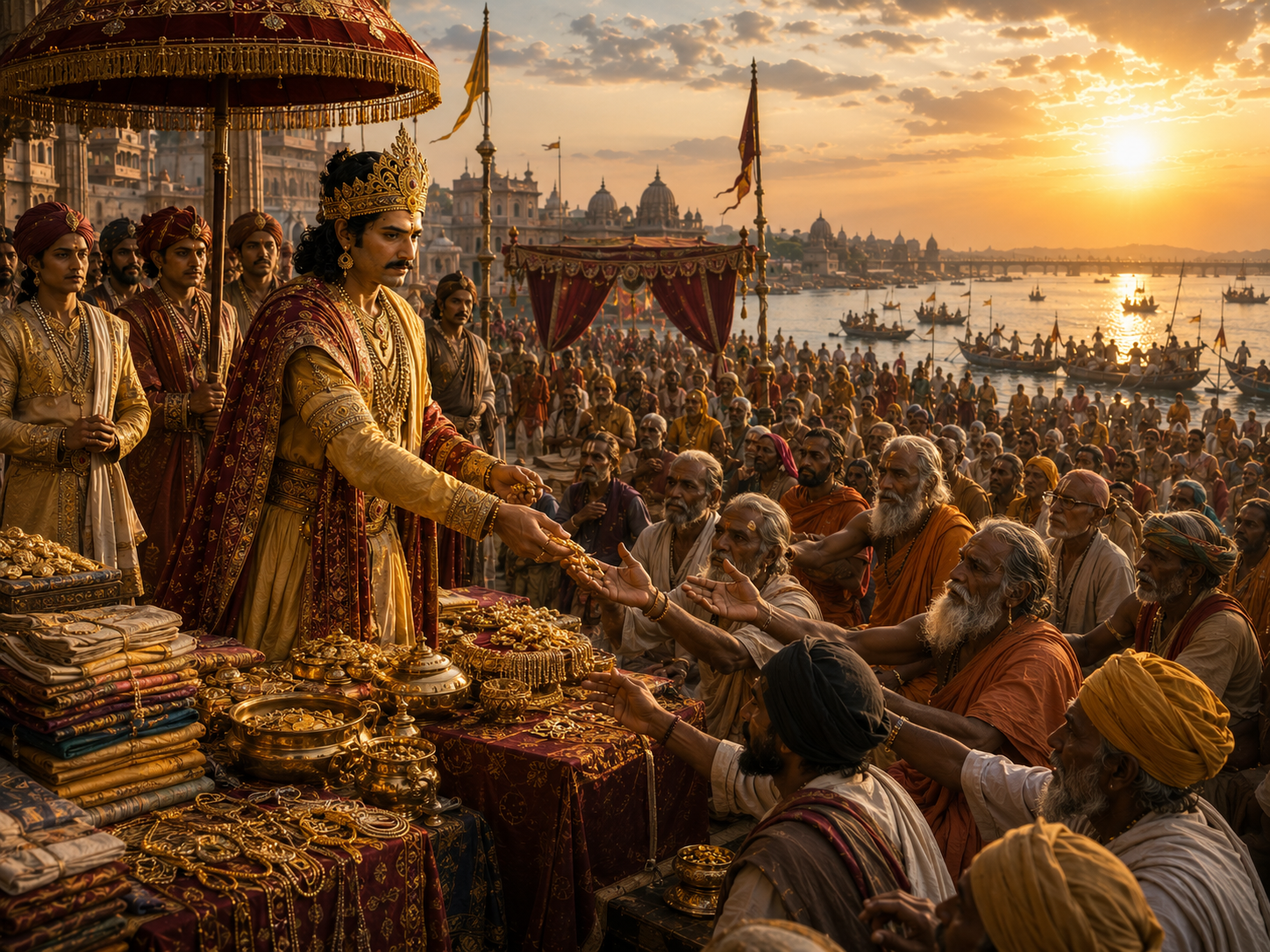
Once every five years, the emperor of northern India would do something that no emperor is ever really supposed to do. He would gather up all the wealth he had collected over those five years, his gold, his jewels, his fine robes, every last piece of it, carry it down to a great gathering on the banks of a sacred river, and then he would give the whole of it away.
He gave to the poor, to holy men of every faith, to anyone at all who was in need, until absolutely nothing was left. He gave so completely, the old story goes, that at the very end he had to borrow a plain robe from his own sister, simply so that he would have something to wear on the journey home. His name was Harshavardhana, and he was the last great emperor of ancient India. This is his story.
Reign of Raja Raja Chola I: The Golden Age of the Cholas
A boy king forged in tragedy
Harsha did not choose his throne. Grief thrust him onto it. He was a younger son, never really meant to be king at all. But then, one after another, a series of disasters struck his family.
First his father died. Then his sister’s husband, a neighbouring king, was murdered by a rival ruler, and his sister herself was thrown into prison. And then his elder brother, the new king, marched off to avenge her, and was killed too, by the very same enemy, through treachery. And so, at just sixteen years old, Harsha suddenly found himself the last man standing, and the king.
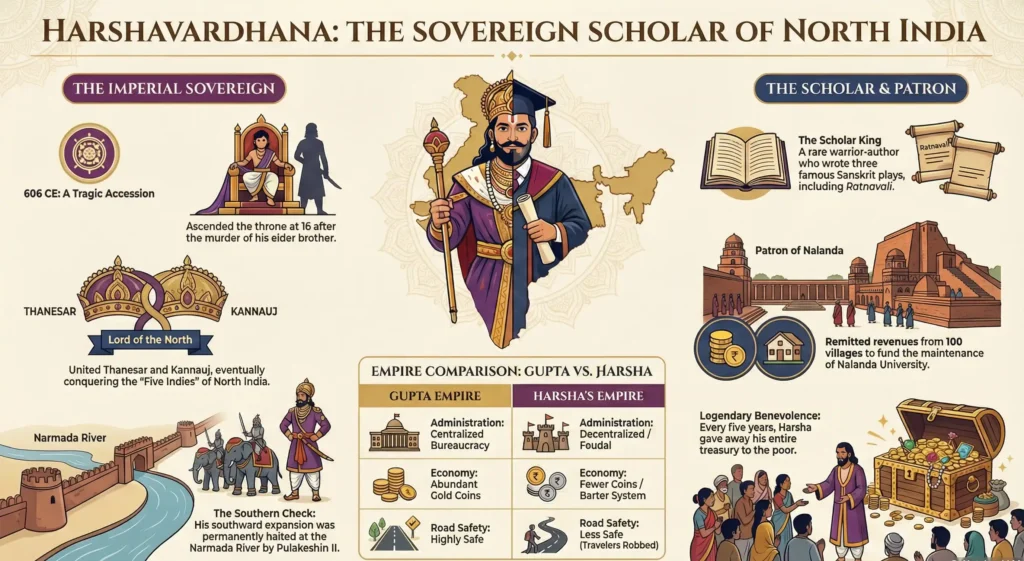
At sixteen, after his father, his brother-in-law, and his brother had all died, Harsha became king. He vowed to avenge his brother and to rescue his sister, and in time he did both.
He made two solemn vows: to avenge his brother, and to save his sister. He allied himself with a powerful neighbour, drove the enemy back, and then rode out himself to find her, reaching her, they say, at the very last possible moment, just as, in her despair, she was about to throw herself onto a funeral fire. He saved her. And in the doing of all this, he joined two kingdoms into one, and became a great king.
The king who gathered the pieces
To understand why Harsha matters so very much, you have to remember what had come just before him. For two hundred years, India had basked in the glory of the Gupta golden age. But that age had ended. Its great empire had been smashed by invaders, and the whole of northern India had shattered into a chaos of small, quarrelling kingdoms.
And then came Harsha. One by one, patiently, he gathered the broken pieces back together again, until once more a single emperor ruled over almost all of the north, from the Himalayan mountains down to the Narmada river, and from Punjab across to Bengal. For one last, brilliant moment, the north of India remembered what it felt like to be whole. A Chinese traveller who came to visit him gave him a fine title: the “Lord of the Five Indies.”
Chola Naval Expedition to Southeast Asia: When India Ruled the High Seas
The river he could not cross
But there was one thing that even Harsha could not do. He could not take the south.
When he marched his great army down toward the Deccan, hoping to make himself the master of all India, he was met at the Narmada river by a mighty southern king named Pulakeshin, of the Chalukya dynasty. And there, at the river’s edge, Harsha, the great lord of the north, was soundly defeated and turned back.
Harsha ruled all of the north, but when he marched south to conquer the whole of India, the Chalukya king Pulakeshin defeated him at the Narmada and turned him back. The north was his; the south never would be.
The Narmada became the wall that he simply could not climb. He would rule the north, and only the north, and the proud old kingdoms of the south would stay forever free of him. It was a lasting reminder that India was, and perhaps always would be, far more than any single land could ever fully hold in one hand.
The king who wrote plays
Harsha was a hard soldier when he had to be. But there was another, far gentler side to this emperor, and it is one of the most surprising things of all about him. This mighty conqueror was also, in his heart, a writer.
In his quieter hours, Harshavardhana wrote plays, real, polished, graceful dramas in Sanskrit, three of which have survived all the way down to our own day. Picture it: a king who commanded whole armies by day, and sat down to write love stories and comedies by night.
This emperor was also a playwright. Harsha wrote three Sanskrit dramas that still survive, a king who commanded his armies by day and wrote his plays by night.
He filled his court with poets and scholars, and his own court writer composed a famous account of his life, one of the very first true biographies that India ever produced. He generously supported the great university at Nalanda, where students journeyed from all across Asia to study. Like the golden-age emperors before him, Harsha firmly believed that a true king should be a man of learning every bit as much as a man of war.
The great giving
And so we come back, at last, to that astonishing act of giving. Every five years, Harsha held his huge gathering at the holy meeting-place of the rivers, and there he gave everything he owned away.
He was a deeply religious man, first a follower of the god Shiva, later drawn toward the teachings of the Buddha, but always respectful of every single faith. And he believed, sincerely, that a king held his great wealth not for himself, but only in trust for his people. So, quite simply, he gave it all back to them. Piece by piece, he handed out the entire contents of his treasury, until, it is said, he had given away even the royal robe off his own back, and stood there before his people with nothing at all.
Every five years, Harsha gave away his whole treasury to the poor and to holy men of every faith, keeping nothing for himself, until he had to borrow a plain robe just to travel home.
A Chinese monk named Xuanzang, who spent years living at Harsha’s court, watched one of these great givings with his own eyes. He wrote of a land that was prosperous and peaceful and just, with rest-houses along the roads for weary travellers and real care for the poor, all of it ruled by a king who chose to keep almost nothing for himself.
The light goes out
But here is the sad and important truth about Harsha’s whole empire. It was held together, in the end, by one single thing above all others: by Harsha himself. By his own restless energy, his own iron will, his own personal greatness. There was no deep and lasting machine of government running quietly beneath him, of the kind that the Guptas had so carefully built. In a real sense, the empire simply was Harsha.
And so, when Harsha died in the year 647, after forty-one long years upon the throne, and left behind him no son, no heir, no one at all to take up his fallen crown, the whole great structure simply collapsed. Almost at once, the north shattered once again into a hundred squabbling little kingdoms. And this time, it would stay shattered for a very, very long time indeed. No one would manage to gather the north of India back into a single empire for another six hundred years.
Foundation of the Vijayanagara Empire: The Rise of Hampi
The sunset of an age
That is exactly why Harshavardhana is remembered as the last great king of ancient India. He was the final flicker of a golden lamp that had been burning, on and off, for a thousand years.
In this one man, all the old ideals came together one final time: the conqueror and the poet, the mighty ruler and the humble giver, the man of war and the man of God. He briefly lit the whole north back up, and reminded it, for a moment, of its own lost glory. And then he died, and the lamp guttered out, and a long twilight settled slowly over the land. There is something fitting, somehow, in the fact that the very last of the great old kings was not a man who grasped and hoarded and clung, but a man who gave everything away. Harsha ruled a vast empire, wrote beautiful plays, and gathered a shattered world back together for a few short decades. But perhaps the thing he most wished to be remembered for was the simplest of them all: that he was an emperor who, again and again, gave away all that he had, and asked to keep nothing but the memory of having done a little good.
Reign of Akbar 1556-1605: The Golden Age of the Mughal Empire
If you think you have remembered everything about this topic take this QUIZ
Results


#1. After uniting the kingdoms of Thanesar and Kannauj, to which city did Harshavardhana move his political capital?
#2. Which Chalukya king defeated Harshavardhana at the Battle of Narmada, successfully halting his southward expansion?
#3. Harshavardhana was a unique blend of a warrior and a writer. Which of the following Sanskrit plays was authored by him?
#4. Which famous Chinese traveler visited India during Harsha’s reign and noted that the roads were less safe compared to the Gupta period?
#5. Harsha was a chief patron of which ancient educational institution, remitting the revenues of 100 villages for its upkeep?
#6. At the Prayag Assembly (Moksha Parishad) held every five years, what extraordinary act of generosity was Harsha known for?
#7. According to the comparison table, how did Harsha’s administration primarily differ from that of the Gupta Empire?
#8. Harsha’s first mission upon being crowned king at age 16 was to rescue his sister from committing Sati in the Vindhya forests. What was her name?
Who was the court poet of Harsha?
Banabhatta was his court poet, who wrote Harshacharita and Kadambari.
Which Chinese traveler visited Harsha’s court?
Xuanzang (Hiuen Tsang) visited his court and stayed in India for 15 years.
Who defeated Harshavardhana?
The Chalukya king Pulakeshin II defeated him on the banks of the Narmada River.
What plays did Harsha write?
He wrote Ratnavali, Priyadarshika, and Nagananda.
Where did Harsha shift his capital?
He shifted his capital from Thanesar to Kannauj.
Sources and references
- BYJU’s and The Indosphere (“Harsha”) — Harsha (r. 606–647 CE) of the Pushyabhuti/Vardhana dynasty, his accession at sixteen after Shashanka of Gauda killed his brother-in-law Grahavarman and his brother Rajyavardhana, his rescue of his sister Rajyashri, and the uniting of Thanesar and Kannauj.
- SPMIAS and Vishvas Career Academy — the empire stretching from the Himalayas to the Narmada and Punjab to Bengal, the “Lord of the Five Indies,” and the defeat by the Chalukya Pulakeshin II at the Narmada (c. 618–619 CE) that prevented an all-India empire.
- BYJU’s and UPSC-notes sources — Harsha’s authorship of the Sanskrit plays Ratnavali, Priyadarshika and Nagananda, his court poet Banabhatta’s Harshacharita, and the visit of the Chinese pilgrim Xuanzang.
- Cultural India and general histories — Harsha’s shift from Shaivism toward Buddhism (encouraged by his sister Rajyashri), his tolerance and patronage of Nalanda, his benevolent rule and rest-houses for the poor as recorded by Xuanzang, and the quinquennial charitable assembly at Prayag where he distributed his wealth.
- Curious Indian’s own overview (“Reign of Harshavardhana”) and Wikipedia — his death in 647 without an heir, the rapid disintegration of his personally-held empire, and his standing as the last great emperor of northern India before centuries of fragmentation.
Author


Exploring the Soul of Bharat through History, Science, Culture, and its Diversity
Our Mission
Curious Indian is a definitive knowledge portal dedicated to chronicling the events, personalities, and cultural shifts that defined the Indian subcontinent. From the ancient Vedic Period to the complexities of 21st-century politics, our goal is to provide deep-dive analysis that inspires.
Editorial Standards & E-E-A-T
Every article published under our brand undergoes a rigorous fact-checking process. We prioritize primary historical records, academic citations, and credible archives to ensure our readers receive accurate, high-authority information.
Historical Integrity Directly sourcing from ASI archives and academic journals.Topical Authority Comprehensive clustering of Indian Science, Biographies, and Wars.Managed by Paripurna Datta and TEAM | Dedicated to the Knowledge of India.