How Akbar the Great ruled India by tolerance, not the sword
Here is a strange fact about the man many people call the greatest ruler in Indian history. He could not read a single word.
Akbar, the third Mughal emperor, almost certainly never learned to read or write. Many historians think he was dyslexic. And yet this is the man who built one of the largest and best-run empires the subcontinent had ever seen, filled his court with poets and scholars, and had books read aloud to him every day until he knew more than most of the learned men around him.
He came to the throne as a frightened boy of thirteen. He left it, fifty years later, as “Akbar the Great.”
This is the story of how that happened, and of the one big idea that made it possible.
A boy king among wolves
It began, as these Mughal stories often do, with a sudden death.
In 1556, Akbar’s father Humayun slipped on the stone steps of his library and died. Akbar was only thirteen, and far from safe. He was crowned in a hurry on a raised brick platform at Kalanaur, in Punjab, while enemies closed in from every side.
The most dangerous of them was a general named Hemu, who had already seized Delhi and Agra and crowned himself king. The child emperor did not save himself. His guardian and regent, Bairam Khan, did that, winning the Second Battle of Panipat later the same year when a chance arrow struck Hemu down at the decisive moment.
So Akbar kept his throne. Now he had to work out how to keep an empire.
Nadir Shah’s Invasion of Delhi 1739: The Massacre That Emptied India
The lesson he learned early
Akbar understood something that many conquerors never do. He saw that a small group of foreign Muslim nobles, Turks and Persians and Uzbeks, could not hold down a vast land where most people were Hindu. Not by force alone, and not forever.
If the Mughals wanted to stay, they had to stop being foreign occupiers and start being Indian rulers. That single insight shaped almost everything he did.
He reached out to the proud Rajput kings of the north. He married a Rajput princess, Harkha Bai of Amber, and did something his ancestors would never have done: he let her keep her own religion inside his own household, praying as a Hindu in the heart of the Mughal palace.
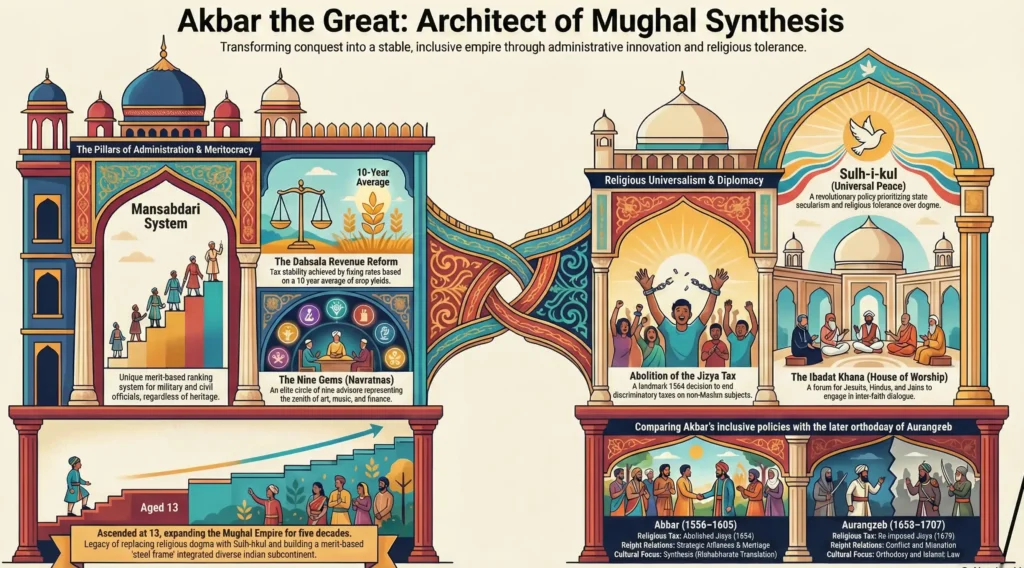
In 1564 he abolished the jizya, the special tax that non-Muslims alone had to pay. To ordinary Hindus, it was a clear signal that this emperor might actually be theirs too.
Not everyone was won over, and Akbar did not win every fight. The Rajput hero Maharana Pratap of Mewar refused to bow, and their long struggle, remembered in the Battle of Haldighati in 1576, became a lasting legend of resistance. But across most of the land the strategy worked. Through a mix of marriage, respect and war, Akbar spread Mughal rule over Gujarat, Bengal, Kashmir and much of the rest of the subcontinent.
The machine that ran an empire
Winning land is one thing. Governing it is much harder, and this is where Akbar truly shone.
He built a system to run his empire that historians sometimes call its steel frame: the Mansabdari system. Every important officer was given a numbered rank that fixed both his personal standing and the number of soldiers he had to supply. It tied the whole nobility into one clear chain of command.
The clever part was that rank was not inherited. You rose by ability, not by birth. A Hindu Rajput like Raja Man Singh could climb to the very top of a Muslim empire on merit alone.
Akbar’s finance minister, Raja Todar Mal, tied farmers’ taxes to a ten-year average of their harvests, so a single bad year no longer meant ruin. It steadied the peasant and the treasury at once.
For its day, it was a remarkably fair and modern way to run a state.
Battle of Plassey 1757: The Betrayal That Changed India’s Destiny
The house of worship
For all his soldiering, the thing that fascinated Akbar most was religion, and here the emperor who could not read turned into a genuine seeker.
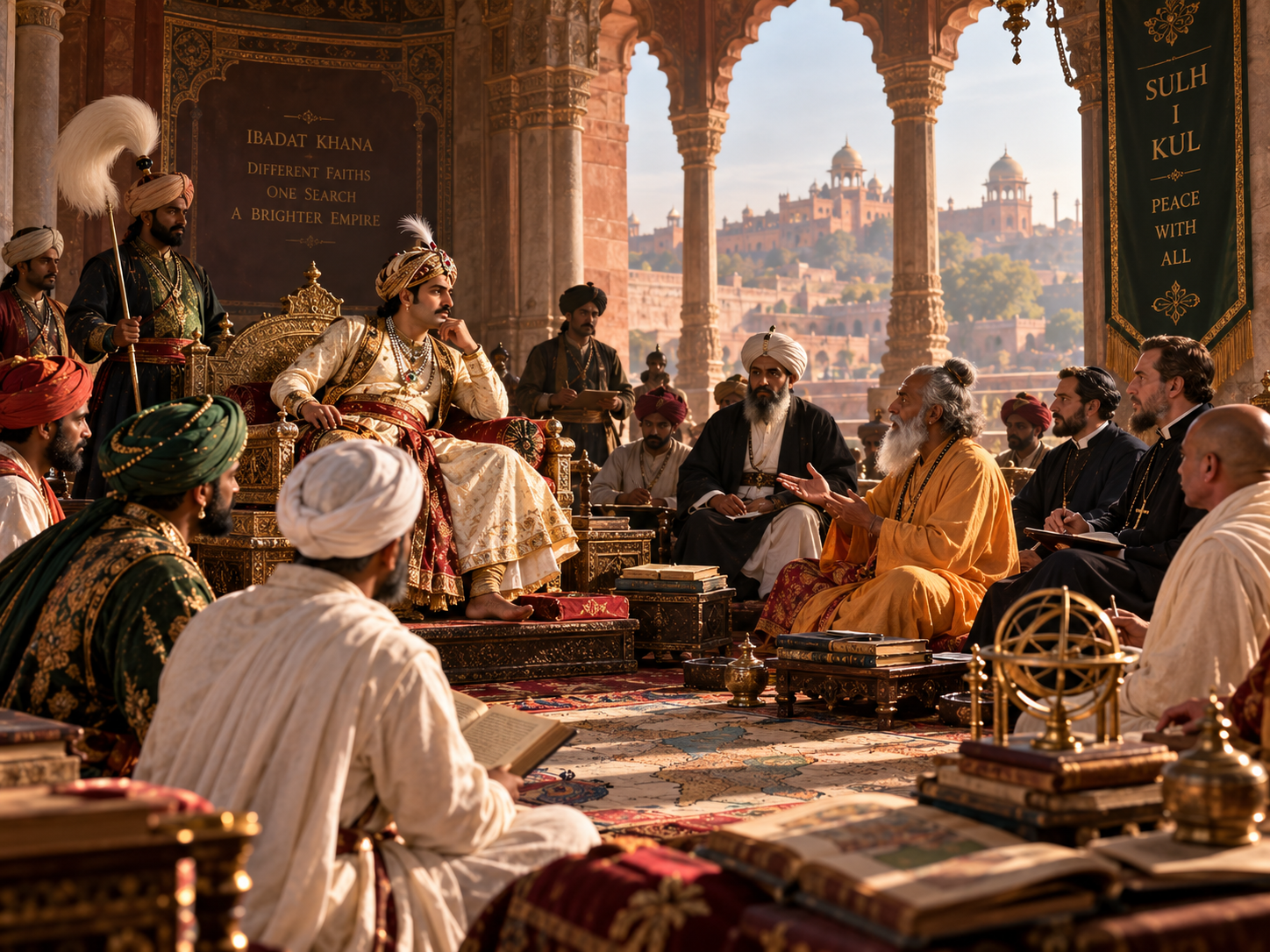
At his new city of Fatehpur Sikri, he built a hall called the Ibadat Khana, the House of Worship. Into that room he invited Muslim clerics, Hindu pandits, Jain monks, Zoroastrian priests and Christian Jesuits who had travelled up from Goa, and he set them to debate the deepest questions of faith while he listened.
What he heard, mostly, was learned men squabbling, each insisting he alone held the truth. It seems to have left him unimpressed with all of them.
Out of that disappointment came his most personal experiment. In 1582 he put forward something he called Din-i-Ilahi, the Divine Faith. It was less a religion than a simple code of good living: be kind, be honest, be moderate, be devout. It won almost no followers beyond a few close friends like Birbal, and it quietly died when Akbar died. But it captured his real conviction, summed up in his guiding idea of sulh-i-kul, or peace with all.
The man himself
Behind the emperor was a curious, restless human being.
He could not read, yet he loved knowledge so much that he kept a stream of readers going through the great books of the world. He also gathered nine brilliant men, the Navratnas or “nine gems,” around him. Among them were the witty Birbal, the historian Abul Fazl who wrote the official chronicle of the reign, and the singer Tansen, whose voice people swore could summon the rain.
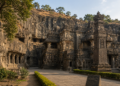
He built a whole new capital, Fatehpur Sikri, in red sandstone, to honour a Sufi saint who had promised him a son. Then, only about fifteen years later, he simply walked away from it when the water ran short, leaving behind the beautiful ghost city that still stands today.
In his later years he mostly gave up meat, uneasy about the killing. His reason was gentle and blunt at the same time:
“It is not right that a man should make his stomach the grave of animals.”
He was not a saint, and it is worth being honest about that. His flirtation with a faith built around himself, and a court greeting, Allah-u-Akbar, that could be read as either “God is Great” or “Akbar is God,” show a man who rather enjoyed sitting near the centre of the universe.
Reign of Aurangzeb 1658-1707: The Zenith and Decline of the Mughals
Why he still matters
Strip away the battles and the buildings, and Akbar’s real achievement was an idea.
He grasped, earlier and more fully than almost any ruler of his age, that you cannot govern a mixed country by crushing its differences. You have to make room for them. He turned a foreign warlord’s dynasty into something that felt Indian, and he held it together not with fear but with a kind of deliberate, hard-headed tolerance.
The tragedy is how fragile that turned out to be. His personal faith vanished within a generation, and later Mughal rulers would throw away much of his open-handed spirit and reap the bitterness that followed. But for half a century, an illiterate boy who grew into a thoughtful king showed what was possible. That, far more than any conquest, is why history still calls him great.
Reign of Shah Jahan: The Golden Age of Mughal Architecture
If you think you have remembered everything about this topic take this QUIZ
Results


#1. At what age did Akbar ascend the throne after the sudden death of his father Humayun?
#2. Who was the regent and guardian who led the Mughal forces to victory at the Second Battle of Panipat?
#3. Which discriminatory tax on non-Muslims did Akbar abolish in 1564?
#4. What was the name of the new capital city built by Akbar to honor the Sufi saint Salim Chishti?
#5. The “Mansabdari System” introduced by Akbar was a unique administrative system based on:
#6. Who was the Finance Minister (Diwan) responsible for introducing the Dahsala revenue system?
#7. What was the name of the syncretic ethical code or “Divine Faith” propounded by Akbar in 1582?
#8. Which legendary musician, one of the Navratnas, was believed to be able to light lamps with his voice?
When did Akbar ascend the throne?
He became emperor in 1556 at the age of 13.
What was the Second Battle of Panipat?
It was a battle fought in 1556 between the forces of Akbar (led by Bairam Khan) and the Hindu king Hemu. Akbar’s victory secured Mughal rule in India.
What was the Mansabdari System?
It was an administrative system introduced by Akbar where every official was given a rank (Mansab) determining their status and the number of troops they had to maintain.
Who was Akbar’s famous Finance Minister?
Raja Todar Mal was his finance minister, famous for introducing the Dahsala revenue system.
Did Akbar start a new religion?
He started a syncretic spiritual movement called Din-i-Ilahi (Divine Faith), which blended elements of Islam, Hinduism, Zoroastrianism, and Christianity, but it was not a formal religion with a scripture.
Sources & References
- Encyclopaedia Britannica (“Akbar”) — his accession at thirteen, the reign from 1556 to 1605, the conquests, and the administrative and religious reforms.
- Abul Fazl, Akbarnama and Ain-i-Akbari (Packard Humanities Persian archive) — the workings of Akbar’s court and administration, recorded by his own official historian.
- Oxford Reference (Din-i-Ilahi) — the Divine Faith of 1582 as an ethical code rather than a formal religion.
- Ministry of Culture, Indian Culture portal (Battle of Haldighati) — the 1576 clash with Maharana Pratap and the Rajput resistance to Mughal expansion.
- UNESCO World Heritage Centre (Fatehpur Sikri) — the capital Akbar built and soon abandoned.
Author


Exploring the Soul of Bharat through History, Science, Culture, and its Diversity
Our Mission
Curious Indian is a definitive knowledge portal dedicated to chronicling the events, personalities, and cultural shifts that defined the Indian subcontinent. From the ancient Vedic Period to the complexities of 21st-century politics, our goal is to provide deep-dive analysis that inspires.
Editorial Standards & E-E-A-T
Every article published under our brand undergoes a rigorous fact-checking process. We prioritize primary historical records, academic citations, and credible archives to ensure our readers receive accurate, high-authority information.
Historical Integrity Directly sourcing from ASI archives and academic journals.Topical Authority Comprehensive clustering of Indian Science, Biographies, and Wars.Managed by Paripurna Datta and TEAM | Dedicated to the Knowledge of India.