Santiniketan, 1928: at sixty-seven, an old poet who had spent his life with words suddenly sat down with only black ink and paper. What emerged were faces that refused to smile
For fifty years, Rabindranath Tagore had written with words. Poems that made India think differently about itself. Love songs on the soul. He had founded a university, travelled the world, won the Nobel Prize. He had made a career out of teaching people to see beauty.
Then, at sixty-seven years old, he put down the pen and picked up the brush.
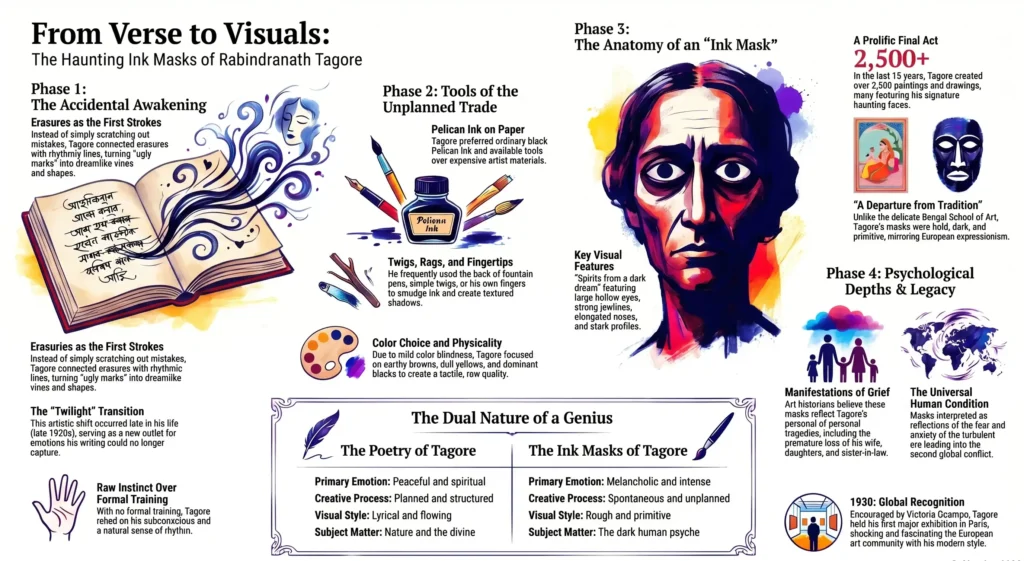
It was 1928. He had done this before, scattered through his life—little drawings in the margins of his poetry manuscripts, doodles and scribbles made from words he had crossed out. But now, for the first time, he sat down deliberately and decided to paint. Not as a hobby. As a practice. As a discipline.
He made thousands of sketches that year.
Begum Hazrat Mahal: How She Held Awadh Together in 1857
What emerged from the vacant hours
He wrote: “The phantoms of faces, come unbidden into my vacant hours.”
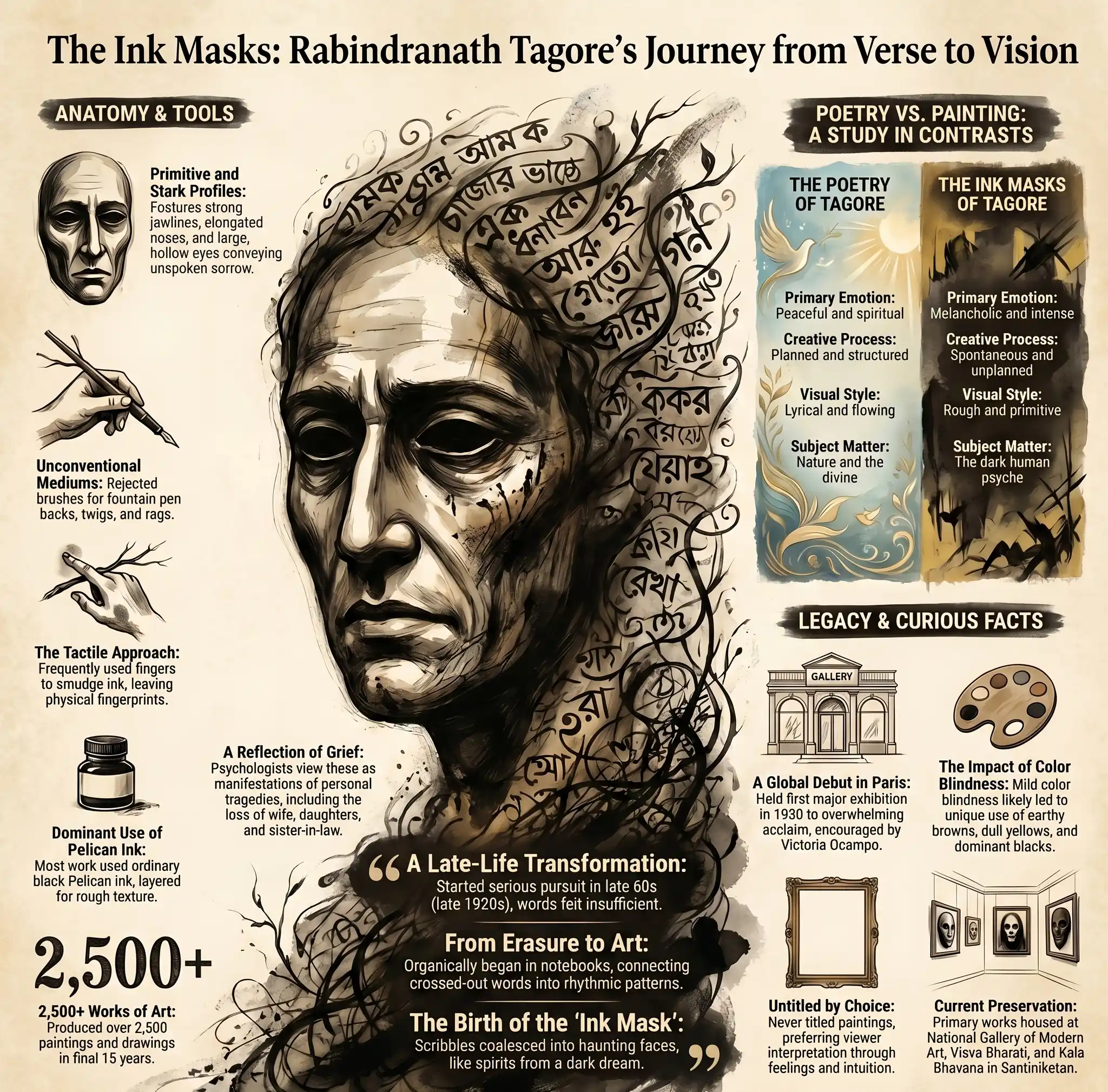
The faces were not beautiful. They were mask-like, dark, heavy with feeling. Some grotesque, some tragic. All drawn in black ink with lines that seemed to move on their own, as if his hand was allowing what was inside him to pour out rather than deciding what to draw.
The eyes were often downcast. Heavy undereye circles suggested exhaustion or dejection. The noses were sharp. The mouths thin. It was as if, after a lifetime of painting India in words—its beauty, its philosophy, its spiritual depth—he was finally drawing what he actually felt: the weight of memory, the ache of loss, the knowledge that some things could not be made beautiful.
The man who had taught the world to see beauty was finally drawing what he actually felt.
The memory that haunted the brush
Scholars have pointed to a particular face that recurs in his paintings: a woman with pensive eyes, often interpreted as the looming memory of his intellectual companion and sister-in-law Kadambari, who died by suicide a few months after Tagore’s marriage.
That was in 1884. It was now 1928. Forty-four years had passed, and the face was still there, emerging unbidden from his hand. Not in any conscious way. The faces came through “rhythmic automatism”—not deliberate distortion, but a process of the hand moving as the mind ordered it, anatomical changes and variations of form and proportion happening as if on their own.
The man who had spent his life teaching others to see beauty had spent fifty years carrying a face he could not forget. And now, in his vacant hours, he was finally drawing her.
Why the mask
He began to study masks. Native American totemic masks. Ancient ritual masks. The idea that a face could be a mask—something that conceals as much as it reveals. Something that hides the person inside.
His paintings became full of these mask-like faces. Masks and mask-like faces suggested performance, concealment, and the fragmentation of identity in modern life. Sometimes there were whole fields of them, repeated faces floating against pale ground, each one slightly different, each one suggesting a presence without personality. A collective face. A human psyche fractured into pieces.
He was painting the inside of his own mind. Not the India he had written about, which was ancient and spiritual and wise. But the India inside Rabindranath Tagore, which was fragmented, haunted, full of faces that would not leave him alone.
The first exhibition
Savitribai Phule: School That Changed India’s History
His first exhibition of paintings was held in 1930 in Paris. He was sixty-nine years old. He had created thousands of drawings in two years. The art world received him well. Critics compared him to European modernists. They saw in his work the influence of Surrealism, of Expressionism, of the artistic movements of the time.
But what he had made was simpler than any of that. He had simply opened himself and let the contents spill onto paper. No beauty. No philosophy. No instruction. Just the faces.
What a poet could not say with words
A poet’s power is that he can make you feel things you did not know you felt. He can turn grief into art that means something to strangers. He can universalise the personal until it becomes almost philosophical.
But some things resist that transformation. Some things cannot be made beautiful. Some things can only be drawn, in black ink, in the form of a mask-like face that refuses to smile.
Tagore spent his life teaching India to see itself with new eyes. In his final years, he drew what his own eyes had seen, what they could never unsee: the face of someone he loved, haunting him across forty-four years, finally emerging from the dark ink, finally allowed to be real.
Mysterious Bird Deaths In Jatinga Valley That Science Cannot Fully Explain
If you think you have remembered everything about this topic take this QUIZ
Results


#1. At what stage of his life did Rabindranath Tagore unexpectedly shift his creative focus from writing to painting?
#2. How did the visual patterns that birthed Tagore’s new artistic career initially begin?
#3. What specific commercial medium readily found on his writing desk did Tagore primarily use for his dark portraits?
#4. What name is frequently used to describe the haunting, hollow-eyed human faces that became a primary subject of Tagore’s art?
#5. In which major city did Rabindranath Tagore hold his first successful public art exhibition in the year 1930?
#6. How did Tagore’s artistic style differ from the contemporary Bengal School of Art led by his nephew Abanindranath Tagore?
#7. According to the fast facts, what physical condition is believed to have influenced Tagore’s unique, earthy color choices?
#8. Why did Rabindranath Tagore intentionally choose to never give official titles to his paintings?
When did Rabindranath Tagore start painting?
He seriously began drawing and painting when he was around sixty seven years old in the late nineteen twenties.
What materials did he use for his art?
He mostly used ordinary writing ink on paper, applying it with fountain pens, twigs, small rags, and even his own fingers.
Why do his faces look so dark and sad?
Experts believe the dark emotion reflects his deep personal grief over losing many family members and his thoughts on human suffering.
Did he ever exhibit his paintings in public?
Yes, he held his first major and highly successful art exhibition in Paris in the year nineteen thirty.
Where can people view these original paintings today?
Many of his original artworks are kept at the National Gallery of Modern Art in New Delhi and the museum in Santiniketan.
Sources & References
Metropolitan Museum of Art, “Face” (n.d.) — Rabindranath Tagore’s first exhibition held in 1930 in Paris, developed visual art practice later in life, interest in subconscious and how memories and emotions could guide image making, focus on rendering human face.
En Route Indian History, “Rabindranath Tagore: Painting the Subconscious Mind” (2023) — pen-and-ink drawings of heads in later years, mastery over line and tone, “The phantoms of faces, come unbidden into my vacant hours” from Chitralipi, the book of his paintings, process of “rhythmic automatism” where anatomical changes happen through rhythmic rather than deliberate distortion.
Impart, “Rabindranath Tagore” (2026) — the haunting face of a woman with pensive eyes interpreted as looming memory of Kadambari, sister-in-law who died by suicide a few months after Tagore’s marriage; masks and mask-like faces suggesting performance, concealment, and fragmentation of identity.
Simply Kalaa, “Rabindranath Tagore Paintings: A Poet’s Take at Art of Painting” (2024) — black ink with hues of black shades in dark moments in life, discovery of Native American ritual masks and totemic animals influencing the turn toward mask-like faces.
Astaguru, “Rabindranath Tagore — Artist Profile” (2024) — ink and wash technique with subtle gradations, spontaneous and fluid approach, repetitive motifs including dark brooding figures, mysterious landscapes, abstract forms resembling masks or faces.
V&A Museum, “Lithograph, Tagore” (n.d.) — around age 67, around 1928, took up painting more consistently, made thousands of sketches and drawings using brush, pencil and pen, style characterized by simple bold forms and rhythmic quality.