Lucknow, 30 June 1857: a woman whose husband had been exiled and whose state had been annexed watched the British army retreat into the Residency. She had ten months to hold what they had lost
Three days earlier, on May 31, 1857, Awadh had declared itself free. The native rulers and people of Lucknow gathered and rose with the rebellion, united by one fact: the British had taken their state. A year before, they had imprisoned the last nawab, Wajid Ali Shah, exiled him to Calcutta, and annexed his kingdom claiming it was misgoverned.
On June 30, 1857, at Chinhat, a village outside Lucknow, the first real test came.
The British army marched out to crush the rebellion. They had thousands of troops, artillery, the discipline of the Raj. What they faced was something they had not expected: the local nobility, the people, the peasants—a coalition of everyone who had lost something to British rule. And at the front of that coalition was a woman.
By November, British relief forces finally broke through.
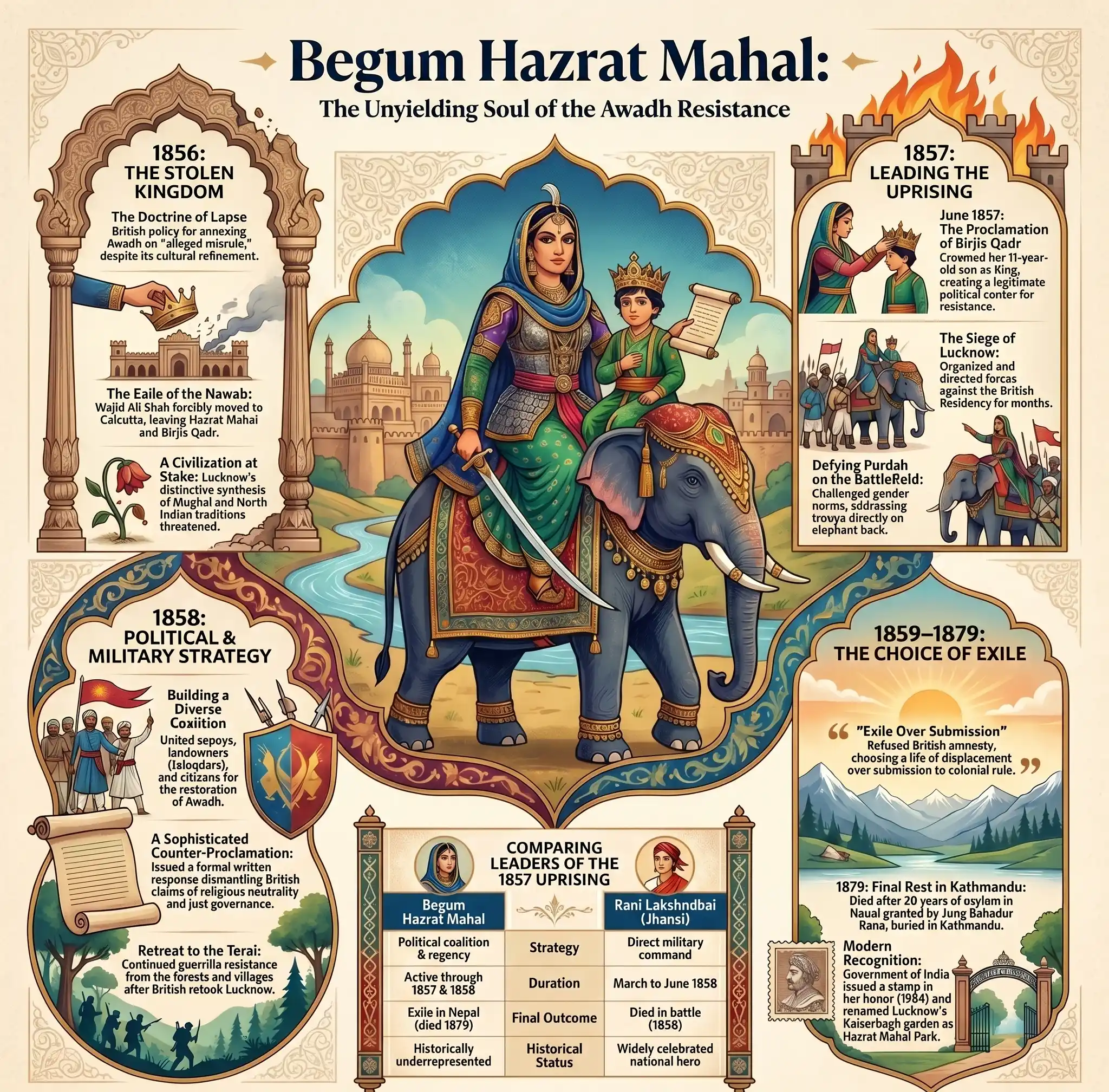
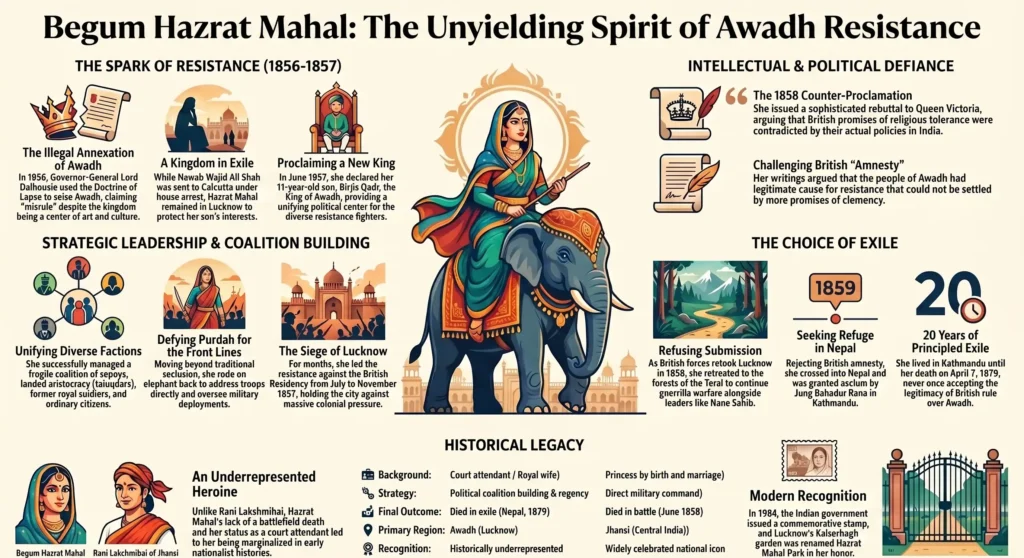
She came from a modest background in Faizabad, likely Afghan-Pashtun descent. Born Muhammadi Khanum, she had been taken into the nawab’s household as a young girl and became his second wife. When the British exiled her husband to Calcutta, they left her behind with her son—a boy of eleven. She had nothing left except the knowledge that if she did nothing, her son would grow up under British rule. She decided to act.
When the rebellion started, she moved quickly. She reached out to the local zamindars, the military commanders, the religious leaders, the ordinary people of Awadh who had been wronged by the annexation. She appealed to them personally, going from camp to camp, giving fiery speeches. She offered something that might have seemed impossible: a way to fight back.
On June 30, at Chinhat, that coalition faced the British. And they won. The British army was decisively defeated and forced to retreat into the fortified Residency in Lucknow—the compound where the Company’s Chief Commissioner Henry Lawrence was based, along with a garrison of about 1,700 troops and hundreds of civilians.
That single victory changed everything. William Howard Russell, the famous British war correspondent, later wrote: “The Begum of Awadh shows greater strategic sense and courage than all her generals put together.”
For ten months, she laid siege to the British Residency.
The regent and the young king
She proclaimed her son, Birjis Qadr, as the new Nawab of Awadh on July 7, 1857. He was eleven years old. She would rule as regent.
This was a deliberate political act to consolidate the diverse forces fighting the British—taluqdars, sepoys, ordinary citizens. By putting her son on the throne, she gave them all something to fight for: Awadh’s independence.
She gathered an army. The accounts say she assembled as many as 180,000 troops. She renovated the Lucknow fort and spent enormous sums reinforcing it. She established a high-level committee for the governance of Awadh, appointing nobles and experienced administrators to run the state while she fought.
And then, for ten months, she laid siege to the British Residency.
From July 1857 to November 1857, the Begum’s forces pressed against the walls of the Residency. The British inside were surrounded. They had limited supplies. They were trapped in their compound with thousands of civilians—wives, children, servants, all of them dependent on the garrison for protection.
The Begum did not stay in a palace. The accounts describe her going from camp to camp, on an elephant, to raise the morale of her troops. She gave speeches. She was present at battles. She was not a figurehead who sent men to fight for her. She was a woman who risked her own life alongside them.
By November, British relief forces finally broke through. Sir Colin Campbell’s army relieved the Residency. The Begum’s forces were pushed back. The city fell to the British again.
What came after
She could have surrendered. The British offered her money, luxury, comfort—everything they could give her if she would only acknowledge British rule and come back.
Instead, she retreated to the Nepal forests along with other rebel leaders. And from Nepal, she continued to fight, to write, to organise, refusing every offer the British made her. They offered her pensions, honours, a return to Lucknow. She refused everything. There was only one thing acceptable to her: an independent Awadh.
She never got it. In 1879, in Kathmandu, she died. Still fighting. Still refusing to accept British rule. Still the regent of a state that no longer existed.
The name that remained
In 1984, more than a hundred years after her death, the Government of India issued a commemorative postal stamp in her honour. The Kaiserbagh garden in Lucknow, near the site of the most intense fighting during the siege, was renamed Hazrat Mahal Park.
She had been left with nothing: a husband exiled, a kingdom taken, a son too young to rule. She had not accepted any of it. Instead, for ten months, she had held Awadh together. She had shown that even when defeat came, there was a choice: to bow or to keep standing.
If you think you have remembered everything about this topic take this QUIZ
Results
QUIZ START
#1. Who was the last Nawab of Awadh and the husband of Begum Hazrat Mahal?
Previous
Next
#2. Under which political policy did the British East India Company annex the kingdom of Awadh in 1856?
Previous
Next
#3. What was Begum Hazrat Mahal’s original name before she was given her royal title?
Previous
Next
#4. Whom did Begum Hazrat Mahal proclaim as the king of Awadh under her regency in June 1857?
Previous
Next
#5. How did Begum Hazrat Mahal publicly defy the purdah conventions of her time during the Lucknow campaign?
Previous
Next
#6. Begum Hazrat Mahal issued a politically sophisticated counter-proclamation in response to which British declaration?
Previous
Next
#7. In which country did Begum Hazrat Mahal seek asylum and spend the last twenty years of her life in exile?
Previous
Next
#8. Which historical garden in Lucknow was renamed in memory of Begum Hazrat Mahal?
Previous
Finish
Who was Begum Hazrat Mahal and what was her role in 1857?
Begum Hazrat Mahal was the wife of Wajid Ali Shah, the last Nawab of Awadh, whose kingdom was annexed by the British East India Company in 1856. When the uprising of 1857 reached Lucknow, she stepped forward to lead the Awadh resistance, proclaiming her young son Birjis Qadr as king and herself as regent. She organized and led the military and political resistance to British forces during the Siege of Lucknow and continued fighting after the city fell, before seeking exile in Nepal rather than accepting British authority.
Why is Begum Hazrat Mahal less well known than Rani Lakshmibai?
Several factors have contributed to Hazrat Mahal’s relative obscurity in popular history. Her origin as a court attendant rather than a princess by birth made her less legible as a conventional hero in nationalist historiography. Her Muslim identity in a historical narrative that sometimes privileged Hindu heroic figures reduced her visibility in mainstream accounts. Her death in Nepalese exile rather than on a battlefield denied her the martyrdom narrative that shaped Rani Lakshmibai’s celebrated place in popular memory.
What was Hazrat Mahal’s counter-proclamation and why does it matter?
When Queen Victoria issued a proclamation in November 1858 promising religious tolerance and equal treatment to Indians following the transfer of power from the East India Company to the Crown, Hazrat Mahal issued a detailed counter-proclamation systematically challenging the promises being made. She argued that the actual British policies in India contradicted the stated principles of the proclamation and that the annexation of Awadh itself demonstrated the nature of British governance. The document is considered one of the most politically sophisticated writings produced by any leader of the 1857 uprising.
Why did Begum Hazrat Mahal go into exile in Nepal?
After the organized resistance in Awadh was broken by British forces in 1858, Hazrat Mahal was offered amnesty by the British, which would have required acknowledging British authority. She refused and crossed into Nepal with her son Birjis Qadr, seeking asylum with Jung Bahadur Rana, the Prime Minister of Nepal. She lived in Kathmandu for the remaining twenty years of her life and died there in 1879, maintaining her refusal to return to British-controlled Awadh on British terms.
How has India formally recognized Begum Hazrat Mahal?
The Government of India issued a commemorative postage stamp honoring Begum Hazrat Mahal in 1984. The Kaiserbagh garden in Lucknow, located near the site of some of the most intense fighting during the 1857 siege, was renamed Hazrat Mahal Park in her memory. Her grave in Kathmandu remains a site of historical significance, though her formal recognition in India’s national memory remains considerably smaller than her historical role warrants.
Sources & References
The Better India, “Warrior Begum of Awadh: The Untold Story of Hazrat Mahal’s War on the British” (2018) — Battle of Chinhat June 30, 1857, British forced to retreat to Residency, Hazrat Mahal took control as regent, ten months holding Awadh, going from camp to camp giving fiery speeches, William Howard Russell’s quotation, 1858 Times article on her strategic sense.
Siasat, “Begum Hazrat Mahal: Prominent woman of 1857 rebellion” (2023) — May 31, 1857 gathering at Chavani, declaration of independence, proclaimed son Birjis Khadir as Nawab July 7, 1857, gathered 180,000 troops, renovated fort, established governance committee, British offered money and facilities to return, she refused and retreated to Nepal.
Vocal Media, “Begum Hazrat Mahal: The Rebel Queen of Awadh” (n.d.) — Born Muhammadi Khanum around 1820 in Faizabad, modest background, Afghan-Pashtun descent, taken into nawab’s household as young girl, February 13 1856 imprisonment of Wajid Ali Shah and annexation of Awadh, son was around 11 years old.
Curious Indian, “Begum Hazrat Mahal — How She Held Awadh Together in 1857” (2026) — Proclaimed son Birjis Qadr as new king, political act of coalition consolidation, Siege of Lucknow July-November 1857, took to battlefield, Government of India commemorative stamp 1984, Kaiserbagh renamed Hazrat Mahal Park.
Wikipedia, “Siege of Lucknow” — 30 May – 27 November 1857, Begum Hazrat Mahal as commander, initial British defeat.
Wikipedia, “Raja Jai Lal Singh” — Appointed Commander-in-Chief by Begum Hazrat Mahal, played decisive role in early victories around Lucknow.
Paripurna Datta is the founder and editor of Curious Indian, an independent editorial publication focused on Indian history, culture, science, society, and the stories behind them. He oversees research, editorial standards, and the publication's long-term direction.
Paripurna Datta is the founder and editor of Curious Indian, an independent editorial publication focused on Indian history, culture, science, society, and the stories behind them. He oversees research, editorial standards, and the publication's long-term direction.