Saturday, May 23, 2026
28 °c
Dunkerque
Curious Indian
  • Arts & Culture
  • Festivals of India
  • Indian History
  • Indian Politics
  • Biography
    • Entertainment Personalities
    • Science Personalities
  • Unsolved India
No Result
View All Result
  • Arts & Culture
  • Festivals of India
  • Indian History
  • Indian Politics
  • Biography
    • Entertainment Personalities
    • Science Personalities
  • Unsolved India
No Result
View All Result
Curious Indian
No Result
View All Result
Home Biography

Surya Sen: Chittagong Armoury Raid That Shook British India

paripurnadatta by paripurnadatta
in Biography, Colonial India, Freedom Fighters, Freedom Movement, Indian History
Reading Time: 19 mins read
0 0
A A
Surya Sen
Share on FacebookShare on Twitter

Table of Contents

Toggle
  • The Teacher Who Read Military History
  • Building the Indian Republican Army
  • The Plan in Its Full Ambition
  • The Night of April 18, 1930
  • Jalalabad and the Hills
    •  
  • Pritilata Waddedar and the Pahartali Attack
  • The Capture and the End
  • Quick Comparison Table
  • Curious Indian: Fast Facts
  • Conclusion
  • If you think you have remembered everything about this topic take this QUIZ
    • Who was Surya Sen and why is he called Masterda?
    • What were the objectives of the Chittagong Armoury Raid?
    • Why did the Chittagong Armoury Raid not achieve its full operational objective?
    • Who was Pritilata Waddedar and what was her role in the Chittagong movement?
    • How was Surya Sen captured and what happened to him afterward?

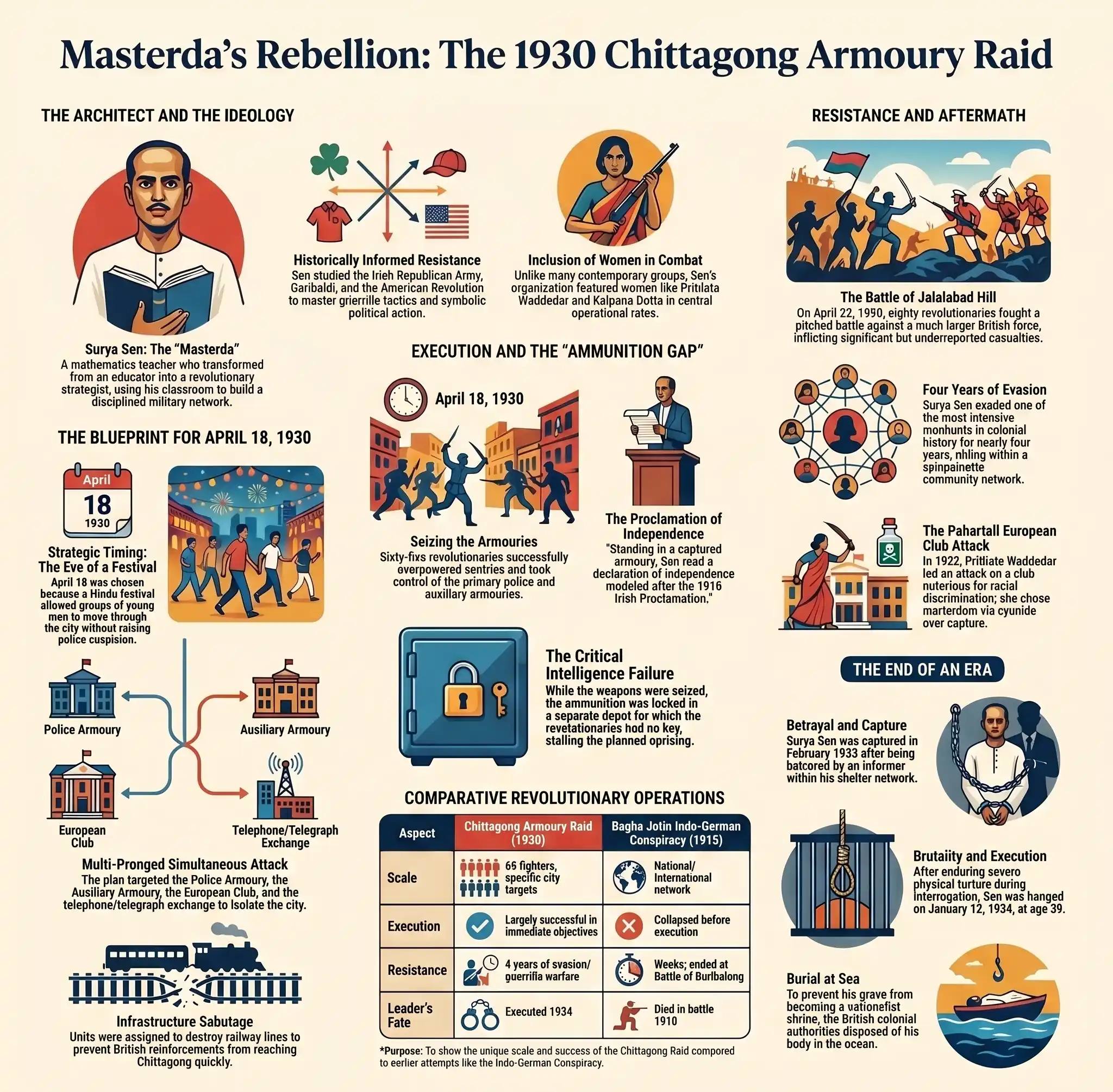
Surya Kumar Sen, known to his followers and to history as Masterda, was a schoolteacher and revolutionary leader in Chittagong, Bengal, who on the night of April 18, 1930, led sixty-five members of his Indian Republican Army in a coordinated military assault on two British armouries, the telegraph office, the European Club, and the railway communications infrastructure of Chittagong simultaneously. The operation was designed to cut Chittagong off from British India, seize weapons for a wider armed uprising, and demonstrate to the Indian population and to the world that armed resistance to colonial rule was possible at a level of organization and military sophistication that the colonial narrative of Indian incapacity consistently denied. The raid succeeded in its most visible objectives and failed in its most operationally critical one. The ammunition depot was separately secured and could not be opened. But what Surya Sen achieved in Chittagong on that night, and in the four years of evasion, guerrilla resistance, and ultimately capture and execution that followed, constitutes one of the most carefully planned and courageously executed episodes in the entire history of India’s freedom movement.

DetailInformation
Full NameSurya Kumar Sen (known as Masterda, meaning Master Teacher)
BornMarch 22, 1894, Noapara village, Chittagong, Bengal
DiedJanuary 12, 1934, Chittagong Central Jail, executed by hanging
Revolutionary OrganizationIndian Republican Army, Chittagong branch
Key ActionChittagong Armoury Raid, April 18, 1930
Co-conspiratorsPritilata Waddedar, Ganesh Ghosh, Ananta Singh, Kalpana Dutta, Lokenath Bal
Weapons SeizedArmoury raided but ammunition depot separately locked, limiting operational capacity
British ResponseLargest military mobilization against revolutionaries in colonial Bengal
MemorialSurya Sen’s execution date, January 12, is observed as Martyrs Day in Chittagong
Surya Sen

The Teacher Who Read Military History

To understand the Chittagong Armoury Raid, it is necessary to understand the man who planned it, and to understand Surya Sen it is necessary to understand that his revolutionary thinking was not impulsive or ideologically abstract. It was educated, deliberate, and historically informed in ways that distinguished him from most of his contemporaries in the Bengal revolutionary movement.

Surya Kumar Sen was born in 1894 in Noapara village near Chittagong in the Bengal Presidency. He came from a modest family, received his education through scholarship and personal determination, and became a schoolteacher of mathematics in Chittagong, a profession that gave him both the title Masterda by which his followers knew him and a sustained relationship with the young men and women of the city who became the core of his revolutionary network.

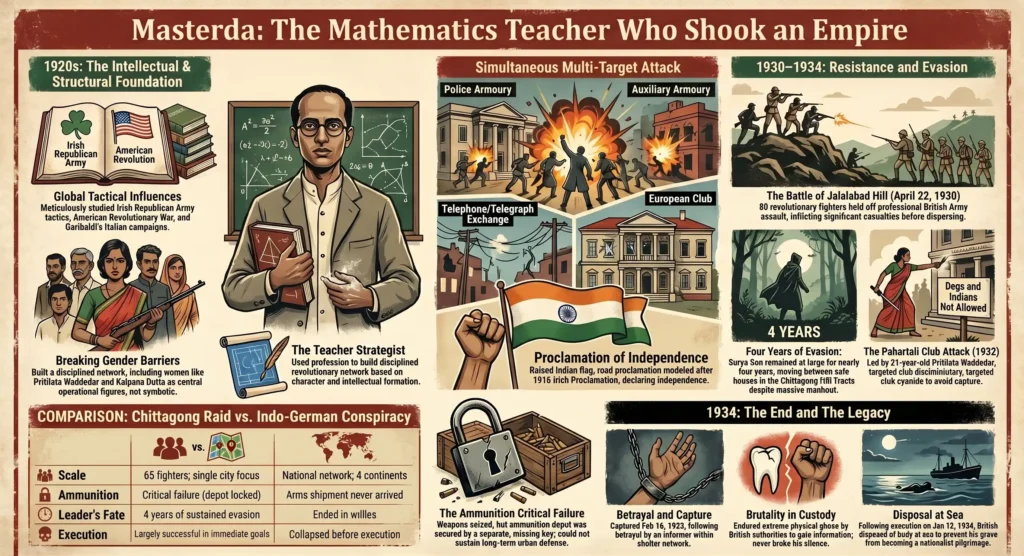
His intellectual formation as a revolutionary was shaped by engagement with the history of armed resistance movements across multiple cultures and periods. He studied the Irish Republican Army’s guerrilla tactics during the Irish War of Independence, which had concluded only a decade before the Chittagong raid and had demonstrated that a small, committed armed organization could successfully challenge a much larger imperial military force through a combination of tactical intelligence, popular support, and willingness to sustain a prolonged campaign. He drew on the history of the American Revolutionary War. He was familiar with the tactics of the Italian nationalist Garibaldi. He read whatever military history he could access in the libraries and lending networks available to a schoolteacher in colonial Chittagong.

This historical education produced a particular understanding of what armed revolutionary action needed to accomplish in order to be meaningful. Surya Sen believed that the primary objective of a revolutionary action was not to inflict maximum military damage, which a small group could rarely achieve against a major military power, but to demonstrate possibility. To show, concretely and undeniably, that resistance was possible, that the empire was vulnerable, and that ordinary Indians had the capacity to plan and execute military operations of genuine sophistication. The Chittagong Armoury Raid was designed from the beginning as a demonstration as much as an operation.

Building the Indian Republican Army

The organization Surya Sen built in Chittagong across the late 1920s was structurally different from the cell-based revolutionary networks that characterized the Yugantar movement in Bengal. Surya Sen created something closer to a genuine military organization, with designated units, specific operational roles, a chain of command, and a training program that prepared his recruits for the physical and psychological demands of what he was planning.

The membership of the Indian Republican Army in Chittagong drew heavily from the young men who had passed through Surya Sen’s classroom and from the broader network of nationalist youth organizations in the city. What distinguished his recruitment approach was his attention to character alongside commitment. He was looking for people who would hold under pressure, who could maintain operational security, who would follow orders in chaotic conditions, and who understood the stakes of what they were joining clearly enough to have made a genuine decision rather than an impulsive one.

READ MORE:  Second Battle of Panipat: How Akbar Defeated Hemu Vikramaditya

Women were not an afterthought in Surya Sen’s organization. Pritilata Waddedar, who would become one of the most celebrated revolutionary figures of the period, was a central participant in the planning and execution of the Chittagong operations, as was Kalpana Dutta, who survived the post-raid period and left behind one of the most valuable firsthand accounts of the organization and its operations. Their inclusion in the armed revolutionary network reflected Surya Sen’s understanding that independence was not a cause that belonged to one gender, and their actual participation in dangerous operations reflected their own courage and commitment rather than any symbolic inclusion.

According to research compiled by the Nehru Memorial Museum and Library in New Delhi, which holds significant collections of primary documents relating to the Bengal revolutionary movement of this period, Surya Sen’s organizational records and the testimony of surviving participants provide a picture of the Indian Republican Army in Chittagong as a genuinely functioning paramilitary organization rather than simply a political group with aspirations to military action.

The Plan in Its Full Ambition

The plan Surya Sen developed for the night of April 18, 1930, was operationally ambitious in ways that become clearer the more carefully its individual components are examined.

The primary target was the police armoury at the Chittagong police lines, which held weapons and ammunition that could equip a significant armed force if successfully seized. A secondary target was the auxiliary armoury of the Chittagong Volunteer Corps, the local territorial defense organization. Simultaneously, a separate unit was to attack and destroy the telephone and telegraph exchange in Chittagong, cutting the city’s communications with the broader British administrative network. Another unit was to attack the European Club, which served as the social center of the British colonial community in Chittagong and was selected both for its symbolic significance and because it was expected to contain a concentration of British officers on the night of a major social event. The railway lines and communications infrastructure were to be disrupted to prevent rapid British military reinforcement reaching the city from outside.

The date of April 18 was not random. It was selected because it fell on the eve of a major Hindu festival, a period when the movement of groups of young men through the city streets would attract less attention from the colonial police than on an ordinary night. The timing within the night was set to allow the simultaneous execution of all operational elements before any alarm raised by one group could compromise the others.

The logistical preparation for the raid extended across months. Weapons were accumulated and hidden. The layout of each target building was studied. Operational assignments were practiced. Surya Sen imposed strict operational security, limiting knowledge of the full plan to a small inner circle while ensuring that each unit had clear and complete knowledge of its specific assignment without necessarily knowing the full scope of the overall operation.

The Night of April 18, 1930

The sixty-five members of the Indian Republican Army who assembled at Chittagong on the night of April 18, 1930, were organized into units under designated commanders. Surya Sen took personal command of the main force attacking the police armoury. Ganesh Ghosh led the unit assigned to the Volunteer Corps armoury. Other units moved toward their respective targets simultaneously as the operation began.

The police armoury was taken. The unit broke through its defenses, overpowered the sentries, and gained control of the building. Ganesh Ghosh’s unit similarly succeeded in taking the auxiliary armoury. Surya Sen assembled his forces at the police armoury grounds, raised the Indian national flag, and delivered a brief address. He then read out the proclamation of independence, a document modeled consciously on the Irish Proclamation of Independence of 1916, which he and his colleagues had studied carefully as a template for how a revolutionary organization should formally announce its break with colonial authority.

It was a moment of extraordinary symbolic power. A schoolteacher from Chittagong, standing in a captured British armoury in the middle of the night, reading a declaration of Indian independence to sixty-five young men and women who had just successfully executed a military operation against the colonial government. The British Empire had not ended. But something had happened that night that could not be undone.

Then came the discovery that defined the operational outcome of the raid. The ammunition depot connected to the police armoury was secured with a separate lock whose key had not been obtained in the planning phase. The weapons were in the armoury. The ammunition required to make those weapons operationally useful for a sustained campaign was physically inaccessible. Without ammunition, the seized weapons could not transform the Chittagong operation from a demonstration into the armed uprising that Surya Sen had envisioned as its wider consequence.

The units assigned to the European Club found it empty. The expected gathering of British officers had not taken place on that particular night. The telegraph office attack succeeded partially. The railway disruption was executed as planned.

Surya Sen made the decision to withdraw with his forces into the Chittagong Hill Tracts rather than attempt to hold the city against the British military response that was inevitable and imminent. The withdrawal was orderly. All sixty-five members of the raiding party survived the night of April 18 and made it out of the city.

READ MORE:  S. P. Balasubrahmanyam Biography: 5 Decades of Musical Supremacy

Jalalabad and the Hills

The British response to the Chittagong Armoury Raid was the largest military mobilization against a revolutionary group that colonial Bengal had seen. Units of the British Indian Army were deployed to Chittagong within hours of the alarm being raised. The Chittagong Hill Tracts were designated a special operations zone. Surya Sen and his surviving force became the object of the most intensive manhunt that the colonial administration had conducted in the region.

The confrontation that the colonial government sought came on April 22, 1930, four days after the raid, at Jalalabad Hill in the Chittagong Hill Tracts. Surya Sen’s force, numbering around eighty fighters including those who had joined them after the initial raid, took up positions on the hill and fought a pitched battle against a much larger British Indian Army force.


1 of 2
– +
Surya Sen
Surya Sen

The Battle of Jalalabad was remarkable in several respects. The revolutionary force held its position against a professional military assault for a sustained period, inflicting significant casualties. Twelve revolutionaries were killed in the fighting. The British forces suffered casualties that the colonial government’s official accounts consistently underreported, a discrepancy that later research has identified and documented.

The force eventually dispersed into the surrounding hills and villages, with small groups breaking contact and attempting to evade the continuing British sweep operations. Surya Sen remained in the Chittagong region, moving between safe houses maintained by the network of sympathizers the organization had built across the area over years of patient community engagement.

According to documentation held by the West Bengal State Archives, Surya Sen remained at large in the Chittagong Hill Tracts and surrounding areas for nearly four years after the raid, a remarkable feat of sustained evasion against an intelligence apparatus that had enormous resources and strong motivation to find him. During this period he maintained contact with surviving members of his organization, continued to direct smaller operations, and remained a symbolic and operational center of the Bengal revolutionary movement.

Pritilata Waddedar and the Pahartali Attack

The most significant operation conducted by the remaining Chittagong revolutionary network during Surya Sen’s period of evasion was the attack on the Pahartali European Club on September 23, 1932, led by Pritilata Waddedar.

The European Club at Pahartali was one of the establishments that had displayed a sign reading Dogs and Indians Not Allowed, a specific and deliberate humiliation that had become a symbol of the racial contempt embedded in colonial social structures. Surya Sen selected it as a target with the same symbolic intelligence that had characterized the original raid planning. Pritilata Waddedar led a unit of revolutionaries in an armed attack on the club during a social function, causing significant disruption and casualties among the colonial community gathered there.

Pritilata Waddedar was wounded during the operation. Surrounded by British forces with no possibility of escape or evasion, she swallowed potassium cyanide rather than be captured. She was twenty-one years old. Her death was reported extensively within the revolutionary networks of Bengal and became one of the defining martyrdom narratives of the Chittagong movement.

Surya Sen’s response to her death, documented in letters that have been preserved in the collections of the Netaji Research Bureau, reflects a grief that was personal as well as political. Pritilata was not simply a subordinate commander to him. She was one of the most capable members of his organization, someone he had trained, trusted with significant operational responsibility, and lost in the kind of circumstances that the planning of armed revolutionary action always risks producing.

The Capture and the End

Surya Sen was finally captured on February 16, 1933, betrayed to the British by an informer within the network of people who had been sheltering and supporting him across his four years of evasion. The circumstances of his capture, and the identity of the informer, became subjects of considerable discussion within the surviving revolutionary community in the years following independence.

The colonial government’s treatment of Surya Sen after his capture was brutal in ways that went beyond the standard practices of colonial imprisonment. According to testimony preserved in accounts from members of the Chittagong revolutionary network documented by the Indian Council of Historical Research, his fingernails were extracted during interrogation and his teeth were broken, physical abuse intended to extract information about remaining network members and operational planning. He did not provide information that led to significant further arrests, a fact that the surviving members of his organization consistently emphasized in their subsequent accounts.

He was tried for his role in the Chittagong Armoury Raid and related operations, convicted, and sentenced to death. He was hanged in Chittagong Central Jail on January 12, 1934. He was thirty-nine years old. His body was reportedly disposed of at sea by the colonial authorities to prevent his grave from becoming a site of nationalist pilgrimage, a final act of suppression that underestimated how thoroughly the story of what he had done would survive without a physical memorial to anchor it.

Kalpana Dutta, who was captured, tried, and sentenced to life imprisonment before being released following public pressure and the eventual changing political climate, lived until 1995 and spent decades ensuring that the full record of the Chittagong revolutionary movement was preserved and accessible to historians and the public alike. Her memoir and her testimony represent some of the most important primary source material available for understanding what Surya Sen built and what it meant.

READ MORE:  The Sack of Delhi 1739: When Nadir Shah Stole the Peacock Throne

Quick Comparison Table

AspectChittagong Armoury Raid 1930Bagha Jatin Indo-German Conspiracy 1915
Scale of Operation65 fighters, multiple simultaneous targets in one cityNational network, four continents, arms shipment plan
Planning PeriodSeveral months of intensive local preparationOver a year of international coordination
ExecutionLargely successful in immediate objectivesCollapsed before execution due to arms interception
Ammunition AccessCritical failure, depot locked separatelyArms never arrived
British Military ResponseLargest anti-revolutionary mobilization in colonial BengalWidespread arrests across Bengal and internationally
Duration of Resistance After ActionFour years of sustained evasion and guerrilla operationsWeeks, ending at Battle of Buribalang river
Leader’s FateCaptured 1933, executed January 12, 1934Died in battle September 10, 1915

Curious Indian: Fast Facts

  • Surya Sen modeled his Proclamation of Independence, read out at the captured Chittagong police armoury on April 18, 1930, directly on the Irish Proclamation of Independence of 1916, reflecting his careful study of the Irish Republican Army’s tactics and political methods.
  • The European Club at Pahartali, attacked by Pritilata Waddedar’s unit in September 1932, reportedly displayed a sign reading Dogs and Indians Not Allowed, making it a target of particular symbolic significance to the Chittagong revolutionary network.
  • Surya Sen remained at large in the Chittagong Hill Tracts and surrounding areas for nearly four years after the armoury raid, evading one of the most intensive manhunts in colonial Bengal’s history until his betrayal by an informer in February 1933.
  • Kalpana Dutta, one of the central women of the Chittagong revolutionary movement, survived her imprisonment and lived until 1995, spending decades preserving and documenting the history of the organization she had been part of.
  • The colonial government disposed of Surya Sen’s body at sea after his execution on January 12, 1934, specifically to prevent his grave from becoming a site of nationalist pilgrimage, an action that reflects how seriously the British administration regarded the symbolic power of his memory.
  • The Battle of Jalalabad, fought four days after the armoury raid on April 22, 1930, saw Surya Sen’s force hold a hilltop position against a professional British Indian Army assault, with British casualty figures in official colonial accounts consistently underreported compared to later historical reconstructions.
  • Pritilata Waddedar was twenty-one years old when she swallowed potassium cyanide rather than be captured following the Pahartali European Club attack in September 1932, becoming one of the most celebrated martyrs of the Bengal revolutionary movement.

Conclusion

Surya Sen was a mathematics teacher. It is worth returning to that fact at the end, because it contains something important about what the Chittagong Armoury Raid was and what it meant.

He did not have military training. He did not have government resources, institutional support, or access to the professional networks that produce military planning in conventional contexts. He had books, a classroom, a network of young people who trusted him, and an understanding of history clear enough to tell him that the question of Indian independence was not going to be settled by petitions alone.

What he built in Chittagong across the late 1920s was a genuine military organization. What he planned for the night of April 18, 1930, was a genuine military operation, thought through with care, prepared with discipline, and executed with a precision that surprised the colonial administration and has impressed military historians who have studied it since. The failure to access the ammunition depot was a planning failure, an intelligence gap that no amount of courage could compensate for on the night. But the simultaneous coordination of multiple targets, the communications disruption, the orderly withdrawal, the sustained evasion that followed, these are not the achievements of improvisation. They are the achievements of a man who thought carefully about what he was doing and prepared thoroughly for it.

His execution on January 12, 1934, was the colonial government’s attempt to end the story he had started. The disposal of his body at sea was their attempt to prevent the story from having a physical address. Neither worked. The story has outlasted the empire that tried to suppress it, and the mathematics teacher from Chittagong who read a proclamation of independence in a captured armoury in the middle of a night in 1930 has a permanent place in the history of what it cost to make India free.

If you think you have remembered everything about this topic take this QUIZ

Who was Surya Sen and why is he called Masterda?

Surya Kumar Sen was a schoolteacher and revolutionary leader from Chittagong in colonial Bengal, born in 1894. He taught mathematics, and his students and revolutionary followers called him Masterda, combining the Bengali word for teacher with the honorific da, meaning elder brother. The name reflected both his professional identity and the personal authority and affection he commanded within the revolutionary network he built in Chittagong.

What were the objectives of the Chittagong Armoury Raid?

The raid on April 18, 1930, had multiple simultaneous objectives. The primary objective was to seize weapons from the British police armoury and the Chittagong Volunteer Corps auxiliary armoury to equip a wider armed uprising. Secondary objectives included cutting telegraph communications to isolate Chittagong from British India, attacking the European Club to target the colonial community’s social center, and disrupting railway infrastructure to prevent rapid military reinforcement. The raid was also explicitly designed as a demonstration that coordinated military action against British colonial installations was possible.

Why did the Chittagong Armoury Raid not achieve its full operational objective?

The critical failure of the raid was the inability to access the ammunition depot connected to the police armoury, which was secured with a separate lock whose key had not been obtained during the planning phase. Weapons were seized from the armoury building itself, but without the ammunition stored in the adjacent depot those weapons could not be used to sustain the armed uprising that Surya Sen had envisioned as the wider consequence of the raid. The European Club attack also failed because the expected gathering of British officers did not take place on that night.

Who was Pritilata Waddedar and what was her role in the Chittagong movement?

Pritilata Waddedar was one of the central women in Surya Sen’s Indian Republican Army and one of the most significant female revolutionary figures of the colonial period. She participated in the planning and operations of the Chittagong movement and led the armed attack on the Pahartali European Club in September 1932. Wounded during the operation and surrounded by British forces with no possibility of escape, she swallowed potassium cyanide rather than be captured. She was twenty-one years old at the time of her death.

How was Surya Sen captured and what happened to him afterward?

Surya Sen was captured on February 16, 1933, after nearly four years of evading the British manhunt, betrayed to the colonial authorities by an informer within the network sheltering him. After his capture he was subjected to brutal interrogation including physical abuse but did not provide information leading to significant further arrests. He was tried, convicted, and sentenced to death. He was executed by hanging in Chittagong Central Jail on January 12, 1934. His body was disposed of at sea by colonial authorities to prevent his grave from becoming a nationalist pilgrimage site.

Tags: 1930 India uprisingBengal revolutionariesChittagong Armoury RaidIndian Republican ArmyKalpana DuttaSurya Sen
ShareTweetPin
paripurnadatta

paripurnadatta

Related Posts

S.H. Raza Bindu
Artists & Cultural Icons

S.H. Raza and the Bindu: How a Dot Held the Universe

May 23, 2026
Abanindranath Tagore
Artists & Cultural Icons

How Abanindranath Tagore Built a Distinctly Indian Art Movement

May 23, 2026
Bagha Jatin
Biography

Bagha Jatin: German Plot That Shook Colonial India 1915

May 23, 2026
No Result
View All Result

Stay Updated

  • Trending
  • Latest
Life of Mahavira: From Prince Vardhamana to Great Conqueror

Life of Mahavira: From Prince Vardhamana to Great Conqueror

April 11, 2026
Life of Buddha: The Journey to Enlightenment

Life of Buddha: The Journey to Enlightenment

April 11, 2026
Christmas in India

Christmas in India: A Festive Blend of Faith, Flavors, and Tradition

April 11, 2026
From Shimla to Stardom: The Complete Biography of Anupam Kher

From Shimla to Stardom: The Complete Biography of Anupam Kher

April 11, 2026
Warli paintings

Warli Paintings and the Ancient Visual Language of Maharashtra’s Tribes

May 23, 2026
Shekhawati murals

Shekhawati Murals and the Stories Painted on Desert Walls

May 23, 2026
S.H. Raza Bindu

S.H. Raza and the Bindu: How a Dot Held the Universe

May 23, 2026
Abanindranath Tagore

How Abanindranath Tagore Built a Distinctly Indian Art Movement

May 23, 2026

Widget Title

Facebook Twitter Youtube RSS
Curious Indian Logo

Explore the soul of Bharat with Curious Indian. A definitive guide to Indian history, arts, culture, biographies, and the events that defined our future.

Follow us on social media:

Recent News

  • Warli Paintings and the Ancient Visual Language of Maharashtra’s Tribes
  • Shekhawati Murals and the Stories Painted on Desert Walls
  • S.H. Raza and the Bindu: How a Dot Held the Universe

Category

  • Ancient Civilizations & The Vedic Age
  • Architecture
  • Artists & Cultural Icons
  • Arts & Culture
  • Battles of India
  • Biography
  • Business & Industrialists
  • Colonial India
  • Cultural Insights
  • Dance & Music
  • Entertainment Personalities
  • Festivals of India
  • Freedom Fighters
  • Freedom Movement
  • Historical Events & Turning Points
  • Indian History
  • Indian Politics
  • Lesser-Known Facts
  • Major Festivals
  • Medieval India
  • North East India
  • Paintings & Visual Arts
  • Political Leaders
  • Post-Independence India
  • Regional Culture
  • Religious & Spiritual Figures
  • Science Personalities
  • Scientific Discoveries
  • Sculpture
  • Social Issues
  • SOCIETY & MYSTERIES
  • Strange & Unknown Stories
  • Textiles & Handicrafts
  • Uncategorized
  • Unsolved India
  • Unsung Heroes

© 2026 Curious Indian- Everything about India

Welcome Back!

Login to your account below

Forgotten Password?

Retrieve your password

Please enter your username or email address to reset your password.

Log In

Add New Playlist

No Result
View All Result
  • Arts & Culture
  • Festivals of India
  • Indian History
  • Indian Politics
  • Biography
    • Entertainment Personalities
    • Science Personalities

© 2026 Curious Indian- Everything about India

This website uses cookies. By continuing to use this website you are giving consent to cookies being used. Visit our Privacy and Cookie Policy.
Are you sure want to unlock this post?
Unlock left : 0
Are you sure want to cancel subscription?
×