How a Festival That Arrived With an Apostle Became One of India’s Own Festivals of Light
When most of us picture Christmas, we picture something imported: snow, pine trees, reindeer, and a round man in a red coat, all of it shipped in from the cold West.
So it surprises many people to learn that Christmas is not a new or a foreign thing in India at all. By a tradition that Indian Christians hold dear, their faith first arrived on these shores with one of Jesus’s own disciples, almost two thousand years ago, long before Christianity ever reached most of Europe. And in all those centuries since, Christmas has quietly become as Indian as any other festival in the land.
An Apostle on the Malabar Coast
The story goes back to about the year 52, barely twenty years after Jesus himself lived.
One of his twelve disciples, Thomas, the very man remembered as “Doubting Thomas” because he asked to see the wounds before he would believe, is said to have sailed all the way to the busy spice ports of Kerala, on India’s south-western coast. There, the tradition says, he preached, baptised the first Indian Christians, and founded a string of small churches. The Christians of Kerala, often called the Thomas Christians, have kept that story alive, unbroken, ever since. For many centuries they prayed in Syriac, a close cousin of Aramaic, which was the very language that Jesus and Thomas themselves would have spoken.
By tradition, Christianity reached the coast of India around the year 52, carried by the apostle Thomas, earlier than it arrived in much of Europe.
Historians cannot prove every detail of that ancient journey. But one thing is beyond doubt: Christianity has been at home in India for a very, very long time, and its Christmas is no newly arrived guest from the West.
Eid al-Fitr and Eid al-Adha: Celebrating Faith and Community
The Indian Face of Christmas
Because it has lived here so long, Indian Christmas has grown a face all its own.
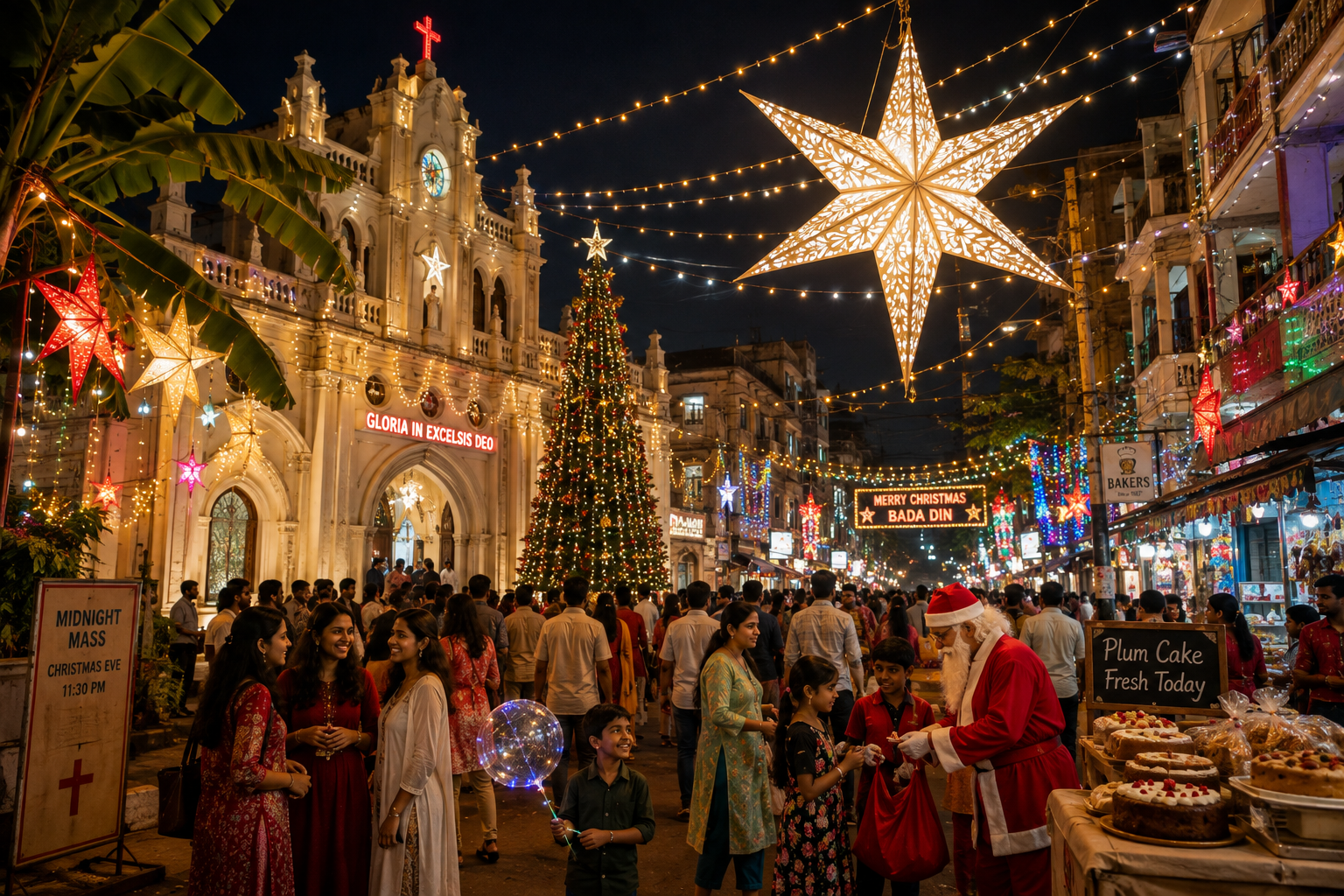
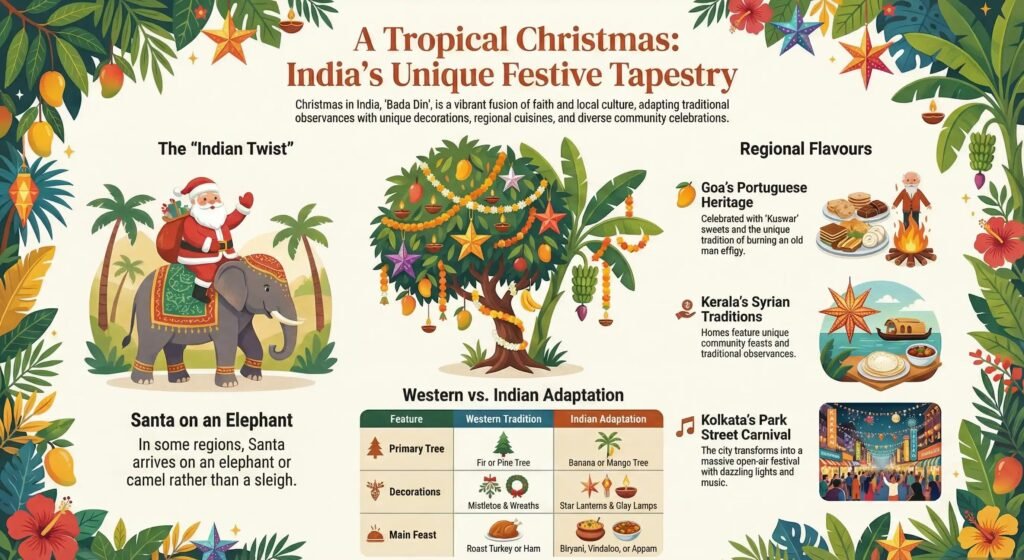
Most of India has no pine or fir trees, so families simply decorate what grows around them instead: a mango tree, a banana tree, or a leafy branch strung with lights. In place of endless snowmen, homes and churches hang up big, glowing paper lanterns shaped like stars, standing for the star of Bethlehem, until whole streets seem to sparkle overhead. And, in exactly the way people do at Diwali, they light rows of little oil lamps and candles, which turns Christmas into one more Indian festival of light glowing in the dark of winter. Even Santa Claus has picked up Indian names along the way; in some parts of the country, children wait eagerly for “Christmas Baba.”
Then there is the food, which changes as you travel. In Goa, families prepare a whole festive platter of sweets called kuswar, full of rich cakes, coconut treats and curls of fried kulkuls. Across the south there is plum cake soaked in homemade wine, and somewhere in almost every Indian Christmas there is a dark, sweet slice of fruit cake.
Reign of Akbar 1556-1605: The Golden Age of the Mughal Empire
Many Christmases Across the Map
India does not really have one Christmas. It has many.
In Kerala, the ancient Christian community holds its midnight mass inside grand old churches, some of which trace their beginnings all the way back to Thomas himself. In Goa, shaped by its long Portuguese Catholic past, Christmas is the single biggest festival of the year, with midnight mass, carol singing, great feasts, and whole villages strung with lights.
But the most surprising Christmas of all is found up in the hills of the North-East.
In the states of Nagaland, Mizoram and Meghalaya, most of the people are Christian, and Christmas is by far the biggest festival of the entire year.
There, the festival stretches over a week or more: church choirs singing, huge community feasts, churches decorated with care, and whole towns lifting their voices in carols late into the cold night. And in a city like Kolkata, an old leftover of colonial days has grown into a huge and happy shared street party, with Park Street lit end to end, cake in every shop window, and people of every faith joining the crowd.
Rise of Jainism and Buddhism 6th Century BCE
The Big Day for Everyone
That last point is worth pausing on, because in much of India, Christmas has spilled far beyond the Christian community.
Hindus, Muslims, Sikhs and everyone else enjoy the lights, buy the cake, and cheerfully wish one another well. In Hindi, the festival even has its own warm and simple name: Bada Din, which means “the big day.” On Bada Din, you do not have to be a Christian to stand beneath the strings of lights, share a slice of plum cake with a neighbour, and feel that something bright and gentle is happening in the middle of winter.
An Indian Festival of Light
So the next time someone calls Christmas a purely Western festival that has only lately reached India, you will quietly know better.
It came to these shores with a wandering disciple when Rome still ruled and much of Europe had never yet heard the story. Over the centuries it learned to hang itself upon banana trees and to glow through paper stars. It made its homes in Kerala’s ancient churches, in Goa’s lamp-lit villages, and in the singing green hills of the North-East. Christmas in India is not a visitor from somewhere colder and far away. By now, after nearly two thousand years, it is simply one more of India’s own festivals of light.
Sunayani Devi: A Woman’s Voice in the Bengal School
If you think you have remembered everything about this topic take this QUIZ
Results


#1. According to the source material, which figure is traditionally believed to have brought Christianity to India in 52 CE?
#2. In the tropical climate of South India, which plants are frequently decorated as alternatives to traditional pine trees?
#3. What is the symbolic meaning behind lighting clay oil lamps (Diyas) on rooftops during an Indian Christmas?
#4. Which unique Goan tradition is performed on New Year’s Eve to mark the end of the year?
#5. What distinguishes an ‘Allahabadi Cake’ from traditional Western fruitcakes?
#6. In Kerala, what is the traditional breakfast served on Christmas morning?
#7. Which city is famous for transforming Park Street into a carnival of lights and hosting parties in Bow Barracks?
#8. Why is the traditional ‘Midnight Mass’ often held as early as 8:00 PM or 10:00 PM in many Indian cities?
How do Indians say “Merry Christmas”?
While “Merry Christmas” is widely used, in Hindi it is “Bada Din Mubarak” (Happy Big Day).
What is “Kuswar”?
Kuswar is a collection of traditional Christmas sweets and snacks prepared in Goa and Mangalore, including items like Bebinca, Kulkuls, and Neureos.
Which Indian city is famous for its Christmas carnival on Park Street?
Kolkata (West Bengal).
Do non-Christians celebrate Christmas in India?
Yes, widely! People of all religions visit churches to see the decorations, eat cake, and enjoy the holiday atmosphere.
What is the traditional Christmas breakfast in Kerala?
Appam (rice hoppers) with Stew (chicken, mutton, or vegetable).
Sources and References
- Encyclopaedia Britannica (“Thomas Christians”) and the Smithsonian — the tradition that St. Thomas the Apostle arrived at Kodungallur (near Muziris) in Kerala around 52 CE and founded seven congregations, the Syriac liturgical roots of the Kerala Christians, and the note that the historicity is traditional while Christian presence on the Malabar Coast is old.
- Sociology.Institute and Wikipedia (on Christianity in India) — India’s roughly 28 million Christians (about 2.3% of the population), the concentration in the south, Goa and Mumbai, and Christianity arriving in India well before much of Europe.
- Malevus and census-based sources — the Christian-majority North-Eastern states of Nagaland, Mizoram and Meghalaya, and the especially intense Christmas celebrations there and in Goa, Mumbai and Kerala.
- General accounts of Indian Christmas customs — the decorating of mango and banana trees, the paper star lanterns of Bethlehem, the use of oil lamps and candles, the regional sweets such as Goan kuswar and southern plum cake, midnight mass, and the Hindi name “Bada Din.”
- Original Curious Indian article (“Christmas in India”) — the blend of Christian worship with local customs, the regional variety of celebrations, the festive foods, and the wide, cross-community enjoyment of the festival.
Author


Exploring the Soul of Bharat through History, Science, Culture, and its Diversity
Our Mission
Curious Indian is a definitive knowledge portal dedicated to chronicling the events, personalities, and cultural shifts that defined the Indian subcontinent. From the ancient Vedic Period to the complexities of 21st-century politics, our goal is to provide deep-dive analysis that inspires.
Editorial Standards & E-E-A-T
Every article published under our brand undergoes a rigorous fact-checking process. We prioritize primary historical records, academic citations, and credible archives to ensure our readers receive accurate, high-authority information.
Historical Integrity Directly sourcing from ASI archives and academic journals.Topical Authority Comprehensive clustering of Indian Science, Biographies, and Wars.Managed by Paripurna Datta and TEAM | Dedicated to the Knowledge of India.