How an illiterate boy-king bet his empire on the idea that everyone should belong
When Akbar became emperor, he was thirteen years old, and he could not read a single word. He never would.
Yet this boy went on to rule for nearly fifty years, to build one of the richest courts the world had ever seen, and to make a bet that was radical in his own time and still feels radical in ours: that an empire could be held together not by forcing everyone to believe the same thing, but by making everyone, whatever their faith, feel that they truly belonged. This is the story of Akbar, and of that bet.
Rajput Kingdoms: The Warrior Clans of India
A throne won by a lucky arrow
Akbar was born in 1542, while his father, the emperor Humayun, was on the run and had lost his kingdom. So Akbar came into the world as the son of a king with no throne.
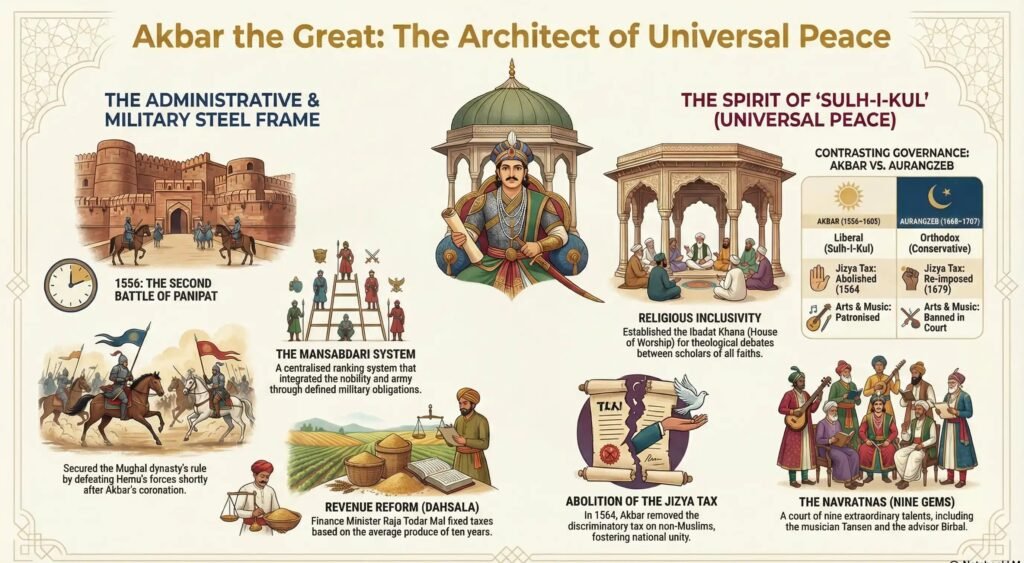
When Humayun died suddenly in 1556, the thirteen-year-old inherited a shaky, half-lost empire. Almost at once a brilliant Hindu general named Hemu seized the great cities of Delhi and Agra. At the Second Battle of Panipat, Akbar’s army, led by his guardian Bairam Khan, faced Hemu’s larger force, and the whole battle turned on a single stroke of luck. An arrow struck Hemu in the eye, his army lost heart at the sight of their fallen leader, and the young Mughal throne was saved. It was the shakiest start a king could have.
Reign of Emperor Ashoka: The Transformation of a Tyrant
Winning over the people he ruled
Akbar understood something that many rulers before him had missed. He was a Muslim king, but most of the people he ruled were Hindu. He could sit on top of them as a conqueror and hold them down by force, or he could try to make them his partners. He chose partnership, and he chose it again and again.
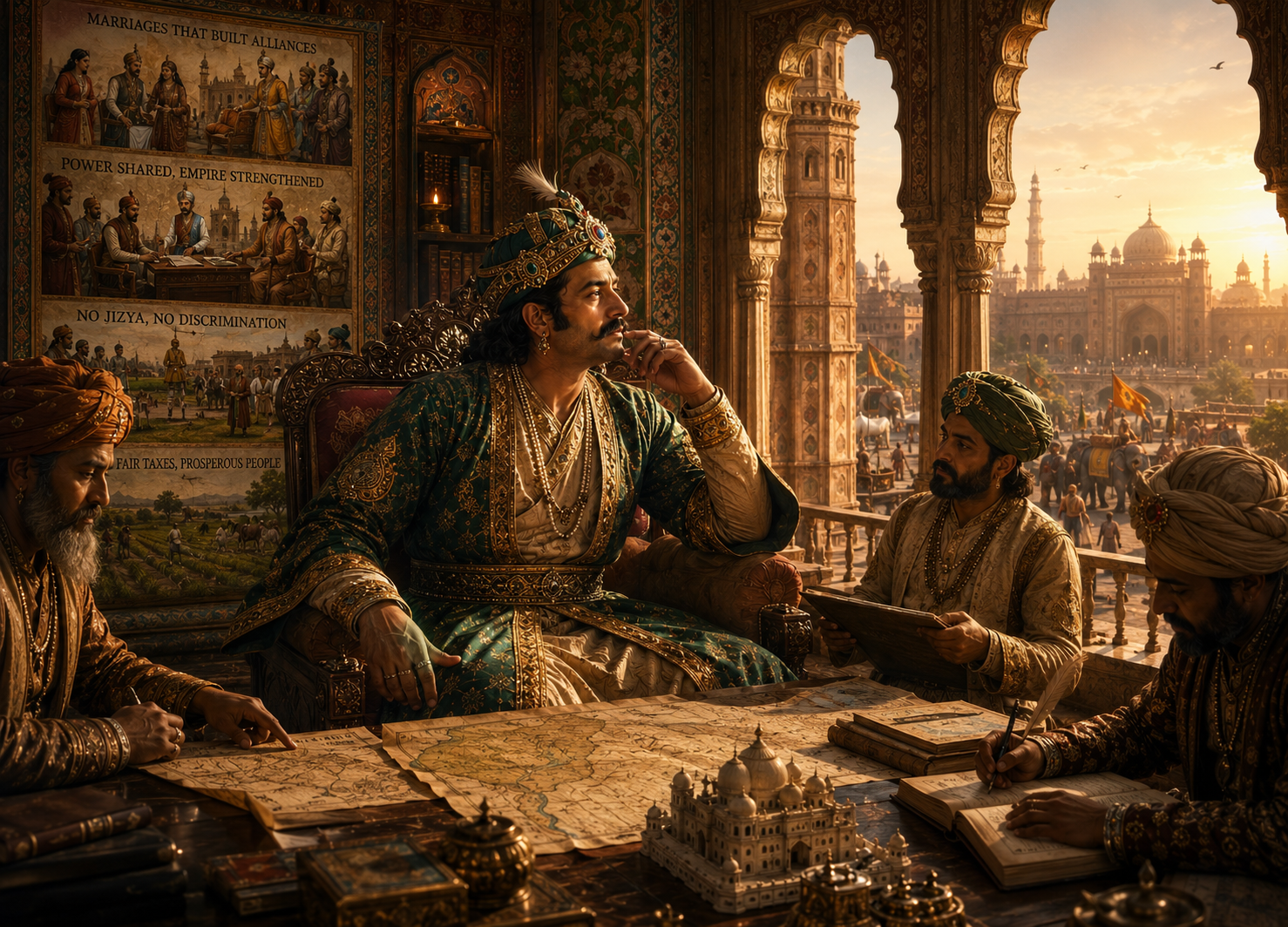
He married into the Rajputs, the proud Hindu warrior royalty of the land. And here he broke sharply with the past. He did not ask his Hindu wives to give up their religion; they kept their own gods and their own worship inside his very palace. One of them, a princess of Amber, became the mother of the next emperor, and is the queen popularly, though not quite accurately, remembered today as Jodha Bai. Cleverly and kindly, Akbar treated these marriages not as the shaming of a beaten people but as an honour: he raised the princesses’ fathers and brothers to the very highest ranks of his court.
He also handed Hindus real power. His finance genius, Raja Todar Mal, and one of his greatest generals, Raja Man Singh, were both Hindus. And in 1563 and 1564 he did two things no Mughal emperor before him had dared. He scrapped the tax that Hindu pilgrims paid to visit their holy places, and then he abolished the jizya, the hated tax that non-Muslims had to pay simply for not being Muslim.
By ending the jizya, the tax non-Muslims paid just for being non-Muslim, Akbar told the majority of his people something new: in this empire, you are not second-class.
Second Battle of Tarain 1192: The Turning Point of Indian History
The steel frame
An empire this size needed more than goodwill. It needed a machine to run it, and Akbar built one.
He placed every noble and officer on a single ladder of ranks called the mansabdari system, which fixed each man’s pay and the number of soldiers he had to keep ready. This tied the army and the nobility together, all of it answering to the emperor. And working with Raja Todar Mal, he built a fairer way of collecting taxes. Officials carefully measured the farmland, then set the tax on the average of the last ten years’ harvests, so that a family would not be crushed in a bad year by a tax that had been meant for a good one.
The house of worship
But Akbar’s deepest hunger was not for land or taxes. It was for answers. By every account, he was endlessly, restlessly curious about God.
In 1575, at his splendid new capital of Fatehpur Sikri, he built a special hall called the Ibadat Khana, the “house of worship.” There he did something almost unheard of for a king of his age. He gathered together priests and scholars of every faith he could find, Muslims and Hindus, Jains and Zoroastrians, and Christian priests who travelled all the way from Goa, and he had them sit and debate their beliefs late into the night while he listened.
Out of all that listening, in 1582, he tried to shape a gentle faith of his own, which he called Din-i-Ilahi, the “religion of God.” It was built around kindness, honesty and devotion rather than any single tradition. It never truly caught on, drawing only a handful of followers and fading away after his death. But it showed just how far this one man was willing to go in his search for something that everyone could share.
A court of nine jewels
Akbar’s court became a magnet for the most gifted people of the age, and nine of its brightest stars were remembered together as his Navratnas, his “nine jewels.”
Among them was Birbal, the quick-witted advisor and close friend whose clever answers still live on in folk tales told to children today. There was Tansen, the greatest musician of the age, about whose songs people spun legends. And there was Abul Fazl, the devoted historian who wrote the vast life of the emperor, the Akbarnama. That a king who could not read surrounded himself with the finest poets, singers and thinkers of his time tells you almost everything you need to know about him.
The riddles of a great king
Akbar was a man woven from striking contradictions.
He never learned to read, and some historians think he may have been dyslexic. Yet he built up a library of around 24,000 books and had them read aloud to him for hours on end, holding much of what he heard in a remarkable memory. He was a Muslim emperor who, moved by the gentleness of Jain monks, gave up eating meat on many days of the week and forbade the killing of animals during Jain holy days. He welcomed Christian priests to his court with real warmth, listened closely to every word of their teaching, and then, to their deep disappointment, politely declined to convert. No one, of any faith, could quite put him in a box.
The bet and how it held
For all of this, Akbar was still, in the end, a conqueror. He won his empire and held it with armies, and his long reign was not free of war or of cruelty. It would be wrong to paint him as a saint.
But the idea he built his rule upon was a rare one for his time: that a king should be a father to all of his people, and not the champion of just one group among them. It is worth remembering that a hundred years later, one of his own descendants, the emperor Aurangzeb, made the opposite bet entirely. He brought back the jizya, leaned hard on strict religious orthodoxy, and spent his life fighting long, draining wars against those who would not fall in line. History let both experiments run their course, and it is not hard to see which one held an empire together more gently.
Akbar died in 1605, after almost half a century on the throne. He left behind a vast and steady empire, but he also left behind an argument, one that India has never quite stopped having. Is a country strongest when all its people are made the same, or when all of them, however different, are made to feel that they belong? For a man who could not read a single word, that was a remarkably wise question to leave the world to puzzle over.
Reign of Harshavardhana: The Empire of Benevolence
If you think you have remembered everything about this topic take this QUIZ
Results


#1. At which location was the 13-year-old Akbar crowned as the Mughal Emperor?
#2. What specific event led to the Mughal victory at the Second Battle of Panipat in 1556?
#3. To commemorate his conquest of Gujarat, which architectural landmark did Akbar commission?
#4. In the Mansabdari system, what did the rank of ‘Sawar’ represent?
#5. Which of the following describes the ‘Zabti’ land revenue system introduced by Raja Todar Mal?
#6. What was the primary purpose of the ‘Ibadat Khana’ established in 1575?
#7. Which member of the ‘Navratnas’ was a close friend and witty advisor who also followed Akbar’s Din-i-Ilahi?
#8. Despite being illiterate, Akbar owned a library of approximately how many manuscripts?
Who was the regent of Akbar during his early years?
Bairam Khan was his regent and mentor.
Which battle secured Akbar’s throne?
The Second Battle of Panipat (1556) against Hemu.
What was the name of the new “religion” founded by Akbar?
Din-i-Ilahi (Divine Faith) or Tauhid-i-Ilahi.
Who was the finance minister responsible for Akbar’s revenue reforms?
Raja Todar Mal.
Why was the Jizya tax abolished by Akbar significant?
It removed the second-class status of non-Muslims, integrating Hindus fully into the empire’s citizenry.
Sources and references
- Encyclopaedia Britannica (“Akbar”) and Byju’s IAS history notes — Akbar’s accession at thirteen in 1556, the regency of Bairam Khan, the Second Battle of Panipat against Hemu, the abolition of the pilgrim tax in 1563 and the jizya in 1564, and the Rajput alliance policy.
- Wikipedia (“Mariam-uz-Zamani”) and related sources — the Rajput princess of Amber (daughter of Raja Bharmal) married to Akbar in 1562, mother of Jahangir, known in Mughal records as Mariam-uz-Zamani, with “Jodha Bai” identified as a later misnomer absent from the period chronicles.
- Standard histories of Mughal administration — the mansabdari system of ranks tying pay, cavalry and nobility to the emperor, and Raja Todar Mal’s land-revenue system based on measurement and the average produce of ten years.
- Accounts of Akbar’s religious policy — the Ibadat Khana built at Fatehpur Sikri in 1575 for inter-faith debate, the Din-i-Ilahi of 1582 and its few followers, the three Jesuit missions from Goa, and the Jain influence on Akbar’s vegetarianism.
- Original Curious Indian article (“Akbar the Great”) — the Navratnas including Birbal, Tansen and Abul Fazl, Akbar’s illiteracy alongside his library of some 24,000 manuscripts, the Akbarnama and Ain-i-Akbari of Abul Fazl, and the contrast drawn between Akbar’s inclusive rule and Aurangzeb’s orthodoxy.
Author


Exploring the Soul of Bharat through History, Science, Culture, and its Diversity
Our Mission
Curious Indian is a definitive knowledge portal dedicated to chronicling the events, personalities, and cultural shifts that defined the Indian subcontinent. From the ancient Vedic Period to the complexities of 21st-century politics, our goal is to provide deep-dive analysis that inspires.
Editorial Standards & E-E-A-T
Every article published under our brand undergoes a rigorous fact-checking process. We prioritize primary historical records, academic citations, and credible archives to ensure our readers receive accurate, high-authority information.
Historical Integrity Directly sourcing from ASI archives and academic journals.Topical Authority Comprehensive clustering of Indian Science, Biographies, and Wars.Managed by Paripurna Datta and TEAM | Dedicated to the Knowledge of India.