How the same two armies met on the same field a year apart, with opposite results that changed India
In the winter of 1191, two great armies met on a dusty field in northern India, and one of them was shattered. The invader, a warlord from the mountains of Afghanistan named Muhammad Ghori, was beaten so badly that he was wounded and had to flee for his very life. The victor was Prithviraj Chauhan, a proud Rajput king, and his triumph was complete.
And then, just a little over one year later, in the spring of 1192, those very same two armies met once again, on the very same field. But this time, everything was different. This time, it was Prithviraj who lost. And he did not merely lose a single battle. He lost his kingdom, his life, and, in a very real sense, the fate of all northern India for the next six hundred years. This is the story of the two battles of Tarain, and of the single year that flipped the history of India. And it holds within it a lesson as old and as sharp as war itself.
The first battle: a total victory
To understand it, picture the north of India in those days. It was ruled by the proud warrior-clans known as the Rajputs, magnificently brave, but forever divided among many quarrelling little kingdoms. And from the northwest, a new danger was steadily pushing in: Muhammad Ghori, the ambitious ruler of an empire based in Afghanistan, who wanted not merely to raid India for its riches, as earlier invaders had, but to conquer it and rule it.
In 1191, his army clashed with the forces of Prithviraj Chauhan, the greatest of all the northern Rajput kings, near a place called Tarain. And the Rajputs won, gloriously. Prithviraj’s warriors broke the invader’s army and sent it reeling in retreat. Ghori himself was wounded, and barely escaped with his life. It was a famous and shining victory.
But hidden inside that victory lay a seed of disaster. Following the Rajput code of honour, Prithviraj let the beaten enemy limp home, rather than chasing him down and finishing him. It would prove the most costly mercy in Indian history.
Timur’s Invasion of Delhi 1398: The Massacre That Shook India
The year in between
Now watch very closely what each of these two men did with the year that followed, because absolutely everything turned upon it.
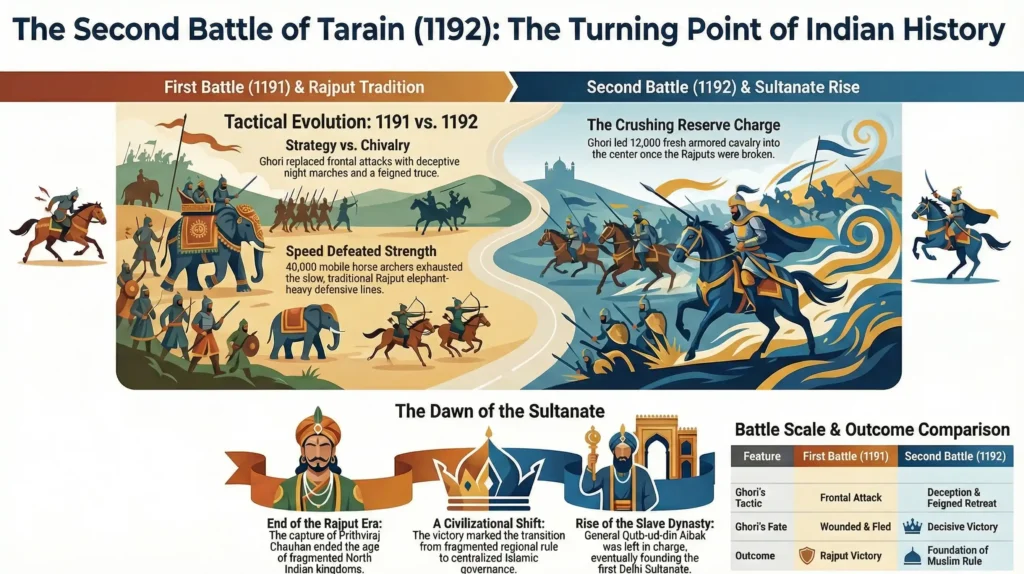
Muhammad Ghori, the loser, went home in disgrace. And he did not sulk, and he did not despair. He got to work. He was said to be so consumed by the shame of his defeat that he swore off all comfort and luxury until he had avenged it. He publicly shamed the officers who had failed him in the fight. And, above all else, he studied hard exactly why he had lost, and then rebuilt his whole army to fix it, training it now for speed, for iron discipline, and for a clever new way of fighting. He took his defeat, and he turned it into a lesson.
Prithviraj Chauhan, the winner, did precisely the opposite. He went home in triumph, and he relaxed.
The loser learned; the winner rested. Ghori studied his defeat and rebuilt his army. Prithviraj celebrated his victory and prepared for almost nothing. That, in the end, was the whole difference.
Confident that he had already beaten this particular enemy once before, he simply did not take the danger of a return seriously enough. And he did not do the one thing that might truly have saved him: he did not unite the squabbling Rajput kingdoms into a single, ready army. His proud rivals, jealous of his fame, would not have stood beside him anyway. He rested on his victory, and in doing so, he quietly turned his own triumph into a trap.
Reign of Alauddin Khalji 1296-1316: The Iron Fist of Delhi
The second battle: the reversal
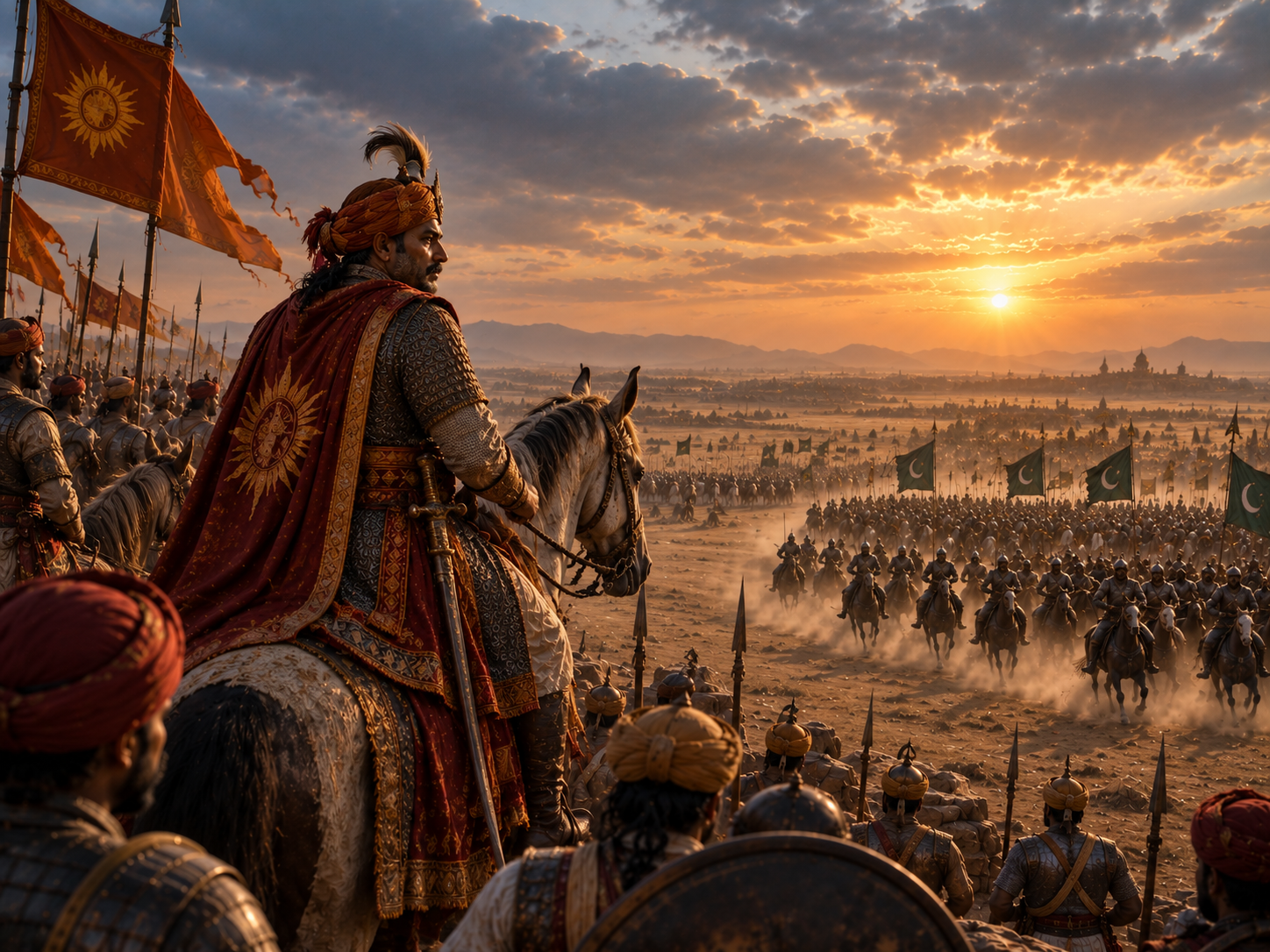
So when Ghori came marching back in 1192, the two armies that faced one another across the field of Tarain were no longer the same as they had been. Ghori’s was now leaner, faster, and far cleverer. Prithviraj’s was larger, but slower, prouder, and not fully united behind him.
And Ghori fought a brilliant and tricky battle. His soldiers were expert horsemen who could gallop and shoot their arrows both at once, darting in and out, stinging the heavy Rajput army and then wheeling swiftly away before it could ever strike back. All through the long day, they wore the Rajputs down, tiring them out, scattering their neat formations, and luring them into chasing an enemy that simply would not stand still and fight. And then, right at the very end, when the Rajput soldiers were exhausted and parched and their proud lines had broken apart, Ghori unleashed the blow he had been saving all along: a great charge of fresh, heavily-armoured cavalry, driven straight into the very heart of the tired Rajput army. It shattered. The war-elephants panicked, the lines collapsed, and it was finished. Prithviraj Chauhan tried to flee the field, but he was captured, and soon afterward he was put to death.
There is a beautiful and famous legend, sung by the bards for centuries after, that Prithviraj was carried off in chains, blinded, and then took a final revenge by shooting Ghori dead with an arrow aimed by nothing but the sound of his voice. It is a wonderful story. But it is only a story. The sober history is simpler, and sadder: the brave king was captured and executed not long after his defeat.
First Battle of Panipat 1526: The Dawn of the Mughal Empire
The door swings open
And with that single battle, the whole long course of India’s history quietly turned.
The defeat of Prithviraj shattered the main power of the Rajputs across the north, and now there was no one left strong enough to hold the door shut. Ghori himself soon returned to Afghanistan, but he left behind a trusted general, a man named Qutb al-Din Aibak, to govern his new conquests in his place.
A few years later, that general founded a new state with its heart at Delhi: the Delhi Sultanate. It was the beginning of a new age, one that would reshape the politics and culture of the north for centuries to come.
For the next several hundred years, northern India would be ruled by a succession of these new powers. It was a fundamental turning point in the story of the subcontinent, and it all traced back, in the end, to one lost battle on the field of Tarain.
The lesson of Tarain
The two battles of Tarain are remembered, and rightly so, as one of the great hinge-points of all Indian history. But they are something more than that, as well. They are a lesson, told about as plainly as any story has ever told one.
Prithviraj Chauhan was, by every account we have, a brave and a capable king. Muhammad Ghori was not braver than him, and indeed, on that very same field just one year earlier, had been soundly and thoroughly beaten by him. The difference between the two men was never courage. The difference was simply that one of them learned from his defeat, while the other grew careless in his victory. History, it turns out, does not always belong to the strongest, nor even to the bravest. Very often, it belongs instead to the one who is willing to look honestly at his own mistakes, and then go and fix them. Ghori lost, and studied why he had lost, and came back and won everything. Prithviraj won, and then he rested, and he lost everything. And a whole subcontinent turned, that spring, upon the narrow difference between the two.
Establishment of the Delhi Sultanate: The Five Dynasties That Ruled India
If you think you have remembered everything about this topic take this QUIZ
Results


#1. In which year was the decisive Second Battle of Tarain fought?
#2. Who were the two opposing leaders in the Second Battle of Tarain?
#3. What “chivalrous mistake” did Prithviraj Chauhan make after the First Battle of Tarain in 1191?
#4. What deceptive tactic did Muhammad Ghori use to lull the Rajputs into a false sense of security before the battle?
#5. Which military tactic proved decisive for the Ghurid army against the Rajput elephants and infantry?
#6. The Second Battle of Tarain is historically significant because it paved the way for:
#7. According to historical accounts, what was the fate of Prithviraj Chauhan after the battle?
#8. How did the Rajput army’s preparation differ in 1192 compared to 1191?
When was the Second Battle of Tarain fought?
It was fought in 1192 AD.
Who won the Second Battle of Tarain?
Muhammad Ghori (Ghurid Dynasty) won the battle.
Who was the Rajput king defeated in this battle?
Prithviraj Chauhan (Prithviraj III) was defeated.
What was the main reason for Prithviraj’s defeat?
Ghori’s deceptive tactics (surprise dawn attack and feigned retreat), combined with the Rajput army’s exhaustion and lack of mobility.
What happened after the battle?
Prithviraj was captured and killed. Muhammad Ghori appointed Qutb-ud-din Aibak as his governor, leading to the establishment of the Delhi Sultanate.
Sources and references
- Wikipedia (“Battle of Tarain”) and Vajiram & Ravi — the First Battle of Tarain (14 January 1191) won by Prithviraj Chauhan and the Second Battle (8 March 1192) won by Muhammad Ghori on the same field, and Ghori’s return to Ghazni to rebuild his army for firepower, mobility and discipline after his defeat.
- Enroute Indian History and Curious Indian’s own overview — Ghori’s Turkish horse-archers and disciplined mobile tactics against the infantry-and-elephant Indian armies, the feigned retreat and day-long harassment, and the decisive charge of fresh heavy cavalry that broke the tired Rajput lines.
- Testbook and India Online — Prithviraj’s overconfidence and neglect of his borders after 1191, the loose Rajput coalition, his capture near the river, and the historical accounts that he was captured and executed shortly after the battle.
- Nelsapy and Enroute Indian History (on the aftermath) — the shattering of Rajput power in the north, Qutb al-Din Aibak left in charge, and the foundation of the Delhi Sultanate in 1206 as a major turning point in medieval Indian history.
Author


Exploring the Soul of Bharat through History, Science, Culture, and its Diversity
Our Mission
Curious Indian is a definitive knowledge portal dedicated to chronicling the events, personalities, and cultural shifts that defined the Indian subcontinent. From the ancient Vedic Period to the complexities of 21st-century politics, our goal is to provide deep-dive analysis that inspires.
Editorial Standards & E-E-A-T
Every article published under our brand undergoes a rigorous fact-checking process. We prioritize primary historical records, academic citations, and credible archives to ensure our readers receive accurate, high-authority information.
Historical Integrity Directly sourcing from ASI archives and academic journals.Topical Authority Comprehensive clustering of Indian Science, Biographies, and Wars.Managed by Paripurna Datta and TEAM | Dedicated to the Knowledge of India.