How a ruthless, brilliant sultan crushed the Mongols — and why the Padmini legend isn’t true
Alauddin Khalji was, by any measure, a tyrant. He seized his throne by murdering his own uncle. He ruled by fear, he crushed anyone who dared to cross him, and he spilled a very great deal of blood along the way.
But to remember him only as a cruel man is to miss the truly astonishing thing about him. For Alauddin was also one of the most extraordinarily effective and controlling rulers that India has ever seen, a man who tried, quite literally, to control everything. He controlled his armies down to the very last horse. He controlled his nobles so tightly that they could barely gather for dinner. And, most remarkable of all, he controlled the price of every single loaf of bread in his markets. This is the story of the sultan who tried to grip an entire empire in his clenched fist, and who, for twenty long years, very nearly managed it.
The sultan who broke the Mongols
To understand why Alauddin grew so obsessed with control, you first have to understand the terror that hung over his whole reign: the Mongols.
In those years, the Mongols, the very same horsemen who had burned the greatest cities of Asia to the ground, turned their eyes upon India, and came pouring down over the northwestern mountains, again and again, in vast and terrifying invasions. They even reached the walls of Delhi itself. Almost any other kingdom in the world might have simply crumbled before them. Alauddin did not.
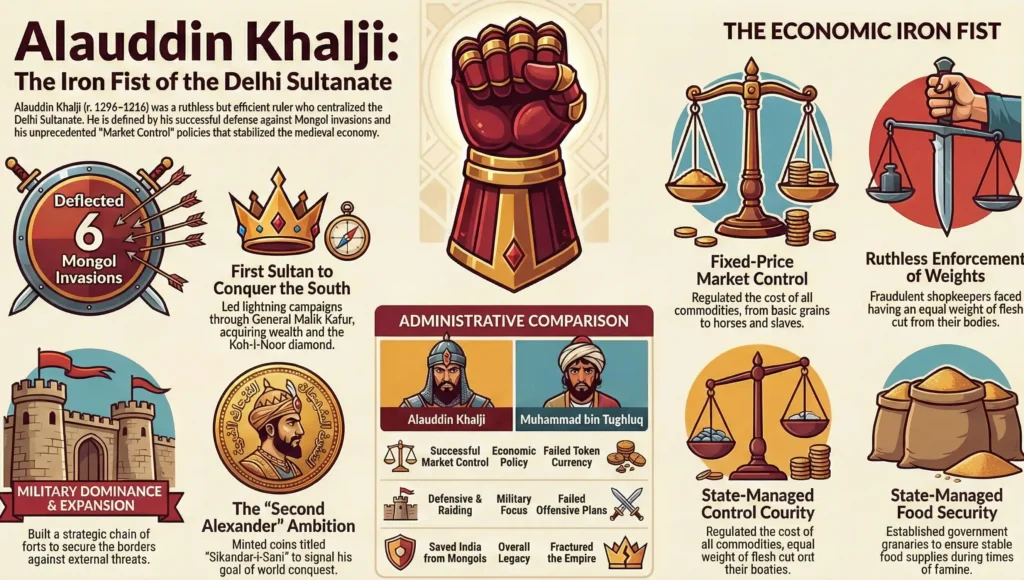
The Mongols had burned the greatest cities of Asia. They poured into India again and again, even reaching the walls of Delhi. Alauddin met them and beat them, time after time, so ruthlessly that at last they simply stopped coming.
He met them, and he beat them, not just once but time after time, in battle after battle. And he did it with a ruthlessness that was genuinely chilling: the Mongol soldiers he captured, he slaughtered without any mercy at all. It was brutal beyond description. But, terribly, it worked. The Mongols grew so afraid of the fearsome sultan of Delhi that, in the end, they simply gave up and stopped coming. Alauddin had managed something that very few rulers anywhere ever did: he had faced the unstoppable Mongols, and made them turn back. He may very well have saved India from the same grim fate that had already swallowed up half of Asia.
Foundation of the Vijayanagara Empire: The Rise of Hampi
The reach into the far south
Safe at last from the Mongol menace, Alauddin turned his enormous armies outward, and he conquered kingdom after kingdom across the north and the west of India. And then he did something that no ruler of Delhi had ever done before him. He reached down into the deep south.
He sent his most brilliant general of all, a man named Malik Kafur who had himself once been a slave, marching all the way down to the very tip of the subcontinent, to the ancient temple-cities of the far south. Kafur came back laden with almost unimaginable treasure, including, it is said, a fabulous diamond that would one day become the most famous jewel in all the world: the Koh-i-Noor. But Alauddin was cleverer than mere greed. He did not try to rule these faraway southern lands directly, for he knew that even that was beyond his grip. He simply forced their kings to pay him rich tribute, and left them sitting on their own thrones. For the very first time, the power of distant Delhi was felt from the mountains of the north all the way to the shores of the deep south.
The sultan who fixed every price
But Alauddin’s single most astonishing achievement was not won on any battlefield at all. It was won in the marketplace.
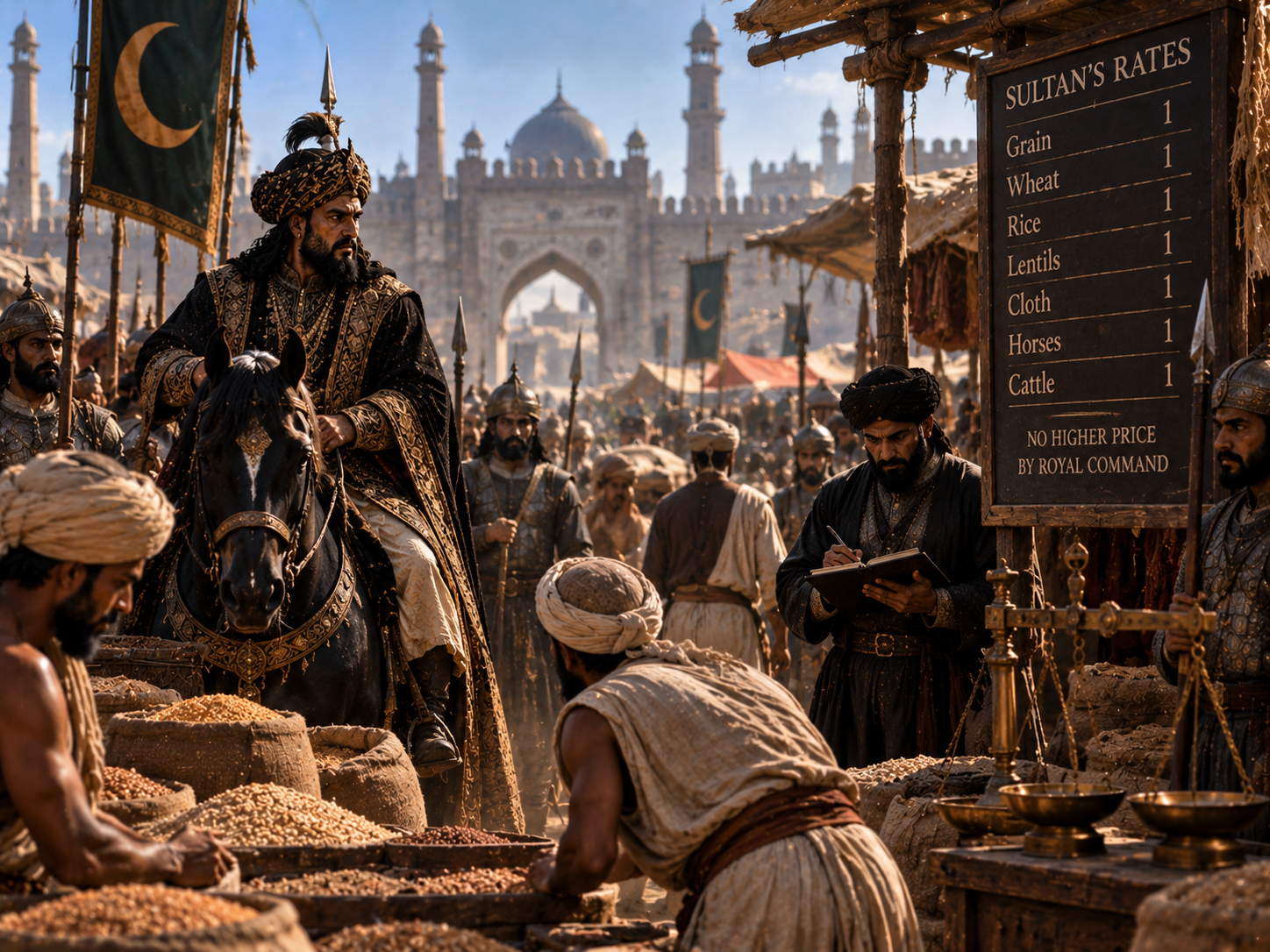
To fight off the Mongols, Alauddin needed an enormous army, the largest that India had ever seen. And to pay for it without emptying his treasury, he needed to pay his soldiers rather low wages. But low wages are only bearable if the things a person must buy are cheap. So Alauddin did something almost unheard of anywhere in the medieval world. He took control of the price of everything.
By royal command, he fixed the price of grain, of cloth, of horses, of cattle, of very nearly every good a person could buy, at low and settled rates, and he forbade anyone at all to charge so much as a penny more.
To afford his vast army, Alauddin fixed the price of grain, cloth, horses, and cattle at low rates, and built a whole machine of state markets, granaries, and spies to enforce it. For twenty years, the price of bread in Delhi did not rise.
And then, remarkably, he built an entire machine to make it all stick. He set up special government-run markets. He built great state granaries, to store grain up and then release it whenever supplies ran short, so that prices could never suddenly spike. And he sent an army of inspectors and secret spies out through the bazaars, to catch any trader who dared to cheat, and he punished the cheats without mercy. And it worked. Right through the whole of his long reign, the price of bread in Delhi simply did not rise. It was one of the most complete systems of price control the world would see for hundreds of years, and the ordinary people of Delhi, rich and poor alike, lived through long years of steady, affordable prices because of it.
First Battle of Panipat 1526: The Dawn of the Mughal Empire
The machine of control
The price controls were really just one part of a far larger machine. Alauddin controlled his soldiers by branding their horses and keeping careful written descriptions of every single man, so that no one could ever cheat the army rolls.
He controlled his nobles, the rich and powerful men who might one day plot against him, by taxing them so very heavily that they could never grow wealthy enough to raise a rebellion, by forbidding them to hold the feasts and gatherings where plots might be hatched, and even by banning wine altogether, so that no drunken conspiracies could ever begin to brew. And he filled his whole empire with spies, until he seemed to hear absolutely everything. It was, in effect, a medieval police state, and it was terrifyingly efficient. Let us be honest about it: this was the machinery of a tyrant. It rested upon fear, upon cruelty, and upon the crushing of ordinary freedom. But as a machine for holding on to absolute power, it was, of its own dark kind, something close to a masterpiece.
The legend and the truth
There is one more thing that Alauddin is famous for, and it is worth setting straight, because it is the very thing that most people think they know about him, and it simply is not true.
During his many conquests, Alauddin besieged and captured the great Rajput fortress of Chittor. And a famous and beautiful story later grew up around that siege: the tale that Alauddin had attacked Chittor out of a burning desire for its queen, the legendary beauty Rani Padmini.
The famous story that Alauddin besieged Chittor out of love for Queen Padmini was written down by a poet more than two hundred years after his death. Most historians doubt that Padmini ever existed at all.
It is a wonderful, dramatic tale. But it is only a tale. That story was written down by a poet more than two hundred years after Alauddin was already dead, as a poem, an invention, and not as history at all. Most historians now agree that Padmini was very likely never a real person in the first place, and that Alauddin took Chittor for exactly the same hard-headed reason that he took every other fort: because it was strong, and strategic, and it stood squarely in his way. The romance came much later, purely from a poet’s imagination. The real Alauddin never needed any such reason to make a conquest.
Reign of Muhammad bin Tughluq: The Visionary Failure of Medieval India
The fist that could not hold
So who, in the end, was Alauddin Khalji? He was a hard, cold, and often cruel man, and there is simply no softening that. But he was also a ruler of rare and frightening genius, a conqueror who broke the Mongols and reached the far south, and an organiser who fixed the very price of bread and held an entire empire clenched tight in his fist. He tried, more completely than almost any ruler before him ever had, to control everything. And for twenty years, astonishingly, he did.
And that, in the very end, was his great weakness as much as it was his strength. Because a machine that is held together by one man’s iron grip carries within it a single fatal flaw: it needs that grip. When Alauddin at last grew old and sick and finally died, the mighty fist that had held everything together simply opened. His great, controlled empire, which had seemed so utterly solid, cracked wide apart within just a few short years. The price controls collapsed. The generals turned upon one another. And soon a whole new dynasty rose up and swept the Khaljis away entirely. It is the oldest lesson of tyranny, written out once more in the story of the sultan who controlled everything: you may grip an empire tight in your hand, but you can never make your hand itself live forever.
Timur’s Invasion of Delhi 1398: The Massacre That Shook India
If you think you have remembered everything about this topic take this QUIZ
Results


#1. What title did Alauddin Khalji adopt on his coins, signifying his ambition to conquer the world?
#2. Who was the trusted general, also known as “Hazardinari,” who led Alauddin’s campaigns into South India?
#3. How did Alauddin Khalji ascend the throne in 1296?
#4. What was the primary objective of Alauddin’s revolutionary Market Control Policy?
#5. According to the text, what was the severe punishment for a shopkeeper who used false weights?
#6. Which unfinished structure did Alauddin intend to build to be double the height of the Qutub Minar?
Why is Alauddin Khalji famous?
He is famous for his market reforms (price control), successfully repelling Mongol invasions, and being the first Muslim ruler to conquer South India.
Who was Malik Kafur?
Malik Kafur was Alauddin’s trusted general (originally a slave captured in Gujarat) who led the successful military campaigns into the Deccan.
Did Alauddin Khalji attack Chittor for Rani Padmini?
This is a subject of debate. Historical records cite strategic reasons for the attack, while the 16th-century poem Padmavat claims it was for Rani Padmini. The Jauhar of 1303 is a historical fact.
What were Alauddin’s market reforms?
He fixed the prices of all goods, established state granaries, and strictly monitored markets to ensure soldiers could live on low salaries.
What title did Alauddin Khalji adopt?
He adopted the title Sikandar-i-Sani, meaning “The Second Alexander.”
Sources and references
- Anantam IAS (“Khilji Dynasty”) and Wikipedia (“Alauddin Khalji”) — Alauddin (r. 1296–1316) as the most powerful Khalji sultan, his seizure of the throne by killing Jalaluddin, his title “Sikandar-i-Sani,” and his reign famous for market control, the southern conquests, and military reforms.
- Wikipedia (“Market reforms of Alauddin Khalji”) and Studocu — the fixing of prices for grain, cloth, slaves and animals, the state-run markets and granaries, the ban on hoarding, the supervisors and spies, and Barani’s account that the aim was to afford a large army through low soldier salaries.
- KPI Academy and Dharmapedia — the repeated Mongol invasions (Kili 1299, the 1303 siege of Delhi, Amroha 1305) decisively repelled, and the massacres that frightened the Mongols into abandoning their invasions of India.
- Anantam IAS and Curious Indian’s own overview — Malik Kafur (a former slave) leading the Deccan campaigns to Devagiri, Warangal (where the Koh-i-Noor came to Delhi), the Hoysalas and Madurai, the tribute-not-annexation policy, and the dagh and chehra military reforms.
Author


Exploring the Soul of Bharat through History, Science, Culture, and its Diversity
Our Mission
Curious Indian is a definitive knowledge portal dedicated to chronicling the events, personalities, and cultural shifts that defined the Indian subcontinent. From the ancient Vedic Period to the complexities of 21st-century politics, our goal is to provide deep-dive analysis that inspires.
Editorial Standards & E-E-A-T
Every article published under our brand undergoes a rigorous fact-checking process. We prioritize primary historical records, academic citations, and credible archives to ensure our readers receive accurate, high-authority information.
Historical Integrity Directly sourcing from ASI archives and academic journals.Topical Authority Comprehensive clustering of Indian Science, Biographies, and Wars.Managed by Paripurna Datta and TEAM | Dedicated to the Knowledge of India.