How a conqueror who never wanted India shattered Delhi and how his bloodline returned to rule it
Some invaders come to conquer, and to rule, and to stay. This one came only to destroy, and to take, and then to leave.
In the year 1398, one of the most terrible conquerors the world has ever known descended upon India, not to make himself its king, but simply to plunder its wealth and to add its ruin to his glory. He fell upon the great city of Delhi like a hurricane, left it a smoking wasteland of the dead, gathered up its treasure and its finest craftsmen, and then vanished back over the mountains as suddenly as he had first appeared. His name was Timur, and this is the story of the storm that came, and went.
The conqueror who wanted only treasure
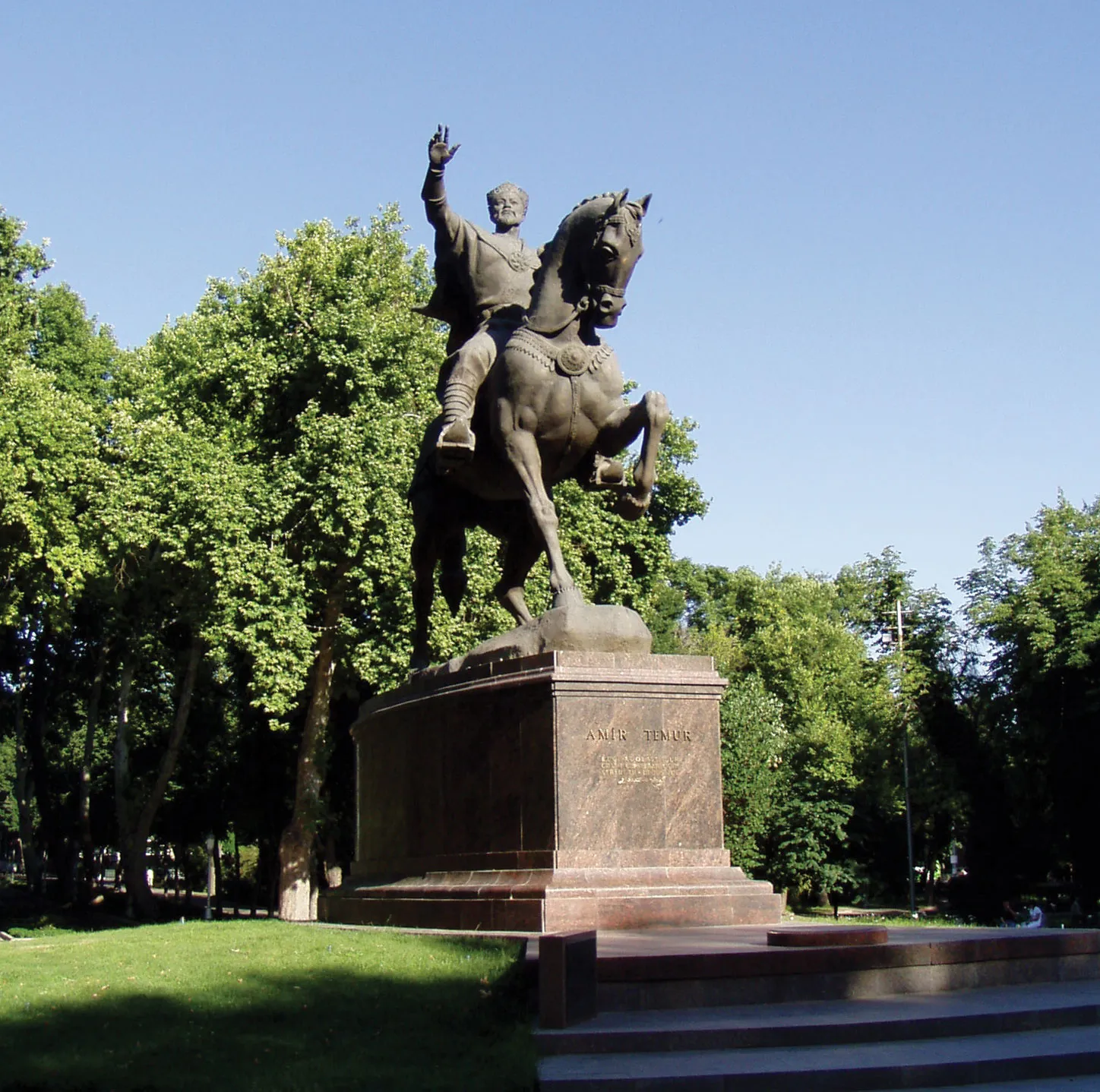
The man who did this was already, by 1398, one of the most feared human beings alive. Timur, known in the West as Tamerlane, was a warlord from Central Asia who had carved out a vast empire from his capital at Samarkand, and he had done it with a savagery that made the whole world tremble. He was famous, and infamous, for the horrors he left behind him: after crushing a city, he was said to build towers out of the skulls of its dead.
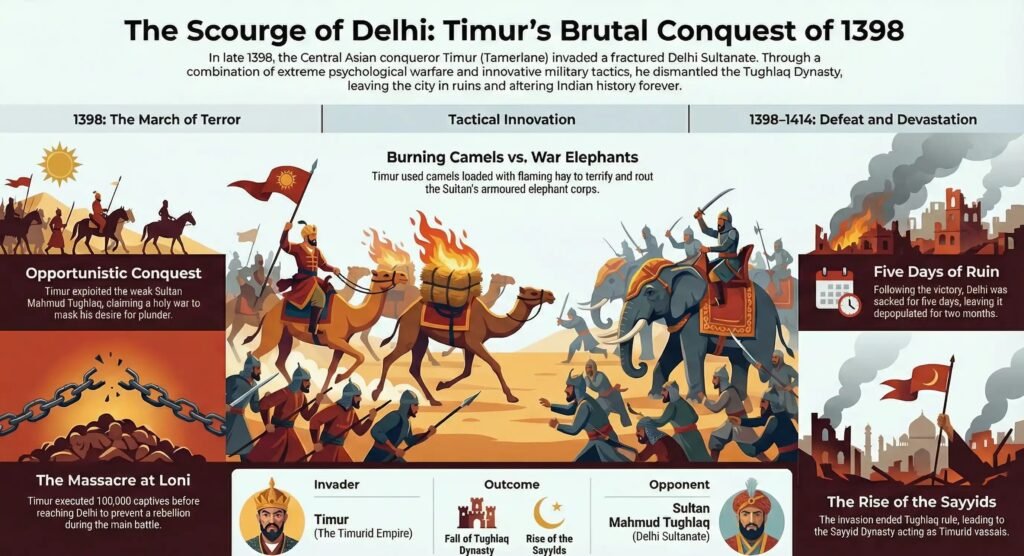
And now he turned his eyes toward India. But here is the most important thing to understand about him. He did not come to rule India. He had no interest whatsoever in adding it to his empire, or in sitting upon its throne. What drew him instead was India’s legendary wealth: its gold, its jewels, its endless riches. He came, quite simply, to rob it.
Timur claimed that he came to punish the rulers of Delhi on religious grounds. Almost no one, then or now, has been fooled. He came for one thing only: India’s legendary wealth. And his slaughter, when it came, spared no one, of any faith.
He dressed up his invasion in grand and holy-sounding words, claiming that he had come to punish the sultans of Delhi on religious grounds. But almost no one, then or since, has been fooled by that excuse. Historians see it plainly for exactly what it was: a thin cover thrown over simple, staggering greed. And there was a bitter irony buried in his excuse, too. For the rulers of Delhi were themselves Muslims, his own fellow believers. And when his terrible slaughter finally came, it would fall upon their people, Muslim and Hindu alike, without the slightest mercy for either.
Third Battle of Panipat 1761: The Day the Maratha Dream Died
Second Battle of Panipat 1556: The Arrow That Changed History
The burning camels and the fall of Delhi
Timur swept down into India with a huge army of horsemen, and as he came, he left a long trail of massacre and burning behind him, destroying town after town in his path. And then, at last, he reached the walls of Delhi.
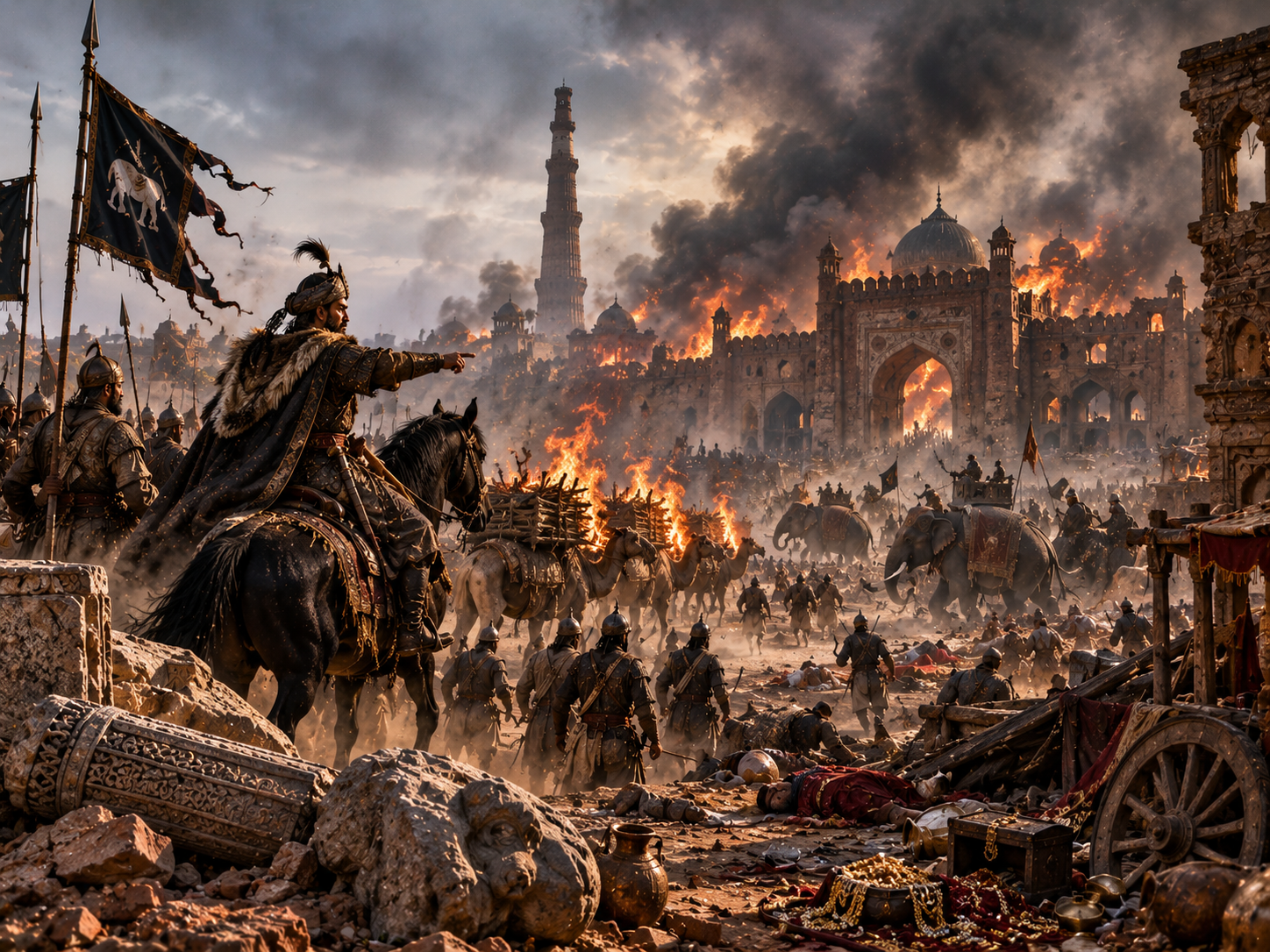
The Sultan of Delhi rode out to meet him with the full pride of his army, including a great line of armoured war elephants, terrifying beasts that could smash straight through any charge of men. But Timur had a cunning and a cruel trick ready and waiting. He had his men load camels down with wood and dry grass, set the whole lot ablaze, and then drive the burning, screaming animals straight at the elephants. The elephants panicked at the roaring fire, turned, and stampeded back through the sultan’s own ranks, trampling his soldiers in the wild chaos. Timur’s horsemen charged into the ruin, and very soon it was all over. The sultan himself simply fled for his life.
The people of Delhi, men, women, and children, were slaughtered in enormous numbers, and the city was stripped bare and burned. One of the greatest cities in all the world became, in a matter of days, a graveyard.
And then came the very worst of it. Timur’s army poured into Delhi, and for several days they visited upon it a horror that is painful even to read about today. The people of the city, men and women and children alike, were slaughtered in enormous numbers. The city was stripped bare of its wealth, and much of it was burned. One of the greatest, richest, and most glorious cities in all the world was, in the space of just a few days, turned into a silent graveyard.
The storm passes
And then, having finally taken everything that he had come for, Timur simply left.
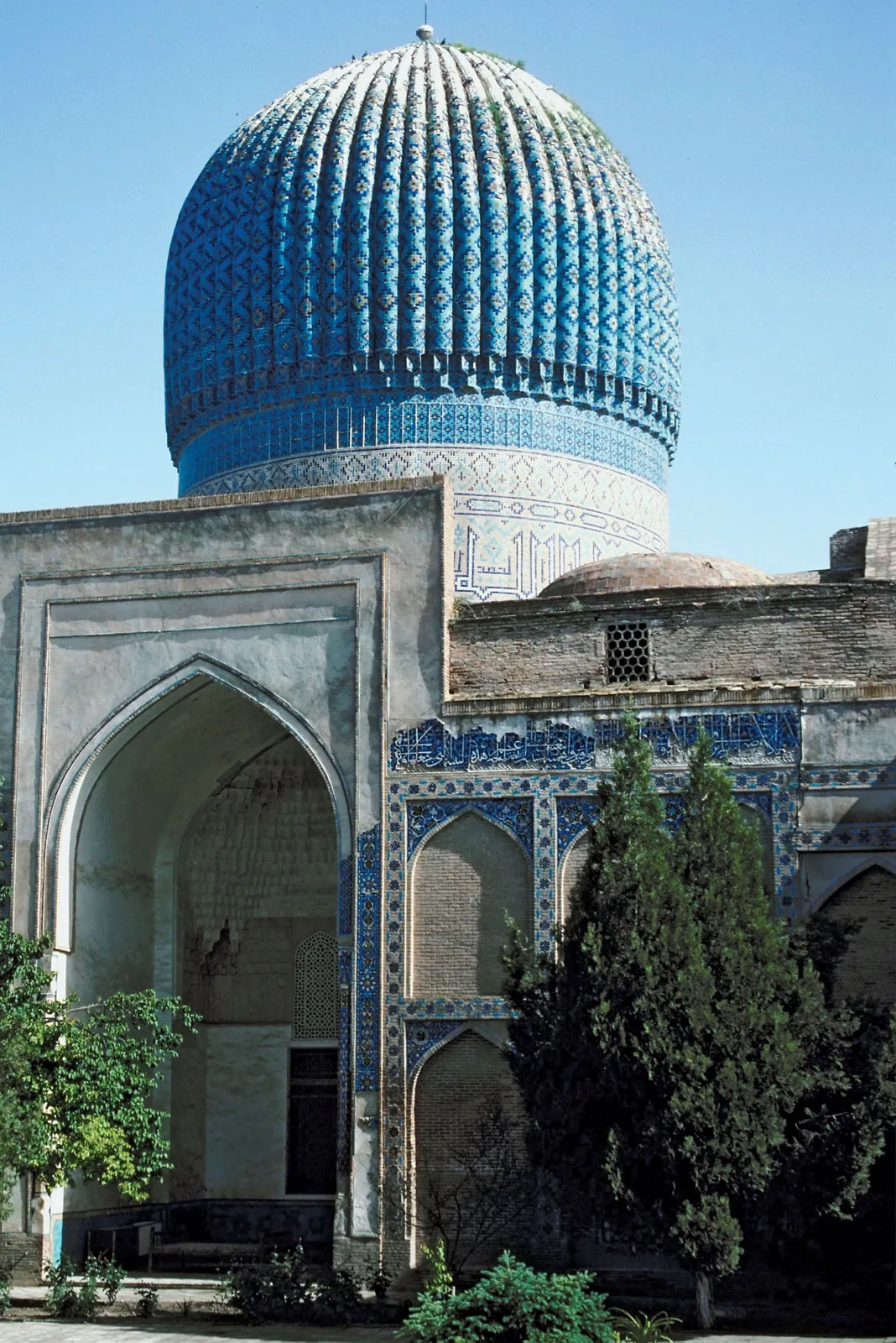
He carried away with him a veritable mountain of plundered gold and jewels. And he carried away something else besides: Delhi’s most skilled craftsmen, its stonemasons and goldsmiths and weavers, marched off as captives all the way to far-distant Samarkand, where they would be set to work building the great and beautiful monuments of Timur’s own capital city. In a strange and rather sorrowful way, the glory of Delhi did not entirely vanish that day. It was carried off, and rebuilt again, in another land, half a world away.
What Timur left behind him was a wasteland. Delhi lay in ruins and half-empty, and those who had somehow survived the sword now faced famine and plague, for the invaders had destroyed the food and the standing crops as well. It is said that the great city took more than a hundred years to truly recover. And the shattered Delhi Sultanate, already weak and divided before he came, never recovered its old strength at all. The Tughlaq dynasty, which had ruled for nearly a century, crumbled away soon afterward, and the whole of northern India fell into a long, bleak spell of chaos and disorder. The storm had passed, and it had left almost nothing at all standing in its wake.
First Battle of Panipat 1526: The Dawn of the Mughal Empire
The long shadow
And yet, this is still not quite the end of the story, and its very last turn is one of the strangest in all of history.
Timur went home to Central Asia and died only a few years later, and India, for a time, was left alone to pick itself slowly up out of the wreckage. But Timur had left behind him more than just ruins. He had left behind a bloodline. More than a hundred years later, a young and ambitious prince named Babur, a direct descendant of Timur himself, would look southward toward India, remember that his own great ancestor had once, however briefly, conquered the city of Delhi, and use that very memory as his own claim to its throne.
More than a century later, Timur’s own descendant Babur used his ancestor’s brief conquest as a claim to the throne of Delhi, and founded the Mughal Empire. The storm that broke India would one day return, generations later, as its emperors.
And Babur would indeed come, and he would win, and he would go on to found the Mughal Empire, one of the mightiest and most glorious empires that India would ever know. So the deepest irony of the whole tale is this. The terrible storm that broke India in 1398 was not, in the end, gone forever. Its own descendants would return, generations later, not this time to plunder and to vanish, but to stay, and to rule, and to build. The man who had come only to destroy Delhi had, without ever knowing it, quietly planted the seed of the very dynasty that would one day make that city a wonder of the world all over again.
Nadir Shah’s Invasion of Delhi 1739: The Massacre That Emptied India
If you think you have remembered everything about this topic take this QUIZ
Results


#1. Beyond the stated goal of religious warfare, what was the primary economic motivation for Timur’s invasion of the Delhi Sultanate?
#2. Which individual held the actual political power in Delhi during the time of Timur’s arrival, effectively making Sultan Mahmud Tughlaq a puppet?
#3. What strategic reason did Timur provide for the mass execution of 100,000 captives at Loni prior to the main battle?
#4. How did Timur’s forces effectively neutralise the threat posed by the Sultan’s 120 armoured war elephants?
#5. Following the sack of Delhi, what was Timur’s primary use for the captured Indian masons and stone-cutters?
#6. In the aftermath of the invasion, what role did Khizr Khan play in the political restructuring of Northern India?
#7. How did Timur’s 1398 invasion later serve the interests of his descendant, Babur, in 1526?
#8. Which of the following describes a key difference between Timur’s invasion and Nadir Shah’s invasion as presented in the source material?
When did Timur invade India?
Timur invaded India in 1398 AD.
Who was the ruler of Delhi during Timur’s invasion?
Sultan Nasir-ud-Din Mahmud Shah Tughlaq was the ruler.
Why did Timur execute 100,000 prisoners?
He feared they would revolt and join the Delhi army during the main battle, so he ordered their massacre at Loni.
How did Timur defeat the war elephants?
He used camels loaded with burning wood to terrify the elephants, causing them to trample their own forces.
Which dynasty rose after Timur’s invasion?
The Sayyid Dynasty (founded by Khizr Khan) rose to power as vassals of the Timurids.
Sources and references
- Britannica (“Sack of Delhi 1398”) — Timur’s December 1398 attack destroying the city, his decision that he could not control India so he unleashed destruction and withdrew to Samarkand, the pretext of the sultan being too lenient toward Hindus, and the burning-camel tactic against the war elephants.
- Wikipedia (“Sack of Delhi (1398)”) and Missed History — Timur crossing the Indus in 1398 with around 90,000 cavalry with no intention of ruling India but interest in its wealth, the roughly 100,000 captives killed before the battle, and the craftsmen taken to Samarkand to build the Bibi Khanum Mosque.
- HistorySphere and GKToday — the real motives of plunder, prestige and weakening a rival dressed as religious duty (widely viewed by historians as a pretext), the indiscriminate massacre of Delhi’s inhabitants over several days, and the sparing of artisans.
- HistoryPak and Curious Indian’s own overview — the death blow to the Tughlaq dynasty, the famine and pestilence left behind, Delhi’s ruin and depopulation, and the chaos in northern India until the rise of the Mughal Empire.
- Curious Indian and Baburnama references — the appointment of Khizr Khan (later founder of the Sayyid dynasty), and Babur’s later use of Timur’s conquest as a claim to the throne of Delhi.
Author


Exploring the Soul of Bharat through History, Science, Culture, and its Diversity
Our Mission
Curious Indian is a definitive knowledge portal dedicated to chronicling the events, personalities, and cultural shifts that defined the Indian subcontinent. From the ancient Vedic Period to the complexities of 21st-century politics, our goal is to provide deep-dive analysis that inspires.
Editorial Standards & E-E-A-T
Every article published under our brand undergoes a rigorous fact-checking process. We prioritize primary historical records, academic citations, and credible archives to ensure our readers receive accurate, high-authority information.
Historical Integrity Directly sourcing from ASI archives and academic journals.Topical Authority Comprehensive clustering of Indian Science, Biographies, and Wars.Managed by Paripurna Datta and TEAM | Dedicated to the Knowledge of India.