How the Third Battle of Panipat in 1761 broke the Marathas and emptied the throne of India
Some weeks after the battle, a letter written in code reached the Maratha capital at Pune.
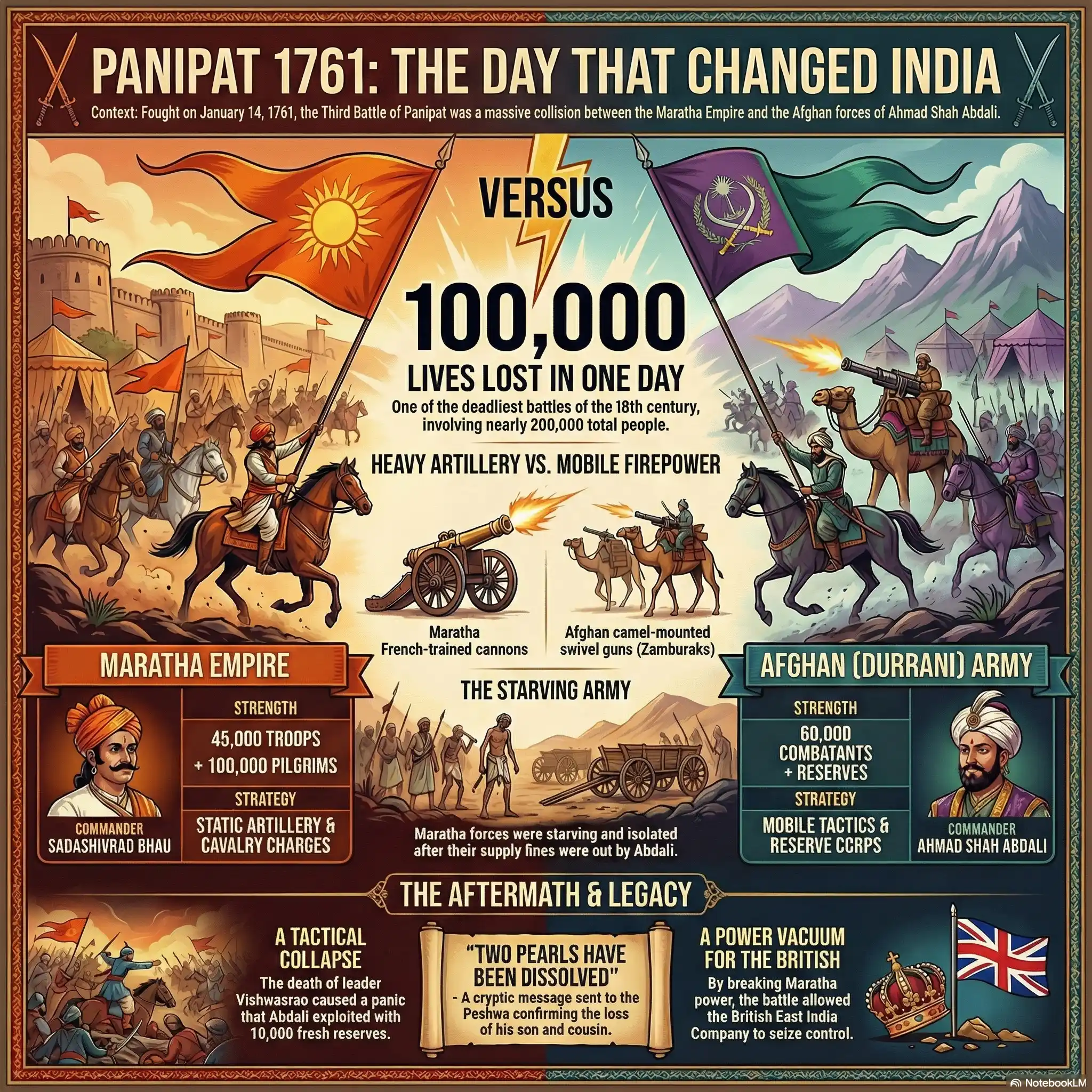
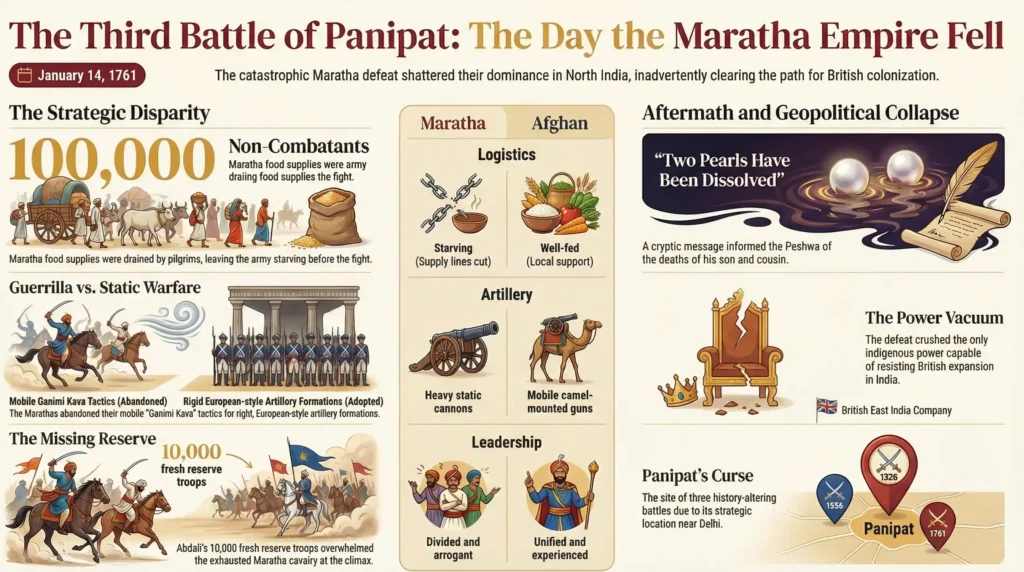
It had been written that way on purpose, because the news it carried was too terrible to state plainly. “Two pearls have been dissolved,” it read. “Twenty-seven gold coins have been lost. And of the silver and the copper, the count cannot be made.”
The two pearls were the Peshwa’s own son and his cousin, both dead. The gold coins were his finest generals. The silver and copper were the ordinary soldiers, tens of thousands of them, so many that no one could count the dead.
This was how Pune learned of the Third Battle of Panipat, fought on 14 January 1761. It was one of the bloodiest single days in the history of India, and it broke the most powerful people in the land. This is the story of how they came to that field, and of the strange, distant figure who truly gained from their ruin.
The saffron flag
Battle of Buxar 1764: The Victory That Made British Rule Inevitable
To feel the size of the fall, you first have to see how high the Marathas had climbed.
By the middle of the eighteenth century, the Mughal Empire was an empty shell, an emperor in Delhi with a grand title and almost no real power. The true masters of India were the Marathas. From their heartland around Pune, their leaders, the Peshwas, had pushed Maratha power clear across the subcontinent, their saffron banners flying as far north as Attock, on the very edge of Afghanistan.
They were, by a distance, the strongest force in the land. If any Indian power was going to inherit the ruins of the Mughal empire and rule the whole country, it was them. That was the prize on the table, and everyone could see it.
The invader and his allies
That rise frightened people, and frightened rulers go looking for a bigger sword.
Several of the Muslim powers of the north, alarmed at the spread of this Hindu-led Maratha empire, looked across the mountains to Ahmad Shah Abdali, the king of Afghanistan. He was a hardened conqueror who had once served as a general under Nadir Shah, the same Nadir Shah who had sacked Delhi twenty years before. Now Abdali was invited to come and cut the Marathas down to size.
The invitation was dressed in the language of religion, a call to defend Islam against the unbeliever. But beneath the rhetoric it was the oldest story in politics: rival powers, frightened of a stronger neighbour, joining hands to bring it down. Abdali, who never needed much persuading to march toward the wealth of India, crossed the Indus with his army, and the northern chiefs, the Rohilla leader Najib-ud-Daula and Shuja-ud-Daula of Awadh, joined him.
The long march and the starving camp
Death of Tipu Sultan: The Fall of the Tiger of Mysore
To meet this threat, the Peshwa sent a huge army north from Pune, under the command of his able cousin, Sadashivrao Bhau. At its head, as the young figurehead of the expedition, rode the Peshwa’s own son, Vishwasrao.
It was a mighty force, and it marched into a trap partly of its own making.
Bhau was a gifted man, but he was proud, and the pride cost him. He fell out with the very people who might have stood beside him, the Jat ruler Suraj Mal and the Rajput chiefs, so that when the fighting came the Marathas faced the enemy almost alone, deep in hostile country far from home. Worse, the army was trailed by a vast crowd of non-combatants, perhaps a hundred thousand pilgrims and family members, who had to be fed from the same shrinking supplies.
Abdali understood exactly how to use this. Rather than rush to battle, he cut the Maratha supply lines and waited. Through the cold weeks of a northern winter, the great Maratha camp slowly starved.
One day at Panipat
By 14 January 1761, the Marathas could wait no longer. Starving and desperate, they resolved to break out and give battle, and they came out of their camp to fight.
For a while, it went well. The Maratha guns, commanded by a brilliant artillery officer named Ibrahim Khan Gardi, tore into the Afghan lines, and the Maratha attack pressed forward. For a few hours, it looked as though they might win.
Then the day turned, as these days so often do, on a single man. Young Vishwasrao, the Peshwa’s son, was struck and killed in the thick of the fighting. When Sadashivrao Bhau saw him fall, he is said to have climbed down from his elephant and thrown himself into the battle on foot.
His soldiers, glancing back for their commander, saw only his empty elephant seat. They did not think he had joined the fight. They thought he was dead, and the heart went out of the army.
That was the moment Abdali had been waiting for. He loosed his fresh, well-fed reserves upon the exhausted and hungry Marathas, and what had been a battle became a collapse. By evening the field was lost.
The killing did not stop with the fighting. In the hours and days that followed, tens of thousands more, soldiers and camp followers alike, were cut down or carried off into slavery. Estimates of the total dead vary widely, but they run into the many tens of thousands. A great part of an entire generation of Maratha men died on that plain.
The message to Pune
Annexation of Punjab 1849: The Fall of the Sikh Empire
And so the coded letter made its way south to a waiting Peshwa.
Balaji Baji Rao was already unwell when it reached him. The scale of the loss, his son, his cousin, his commanders, the flower of Maratha manhood gone in an afternoon, was more than he could bear. He died within a few months, a man broken by grief as much as by illness.
There is one figure from that field who deserves to be remembered here, because he complicates the easy story of a war between religions. Ibrahim Khan Gardi, the Muslim general who commanded the Maratha guns, stayed loyal to his Hindu masters to the very end. He was captured after the battle and put to death by the Afghans. A war supposedly fought to defend one faith had, on the losing side, a devout man of that same faith who gave his life for the other.
Why they lost
It is not hard to see why the Marathas were beaten, and it was not for any want of courage.
They were starving, their supplies cut off, while the enemy was well fed. They fought alone, their possible allies driven away by their own commander’s pride. And they had set aside the very thing that had made them great in the first place. The Marathas had risen through speed and surprise, the hit-and-run mobility of light cavalry. At Panipat they stood and fought a heavy, set-piece battle of the European kind, exactly the sort of fight that suited their enemy and blunted their own strength. Against all of that, Abdali’s cool handling of his reserves and supplies simply proved too much.
The winner who wasn’t there
Here is the strangest part of the whole story.
Ahmad Shah Abdali won the battle completely, and won almost nothing by it. He took his plunder, but his soldiers, unpaid and tired of India, soon mutinied and wanted only to go home. He built no empire here. Within a short time he was gone back over the mountains, and the north of India was left not conquered but hollow, a great space with no strong hand to hold it.
The Marathas, for their part, were shattered for a decade. The one Indian power that might have united the country and ruled it was, for the moment, broken.
Into that double emptiness, the wound of the Marathas and the absence of the Afghans, stepped a third party that had not been anywhere near Panipat.
The man who truly gained from that terrible day was not on the field at all. He was far away in Bengal, where a trading company had just begun to turn itself into a government.
While the Marathas and the Afghans bled each other white in the north, the British East India Company was quietly tightening its grip on the wealth of the east. As one old saying puts it, Panipat did not decide who would rule India. It decided who would not.
Not everything was lost forever. Among the wounded survivors who crawled away from that field was a young man named Mahadji Shinde, carried off with a shattered leg that left him lame for life. He would live to rebuild Maratha power and become, for a time, the real master of Delhi. The Marathas would rise again.
But the moment when they might have inherited all of India passed on that January day, on the same plain north of Delhi where the fate of the country had already been decided twice before. Two pearls, twenty-seven gold coins, and silver and copper beyond counting. A whole future, spent in a single afternoon.
Establishment of the British Raj 1858: The Dawn of Imperial India
If you think you have remembered everything about this topic take this QUIZ
Who fought the Third Battle of Panipat?
It was fought between the Maratha Empire (led by Sadashivrao Bhau) and the Afghan Army (led by Ahmad Shah Abdali).
When was the battle fought?
It was fought on January 14, 1761.
Who won the Third Battle of Panipat?
Ahmad Shah Abdali won the battle, inflicting a crushing defeat on the Marathas.
Who was Ibrahim Khan Gardi?
He was a Muslim general who commanded the Maratha artillery. He refused to desert the Marathas and was executed by the Afghans after the battle.
What was the main consequence of the battle?
It halted Maratha expansion in the North for a decade and weakened Indian resistance, allowing the British East India Company to consolidate power in Bengal and eventually the rest of India.
Sources & References
- Encyclopaedia Britannica (“Ahmad Shah Durrani”) — the Afghan king, his service under Nadir Shah, and the Panipat campaign of 1761.
- Encyclopaedia Britannica (“Maratha”) — the rise of the Maratha confederacy and the impact of the defeat.
- Ministry of Culture, Indian Culture portal (Sadashivrao Bhau and the Marathas) — the northern expedition and its commanders.
- Panipat district administration (panipat.gov.in) — the date and site of the battle on the plain of Panipat.
Author


Exploring the Soul of Bharat through History, Science, Culture, and its Diversity
Our Mission
Curious Indian is a definitive knowledge portal dedicated to chronicling the events, personalities, and cultural shifts that defined the Indian subcontinent. From the ancient Vedic Period to the complexities of 21st-century politics, our goal is to provide deep-dive analysis that inspires.
Editorial Standards & E-E-A-T
Every article published under our brand undergoes a rigorous fact-checking process. We prioritize primary historical records, academic citations, and credible archives to ensure our readers receive accurate, high-authority information.
Historical Integrity Directly sourcing from ASI archives and academic journals.Topical Authority Comprehensive clustering of Indian Science, Biographies, and Wars.Managed by Paripurna Datta and TEAM | Dedicated to the Knowledge of India.