How the Crown took over India and kept the same machine running
When the great revolt of 1857 was finally crushed, the British faced an uncomfortable question. If a single rumour about a rifle cartridge could set half of India on fire, what exactly had gone so wrong with the way India was being ruled?
Their answer, in 1858, looked like a revolution. They abolished the East India Company, the private corporation that had ruled the subcontinent for a hundred years, and handed the whole of India to Queen Victoria and the British Crown. On paper, it was the dawn of a new age.
In practice, the machine of rule barely changed a single bolt.
This is the story of the year the empire changed its costume, and of why that change mattered far more for what it promised than for anything it actually did.
The company that had to go
For exactly a century, from the victory at Plassey in 1757 to the revolt of 1857, India had been ruled by a business.
The East India Company had come to trade, stayed to conquer, and governed a fifth of humanity with one eye always on its profits and its dividends. The revolt of 1857 tore the mask off that arrangement. It showed a shocked British public that a trading company, chasing money, had misgoverned and inflamed a country of some two hundred million people until it exploded.
The conclusion in London was obvious. A company could not be trusted to rule an empire. The Company would have to go.
Mahatma Gandhi Return to India: The Arrival That Changed History
From company to crown
The change was made law by the Government of India Act, passed in 1858 and given the bland, comfortable title of an Act for the Better Government of India.
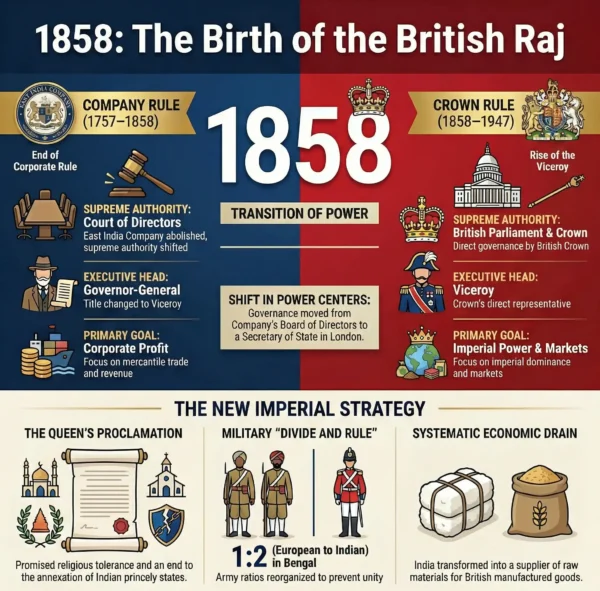
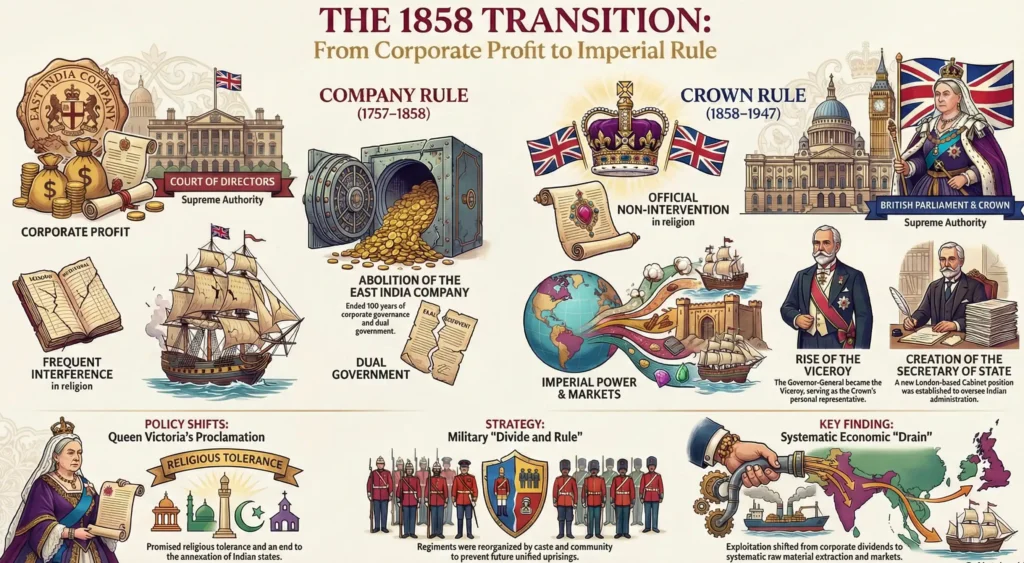
Its effect was sweeping. The East India Company was abolished, its directors and its private government swept away. In London, a new cabinet minister, the Secretary of State for India, was made answerable to Parliament for the running of the country. And in India, the old title of Governor-General was dressed up in grander robes as the Viceroy, the direct representative of the Queen. Lord Canning, who had ridden out the storm of 1857, became the first to hold the new office.
The paperwork was enormous. The reality beneath it was simple: one set of British rulers had handed India to another.
The Queen’s promise
The centrepiece of the new era was a piece of theatre, and a rather brilliant one.
On 1 November 1858, at a grand assembly in Allahabad, Lord Canning read out a proclamation in the name of Queen Victoria herself. It was carefully written to calm a frightened and angry country, and it made three great promises. The British would seize no more Indian kingdoms, and the hated policy of grabbing states without heirs was dropped. They would not interfere with India’s religions. And, most striking of all, they promised that Indians would be treated as equals.
The Queen promised that her Indian subjects would be admitted to office “freely and impartially,” whatever their race or their creed. It was a beautiful sentence, and for many decades it remained just that, a sentence.
The proclamation was so grand in its language that it has sometimes been called the Magna Carta of India. Whether it meant much in practice was another matter entirely.
Muslim League Founded 1906: The Beginning of Communal Politics in India
Divide and rule
Behind the soothing words, the British were quietly making very sure that 1857 could never happen again.
The lesson they had taken from the revolt was cold and clear. So the army was rebuilt on a new principle. Regiments were deliberately organised along lines of caste and community, with Sikhs and Gurkhas and Pathans kept in their own units, so that the men would identify with their group rather than with one another. More British soldiers were folded into the mix, and the artillery, the great decider of battles, was kept firmly in British hands.
The lesson the British took from 1857 was cold and simple: never again could the soldiers of India be allowed to stand together as one.
It was an approach the British would carry across Indian life for the next ninety years, and its shadow would fall heavily on the country long after they had gone.
The same drain, better dressed
For all the ceremony, the thing that mattered most did not change at all.
The Company had drained India’s wealth for its shareholders. Under the Crown, that drain did not stop. If anything it grew more organised. India was steadily turned into a supplier of cheap raw materials, cotton and indigo and jute, and a captive market for goods manufactured in British factories. Its wealth kept flowing outward, toward Britain, year after year.
The difference was mostly in the packaging. What the Company had done for profit, the Crown now did for empire, and dressed it up in the language of good governance and the gift of railways.
The face on the coin had changed. The pockets it filled had not.
Partition of Bengal 1905: The Divide That United a Nation
The promise that became a weapon
So was the birth of the British Raj nothing more than a change of clothes? Mostly, yes. But not entirely, and the exception is the most interesting part of the whole story.
The British had made their grand promises of equality and justice in 1858 in order to pacify India, and then, for the most part, they quietly ignored them. The pledge that Indians would rise freely in their own country stayed on paper, while the good jobs and the real power stayed British.
But here is what the rulers did not foresee. By writing those promises down, in the sacred name of the Queen, they had handed their subjects a weapon.
A promise made to calm a conquered people became, in time, the very words with which that people would shame their rulers.
In the decades that followed, educated Indians picked up the Queen’s proclamation and held it to the Empire’s face. Thinkers like Dadabhai Naoroji, and the founders of the Indian National Congress a generation later, did not at first demand that the British leave. They demanded something more awkward: that the British keep their own word. You promised us equality, they said. You promised us justice. Now give it to us.
That was the trap hidden inside the costume. The rule of India had begun, a century earlier, as a company’s line in an account book. It was rebranded in 1858 as the benevolent care of a queen. And in the end, some of the very words the empire used to make itself look kind became part of the argument that would help bring it down. Power can change its clothes as often as it likes. But a promise, once written, has a way of outliving the intentions behind it.
Indian National Congress Founded 1885: The Birth of Indian Nationalism
If you think you have remembered everything about this topic take this QUIZ
Results


#1. Who became the first Viceroy of India following the Government of India Act 1858?
#2. Where was the grand Durbar held on November 1, 1858, to read Queen Victoria’s Proclamation?
#3. The Government of India Act 1858 created which new cabinet minister position in London?
#4. Queen Victoria’s Proclamation explicitly abandoned which controversial annexation policy?
#5. Which commission was set up to reorganize the army after the 1857 revolt, focusing on “Divide and Rule”?
#6. Which crucial military unit was kept strictly in British hands after the army reorganization?
#7. Which city served as the capital of India for a single day on November 1, 1858?
#8. The “White Mutiny” in 1859 involved a revolt by which group of people?
What ended the rule of the East India Company?
The Government of India Act 1858, passed after the Revolt of 1857, formally ended the rule of the East India Company.
Who was the first Viceroy of India?
Lord Canning was the first Viceroy of India.
Where was Queen Victoria’s Proclamation read?
It was read by Lord Canning at a grand Durbar in Allahabad on November 1, 1858.
What was the main promise regarding religion in 1858?
The Proclamation promised strict religious neutrality and non-interference in the social and religious customs of Indians.
What new post was created in London to govern India?
The post of Secretary of State for India, a British cabinet minister, was created to oversee Indian administration.
Sources & References
- UK legislation records (Government of India Act 1858) — the abolition of the East India Company and the transfer of power to the Crown.
- The British Library (Queen Victoria’s Proclamation, 1858) — the Allahabad proclamation and its promises to India.
- Encyclopaedia Britannica (“Lord Canning” and “British raj”) — the first Viceroy and the structure of Crown rule.
- The National Archives (India Office Records) — the administration of India under the Crown after 1858.
Author


Exploring the Soul of Bharat through History, Science, Culture, and its Diversity
Our Mission
Curious Indian is a definitive knowledge portal dedicated to chronicling the events, personalities, and cultural shifts that defined the Indian subcontinent. From the ancient Vedic Period to the complexities of 21st-century politics, our goal is to provide deep-dive analysis that inspires.
Editorial Standards & E-E-A-T
Every article published under our brand undergoes a rigorous fact-checking process. We prioritize primary historical records, academic citations, and credible archives to ensure our readers receive accurate, high-authority information.
Historical Integrity Directly sourcing from ASI archives and academic journals.Topical Authority Comprehensive clustering of Indian Science, Biographies, and Wars.Managed by Paripurna Datta and TEAM | Dedicated to the Knowledge of India.