How a plea for safeguards in 1906 slowly became the demand for Pakistan
We almost always read the founding of the Muslim League backward.
We look at it through the smoke and the blood of 1947, through the horror of Partition and the millions dead and displaced, and we see the first brick of a wall that was bound to be built. The story becomes a straight line: a Muslim party founded in 1906, a separate nation created in 1947, cause and inevitable effect.
But that is a trick of hindsight, and it is worth resisting. Because on the December day in 1906 when the Muslim League was born, in a palace in Dhaka, there was no wall, and nothing about a separate country was written in the room. There was only a small group of cautious, loyal aristocrats, and a fear.
This is the story of that fear: where it came from, who fed it, who failed to answer it, and how, over forty long and unhappy years, it slowly hardened into a border.
A minority’s fear
By the early 1900s, the Indian National Congress had become the great voice of Indian nationalism, and it spoke, more and more, of one united nation and of majority rule.
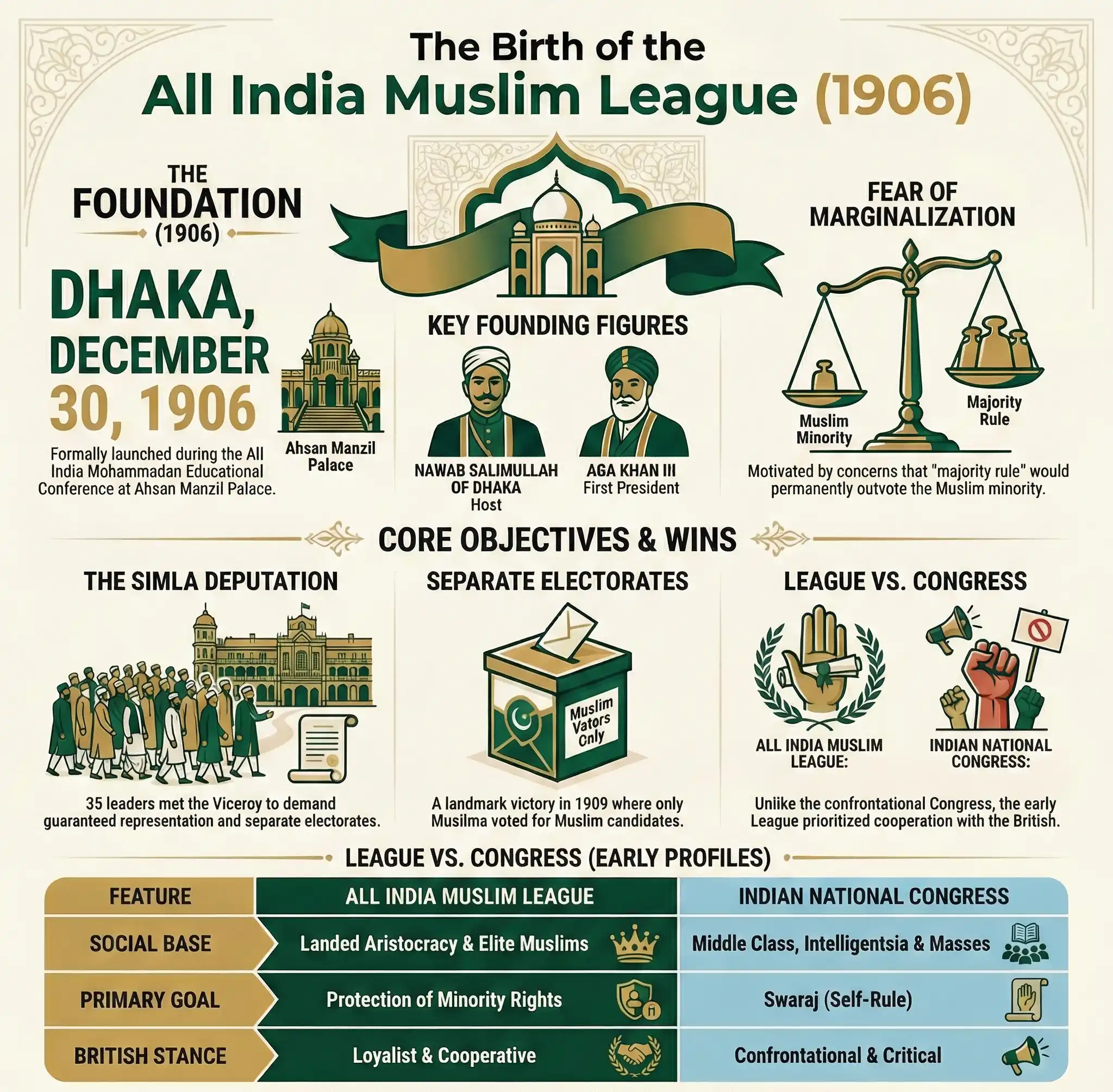
To many educated Muslims, that raised a genuine and uncomfortable question. Muslims were a large minority in India, something like a quarter of the population, tens of millions of people. In a future democracy where every vote counted the same, what would that mean for them? Would they ever hold real power, or would they simply be outvoted, forever, by the far larger Hindu majority?
It was not a paranoid question. It was a hard and fair one: in a democracy of one vote each, how does a permanent minority make sure it is heard, and not merely outnumbered?
That anxiety was sharpened by recent events in Bengal. When the British partitioned the province in 1905, the Muslims of the long-neglected east had gained, for the first time, a province where they were the majority. The Congress had answered with a furious campaign to undo that partition. From where many eastern Muslims stood, this looked like the majority moving to cancel the one arrangement that had finally worked in their favour. The fear of being overruled was no longer abstract. It had a face.
The Cabinet Mission Plan: The Blueprint That Could Have Prevented Partition
The British hand
Into this anxiety stepped the British, and their motives were anything but pure.
In October 1906, a group of thirty-five prominent Muslim leaders, headed by the Aga Khan, travelled to Simla to meet the Viceroy, Lord Minto. They asked for safeguards: separate electorates, in which Muslims would vote only for Muslim candidates, so that their voice could never be entirely swamped. Minto received them warmly and encouragingly.
Historians have long suspected that the warmth was staged. The meeting is often described as a command performance, a piece of theatre quietly arranged by British officials, because a nationalist movement split along religious lines was a movement far easier to rule.
The British had not planted the fear. But they were only too happy to water it. A divided India was an India that would go on needing them.
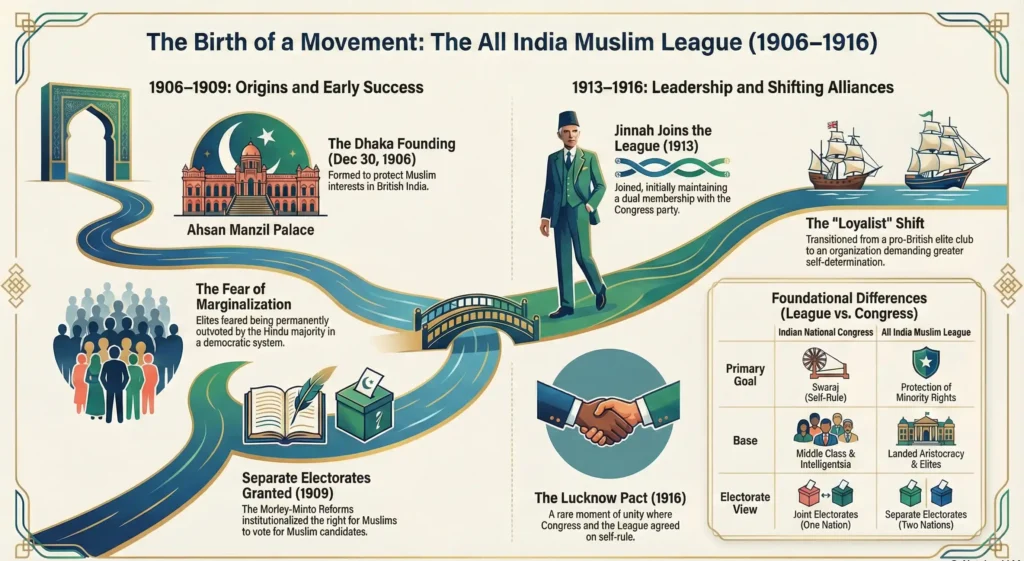
Three years later, in the reforms of 1909, the British made the division official. They granted separate electorates. It was, at one and the same time, a real safeguard for a nervous minority and a fault line poured into concrete: a formal, legal recognition that Hindus and Muslims were separate political peoples. Once that idea was written into law, it would prove very hard to erase.
The party in the palace
The League itself was founded on 30 December 1906, in Dhaka, at the close of an educational conference, in the palace of a leading nobleman, Nawab Salimullah. The Aga Khan became its first president.
It is worth being clear about what this organisation was, and what it was not. Its stated aims were to promote loyalty to the British Crown, to protect the political rights of Muslims, and, in its own words, to prevent hostility between Muslims and other communities. It was a body of nawabs, landlords and titled gentlemen, an elite club, not a mass movement. And it was pointedly loyal to the empire, not opposed to it.
This was not, in 1906, an engine built to break India. It was a cautious insurance policy, taken out by anxious men who wanted a seat at a table they were afraid of being pushed away from.
The Midnight of August 15: Freedom, Partition, and the Blood on the Map
Jinnah’s poison
The clearest proof that Partition was not yet written lies in the story of the one man who would eventually make it happen.
Muhammad Ali Jinnah, the future founder of Pakistan, wanted nothing to do with the Muslim League in 1906. He was then a rising star of the Congress, a sharp, Westernised lawyer and a convinced secularist, so admired as a bridge-builder that he was called an ambassador of Hindu-Muslim unity. He is remembered to have dismissed the League’s central demand, separate electorates, as a poison that would one day destroy India.
The man who would one day lead Muslims out of India began by calling the very idea of religious division a poison. In 1906, the future father of Pakistan was a champion of Hindu-Muslim unity.
When Jinnah did finally join the League, in 1913, he did so on the condition that it would not work against Indian freedom. And in 1916, he helped bring Congress and the League together in the Lucknow Pact, a genuine high point of cooperation, when the two organisations stood side by side to demand self-rule. Even then, even to him, a united India still seemed not only possible but likely.
How a fear becomes a wall
What came after is one of the saddest stories in modern history, and it is not a story with a single villain.
Over the next three decades, the trust built at Lucknow crumbled, and it crumbled through failures on every side. Alliances were formed and broken. Promises were made and not kept. Great movements rose, collapsed, and left bitterness behind them. Each disappointment made the old fear a little harder, and the distance between the communities a little wider. And through it all, the British kept every reason to keep the two apart.
Slowly, across many years and many broken hopes, the League’s demand changed shape. What had begun as a plea for safeguards inside a shared India curdled, at last, into a demand to leave it altogether. Yet even this took an astonishingly long time. Not until 1940, thirty-four years after that meeting in Dhaka, did the League formally call for a separate Muslim homeland. And only in 1947 was the border finally drawn, through the middle of the subcontinent, in blood.
Non-Cooperation Movement 1920-1922: The Day India Said “No” to the British
The fear that nobody answered
It is tempting, standing on the far side of 1947, to look back at that Dhaka palace and see the first stone of an inevitable wall. But that reading takes the wrong lesson, because in 1906 there was no wall. There was only a fear, and the fear was not unreasonable.
A minority had asked a hard and honest question: how can we be sure we will be safe and heard, and not simply outvoted forever? That question deserved a generous and imaginative answer. Over the next forty years, it never quite received one. It was too often brushed aside by a Congress that could not see why anyone would need protection from a free India. It was cynically exploited by a British power that found division useful. And it was, in the end, allowed to sour into separatism by a League that stopped asking for safeguards and started asking for a country.
The real lesson buried in the founding of the Muslim League is not that some group of people were villains. It is something harder, and more universal, than that. A genuine fear, if it is mocked or ignored or used instead of honestly answered, does not fade away. It waits. It hardens. And given enough time and enough broken promises, it can grow into a border. A fear can still be talked about, reasoned with, and eased. A border cannot. That is why the fear should have been answered while it was still only a fear, and that is the quiet tragedy of the day the Muslim League was born.
Salt Satyagraha 1930: Inside Mahatma Gandhi’s Historic Dandi March
If you think you have remembered everything about this topic take this QUIZ
Results


#1. The All India Muslim League was founded on December 30, 1906, in which city?
#2. Who hosted the founding meeting of the Muslim League at Ahsan Manzil Palace?
#3. Who became the first president of the All India Muslim League?
#4. What was the primary political achievement of the Muslim League in the Morley-Minto Reforms of 1909?
#5. When Muhammad Ali Jinnah joined the Muslim League in 1913, he was already a member of which organization?
#6. The famous “Simla Deputation” of 1906 met with which British Viceroy to demand Muslim rights?
#7. Which 1916 agreement marked a brief period of unity where Congress accepted separate electorates?
#8. In its initial years, what was the Muslim League’s stance towards the British Government?
Who founded the All India Muslim League?
It was founded by a group of Muslim leaders, prominently Nawab Salimullah of Dhaka, Aga Khan III, and Nawab Mohsin-ul-Mulk.
When and where was the Muslim League founded?
It was founded on December 30, 1906, at Ahsan Manzil in Dhaka (now Bangladesh).
What was the main demand of the Muslim League in its early years?
Its primary demand was Separate Electorates for Muslims, which they achieved in the 1909 Morley-Minto Reforms.
Did Muhammad Ali Jinnah found the Muslim League?
No, Jinnah was not a founder. He was a member of the Congress at the time and joined the Muslim League only in 1913.
What was the Lucknow Pact?
It was a historic agreement in 1916 between the Congress and the Muslim League, where Congress accepted separate electorates and both parties agreed to work together for self-government.
Sources & References
- Encyclopaedia Britannica (“All India Muslim League”) — the founding at Dhaka in 1906, its early loyalist aims, and its later evolution.
- Encyclopaedia Britannica (“Morley-Minto Reforms”) — the 1909 grant of separate electorates for Muslims.
- Encyclopaedia Britannica (“Muhammad Ali Jinnah”) — his early career as a Congress nationalist, the Lucknow Pact, and his later leadership of the League.
- UK Parliament (living heritage: empire and Commonwealth) — the British constitutional framework and the politics of representation in colonial India.
Author


Exploring the Soul of Bharat through History, Science, Culture, and its Diversity
Our Mission
Curious Indian is a definitive knowledge portal dedicated to chronicling the events, personalities, and cultural shifts that defined the Indian subcontinent. From the ancient Vedic Period to the complexities of 21st-century politics, our goal is to provide deep-dive analysis that inspires.
Editorial Standards & E-E-A-T
Every article published under our brand undergoes a rigorous fact-checking process. We prioritize primary historical records, academic citations, and credible archives to ensure our readers receive accurate, high-authority information.
Historical Integrity Directly sourcing from ASI archives and academic journals.Topical Authority Comprehensive clustering of Indian Science, Biographies, and Wars.Managed by Paripurna Datta and TEAM | Dedicated to the Knowledge of India.