How the last plan for a united India failed for want of trust
For a few weeks in the summer of 1946, something happened that is almost impossible to imagine, given everything that came after.
The Indian National Congress and the Muslim League, the two great rivals whose quarrel was about to tear the subcontinent in two, both said yes to the same plan for a single, united India. For one brief moment, Partition was not written in stone. The country that would soon be split apart, with a border drawn in blood, came genuinely close to staying whole.
And then, within a few weeks, it all fell apart.
This is the story of the Cabinet Mission Plan, the last real chance to keep India united, and of the hard and quiet lesson buried in its failure: that no plan on earth, however clever, can hold together people who have stopped trusting one another.
The end of the Raj
By 1946, the British were finished in India, and they knew it.
The Second World War had left Britain exhausted and nearly bankrupt. Worse for the Raj, its own instruments of control were failing. The trials of Indian soldiers who had fought against the empire, and a mutiny in the Royal Indian Navy, had shown that even the forces the British relied on could no longer be counted on to hold India down. The new government in London, under Prime Minister Clement Attlee, had decided to leave.
But how, and to whom? Attlee sent three senior ministers, the Cabinet Mission, to Delhi with a difficult task: to hand over power peacefully and, if it could possibly be managed, to a single united India rather than two hostile states. Standing in the way was a deadlock that looked hopeless. The Congress wanted one India with a strong central government. The League, led by Muhammad Ali Jinnah, wanted a separate country, Pakistan. The Mission had to find a way to give each side enough of what it wanted to make it say yes.

Assassination of Mahatma Gandhi: The Shot That Silenced a Nation
The clever compromise
On 16 May 1946, the Mission produced its answer, and it was genuinely ingenious.
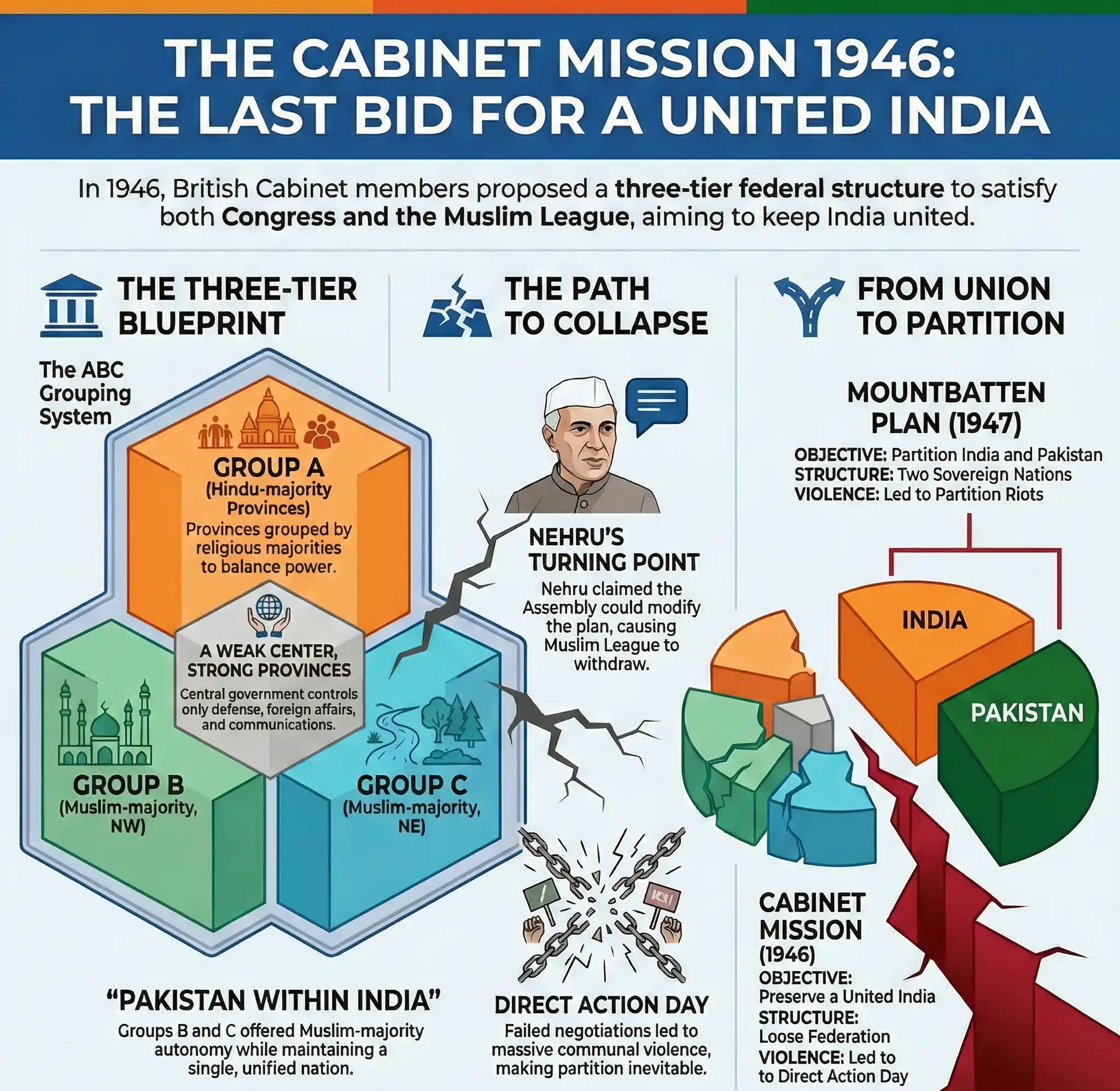
It said no to a separate Pakistan, arguing that carving one out would trap huge minorities on the wrong sides of the line and cut the country’s army and economy in half. Instead, it proposed a single India built in three careful layers. At the top would sit a deliberately weak central government, in charge of only three things: defence, foreign affairs, and communications. At the bottom, the provinces would run almost everything else themselves. And in between lay the clever part: provinces could gather into groups, one for the Hindu-majority provinces, and two for the Muslim-majority regions in the north-west and the east.
The beauty of it was that it offered the Muslim League a kind of Pakistan within India, whole regions where Muslims would govern themselves, without actually breaking the country apart. Congress kept its united India. The League got its Muslim self-rule. On paper, everyone won.
Two yeses, one meaning missing
And astonishingly, for a moment, it worked. Both sides accepted the plan. The trouble was that they accepted it meaning two completely different things.
To Jinnah, the Muslim groups were the seed of a future Pakistan, one that could quietly grow inside the loose federation and one day stand on its own. To the Congress, the weak centre and the single Union were proof that India would remain, in the end, one country. Each side had said yes to the same words while imagining opposite futures.
And at the heart of the plan lay one dangerous ambiguity that nobody had truly settled. Was the grouping compulsory, so that a province had to join its group whether it wished to or not, as the League insisted? Or could a province opt out, as the Congress claimed, so that, for instance, Hindu-majority Assam would not be forced into a group dominated by Muslim-majority Bengal?
Both sides had signed the same document while reading its most important clause in exactly opposite ways. It was less an agreement than two hopes pointed in different directions, resting for a moment on the same piece of paper.
The Indo-Pakistani War of 1947-48: The First War for Kashmir
The press conference
The fragile balance held only for a matter of weeks, until a single press conference brought it down.
On 10 July 1946, Jawaharlal Nehru, newly made president of the Congress, told reporters in Bombay that the Congress would enter the coming constituent assembly completely unbound, free to change the plan, including the grouping, as it thought best.
Whatever Nehru meant by it, and historians still argue about how careless or deliberate the remark was, Jinnah heard in it his oldest and deepest fear. It was the same fear that had haunted the Muslim League from its very beginning: that in a united India the far larger Congress would simply outvote and override the Muslims, and that any promise made to them before independence would be torn up the moment the British were gone. Now, it seemed to him, the leader of the Congress had all but said so out loud.
To Jinnah, Nehru’s words were the old fear made flesh: that once the British had left, a Congress majority would rewrite the rules and leave the Muslims with nothing but broken guarantees.
Within days, Jinnah withdrew the League’s acceptance of the plan. The one moment of agreement was over.
Direct Action Day
With his faith in negotiation gone, Jinnah turned from the conference table to the street, and here the story turns very dark.
He called for a Direct Action Day on 16 August 1946, to show the strength of Muslim feeling for Pakistan. What was meant to be a day of protest became, in the great city of Calcutta, an explosion of communal killing. For several days, Hindus and Muslims killed one another in the streets, and by the end thousands lay dead. The horror did not stay in Calcutta. It spread, in a chain of revenge, to Noakhali, where Hindus were attacked, and to Bihar, where Muslims were, each massacre feeding the next.
In the streets of Calcutta, the idea of a shared country bled to death. After neighbours had murdered one another by the thousand, a united India was no longer something most people could even imagine.
There were no clean hands in that violence, and no single guilty community. There was only the terrible proof that the trust the Cabinet Mission Plan needed in order to work had already been destroyed.
The Constitution of India: How 299 Visionaries Scripted a Nation’s Destiny
Why it really failed
It is tempting to look for the one person who wrecked the last chance for a united India. Was it Nehru, with his reckless press conference? Was it Jinnah, for walking away and calling for Direct Action? Was it the British, for writing a plan so ambiguous that both sides could read it however they wished? Each of them played a part, and the argument over who was most to blame has never ended.
But the truest answer is sadder and larger than any single man, and it is the reason this story still matters.
The Cabinet Mission Plan did not fail because it was badly made. It failed because the one thing it needed most was the one thing no plan can supply: trust.
By 1946, forty years of fear and broken faith had left the Congress and the League each utterly certain that the other would cheat at the first opportunity. And so, offered the same clever compromise, each side read it in the way it most dreaded, and neither could bring itself to believe the other’s promise. A constitution, in the end, is only ink on paper until the people bound by it trust one another enough to live by its spirit, and not merely to fight over its words. The Mission could give India an ingenious set of clauses. It could not give India the trust to make those clauses mean anything, and that trust had already been spent.
So the last real chance for a united India slipped away, not because the design was wrong, but because the people who would have had to share the country no longer believed in one another. Within a year the loose federation was gone, replaced by a hard border, and the cost of that lost trust would be paid in one of the largest and bloodiest migrations the world has ever seen.
The Cabinet Mission Plan is remembered as the great road not taken. Its deeper lesson is quieter, and harder to hear. The most carefully drawn plan in the world cannot hold together people who have stopped trusting each other. And trust, once it is truly gone, is the hardest thing of all to win back.
The Midnight of August 15: Freedom, Partition, and the Blood on the Map
If you think you have remembered everything about this topic take this QUIZ
Results


#1. Who were the three members of the Cabinet Mission sent to India in 1946?
#2. What was the core proposal of the Cabinet Mission Plan regarding the structure of India?
#3. Under the proposed “Grouping System,” which provinces were included in Group C?
#4. What event on July 10, 1946, triggered the collapse of the plan?
#5. After rejecting the plan, Jinnah declared August 16, 1946, as which day?
#6. Which Congress leader did Mahatma Gandhi advise to reject the compulsory grouping clause, fearing subjugation?
#7. Who was the Finance Minister in the Interim Government who blocked Congress proposals, paralyzing the administration?
#8. The Cabinet Mission Plan was eventually replaced by which plan that led to the partition of India?
What was the main aim of the Cabinet Mission Plan?
The main aim was to facilitate the transfer of power from the British to Indian leadership while maintaining a united India through a federal structure.
Who were the three members of the Cabinet Mission?
The members were Lord Pethick-Lawrence (Secretary of State for India), Sir Stafford Cripps (President of the Board of Trade), and A.V. Alexander (First Lord of the Admiralty).
Why did Jinnah reject the Cabinet Mission Plan eventually?
Jinnah rejected it after Jawaharlal Nehru stated that the Constituent Assembly could modify the plan, leading Jinnah to fear that the guarantees for Muslim-majority groups would be removed by the Congress majority.
What was “Direct Action Day”?
It was a day of protest called by the Muslim League on August 16, 1946, following the rejection of the Cabinet Mission Plan. It triggered massive communal riots, particularly in Calcutta.
Did the Cabinet Mission propose Pakistan?
No, the Cabinet Mission explicitly rejected the demand for a separate Pakistan, arguing it was administratively and economically unviable.
Sources & References
- Encyclopaedia Britannica (“India”: the transfer of power) — the 1946 Cabinet Mission, the plan, and its collapse.
- UK Parliament, Hansard (the 1946 Cabinet Mission proposals) — the British plan for handing over power to India.
- Encyclopaedia Britannica (“Direct Action Day”) — the call of 16 August 1946 and the Calcutta killings.
- The British Library (the end of the Raj) — the political deadlock and the road toward partition.
Author


Exploring the Soul of Bharat through History, Science, Culture, and its Diversity
Our Mission
Curious Indian is a definitive knowledge portal dedicated to chronicling the events, personalities, and cultural shifts that defined the Indian subcontinent. From the ancient Vedic Period to the complexities of 21st-century politics, our goal is to provide deep-dive analysis that inspires.
Editorial Standards & E-E-A-T
Every article published under our brand undergoes a rigorous fact-checking process. We prioritize primary historical records, academic citations, and credible archives to ensure our readers receive accurate, high-authority information.
Historical Integrity Directly sourcing from ASI archives and academic journals.Topical Authority Comprehensive clustering of Indian Science, Biographies, and Wars.Managed by Paripurna Datta and TEAM | Dedicated to the Knowledge of India.