Tuesday, May 12, 2026
18 °c
Boydton
Curious Indian
  • Arts & Culture
  • Festivals of India
  • Indian History
  • Indian Politics
  • Biography
    • Entertainment Personalities
    • Science Personalities
  • Unsolved India
No Result
View All Result
  • Arts & Culture
  • Festivals of India
  • Indian History
  • Indian Politics
  • Biography
    • Entertainment Personalities
    • Science Personalities
  • Unsolved India
No Result
View All Result
Curious Indian
No Result
View All Result
Home Indian History Ancient Civilizations & The Vedic Age

Shalihotra: The First Father of Veterinary Medicine

The Ancient Veterinarian Who Wrote the Book on Horses

Curious Indian by Curious Indian
in Ancient Civilizations & The Vedic Age, Biography, Indian History, Science Personalities, Scientific Discoveries
Reading Time: 11 mins read
0 0
A A
Father of Veterinary Medicine
Share on FacebookShare on Twitter

Table of Contents

Toggle
  • The Healer of the Ancient Silk Road
  • The Wisdom of the Shalihotra Samhita
  • The Dawn of Ancient Indian Surgery
  • A Deep Understanding of Animal Psychology
  • The Global Journey of Indian Veterinary Science
  • Quick Comparison: Ancient vs. Modern Veterinary Concepts
    •  
  • Curious Indian: Fast Facts
  • Conclusion
  • If you think you have remembered everything about this topic take this QUIZ
  • Results
    • #1. By what title is the 3rd Century BCE sage Shalihotra globally recognized today?
    • #2. What is the name of the 12,000-verse technical manual authored by Shalihotra?
    • #3. In which ancient Indian city did Shalihotra live and develop his medical system?
    • #4. Shalihotra was a master of ‘Shalya-tantra’ for animals. What does this term refer to?
    • #5. How did Shalihotra apply the concept of ‘Prakriti’ (temperaments) to horses?
    • #6. What was the title of the Arabic translation of Shalihotra’s work that influenced Middle Eastern and European traditions?
    • #7. Which specific animal was the primary focus of Shalihotra’s most famous medical research?
    • #8. What linguistic evidence of Shalihotra’s legacy survives in rural India today?
    • Who is known as the Father of Veterinary Medicine?
    • What is the most famous book written by Shalihotra?
    • Where was Shalihotra from?
    • Did Shalihotra perform surgeries?
    • How did Shalihotra’s work reach other countries?
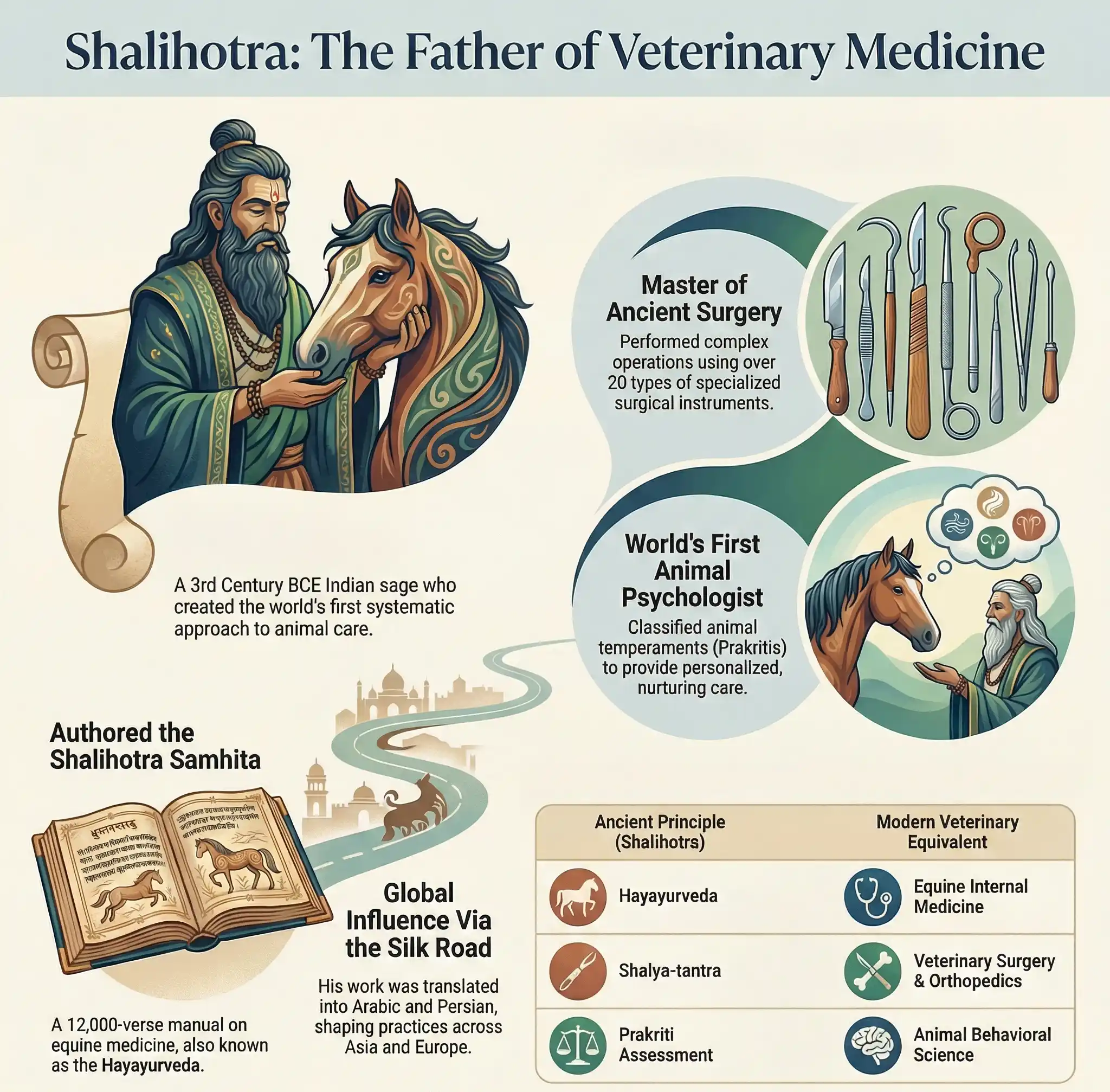
Shalihotra was a pioneering Indian sage of the 3rd Century BCE who earned the title of Father of Veterinary Medicine by creating the world's first scientific system for animal care. His monumental work, the Shalihotra Samhita, provided a comprehensive guide to equine anatomy, surgery, and psychology, blending spiritual compassion with rigorous clinical observation. His teachings traveled across the Silk Road, influencing medical traditions worldwide and establishing ancient India as the cradle of veterinary science.
Data PointHistorical Detail
IdentitySage Shalihotra
Primary TitleFather of Veterinary Medicine
Era3rd Century BCE
Key TextShalihotra Samhita (Hayayurveda)
Main SpecialtyEquine Medicine & Surgery
Legacy LocationShravasti, Ancient India

The Healer of the Ancient Silk Road

The golden age of ancient India was defined not just by its philosophers and kings, but by its deep, scientific compassion for all living beings. In the 3rd Century BCE, amidst the bustling trade and spiritual awakening of Shravasti, a sage named Shalihotra emerged as a figure of monumental importance. Today, he is globally revered as the Father of Veterinary Medicine, a title he earned by documenting the first structured medical system dedicated entirely to animals. At a time when much of the world viewed animals merely as tools of labor or war, Shalihotra saw them as patients requiring the same level of diagnostic precision and ethical care as any human being.

READ MORE:  Rani Gaidinliu: Zeliangrong Uprising's Youngest, Boldest Voice

Living in the heart of Shravasti, Shalihotra was surrounded by the majesty of the Mauryan era’s cavalry and the essential role of elephants in civic life. He realized that the survival and prosperity of a civilization were inextricably linked to the health of its animals. This realization drove him to spend decades observing the physical and emotional states of horses, eventually leading to the creation of a body of work that would serve as the foundation for animal sciences for the next two millennia.

7 Secrets of Padmanabhaswamy Temple Treasure

Father of Veterinary Medicine

The Wisdom of the Shalihotra Samhita

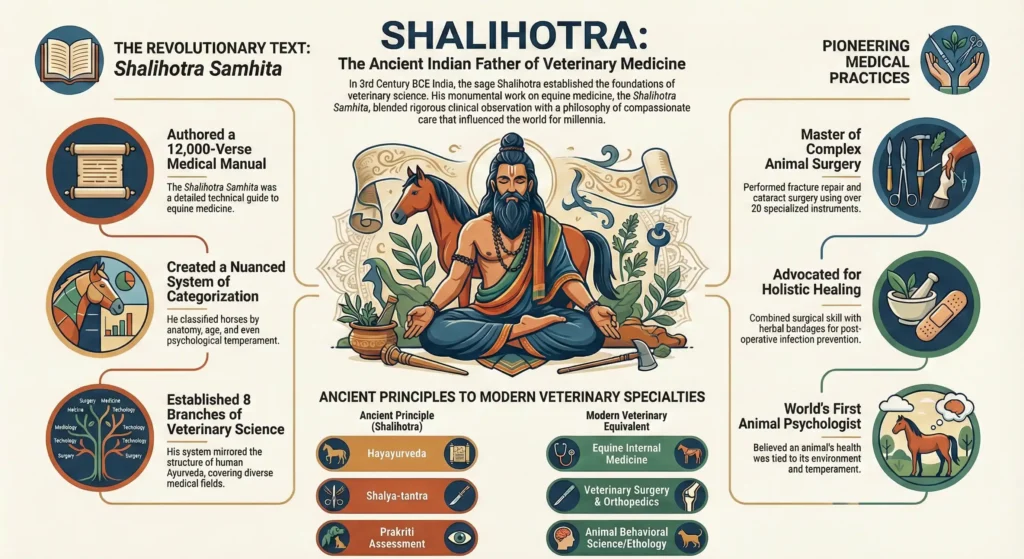
The most significant contribution of this Shravasti sage was the compilation of the Shalihotra Samhita. This wasn’t a simple collection of folk remedies; it was a rigorous, 12,000-verse technical manual known as the Hayayurveda. This text represents a pinnacle in equine medicine history, providing a level of detail that remains astonishing to modern veterinarians. Shalihotra categorized horses based on their physical characteristics, their age, and even their psychological disposition, creating a nuanced approach to treatment that was centuries ahead of its time.

Within the Shalihotra Samhita, the sage divided veterinary science into eight distinct branches, mirroring the structure of human Ayurveda. He wrote extensively on anatomy, physiology, and the causes of diseases, but he also included sections on the “omens” of animal health—early forms of diagnostic symptoms that allowed healers to predict an illness before it became fatal. His work was so authoritative that it traveled far beyond the borders of India, being translated into Arabic, Persian, and Tibetan, ensuring that the roots of veterinary science remained firmly planted in Indian soil.

The Dawn of Ancient Indian Surgery

One of the most remarkable sections of Shalihotra’s teachings involves ancient Indian surgery. In an era long before modern sterilization and anesthesia, Shalihotra was successfully performing complex operations on large animals. He was a master of “Shalya-tantra” (surgery) for animals, describing procedures for treating fractures, extracting foreign bodies from deep tissue, and even performing early forms of ophthalmic surgery to treat cataracts in horses.

His surgical manual detailed the use of over 20 different types of instruments, from sharp scalpels to specialized probes and needles. What makes his story truly inspirational is his emphasis on the “healing touch.” He didn’t just advocate for the operation; he insisted on a recovery protocol that included specific herbal bandages made from medicinal plants like Guggulu and Ghrita (clarified butter) to prevent infection. This holistic view of surgery—combining technical skill with post-operative herbal care—is a hallmark of the sophisticated medical tradition he founded.

READ MORE:  Life of Mahavira: From Prince Vardhamana to Great Conqueror

A Deep Understanding of Animal Psychology

Shalihotra’s genius was not limited to physical ailments; he was perhaps the world’s first animal psychologist. He believed that a horse’s spirit was just as vital as its muscle. In the Shalihotra Samhita, he describes how different environments, sounds, and even the “energy” of the handler could affect an animal’s health. He taught that a veterinarian must be able to “hear” the unspoken needs of the creature.

He categorized animal behavior into various “Prakritis” or temperaments, much like the Dosha system in human Ayurveda. A “Vata” horse might be nervous and quick, requiring a calming diet and gentle handling, while a “Kapha” horse might be sturdy but prone to lethargy. This level of personalized medicine for animals was revolutionary. It shifted the focus from merely “fixing” an animal to truly “nurturing” it, a philosophy that is finally returning to modern veterinary practices today.

6 Unfoldings in the Subrahmanyan Chandrasekhar Biography

The Global Journey of Indian Veterinary Science

The legacy of the Father of Veterinary Medicine is not a stagnant piece of history; it is a living tradition. During the medieval period, as Islamic scholars sought out the greatest scientific minds of the East, Shalihotra’s texts were some of the first to be translated. Under the title Kitab-al-Baitarat, his wisdom influenced the great stables of the Middle East and eventually informed the equestrian traditions of Europe.

In India, the influence was even more direct. For generations, the practitioners of animal medicine were known as Shalihotriyas. Even today, the linguistic echoes of his name can be found in rural India, where traditional healers still use the term “Salootri” to describe their profession. He established a lineage of healers that included Palkapya, the sage of elephants, ensuring that the principles of mercy and science were applied to every creature, from the smallest calf to the largest tusker.

Quick Comparison: Ancient vs. Modern Veterinary Concepts

Ancient Principle (Shalihotra)Modern Veterinary Equivalent
HayayurvedaEquine Internal Medicine
Shalya-tantraVeterinary Surgery & Orthopedics
Prakriti AssessmentAnimal Behavioral Science/Ethology
Dravya-gunaVeterinary Pharmacology
Mrig-AyurvedaWildlife and Livestock Medicine


1 of 2
– +
READ MORE:  Satyajit Ray (1921–1992): The Auteur Who Redefined Indian Cinema
im****@*********ac.uk http://images.wellcome.ac.uk Eye operation on a horse Illustration and Text 18th Century Salihotra (Hindi): Asvacikitsa of Purusottama [treatise on horses] Published: –Copyrighted work available under Creative Commons by-nc 2.0 UK, see http://images.wellcome.ac.uk/indexplus/page/Prices.html” data-image=”https://curiousindian.in/wp-content/uploads/2025/11/London-Eye-operation-on-a-horse-Illustration-and-Text-18th-Century-From.jpg” href=”https://curiousindian.in/wp-content/uploads/2025/11/London-Eye-operation-on-a-horse-Illustration-and-Text-18th-Century-From.jpg” class=”jeg_preview_item active”>
Father of Veterinary Medicine

Curious Indian: Fast Facts

  • Shalihotra’s city, Shravasti, was a major hub where the Buddha also spent many rainy seasons.
  • The Shalihotra Samhita contains exactly 12,000 verses, making it one of the largest ancient technical manuals.
  • He was the first to document “equine dentistry,” noting how the teeth of a horse indicate its age and health.
  • Ancient Indian kings often had a dedicated “Shalihotriya” in their court to ensure the health of the royal cavalry.
  • His work was translated into Arabic as early as the 8th century CE under the Abbasid Caliphate.

10 Remarkable Facts About Meghnad Saha Life and Achievements

Conclusion

Shalihotra remains a beacon of ancient Indian intellectual achievement, proving that our ancestors possessed a profound understanding of the natural world. As the Father of Veterinary Medicine, he didn’t just give us a set of medical instructions; he gave us a philosophy of life that values the silent, the small, and the hardworking animals that have walked beside humanity since the dawn of time. His story is a reminder to every Curious Indian that our history is filled with moments where science and soul met to create something truly eternal.

If you think you have remembered everything about this topic take this QUIZ


Results

Share your score!
Tweet your score!
Tweet your score!
Share to other
QUIZ START

#1. By what title is the 3rd Century BCE sage Shalihotra globally recognized today?

Previous
Next

#2. What is the name of the 12,000-verse technical manual authored by Shalihotra?

Previous
Next

#3. In which ancient Indian city did Shalihotra live and develop his medical system?

Previous
Next

#4. Shalihotra was a master of ‘Shalya-tantra’ for animals. What does this term refer to?

Previous
Next

#5. How did Shalihotra apply the concept of ‘Prakriti’ (temperaments) to horses?

Previous
Next

#6. What was the title of the Arabic translation of Shalihotra’s work that influenced Middle Eastern and European traditions?

Previous
Next

#7. Which specific animal was the primary focus of Shalihotra’s most famous medical research?

Previous
Next

#8. What linguistic evidence of Shalihotra’s legacy survives in rural India today?

Previous
Finish

8 Defining Chapters in the Vikram Sarabhai Biography

Who is known as the Father of Veterinary Medicine?

Sage Shalihotra, an ancient Indian scholar who lived in the 3rd Century BCE, is recognized as the Father of Veterinary Medicine.

What is the most famous book written by Shalihotra?

His most famous work is the Shalihotra Samhita, also known as the Hayayurveda, which focuses on the health and care of horses.

Where was Shalihotra from?

He was from the ancient city of Shravasti, located in present-day Uttar Pradesh, India.

Did Shalihotra perform surgeries?

Yes, he was a pioneer in ancient Indian surgery, performing operations for fractures, cataracts, and internal obstructions in animals.

How did Shalihotra’s work reach other countries?

His texts were translated into Arabic and Persian during the medieval period, spreading Indian veterinary knowledge to the Middle East and eventually Europe.

Read More: https://curiousindian.in/uddalaka-aruni-7th-century-bce/

Tags: Ayurvedic MedicineHorsesShalihotraShravastiVeterinary Science
ShareTweetPin
Curious Indian

Curious Indian

Curious Indian Exploring the Soul of Bharat through History, Science, Culture, and its DIVERSITY
• Our Mission Curious Indian is a definitive knowledge portal dedicated to chronicling the events, personalities, and cultural shifts that defined the Indian subcontinent. From the ancient Vedic Period to the complexities of 21st-century politics, our goal is to provide deep-dive analysis that inspires.
• Editorial Standards & E-E-A-T Every article published under our brand undergoes a rigorous fact-checking process. We prioritize primary historical records, academic citations, and credible archives to ensure our readers receive accurate, high-authority information.
Historical Integrity Directly sourcing from ASI archives and academic journals.
Topical Authority Comprehensive clustering of Indian Science, Biographies, and Wars.
Managed by Paripurna Datta and TEAM | Dedicated to the Knowledge of India.


Related Posts

Son Bhandar Caves
Colonial India

The Mysterious Son Bhandar Caves Lost Gold Vault

May 6, 2026
Flight of Nana Saheb
Colonial India

The Flight Of Nana Saheb And The 1857 Uprising

May 6, 2026
Nidhivan Enigma
Indian History

Reason No One Stays In The Nidhivan Enigma

May 11, 2026
No Result
View All Result

Stay Updated

  • Trending
  • Latest
Life of Mahavira: From Prince Vardhamana to Great Conqueror

Life of Mahavira: From Prince Vardhamana to Great Conqueror

April 11, 2026
Life of Buddha: The Journey to Enlightenment

Life of Buddha: The Journey to Enlightenment

April 11, 2026
Christmas in India

Christmas in India: A Festive Blend of Faith, Flavors, and Tradition

April 11, 2026
From Shimla to Stardom: The Complete Biography of Anupam Kher

From Shimla to Stardom: The Complete Biography of Anupam Kher

April 11, 2026
Son Bhandar Caves

The Mysterious Son Bhandar Caves Lost Gold Vault

May 6, 2026
Flight of Nana Saheb

The Flight Of Nana Saheb And The 1857 Uprising

May 6, 2026
Nidhivan Enigma

Reason No One Stays In The Nidhivan Enigma

May 11, 2026
Muhnochwa attacks

Why The 2002 Muhnochwa Attacks Still Terrify Us

May 11, 2026

Widget Title

Facebook Twitter Youtube RSS
Curious Indian Logo

Explore the soul of Bharat with Curious Indian. A definitive guide to Indian history, arts, culture, biographies, and the events that defined our future.

Follow us on social media:

Recent News

  • The Mysterious Son Bhandar Caves Lost Gold Vault
  • The Flight Of Nana Saheb And The 1857 Uprising
  • Reason No One Stays In The Nidhivan Enigma

Category

  • Ancient Civilizations & The Vedic Age
  • Architecture
  • Artists & Cultural Icons
  • Arts & Culture
  • Battles of India
  • Biography
  • Business & Industrialists
  • Colonial India
  • Cultural Insights
  • Dance & Music
  • Entertainment Personalities
  • Festivals of India
  • Freedom Fighters
  • Freedom Movement
  • Historical Events & Turning Points
  • Indian History
  • Indian Politics
  • Major Festivals
  • Medieval India
  • North East India
  • Paintings & Visual Arts
  • Political Leaders
  • Post-Independence India
  • Regional Culture
  • Religious & Spiritual Figures
  • Science Personalities
  • Scientific Discoveries
  • Sculpture
  • Social Issues
  • SOCIETY & MYSTERIES
  • Strange & Unknown Stories
  • Textiles & Handicrafts
  • Unsolved India
  • Unsung Heroes

© 2026 Curious Indian- Everything about India

Welcome Back!

Login to your account below

Forgotten Password?

Retrieve your password

Please enter your username or email address to reset your password.

Log In

Add New Playlist

No Result
View All Result
  • Arts & Culture
  • Festivals of India
  • Indian History
  • Indian Politics
  • Biography
    • Entertainment Personalities
    • Science Personalities

© 2026 Curious Indian- Everything about India

This website uses cookies. By continuing to use this website you are giving consent to cookies being used. Visit our Privacy and Cookie Policy.
Are you sure want to unlock this post?
Unlock left : 0
Are you sure want to cancel subscription?
×