Walong, 14 to 16 November 1962: the only Indian counterattack of the war, and how close it came
On 11 November 1962 Lieutenant Colonel C.N. Madiah took the tactical headquarters of the 6th Battalion, the Kumaon Regiment, up the mountain above Walong. They climbed from about 6,000 feet to 13,000. There was no road. The only ammunition the Kumaonis would have up there was what they could carry on their own backs.
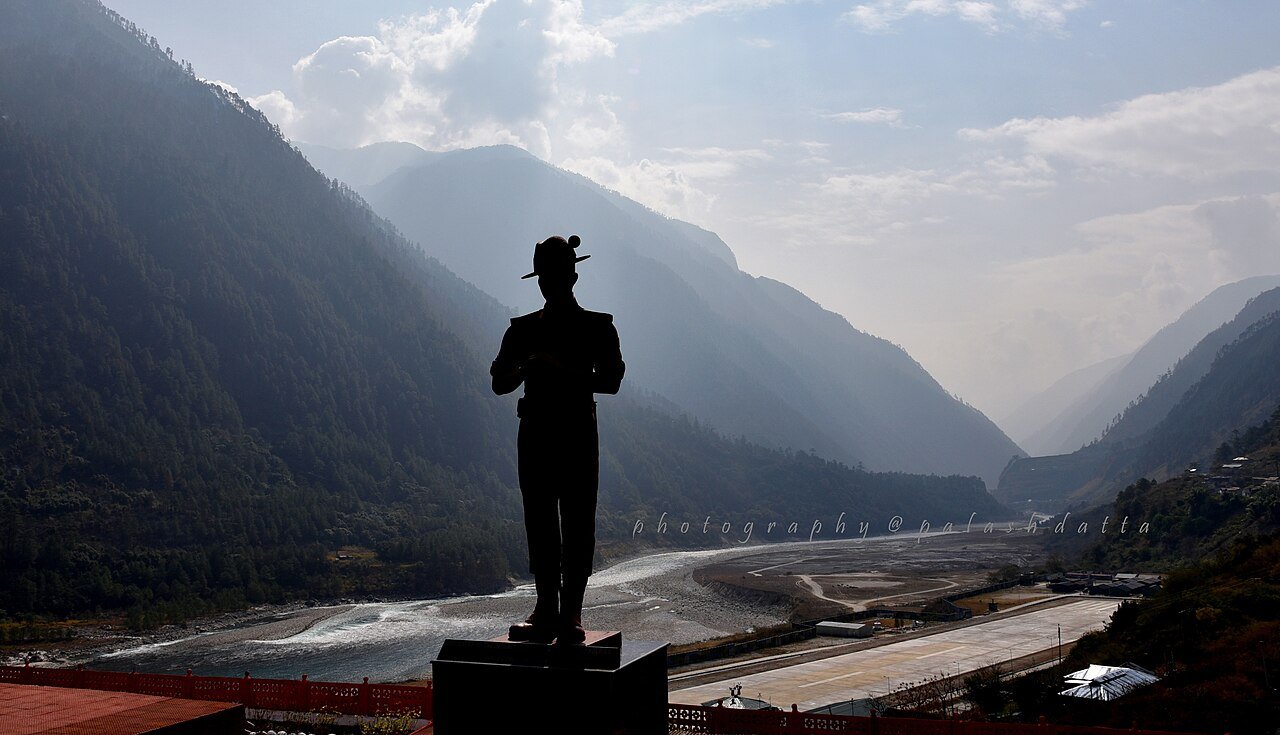
Walong is a small flat stretch beside the Lohit river in the far east of what was then NEFA, with a rough airstrip that only light Otter aircraft could use. The nearest road ended at Tezu, 230 kilometres to the south. The brigade holding it was short of artillery, rations, ammunition and winter clothing.
Above Walong the Chinese had taken two hill features the Indians called Green Pimple and Yellow Pimple. From there they could come down on the airstrip or cut the brigade off from behind. Brigadier N.C. Rawlley decided not to wait for them. He would attack first.
Everywhere else in 1962 the Indian Army was defending. At Walong it went forward.
14 November
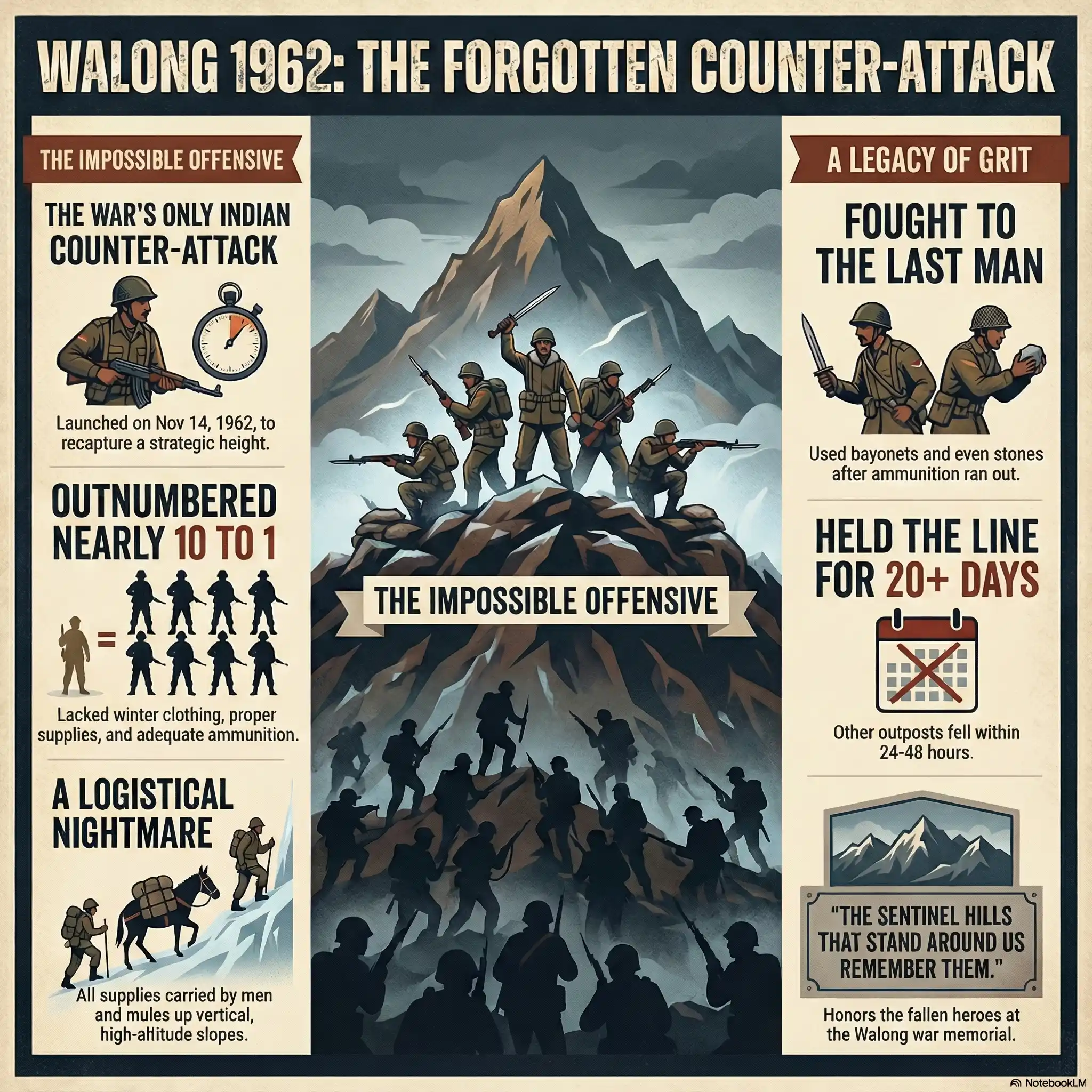
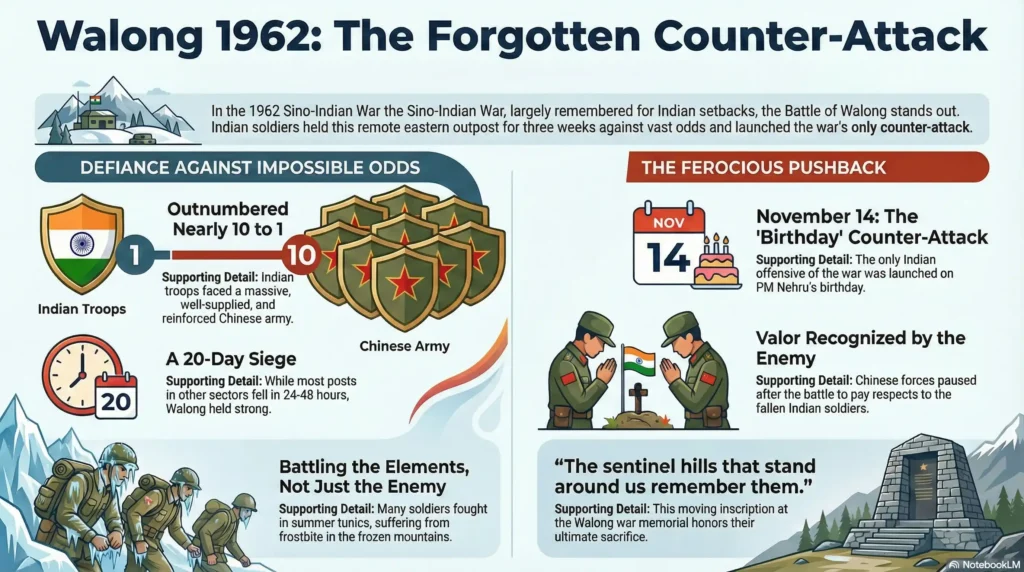
On 12 November a scratch company under Captain B.N. Singh took a height called Tri Junction, above both Pimples. Two days later, on the morning of 14 November, the attack on Yellow Pimple went in. It was Nehru’s birthday.
Two companies went up: Captain B.N. Singh’s on one flank, Major B.N. Sharma’s on the other, with the 4th Sikhs making a diversion. There was no artillery support. All the Kumaonis had behind them were their own 3-inch mortars, which they used as well as anyone could.
The Chinese met them with artillery and machine guns. B.N. Singh’s company kept climbing into it until it was about twenty metres from the top.
The Roopkund Skeleton Lake Mystery: Why Were Greeks Dying in the Indian Himalayas?
1971 Nagarwala Case: India’s Great Bank Heist Mystery
The last twenty metres
Twenty metres from the top, the fire pinned them to the slope. Subedar Govind Singh charged forward with a light machine gun at an enemy bunker. Another machine gun opened up on him. He charged that one too and silenced it, and was killed doing it.
Jemadar Trilok Singh followed his example and charged a third machine gun nest. The gun cut him down.
When the bullets ran out, the Kumaonis went on with bayonets and fought the Chinese hand to hand. The fight lasted the whole day. That night the Chinese counterattacked in waves, and it went on until morning.
The whole of India’s attacking war in 1962 came down to those twenty metres, and they could not be crossed.
The Dogras
At first light on 14 November the first company of the 4th Dogras landed at Walong. They had been flown up from Tezu in twenty-five minutes. On foot it would have taken five days. They were sent straight on towards Tri Junction, loaded with ammunition and rations, up a climb of more than 10,000 feet, with Chinese troops between them and the men they were trying to reach.
On 15 November Dakotas dropped supplies, but the Chinese had reinforced faster. Of about two hundred Kumaonis who had gone forward, ninety made it back to the battalion headquarters at Tri Junction. In the afternoon the Chinese attacked Tri Junction itself, and the adjutant, Captain P.N. Bhatia, was badly wounded. Of the Dogras who had set out up the mountain, thirty-three got through to them.
Thirty-three men with whatever they had carried. The Kumaonis were overjoyed to see them.
Dr. A.P.J. Abdul Kalam: (1931-2015)
Half an hour
On the morning of 16 November the Chinese came for Walong itself. A helicopter tried to reach the wounded and could not land, because of the weather and because there was nowhere to put down out of enemy fire.
On the West Ridge was Lieutenant Bikram Singh with a company of about a hundred men. More than three thousand Chinese attacked it. If it fell, Walong fell. He was ordered to hold for half an hour. His men held for more than three hours, until their ammunition was gone and they were overrun. There appeared to be no survivors, Bikram Singh among them.
Then the order came for everyone left to withdraw.
Of the 642 Indian casualties at Walong, 404 were from 6 Kumaon. The counterattack had not taken Yellow Pimple. It had come to within twenty metres of it, and the half hour Bikram Singh was asked for had lasted three.
The Purulia Arms Drop Mystery 1995: When the Sky Rained Guns
If you think you have remembered everything about this topic take this QUIZ
Results


#1. What distinguished the military action at Walong from other engagements during the 1962 Sino-Indian War, according to the provided text?
#2. Which specific tactical objective was the focus of the Indian counter-attack on 14 November 1962?
#3. The Indian counter-attack was deliberately timed to coincide with which significant date?
#4. Which two Indian Army regiments are primarily credited in the text with leading the counter-attack at Walong?
#5. Aside from enemy action, what was a major source of suffering for the Indian soldiers at Walong?
#6. According to the text, what was the remarkable duration of the Indian defence at Walong compared to other posts?
#7. What unusual sign of respect did the Chinese forces reportedly show after the battle, as per the survivors’ accounts?
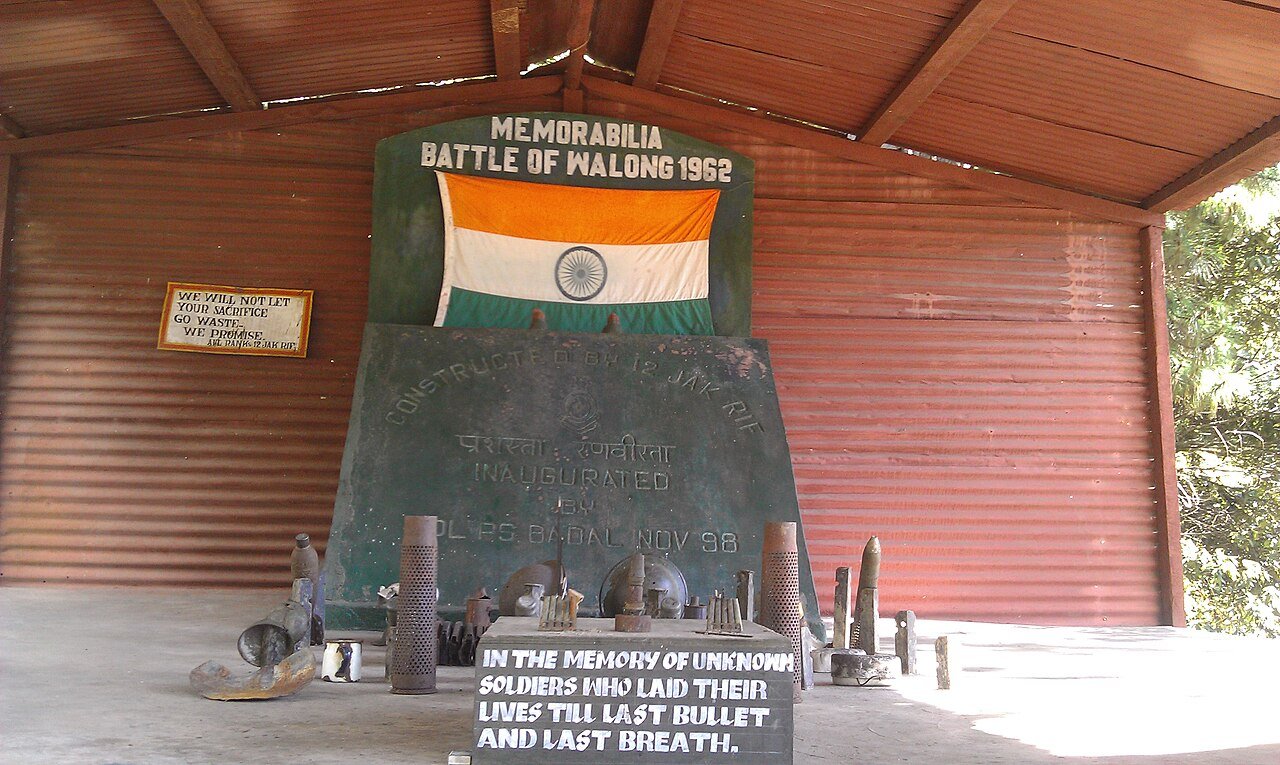
#8. What is the poignant inscription found on the Walong war memorial?
Why is the Battle of Walong called the “forgotten” battle?
It is often overshadowed by the larger defeats in the Se-La and Bomdila sectors. However, it was the only place where India launched a successful, albeit short-lived, counter-attack.
What is the significance of the Walong war memorial?
Located in Arunachal Pradesh, the Walong war memorial honors the men who stayed back to allow their comrades to withdraw, ensuring the Lohit Valley didn’t fall easily.
Which Indian regiments participated in the Battle of Walong?
Primarily the 6 Kumaon, 4 Sikh, 4 Dogra, and 3/3 Gorkha Rifles. Their coordination is a highlight of Kumaon Regiment bravery.
Did the Indian Army win any part of the 1962 war?
While the war ended in a ceasefire and Indian retreat, the Battle of Walong is considered a “moral victory” because of the successful counter-attack on November 14.
How can tourists visit Walong today?
Walong is now accessible via road from Tezu in Arunachal Pradesh. It remains a place of pilgrimage for those interested in Indian Army 1962 war stories.
Sources & References
ThePrint, Amrita Nayak Dutta, “Battle of Walong: how India fought its only counter-attack in 1962 India-China war” (15 November 2019) — the attack on 14 November, the Dakota drop, the fall of Tri Junction, the 33 Dogras and the casualty figures, from Col N.N. Bhatia’s account.
Bharat Rakshak, “Battle of Walong, 18 Oct – 16 Nov 1962” — the two assaulting companies, the Sikh diversion, and the charges of Subedar Govind Singh and Jemadar Trilok Singh.
The Arunachal Times, “Heroes of Battle of Walong in 1962 Sino-India war: 6 Kumaon” (22 November 2020) — the bayonet fighting, the night counterattacks and Lt Bikram Singh on the West Ridge.
Motherland, “6 Kumaon and The Battle of Walong – Timeline” — the climb of the battalion headquarters to Tri Junction on 11 November.
Lt Gen Ghanshyam Katoch (Retd), “The Forgotten Soldier of the 1962 War and his Karma” (2023) — Walong’s supply position, and the 4th Dogras’ flight from Tezu and climb to Tri Junction.
Author


Exploring the Soul of Bharat through History, Science, Culture, and its Diversity
Our Mission
Curious Indian is a definitive knowledge portal dedicated to chronicling the events, personalities, and cultural shifts that defined the Indian subcontinent. From the ancient Vedic Period to the complexities of 21st-century politics, our goal is to provide deep-dive analysis that inspires.
Editorial Standards & E-E-A-T
Every article published under our brand undergoes a rigorous fact-checking process. We prioritize primary historical records, academic citations, and credible archives to ensure our readers receive accurate, high-authority information.
Historical Integrity Directly sourcing from ASI archives and academic journals.Topical Authority Comprehensive clustering of Indian Science, Biographies, and Wars.Managed by Paripurna Datta and TEAM | Dedicated to the Knowledge of India.