How India’s faith in friendship sent its soldiers into the Himalayas unready for war
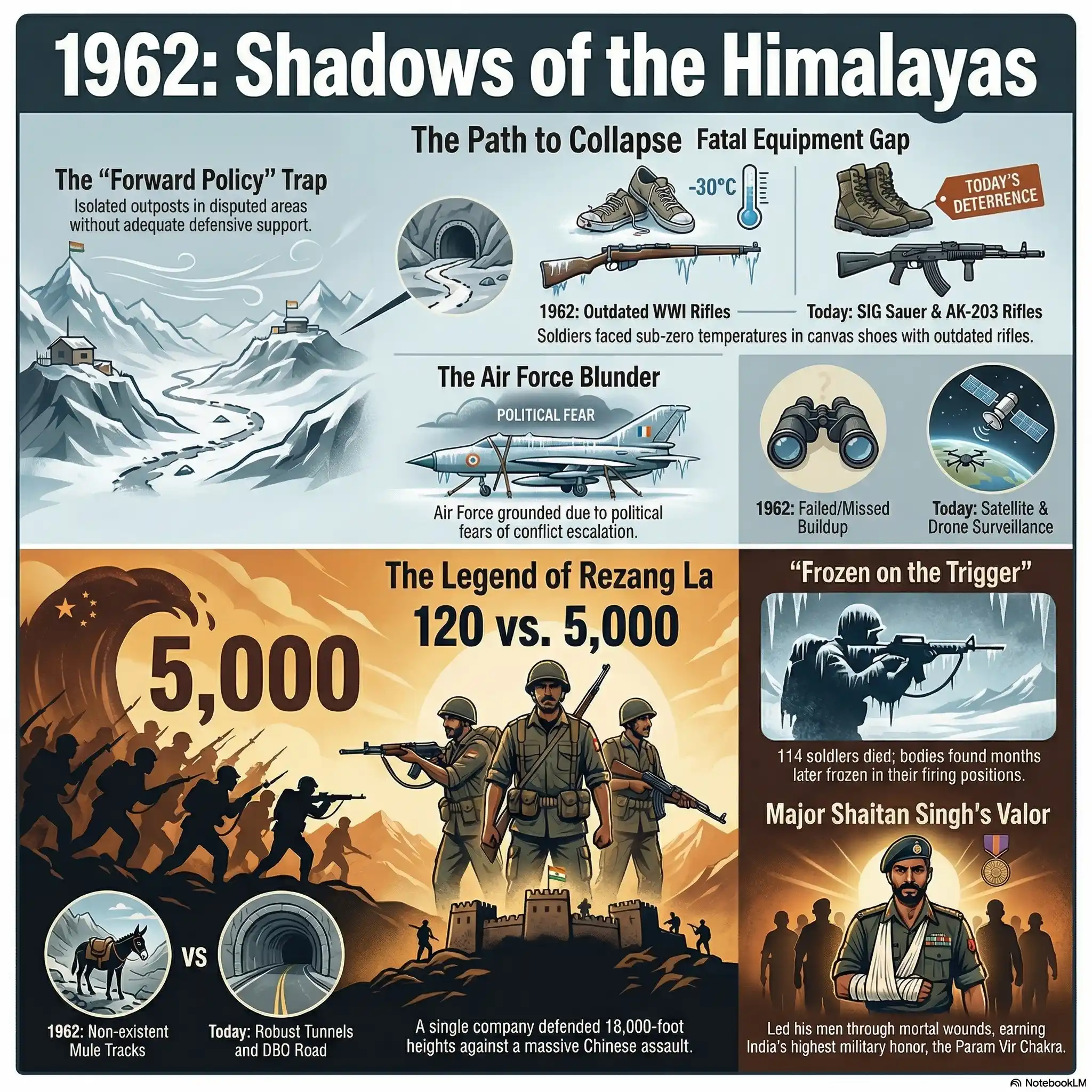
In October 1962, India sent men to hold mountain passes at eighteen thousand feet, and a great many of them went up in canvas shoes.
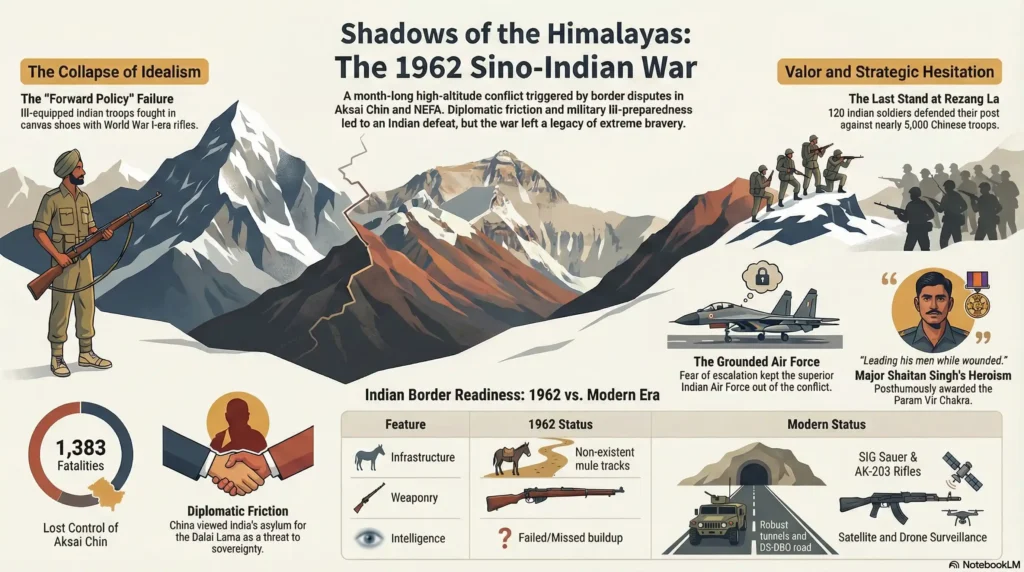
They had cotton uniforms meant for the plains, and .303 Lee Enfield rifles, a bolt-action weapon designed before the First World War, against an enemy with automatic arms. At that altitude the cold takes fingers and feet from men standing still, and kills the wounded who cannot be carried down.
India lost the war that followed in thirty-two days. It is remembered as a national humiliation, and it was. But the humiliation belonged to the men who made the decisions in Delhi, not to the men sent up the mountain to carry them out.
The Indo-Pakistani War of 1965: When Courage Defeated Technology
Hindi-Chini Bhai-Bhai
For most of the 1950s, India believed it had a friend.
The slogan was on posters and in speeches: Hindi-Chini Bhai-Bhai, Indians and Chinese are brothers. Jawaharlal Nehru meant it, and had built a foreign policy on it. He pressed for China’s seat at the United Nations while much of the West still refused to recognise the People’s Republic. In 1954 the two signed the Panchsheel, five principles of coexistence, chief among them mutual respect for each other’s territory.
It was a genuine conviction, held by a serious man. It was also the last thing that should ever have been mistaken for a defence policy.
The road nobody had noticed
While the toasts were being drunk, China was building a road.
Aksai Chin is a high salt plateau in the far north, so barren that almost nobody lives there. India claimed it as part of Ladakh. What made it valuable to China was geography: the flattest ground for a highway between Xinjiang and Tibet. The road was finished around 1957, and India learned of it the way an absent landlord learns of building work, by reading about it.
Then came 1959. A rising in Tibet was put down, the Dalai Lama crossed into India and was given asylum, and later that year Indian and Chinese troops exchanged fire at Longju and the Kongka Pass.
In Parliament in December 1961, Nehru explained that the ground at stake was barren, seventeen thousand feet up, a place where “not a blade of grass grows.” Mahavir Tyagi pointed at his own bald head and asked whether it should therefore be cut off and given away.
The House laughed. The question did not go away.
India’s First Nuclear Test: The Story of Smiling Buddha
The forward policy
India’s answer, that same year, was the forward policy. If Chinese troops were creeping into disputed ground, India would get there first and sit down. Small posts were pushed out across the frontier, some behind Chinese positions.
On a map in Delhi it looked like chess. On the ground the posts were a platoon or less, often unreachable by road and supplied by air drop, which in bad weather meant not supplied at all. They had no winter equipment and no artillery behind them. They were placed to make a point, not to hold a position.
V.K. Krishna Menon, the defence minister, and Lieutenant General B.M. Kaul were confident that China would protest and do nothing more.
The attack came at dawn on 20 October, in both sectors at once. The brigade strung along the Namka Chu river was gone within hours, its commander taken prisoner. Kaul, who commanded the corps, had fallen ill and was directing it from Delhi. Menon was out of the government within three weeks.
Rezang La
On 18 November, near Chushul in Ladakh, about a hundred and twenty men held a pass called Rezang La.
They were Charlie Company of the 13 Kumaon, most of them Ahirs from the country around Rewari, commanded by Major Shaitan Singh. A ridge stood between the pass and the Indian guns, so when the attack came no artillery could reach the attackers. The company was on its own and knew it.
They fought through the morning. Shaitan Singh moved between the trenches under fire, was hit, and went on moving. When the ammunition ran out the fighting went to bayonets. Of the hundred and twenty, a hundred and fourteen were killed.
What it cost the other side is disputed. Indian accounts run into the high hundreds and beyond, Chinese sources are far lower, and no agreed figure exists. What is not disputed is what the recovery party found when the snow cleared in February. The dead were still in their trenches, in their firing positions, frozen where they had fallen.
They were sent to a pass that could not be supported, against odds created for them in an office a thousand miles away, and they stayed anyway.
The Indo-Pakistani War of 1971: A Victory of Humanity and Strategy
The ceasefire
By mid-November the Chinese were through the passes and down towards the plains of Assam. Tezpur was abandoned, the currency in the bank burned, the jail opened.
Then on 21 November, with very little in their way, they stopped. Beijing announced a unilateral ceasefire and pulled back in the east, close to where it had started. In the west it kept Aksai Chin, roughly thirty-eight thousand square kilometres, which India has never got back.
Nehru died eighteen months later, in May 1964.
The report that is still sealed
The army’s inquiry was delivered in 1963 by Lieutenant General Henderson Brooks and Brigadier P.S. Bhagat. It has never been published. Sixty-three years on it remains classified, and much of it reached the public in 2014 only because the journalist Neville Maxwell put his copy online.
So India knows the names of the men who died at Rezang La, and has built memorials to them. It has never been allowed to read its own government’s account of how they were sent there.
Nehru said the truest thing about it himself, five days into the fighting. Speaking in Delhi on 25 October, he admitted the country had been “out of touch with reality” and had been shocked out of an artificial atmosphere of its own creation.
It was an honest thing to say while the shooting was still going on. It was also a decade late, and the people who paid for the delay were not in the room.
Green Revolution in India 1966: From Starvation to Self-Sufficiency
If you think you have remembered everything about this topic take this QUIZ
Results


#1. What was the primary strategic objective of India’s ‘Forward Policy’ established in 1961?
#2. Beyond the border disputes, which event in 1959 significantly intensified the animosity between Beijing and Delhi?
#3. Which of the following best describes the equipment limitations faced by Indian soldiers in 1962?
#4. During the initial Chinese offensive on 20 October 1962, where was the Indian corps commander, Lieutenant General B.M. Kaul, located?
#5. In the Battle of Rezang La, what was the approximate ratio of Indian soldiers to Chinese attackers?
#6. What was the primary reason the Indian political leadership kept the Indian Air Force (IAF) grounded during the conflict?
#7. How did the 1962 war conclude on 21 November?
#8. Which document remains a classified state secret in India, often cited as containing details of political and military failures during the war?
Why did China attack India in 1962?
China attacked primarily due to the border dispute over Aksai Chin and Arunachal Pradesh (NEFA), and to punish India for granting asylum to the Dalai Lama and implementing the “Forward Policy.”
Who was the Major who led the Battle of Rezang La?
Major Shaitan Singh of the 13 Kumaon Regiment led the defense. He was awarded the Param Vir Chakra for his supreme leadership and courage.
Did India use its Air Force in the 1962 war?
No. The Indian government decided not to use the Indian Air Force for offensive roles, fearing Chinese retaliation on Indian cities—a decision widely criticized by historians.
Which territories did India lose in 1962?
India lost control of Aksai Chin (approx. 38,000 sq km) in Ladakh. China withdrew from the captured areas in the North-East (Arunachal Pradesh) after the ceasefire.
What was the Henderson Brooks Report?
It is a classified report by the Indian Army that analyzed the causes of the 1962 defeat. It remains a state secret, though parts of it have been leaked, pointing to political and military leadership failures.
Sources & References
Encyclopaedia Britannica (“Sino-Indian War”) — the course of the 1962 conflict, the disputed sectors and the outcome.
Gallantry Awards portal, Government of India (Major Shaitan Singh) — the Param Vir Chakra citation for the action at Rezang La.
Ministry of External Affairs, Government of India (the India-China boundary question) — Aksai Chin, the eastern sector and the Line of Actual Control.
Encyclopaedia Britannica (“Jawaharlal Nehru”) — the Panchsheel agreement, Nehru’s China policy and his final years.
Author


Exploring the Soul of Bharat through History, Science, Culture, and its Diversity
Our Mission
Curious Indian is a definitive knowledge portal dedicated to chronicling the events, personalities, and cultural shifts that defined the Indian subcontinent. From the ancient Vedic Period to the complexities of 21st-century politics, our goal is to provide deep-dive analysis that inspires.
Editorial Standards & E-E-A-T
Every article published under our brand undergoes a rigorous fact-checking process. We prioritize primary historical records, academic citations, and credible archives to ensure our readers receive accurate, high-authority information.
Historical Integrity Directly sourcing from ASI archives and academic journals.Topical Authority Comprehensive clustering of Indian Science, Biographies, and Wars.Managed by Paripurna Datta and TEAM | Dedicated to the Knowledge of India.