On 17 November 1962 three Garhwali riflemen crawled out to take a Chinese machine gun at Nuranang. One of them made it home, dragging the gun
On the road to Tawang, about 25 kilometres short of the town and 10,000 feet up, there is a small memorial painted in camouflage. Inside are a portrait of a young soldier, his uniform, his cap, his watch and his belt. Soldiers posted there keep the uniform spotless and the boots polished, as if he might need them in the morning.
The place is called Jaswantgarh. Soldiers of every rank who drive past stop to pay their respects. A marble plaque carries his name and the names of 161 other men of his battalion who died on the ridges nearby.
He was Rifleman Jaswant Singh Rawat of the 4th Battalion, the Garhwal Rifles, number 4039009. He was twenty-one.
Nuranang
By the middle of November 1962 the war in the east was going badly. Tawang had been given up in October. The 4th Garhwal Rifles was dug in above Nuranang, on the road the Chinese needed to reach Se La and, beyond it, Bomdila and the plains of Assam. The Garhwalis were short of men, ammunition and winter clothing.
On the morning of 17 November the Chinese came at them. The battalion threw back the first attacks. Then, during the next one, the Chinese brought a medium machine gun forward to within about thirty metres of the Indian trenches and began firing along the lines of A Company. It was accurate, and men were being hit. As long as it kept firing, the company could not hold.
Someone had to go out and take the gun.
Twelve metres
Three men volunteered: Lance Naik Trilok Singh Negi, Rifleman Gopal Singh Gusain and Rifleman Jaswant Singh Rawat.
They crawled out towards the gun. Negi gave covering fire while Rawat and Gusain worked forward until they were ten or fifteen yards from it, close enough to throw grenades. The grenades killed two of the crew and badly wounded the third. Rawat got to the gun, took it, and started back towards his own lines with it.
The Chinese opened automatic fire on them from close range. Near the Indian trenches, almost safe, Jaswant Singh Rawat and Trilok Singh Negi were both hit and killed.
Gopal Singh Gusain was wounded too. He kept going, and he dragged the machine gun into the Indian post.
With the gun gone, the attack broke. The Chinese pulled back, leaving by one count around three hundred dead in front of the Garhwali positions. Rawat was awarded the Maha Vir Chakra after his death. Negi and Gusain were each awarded the Vir Chakra.
Three men went out for the gun. One came back with it.
1971 Nagarwala Case: India’s Great Bank Heist Mystery
Three days
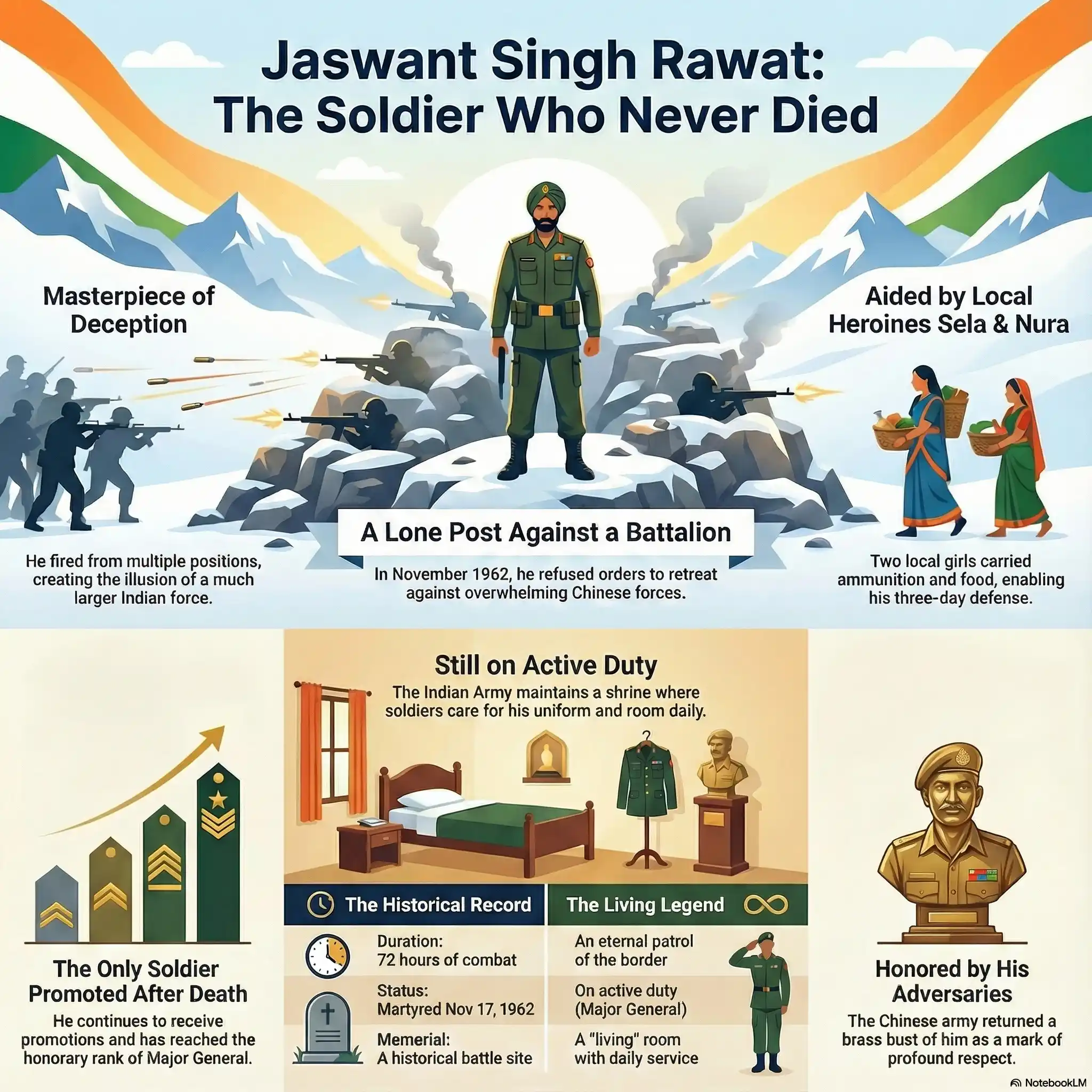
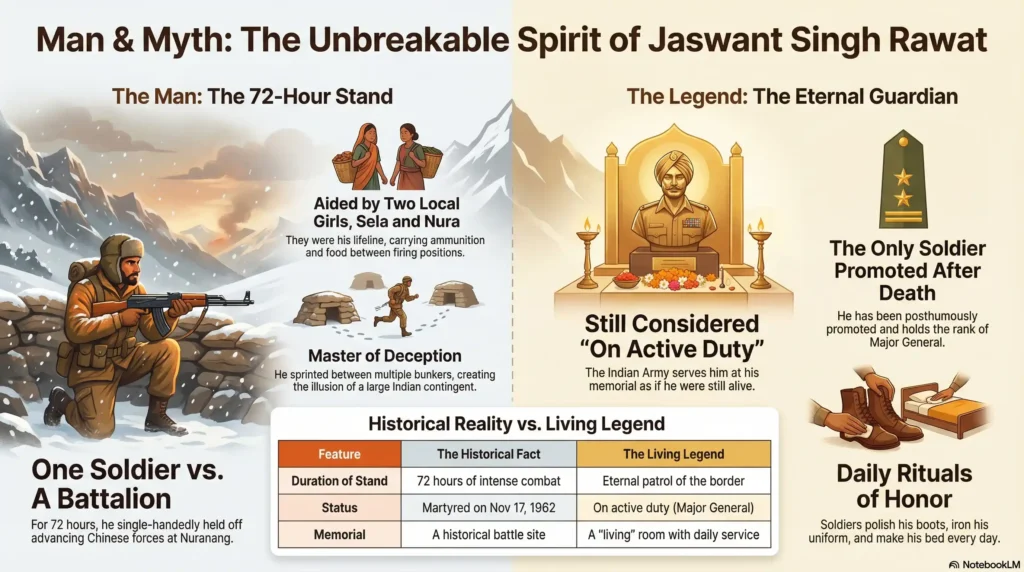
There is another version of that day, and it is the one most people know. In it, Jaswant Singh stays behind when his company is ordered to withdraw. Two young Monpa women, Sela and Nura, help him set up rifles at different points on the hill, and he runs between them firing, so the Chinese believe a whole company is still there. He holds them off for three days before they find him. The story has been told at the shrine for decades, was made into a film in 2019, and appears on the Indian government’s own tourism website.
The record says something plainer. His Maha Vir Chakra citation describes the crawl, the grenades, the captured gun and the fire that killed him on the way back. It does not mention three days, or Sela, or Nura. Everything in it happened on 17 November.
The legend did not need to add anything to what he did. It added time: three more days of him being alive on that hill.
Still on duty
The army has kept him alive in its own way. For decades he was treated as a serving soldier, his kit kept ready, and one account has him retiring in 2002 as an honorary captain. The soldiers posted there believe he still guards the post, and that after a snowfall his boots turn up muddy. Every 17 November, Nuranang Day, the army holds a ceremony at Jaswantgarh, and his family comes.
Trilok Singh Negi died beside him on the same slope. Gopal Singh Gusain, the one who made it home, was wounded doing it.
The gun they went out for got back to the Indian lines that day. The army has spent more than sixty years acting as though Jaswant Singh Rawat did too.
The Purulia Arms Drop Mystery 1995: When the Sky Rained Guns
8 Defining Chapters in the Vikram Sarabhai Biography
If you think you have remembered everything about this topic take this QUIZ
Results


#1. What primary military deception did Jaswant Singh Rawat employ to hold back the Chinese forces at Nuranang?
#2. According to the legend, who provided essential support to Jaswant Singh Rawat during his 72-hour stand?
#3. What unique honour does the Indian Army bestow upon Jaswant Singh Rawat to this day at his memorial?
#4. What gesture of respect did the Chinese army make towards Jaswant Singh Rawat after the conflict ended?
#5. The famous Sela Pass in Arunachal Pradesh is named in memory of:
#6. To which regiment of the Indian Army did Rifleman Jaswant Singh Rawat belong?
#7. What was the reported fate of Sela and Nura during the final Chinese assault?
#8. Which high military honour was posthumously conferred upon Jaswant Singh Rawat for his actions?
Is Jaswant Singh Rawat still considered “on duty”?
Yes, the Indian Army treats him as a serving officer. He receives regular promotions, and soldiers iron his clothes and make his bed daily at the Jaswant Garh memorial.
What was the role of Sela and Nura?
Sela and Nura were local Monpa girls who helped Jaswant by providing food and ammunition and helping him move between firing positions to fool the enemy.
What happened at the Battle of Nuranang?
Jaswant Singh Rawat successfully held off a Chinese battalion for 72 hours, destroying nearly 300 enemy soldiers before his position was finally compromised.
Can I visit Jaswant Garh?
Yes, the memorial is a popular stop for travelers on the way to Tawang in Arunachal Pradesh. It offers free tea and snacks to all visitors as a tradition.
Sources & References
Honourpoint, “Rifleman Jaswant Singh Rawat MVC” — the Maha Vir Chakra citation text, the situation at Nuranang and his service details.
The Arunachal Times, M Panging Pao, “Flights Of Fantasy” — the legend of the three days set against the record of 17 November, and his honorary retirement in 2002.
Incredible India, Ministry of Tourism, “Jaswant Garh War Memorial” — the memorial, its exhibits, the kept uniform and the soldiers’ belief about his boots.
Colours of Glory, “The Ghost who keeps Vigil on the Border” — the machine gun action, the awards to Negi and Gusain, and the plaque to 161 men of the battalion.
Deccan Herald / PTI, “Arunachal: Army honours courage and sacrifices of 1962 Indo-Sino war heroes” (17 November 2024) — Nuranang Day at Jaswantgarh and his family’s attendance.
Author


Exploring the Soul of Bharat through History, Science, Culture, and its Diversity
Our Mission
Curious Indian is a definitive knowledge portal dedicated to chronicling the events, personalities, and cultural shifts that defined the Indian subcontinent. From the ancient Vedic Period to the complexities of 21st-century politics, our goal is to provide deep-dive analysis that inspires.
Editorial Standards & E-E-A-T
Every article published under our brand undergoes a rigorous fact-checking process. We prioritize primary historical records, academic citations, and credible archives to ensure our readers receive accurate, high-authority information.
Historical Integrity Directly sourcing from ASI archives and academic journals.Topical Authority Comprehensive clustering of Indian Science, Biographies, and Wars.Managed by Paripurna Datta and TEAM | Dedicated to the Knowledge of India.