Baluchari sarees from Murshidabad, West Bengal, are among the most extraordinary textile traditions in Indian history. Woven from pure mulberry silk using a complex extra weft technique, these sarees do not carry geometric patterns or floral motifs like most Indian weaves. They carry stories. Scenes from the Ramayana, the Mahabharata, and the royal courts of Nawabi Bengal are rendered in silk with a precision that rivals manuscript illustration. The craft nearly disappeared in the nineteenth century and was brought back from the edge of extinction by a single dedicated effort in the 1950s. Today it holds a Geographical Indication tag and a place in India's most important textile heritage conversations.| Detail | Information |
| Textile Name | Baluchari Saree |
| Origin | Baluchar village, Murshidabad, West Bengal |
| GI Tag Awarded | 2011, Geographical Indication Registry of India |
| Primary Material | Pure mulberry silk |
| Weaving Technique | Extra weft technique on traditional pit loom |
| Dominant Motifs | Ramayana, Mahabharata, and Nawabi court scenes |
| Notable Revival Figure | Subho Thakur, 1950s |
| Current Weaving Hub | Bishnupur, Bankura district, West Bengal |
How a Nawabi Court Preserved Hindu Epics Through Weaving
Baluchari sarees from Murshidabad, West Bengal, are among the most extraordinary textile traditions in Indian history. Woven from pure mulberry silk using a complex extra weft technique, these sarees do not carry geometric patterns or floral motifs like most Indian weaves. They carry stories. Scenes from the Ramayana, the Mahabharata, and the royal courts of Nawabi Bengal are rendered in silk with a precision that rivals manuscript illustration. The craft nearly disappeared in the nineteenth century and was brought back from the edge of extinction by a single dedicated effort in the 1950s. Today it holds a Geographical Indication tag and a place in India’s most important textile heritage
How Banjara Embroidery Maps the Journeys of a Nomadic People
A Village That Gave Its Name to a Legend
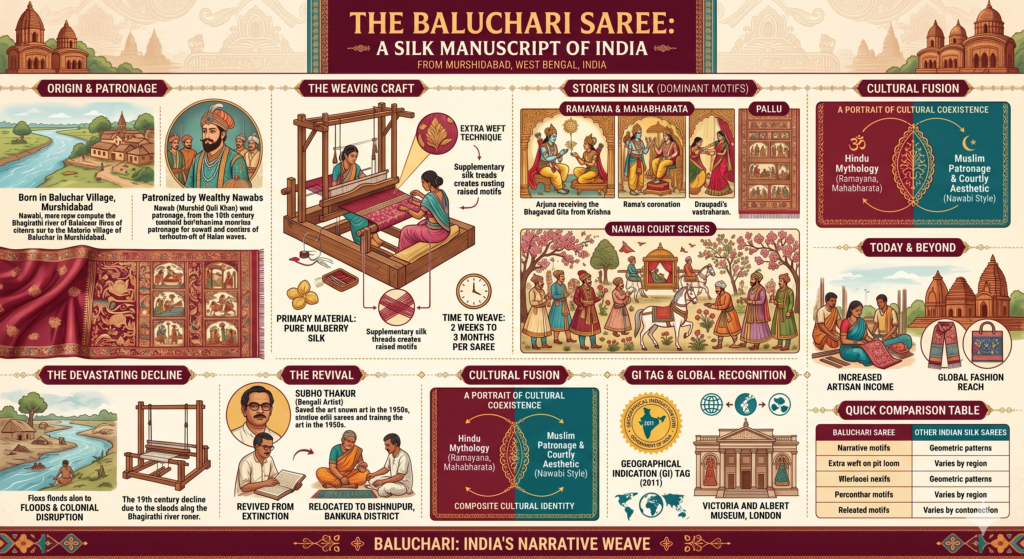
There is a village on the banks of the Bhagirathi river in Murshidabad district that most maps would not bother to mark. It is called Baluchar. In the eighteenth century, under the patronage of the Nawabs of Bengal, this small settlement became the birthplace of one of India’s most technically complex and visually stunning weaving traditions.
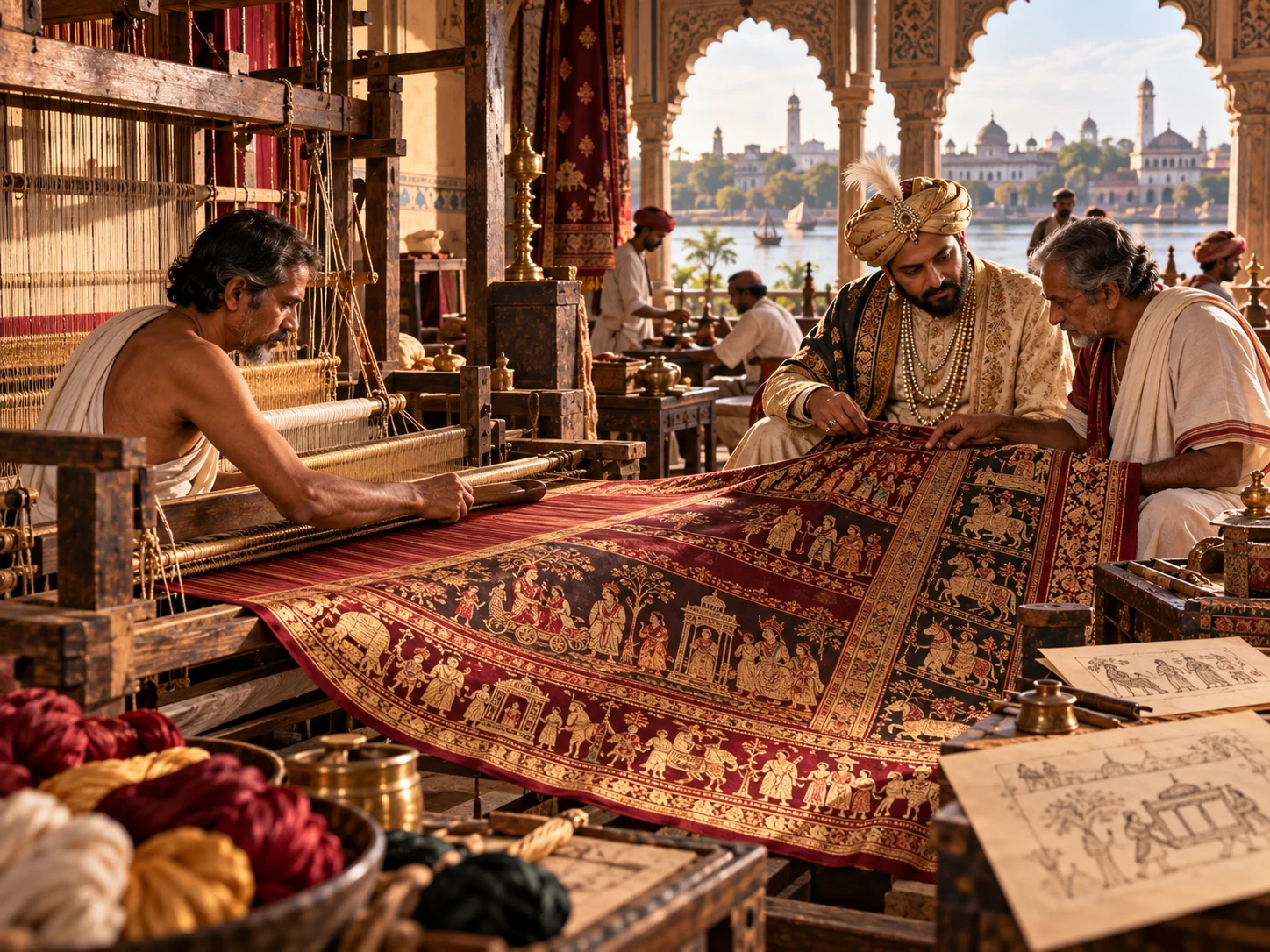
The Nawabs were not modest patrons. Murshidabad under Murshid Quli Khan and his successors was one of the wealthiest courts in the subcontinent. According to historians documented at the Victoria and Albert Museum, the Bengal court during this period rivaled the Mughal court in Delhi for the sophistication of its artistic patronage. Weavers were invited, supported, and celebrated. Silk was brought in. And on the pit looms of Baluchar, something extraordinary began to take shape.
What made the Baluchari weave immediately different from any other Indian textile tradition was its choice of subject matter. While other regional weaves reached for flowers, paisleys, and geometric borders, the weavers of Baluchar reached for mythology. They reached for the great epics of Hindu civilization and began to render them in thread.
Stories Woven Thread by Thread
The technical process behind a Baluchari saree is not something that can be rushed. A single saree can take anywhere from two weeks to three months to complete, depending on the complexity of the narrative panels. The weaving is done on a traditional pit loom using the extra weft technique, where supplementary threads are introduced across the base weave to create the raised pictorial motifs that define the Baluchari visual language.
The motifs themselves are drawn from the Ramayana and the Mahabharata with a specificity that suggests the weavers were not simply decorating fabric. They were illustrating scripture. Scenes of Arjuna receiving the Bhagavad Gita from Krishna on the battlefield of Kurukshetra. Rama’s coronation after his return from Lanka. Draupadi’s vastraharan. These are not simplified symbols. They are full narrative compositions, with figures in posture, expression, and context rendered in silk thread on a loom.
The pallu, which is the decorative end section of a saree that drapes over the shoulder, is where the most elaborate storytelling happens. A single pallu can contain multiple mythological scenes arranged in panels, almost like the sequential frames of an ancient comic. The border running along the length of the saree typically carries smaller repeating motifs of horses, palanquins, courtiers, or flowering trees, all drawn from the Nawabi court aesthetic that shaped the tradition’s early vocabulary.
Matangini Hazra: The Widow Who Walked Into Gunfire
The Man Who Saved a Dying Art
By the mid-nineteenth century, the original village of Baluchar had been devastated. Floods along the Bhagirathi river destroyed large parts of the weaving settlement. The disruption of trade routes during colonial restructuring further eroded the patronage networks that had kept the craft alive. By the early twentieth century, the Baluchari tradition had essentially stopped. The looms were silent. The knowledge was fragmenting with each generation that passed without practicing it.
Subho Thakur was a Bengali artist and cultural figure who, in the 1950s, made it his personal mission to find the surviving knowledge of the Baluchari weave and bring it back into active practice. He worked with weavers in Bishnupur in the neighboring Bankura district, studying old sarees preserved in private collections and museums, reverse engineering the motifs, and training new practitioners in the forgotten techniques. His effort was painstaking and largely unspectacularized. He did not have government funding or institutional backing at the start. He had conviction and an understanding that what was being lost was irreplaceable.
The Craft Museum in New Delhi, which holds one of India’s most significant collections of traditional textiles, credits Subho Thakur’s revival work as one of the defining moments in twentieth century Indian craft preservation. Today, Bishnupur has become the primary weaving hub for Baluchari sarees, carrying a tradition that technically began in Murshidabad but found its second life in Bankura.
Cowries, Coins, and Textile Memory of the Lambadi Tribe
The Nawabi Thread in a Hindu Story
One of the most culturally fascinating aspects of the Baluchari tradition is the way it carries two very different worlds inside a single textile. The mythological motifs are deeply Hindu in their content, drawn from Sanskrit epics and devotional literature. But the aesthetic sensibility that surrounds them, the court scenes, the figures in Mughal style dress, the depictions of hookahs and palanquins and courtiers, comes directly from the Nawabi culture of eighteenth century Bengal.
This is not a contradiction. It is a portrait of a historical moment when Hindu weavers worked under Muslim patronage in a court that celebrated craftsmanship above religious boundaries. The Baluchari saree is, in a very literal way, woven evidence of cultural coexistence. Each saree carries both histories simultaneously, and neither cancels the other out.
Researchers at the Weavers Service Centre under India’s Ministry of Textiles have noted that this dual cultural inheritance is what makes the Baluchari tradition particularly significant in conversations about India’s composite cultural identity. It is not a Hindu textile or a Nawabi textile. It is both, at the same time, woven together.
From Silk Looms to Global Recognition
The Geographical Indication tag awarded to Baluchari sarees in 2011 was an important legal milestone, but the craft’s global recognition had already been built through museum collections and textile scholarship. The Victoria and Albert Museum in London holds several historical Baluchari pieces in its South Asia collection, and these have been referenced in academic textile studies as examples of India’s most sophisticated narrative weaving.
In recent years, designers working at the intersection of traditional craft and contemporary fashion have begun incorporating Baluchari motifs into new formats, from stoles and dupattas to wall hangings and upholstery fabric. The response has introduced the tradition to younger audiences who might never have encountered it through conventional saree culture. According to a report by the Office of the Development Commissioner for Handicrafts under India’s Ministry of Textiles, revival programs supporting Baluchari weavers have helped increase both artisan income and craft visibility in the past decade.
The mythological scenes that once adorned the courts of Murshidabad’s Nawabs are now finding their way into international exhibitions and fashion weeks. The stories woven into those silk threads, of gods and warriors and ancient battles, are still being told. They have simply found new audiences.
Why These Hanging Pillar Of Lepakshi Secrets Still Confuse Us
Quick Comparison Table
| Aspect | Baluchari Saree | Other Indian Silk Sarees |
| Primary Motif Style | Narrative mythological scenes | Geometric, floral, or abstract patterns |
| Weaving Technique | Extra weft on pit loom | Varies by region and tradition |
| Storytelling Element | Full epic scenes from Ramayana and Mahabharata | Rarely narrative in composition |
| Cultural Influence | Hindu mythology meets Nawabi court aesthetic | Typically single regional cultural influence |
| Time to Weave | Two weeks to three months per saree | Varies, often shorter for simpler weaves |
| GI Tag | Yes, awarded 2011 | Varies by specific textile |
| Primary Weaving Hub | Bishnupur, Bankura, West Bengal | Varies across India |
Curious Indian: Fast Facts
- The word Baluchari comes directly from the village of Baluchar in Murshidabad, where the tradition originated under Nawabi patronage in the eighteenth century.
- A single Baluchari saree pallu can contain up to six or more distinct mythological scenes arranged in sequential narrative panels.
- The craft nearly went extinct after devastating floods along the Bhagirathi river destroyed the original weaving village in the nineteenth century.
- Subho Thakur’s revival work in Bishnupur in the 1950s is considered one of the most successful individual craft rescue efforts in modern Indian history.
- Baluchari sarees traditionally used no gold or silver zari thread, relying entirely on the colored silk thread itself to create visual richness.
- The Victoria and Albert Museum in London holds original eighteenth century Baluchari pieces in its permanent South Asia textile collection.
- Bishnupur, the current center of Baluchari weaving, is also famous for its terracotta temples, making it one of West Bengal’s most culturally layered towns.
A Manuscript Written in Thread
A Baluchari saree is not a garment in the ordinary sense. It is a manuscript written in silk, a piece of cultural memory that someone thought to preserve in the most durable medium available to them, which was thread on a loom.
The tradition survived a flood, survived colonial disruption, survived decades of neglect, and survived the slow forgetting that comes when a craft loses its patrons. It came back because the stories inside it were too significant to disappear. The Ramayana and the Mahabharata had been woven into those threads not as decoration but as devotion, and that devotion proved stronger than circumstance.
What Subho Thakur understood in the 1950s was something that textile historians and cultural preservationists still argue for today. A craft tradition does not just carry aesthetic value. It carries historical record, social memory, and cultural identity in forms that no written document can fully replicate. When a weaving tradition dies, something that cannot be reconstructed from books alone goes with it.
The weavers of Bishnupur who sit at their pit looms today, pulling supplementary threads across silk to build a scene of Arjuna at Kurukshetra or Rama returning to Ayodhya, are doing something that connects directly to an eighteenth century courtroom in Murshidabad. That connection, across centuries and floods and colonial disruptions and neglect, is what makes the Baluchari saree one of the most remarkable objects in Indian cultural history.
The Disputed and Fascinating Origins of Kashmiri Pashmina
If you think you have remembered everything about this topic take this QUIZ
Results


#1. In which century did the Baluchari weaving tradition originate in the village of Baluchar?
#2. Under whose patronage did the Baluchari weaving tradition first develop?
#3. What technical weaving method is used on traditional pit looms to create the raised pictorial motifs of Baluchari sarees?
#4. How long can it take to complete a single Baluchari saree depending on the narrative panels’ complexity?
#5. Which natural disaster in the mid-nineteenth century heavily contributed to the devastation of the original village of Baluchar?
#6. Who is credited with single-handedly reviving the Baluchari weaving tradition in the 1950s?
#7. Where did the Baluchari weaving tradition find its second life and become its current primary weaving hub?
#8. In which year was the Geographical Indication (GI) tag officially awarded to Baluchari sarees?
What makes Baluchari sarees different from other Indian silk sarees?
Baluchari sarees are unique because their defining feature is narrative storytelling through woven motifs. While most Indian silk sarees use floral, geometric, or abstract patterns, Baluchari sarees carry full scenes from Hindu epics like the Ramayana and Mahabharata, rendered in silk thread across the pallu and border with compositional detail that resembles illustrated manuscripts.
Where are Baluchari sarees woven today?
The primary weaving hub for Baluchari sarees today is Bishnupur in Bankura district, West Bengal. Though the tradition originated in the village of Baluchar in Murshidabad, the craft was revived in Bishnupur in the 1950s and has remained centered there since.
How long does it take to weave a Baluchari saree?
Depending on the complexity of the mythological scenes and the number of narrative panels in the pallu, a single Baluchari saree can take anywhere from two weeks to three months to complete on a traditional pit loom.
Who revived the Baluchari weaving tradition?
Subho Thakur, a Bengali artist and cultural figure, is credited with reviving the Baluchari tradition in the 1950s. He studied old preserved sarees, reconstructed the techniques, and worked with weavers in Bishnupur to bring the craft back into active practice after it had nearly disappeared entirely.
Do Baluchari sarees have a Geographical Indication tag?
Yes. Baluchari sarees were awarded a Geographical Indication tag in 2011 by the Geographical Indication Registry of India, recognizing their unique regional origin and craft heritage.