The Lambadi tribe, one of India's most widely dispersed nomadic communities, practices a textile tradition unlike almost any other in the subcontinent. Beyond the geometric embroidery and mirror work that defines their visual identity, it is the integration of cowrie shells and metal coins into fabric that tells the deepest story. These were not decorative additions. Cowries functioned as actual currency across large parts of Asia for centuries, and Lambadi women stitched them into garments, bags, and ceremonial textiles as a portable form of stored wealth. Coins from Mughal, colonial, and post-independence periods found their way into the same tradition, turning individual textiles into wearable archives of economic history. Understanding what these objects mean inside Lambadi cloth means understanding how a community with no fixed home found a way to carry everything it valued across centuries of movement.| Detail | Information |
| Community Name | Lambadi (also known as Banjara, Lambani, Sugali, Vanjara) |
| Primary States | Telangana, Andhra Pradesh, Karnataka, Maharashtra, Madhya Pradesh |
| Textile Tradition | Lambadi embroidery with cowrie shells, coins, mirrors, and beads |
| Cowrie Shell Origin | Indian Ocean and Pacific Ocean coastlines |
| Historical Currency Role | Cowries used as medium of exchange across South and Southeast Asia |
| Coin Integration Period | Mughal, British colonial, and post-independence era coins documented in textiles |
| GI Tag | Lambani embroidery, Karnataka, awarded 2010 |
| Key Craft Centers | Nizamabad (Telangana), Sandur (Karnataka), Nanded (Maharashtra) |
How a Nomadic People Wore Their Wealth and Their History
The Lambadi tribe, one of India’s most widely dispersed nomadic communities, practices a textile tradition unlike almost any other in the subcontinent. Beyond the geometric embroidery and mirror work that defines their visual identity, it is the integration of cowrie shells and metal coins into fabric that tells the deepest story. These were not decorative additions. Cowries functioned as actual currency across large parts of Asia for centuries, and Lambadi women stitched them into garments, bags, and ceremonial textiles as a portable form of stored wealth. Coins from Mughal, colonial, and post-independence periods found their way into the same tradition, turning individual textiles into wearable archives of economic history. Understanding what these objects mean inside Lambadi cloth means understanding how a community with no fixed home found a way to carry everything it valued across centuries of movement.
When Currency Became Costume
To understand why a Lambadi woman stitched cowrie shells into her skirt, it helps to understand what a cowrie shell actually was in the economic world of premodern India.
The cowrie, specifically the species Monetaria moneta harvested from the warm shallows of the Indian Ocean and the Maldive Islands, was one of the oldest and most widely circulated currencies in human history. Long before metal coinage arrived in every corner of the subcontinent, cowries moved through markets, settled debts, purchased grain, and changed hands in transactions that kept local economies functioning. According to research documented by the American Numismatic Society, cowrie shells were used as currency across large parts of South Asia, Southeast Asia, China, and sub-Saharan Africa for at least three thousand years, making them one of the most geographically widespread monetary instruments ever used by human civilization.
For the Lambadi, who were themselves the primary movers of traded goods across the Deccan plateau and beyond, cowries were not an abstract economic concept. They were a daily reality. The community handled commodities, moved them across distances, and received payment in forms that included cowrie shells during periods when metal coinage was scarce or inconsistent in rural and tribal trade networks.
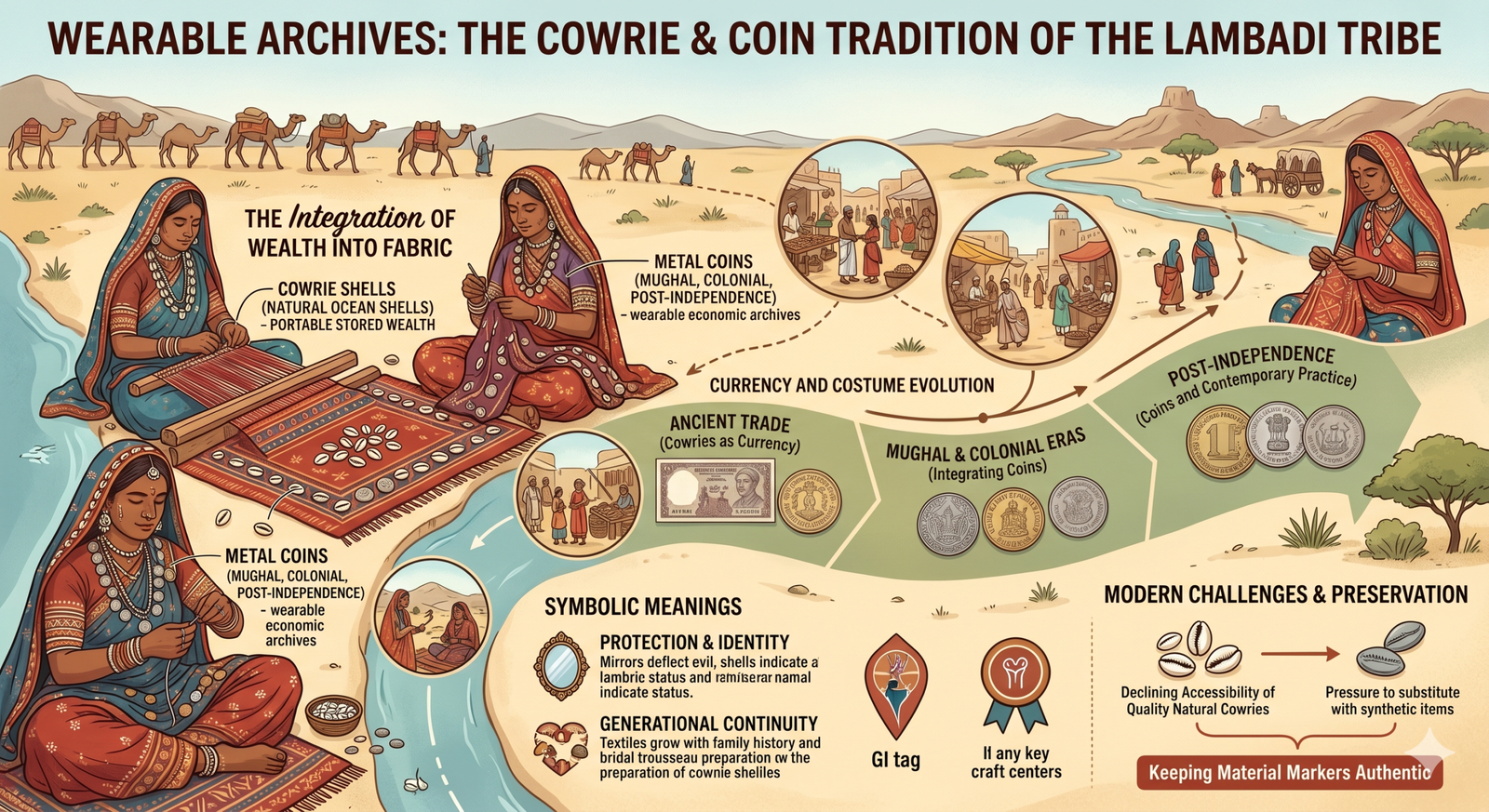
Stitching a cowrie shell into fabric was, in this context, not a decorative impulse. It was an act of safekeeping. A shell pressed into the border of a skirt or the strap of a shoulder bag was wealth in the most portable form imaginable, carried on the body, visible as identity, and available if needed as exchange. The garment itself became a walking treasury.
The Architecture of a Cowrie Stitch
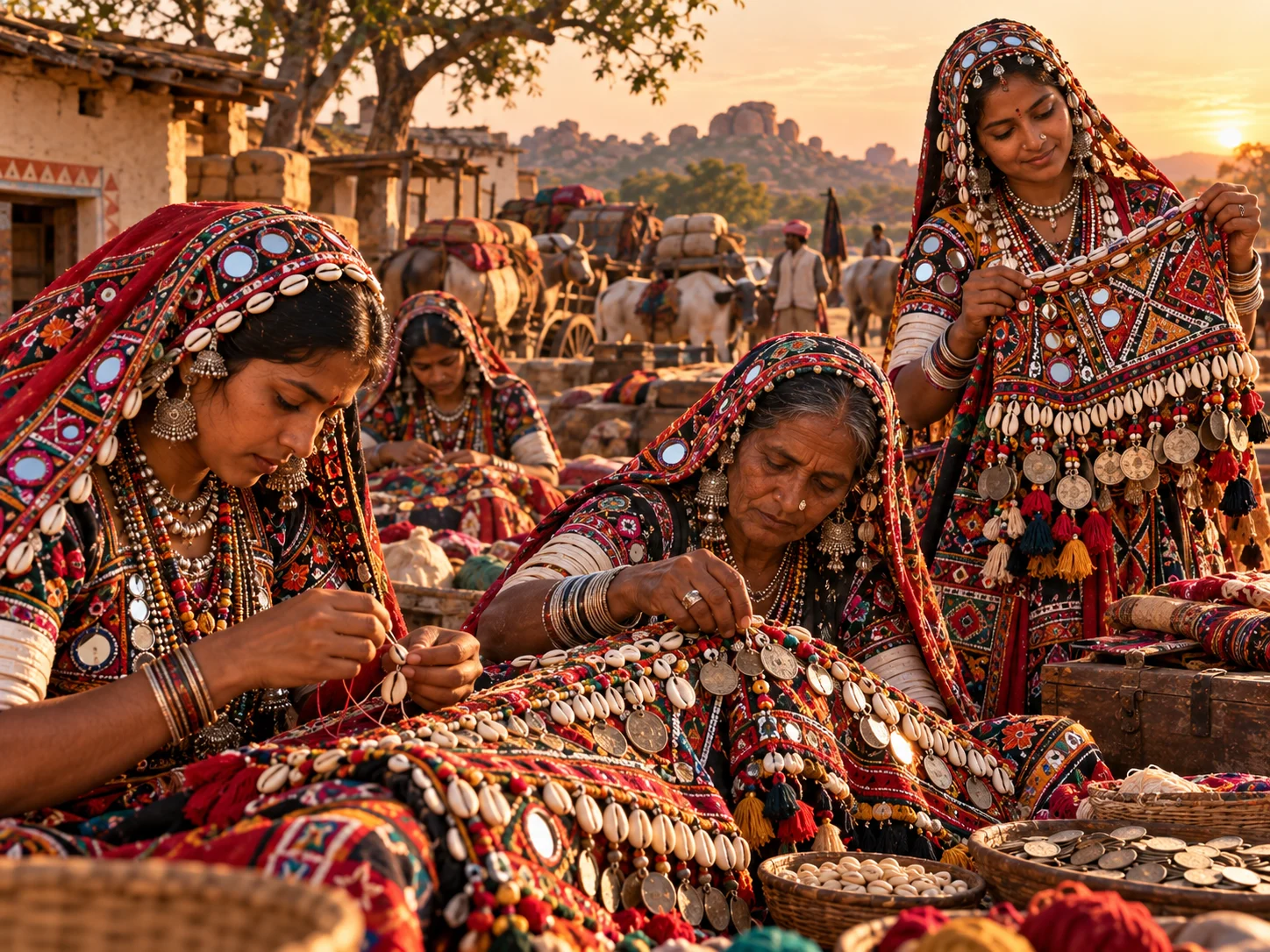
The way Lambadi artisans integrate cowrie shells into their embroidery is technically deliberate and visually precise. Shells are not simply attached to the surface of the fabric. They are stitched through their natural aperture, the narrow opening on the underside of the shell, using strong thread that anchors them firmly while allowing a small degree of movement that produces the characteristic soft rattling sound of Lambadi garments in motion.
This sound was functional as well as aesthetic. In a moving caravan, the rustling and clicking of cowrie-laden garments helped mark the presence and position of women and children within the group. It was auditory identification in environments where visual tracking was difficult, a practical adaptation built into the textile itself.
Around each cowrie, Lambadi embroiderers construct geometric frameworks of colored thread that both secure the shell and integrate it into the larger pattern of the piece. Triangular formations, diamond grids, and zigzag borders surround individual shells or clusters of shells, creating compositions where the cowrie functions simultaneously as focal point, structural anchor, and symbolic center of each embroidered unit. The density of cowrie placement on a single garment varied historically according to the wealth and status of the family. A heavily cowrie-laden ceremonial skirt or headpiece represented significant accumulated value, functioning in Lambadi social life in ways that jewelry functions in settled communities. When a family faced economic hardship, shells could theoretically be removed and used. When prosperity allowed, more were added. The textile grew or contracted with the family’s fortunes, making it a living financial record as much as a craft object.
The Disputed and Fascinating Origins of Kashmiri Pashmina
Coins From Every Era They Passed Through
If cowrie shells represent the oldest layer of material history in Lambadi textiles, the coins represent every subsequent chapter. Lambadi embroidery pieces documented by researchers and held in regional museum collections across Telangana and Karnataka contain coins spanning multiple centuries and multiple political regimes, from Mughal copper coins to British colonial currency to post-independence Indian paise.
This is not a coincidence. It is a direct record of the economic environments the community moved through. As metal coinage gradually displaced cowrie shells as the dominant currency of everyday transactions across the subcontinent during the Mughal period and more completely during British colonial rule, Lambadi women incorporated coins into their textiles using the same logic they had always applied to cowries. Currency that was becoming obsolete in the marketplace still held material value, historical meaning, and symbolic weight. Stitching it into fabric preserved it from loss and kept it within the community’s visible identity.
The Telangana State Museum in Hyderabad holds documented examples of Lambadi textiles containing coins from at least three distinct historical periods stitched into a single piece, a layering that transforms the garment into something closer to a stratigraphic archaeological record than a conventional craft object. Each coin marks a moment in time when a family encountered a particular economic system and incorporated its material evidence into their most personal possessions.
Craft researchers associated with the Crafts Council of India have noted that the practice of integrating coins into Lambadi textiles continued well into the twentieth century, with certain artisan families documented as having stitched coins bearing the portrait of George V alongside coins from independent India into the same ceremonial pieces, producing objects that hold colonial and post-colonial history in physical proximity without apparent contradiction.
How Phulkari Embroidery Became a Celebration of Womanhood in Punjab
What Women Wore to a Wedding
The most elaborate expressions of Lambadi cowrie and coin embroidery appear in bridal and ceremonial contexts. A Lambadi bride’s textile ensemble, which includes a heavily embroidered and ornamented skirt called a lehenga, a fitted bodice, a head covering, and various accessory bags and straps, represents years of preparation by the women of her family.
The assembly of a bridal trousseau in Lambadi culture is a communal act. Mothers, grandmothers, aunts, and older sisters contribute embroidery, attach cowries and coins, and add beads and mirrors over a period that can span several years before a marriage takes place. The resulting ensemble is not simply clothing. It is a collective biography of the women who made it, carrying their individual stitches, their choices of color and shell placement, their particular geometric vocabularies, all assembled into a single object that the bride will wear on the most significant day of her life and preserve afterward as her most important inherited possession.
The weight of a fully ornamented Lambadi bridal garment can be considerable. Cowrie shells, metal coins, glass beads, and mirror pieces accumulate to create textiles that are physically substantial, garments that announce their presence not just visually but through sound and weight. This physicality is intentional. The heaviness of the textile communicates the depth of the family’s investment, the breadth of the community’s participation, and the significance of the occasion being marked.
According to field documentation published by the Indira Gandhi National Centre for the Arts, Lambadi bridal textiles in certain family lineages have been preserved across four and five generations, with later women adding their own embroidery and ornamentation to pieces begun by great-grandmothers, creating objects whose physical layers correspond directly to generational layers of family history.
The Slow Disappearance of the Old Shells
The cowrie shells used in traditional Lambadi embroidery were natural, ocean-harvested shells with the particular luster and organic irregularity that comes from a living creature’s growth. Contemporary craft production increasingly substitutes plastic cowrie-shaped beads for natural shells, driven by cost, availability, and the declining accessibility of quality natural cowries in inland craft markets.
This substitution matters beyond aesthetics. Natural cowrie shells carry the cultural and historical associations that made them meaningful in the first place. A plastic imitation carries the visual reference but not the substance. Within Lambadi communities, older artisans and craft researchers have expressed concern that younger practitioners learning the tradition with plastic substitutes may not fully internalize the original significance of what they are stitching, learning a form without the meaning that gave the form its purpose.
The same concern applies to coins. As the practice of incorporating genuine historical coins into new textiles becomes economically impractical and legally complicated under regulations governing the handling of old currency, artisan communities face pressure to substitute decorative metal discs that resemble coins without being them. The visual language survives while the material authenticity that made it legible as historical record gradually thins.
The World Intellectual Property Organization features active case studies on how Geographical Indications like the one assigned to the Lambani embroidery of Karnataka assist indigenous groups in keeping material markers authentic against artificial replication, providing a legal mechanism to support targeted materials sourcing and cultural preservation for vulnerable artisan ecosystems.
Manipuri Phanek: Ancient Geometric Language Woven Into Its Cloth
Quick Comparison Table
| Aspect | Cowrie Shells in Lambadi Textiles | Coins in Lambadi Textiles |
| Historical Function | Currency, protection, wealth storage | Currency record, status marker, historical document |
| Period of Primary Use | Ancient through early modern India | Mughal period through post-independence era |
| Attachment Method | Stitched through natural shell aperture | Pierced and stitched or looped with thread |
| Symbolic Meaning | Fertility, prosperity, protection from evil eye | Economic memory, family history, political eras encountered |
| Sound Function | Auditory identification in caravan movement | Metallic ring used in ceremonial contexts |
| Contemporary Status | Often replaced with plastic imitations | Genuine coins increasingly rare in new pieces |
| Cultural Significance | Foundation element of Lambadi material identity | Layered historical archive within individual textiles |
Curious Indian: Fast Facts
- The Monetaria moneta cowrie shell used historically in South Asian trade was harvested primarily from the Maldive Islands, which functioned for centuries as the world’s largest natural supplier of currency cowries.
- A fully ornamented Lambadi bridal skirt can contain hundreds of individual cowrie shells, each stitched by hand through its natural aperture using traditional anchoring techniques.
- Lambadi textiles held in the Telangana State Museum include pieces with coins from the Mughal, British colonial, and post-independence Indian periods stitched into the same garment.
- The rattling sound produced by cowrie-laden Lambadi garments in motion was historically used as an auditory location marker within moving nomadic caravans.
- Cowrie shells have been documented as currency instruments across at least three thousand years of human economic history, spanning South Asia, Southeast Asia, China, and sub-Saharan Africa.
- Lambadi bridal textiles in some family lineages have been actively added to across four and five generations, making them among the longest continuously produced personal objects in Indian material culture.
- The Criminal Tribes Act of 1871, which criminalized Lambadi movement under British colonial law, was repealed in 1952, but its social and economic impacts on the community continued for decades afterward.
What Is Being Lost
A cowrie shell is a small thing. Smooth, pale, and light enough to hold a dozen in one palm, it does not look like it could carry the weight of centuries. But pressed into the border of a Lambadi skirt and surrounded by a careful geometry of colored thread, it holds more history than most objects ten times its size.
The Lambadi textile tradition of embedding cowries and coins into fabric is one of the most direct expressions of nomadic material intelligence in Indian cultural history. It solved a real problem with a real solution. People who could carry nothing permanently found a way to carry everything that mattered by pressing it into the cloth they wore every day.
The economic history of the subcontinent, from cowrie-based trade networks to Mughal coinage to British colonial currency to independent India’s paise, is documented in these textiles with a fidelity that no written ledger fully captures. Not because anyone planned to create an archive, but because Lambadi women stitched what was around them and what mattered to them, generation after generation, into the most durable medium they had.
What is at risk today is not just a craft technique. It is a way of reading history through objects that were never meant to be read by outsiders, but that have enormous things to say if the knowledge of how to read them is kept alive. The shells and coins in Lambadi cloth are not decoration. They are testimony.
Double Ikat Patola of Patan and Why It Takes a Year to Weave
If you think you have remembered everything about this topic take this QUIZ
This quiz no longer existsWhy did the Lambadi tribe stitch cowrie shells into their clothing?
Cowrie shells functioned as actual currency across large parts of South and Southeast Asia for thousands of years. Lambadi women stitched them into garments as a form of portable wealth storage, keeping accumulated value on the body where it was safe, visible as identity, and available for use if economic need arose. The shells also carried protective symbolic meaning, believed to guard wearers against the evil eye during travel.
What kinds of coins appear in Lambadi textiles?
Documented Lambadi textile pieces contain coins from multiple historical periods, including Mughal copper coins, British colonial currency, and post-independence Indian paise. Some individual pieces contain coins from all three eras stitched together, creating layered records of the political and economic environments the community passed through across generations.
How are cowrie shells attached to Lambadi embroidery?
Cowrie shells are stitched through their natural aperture, the narrow opening on the underside of the shell, using strong thread that anchors them firmly to the fabric. The stitching allows a small degree of movement, producing the characteristic sound of Lambadi garments. Geometric thread formations are then built around each shell or cluster of shells to integrate them into the overall embroidery pattern.
What is the significance of Lambadi bridal textiles?
A Lambadi bridal ensemble represents years of collective preparation by the women of the bride’s family. Mothers, grandmothers, aunts, and sisters contribute embroidery, cowries, coins, beads, and mirrors to build a garment that functions simultaneously as ceremonial clothing, family biography, and the bride’s most significant inherited possession. In some lineages, bridal textiles have been added across multiple generations.
Are natural cowrie shells still used in Lambadi embroidery today?
The use of natural ocean-harvested cowrie shells in contemporary Lambadi embroidery is declining. Cost, availability, and market access challenges have led many artisans to substitute plastic cowrie-shaped beads, which replicate the visual form but not the material history or cultural significance of natural shells. Craft preservation organizations have identified this substitution as a concern for the long-term integrity of the tradition.