Embroidery That Carried Stories Across Borders
Phulkari is a Punjabi embroidery tradition, and its name means flower work. For centuries, women across the undivided Punjab region—what is now Indian Punjab and Pakistani Punjab—used it to mark the major moments in their lives. A mother embroidered a piece for her daughter’s wedding. A grandmother for a granddaughter. These were not commercial pieces made for sale. They were made inside households for the women who would wear them.
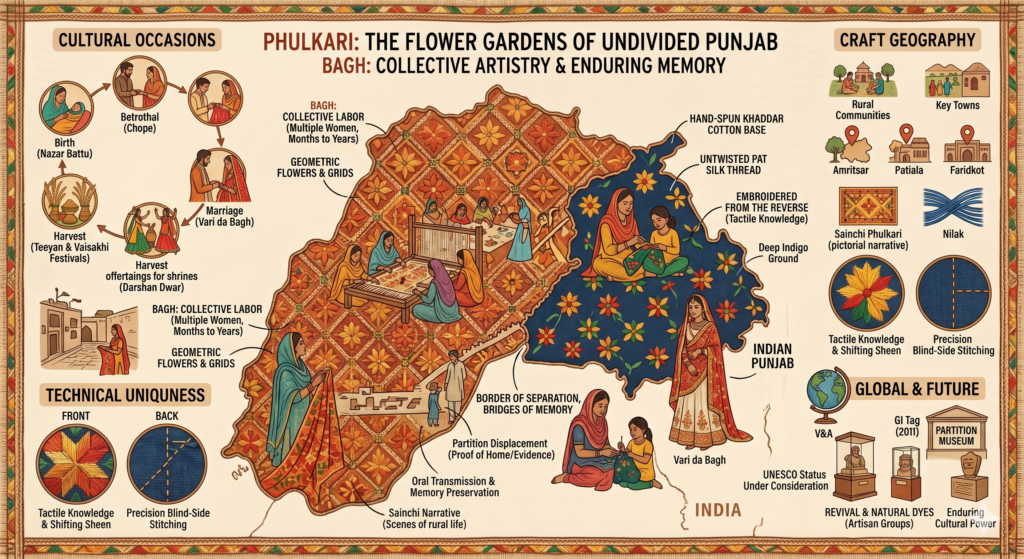
The cloth was rough hand-spun cotton, usually dyed dark indigo or brown. The thread was untwisted silk called pat, bright and luminous against that darkness. A woman worked from the reverse side of the fabric, using a darning stitch, building patterns she could not see directly on the front. She had to count threads by hand and trust the work would read true when she turned it over.
Phulkari crossed religious lines. Hindu, Sikh, and Muslim women all practiced it across undivided Punjab. The craft has a GI tag, awarded in 2011. It appears on UNESCO’s list of traditions being considered for Intangible Cultural Heritage recognition.
Before Phulkari became a fashion piece, women made it for ceremonies
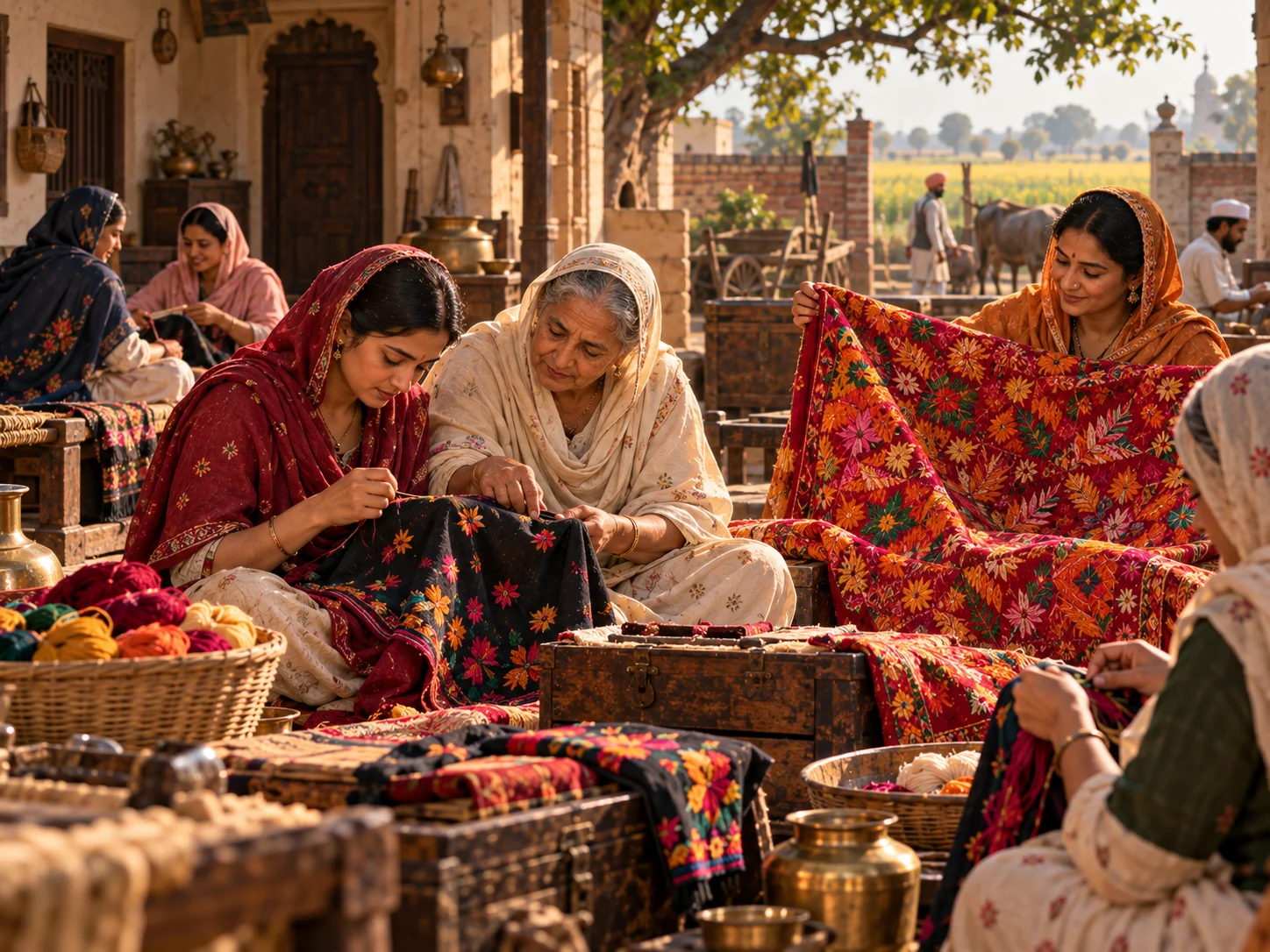
A Phulkari was often started years before a girl would wear it. A mother or grandmother could begin embroidering pieces for a daughter’s future trousseau when she was still young. The work happened in the hours left after cooking, cleaning, fieldwork. Women sat together in courtyards, stitched, talked, and watched younger girls learn the stitch by watching their hands.
The Smithsonian’s National Museum of Asian Art describes bagh embroidery—the densest form of Phulkari—as standard dowry gifts made by family. Specific pieces belonged to specific ceremonies. The Chope, given by a maternal grandmother at a granddaughter’s betrothal, used only red and yellow thread. The Vari da Bagh accompanied a bride into her new household.
But the details were not uniform across Punjab. Hindu villages had their own patterns and colors. Sikh communities did theirs differently. Muslim practice in one district looked unlike that in another fifty miles away. What stayed consistent was the fact of women gathered, stitching for other women they loved.
Manipuri Phanek: Ancient Geometric Language Woven Into Its Cloth
The stitch had to be learned by feel
The basic technique is simple in theory. You work a darning stitch from the back of coarse cotton. By changing the direction and length of each stitch, the silk thread catches light in different ways. A geometric field seems to shift and change as the cloth moves.
But learning it took years. A girl had to count threads accurately without marking them. She had to keep her tension even across hours of work. She built patterns she could not see. The stitch itself was part of what passed from one generation to the next, but so was the knowledge. A girl did not simply receive embroidery instruction. She grew up inside the practice of it.
A bagh could take more than a year
In ordinary Phulkari, embroidered motifs leave stretches of the dark base cloth visible. In a bagh, meaning garden, the silk becomes so dense it covers almost the entire ground. The V&A notes that a single bagh could take more than a year to complete.
That means a finished wedding piece represented time accumulated. Women often embroidered after household work, gathering during available hours. News and jokes moved through the group while patterns moved across the cloth. A large bagh contains millions of individual stitches placed from the reverse of the fabric. That required repeated sessions of careful, meticulous work.
When a bride wore one, she could literally be wrapped in the labor of the women who had raised her. This was not metaphorical. It was practical. She left home carrying cloth that had been made over months or years by mothers and grandmothers and aunts.
Double Ikat Patola of Patan and Why It Takes a Year to Weave
Partition broke the tradition
In 1947, the partition of India and Pakistan split Punjab across an international border. Millions of people displaced. Families fled with what they could carry. Many brought Phulkari pieces with them—one of the few things that connected them to villages they would never see again.
The Partition Museum in Amritsar has documented testimonies of survivors who, decades later, identified their regional origin through specific Phulkari patterns they recognized. The cloth had become a map of home.
But Partition also broke something harder to restore: the networks of women through which the tradition passed down. Families were scattered. Some went to India, some to Pakistan. The craft that belonged to an undivided region became divided too.
Then came commercialisation
The twentieth century changed Phulkari in other ways as well. What had been made inside households for ceremony and gift began entering markets. New synthetic threads replaced pat silk. Machine work appeared. Production shifted from “made for my daughter” to “made for sale.”
That does not make contemporary Phulkari false. Living crafts change because the lives of the people making them change. But an old wedding bagh in a museum and a Phulkari garment bought today may belong to very different systems entirely. The stitch is the same. The reason for making it has shifted.
The Crafts Council of India has documented that master embroiderers capable of producing authentic bagh work now number in the low hundreds across Indian Punjab. That figure matters. It tells you something about what happened to this craft in less than a century.
How Chhau Mask Dance of Purulia Invoke Martial Spirits
What the cloth says
It is tempting to turn Phulkari into a symbol: flowers as fertility, colors as emotion, stitches as secret language. Some family stories may support those readings. They should not be turned into universal rules without evidence.
The documented story is already specific enough.
Women learned from women. They worked from the reverse side of rough cotton, counting threads by practice, in stolen hours between other work. They prepared embroidered cloth for marriages and other ceremonies. Some pieces consumed extraordinary amounts of time and effort.
When a bride wore Phulkari, the flowers stitched into the cloth were made by the hands that had raised her.
That is how this embroidery became tied to womanhood. Not through metaphor. Through labor.
Konyak Naga Facial Tattoos: History Written on Human Skin
If you think you have remembered everything about this topic take this QUIZ
This quiz no longer existsWhat does the word Phulkari mean and where does it come from?
Phulkari combines the Punjabi words phul, meaning flower, and kari, meaning work or craft. The tradition originated in the undivided Punjab region spanning present day Indian Punjab and Pakistani Punjab and was practiced across Hindu, Sikh, and Muslim communities as a deeply personal female embroidery tradition marking life’s major occasions.
What is the difference between Phulkari and Bagh embroidery?
Phulkari refers broadly to the embroidery tradition and to pieces where floral and geometric motifs are worked on a visible dark cotton ground. A Bagh, meaning garden, is the most elaborate form where silk embroidery covers the base fabric so completely that the ground becomes almost entirely invisible. A Bagh requires significantly more labor and is reserved for the most important ceremonial occasions.
How did Partition affect the Phulkari tradition?
The Partition of 1947 divided the undivided Punjab between India and Pakistan, displacing millions of people and breaking the intergenerational female networks through which Phulkari knowledge was transmitted. Many families carried Phulkari pieces across the border as primary connections to their lost homes. The Partition Museum in Amritsar has documented testimonies of survivors who identified their regional origins through specific Phulkari patterns decades after displacement.
Why is Phulkari embroidered from the wrong side of the fabric?
Phulkari uses a darning stitch worked from the reverse of the coarse khaddar cotton base. This technique allows the untwisted pat silk thread to lie flat against the right side of the fabric in long stitches that catch light and create the characteristic sheen of Phulkari work. Working from the reverse requires years of practice to develop the tactile precision needed to place stitches accurately without viewing the design surface directly.
What occasions traditionally called for Phulkari embroidery?
Phulkari marked the full arc of a woman’s life in Punjabi culture. Specific pieces were made for births, betrothals, and weddings, with the Chope given by a maternal grandmother at betrothal and the Vari da Bagh accompanying a bride to her new home. Phulkari was also worn at harvest festivals including Vaisakhi and the monsoon celebration of Teeyan, and specific forms were made as offerings for religious shrines.
Sources & References
Smithsonian Institution National Museum of Asian Art — documentation of bagh embroidery as standard dowry gifts, ceremonial Phulkari types (Chope, Vari da Bagh), and regional variations across undivided Punjab.
V&A Museum (Victoria & Albert Museum) — technical analysis of Phulkari construction, timeline for bagh completion (over one year), and the darning stitch methodology used in the tradition.
Partition Museum, Amritsar — documented survivor testimonies identifying regional origins through Phulkari patterns, and the role of embroidered textiles as cultural memory objects after Partition.
UNESCO Intangible Cultural Heritage — Phulkari’s listing status and recognition as a tradition under consideration for ICH protection.
Crafts Council of India — statistical documentation on the current number of master bagh embroiderers in Indian Punjab, and analysis of craft decline over the twentieth century.
GI Tag (Geographical Indication) — 2011 award recognizing Phulkari as a protected regional craft tradition from Punjab.
Academic research on craft transmission — studies on how women transmitted embroidery knowledge through observational learning and household practice across generations.