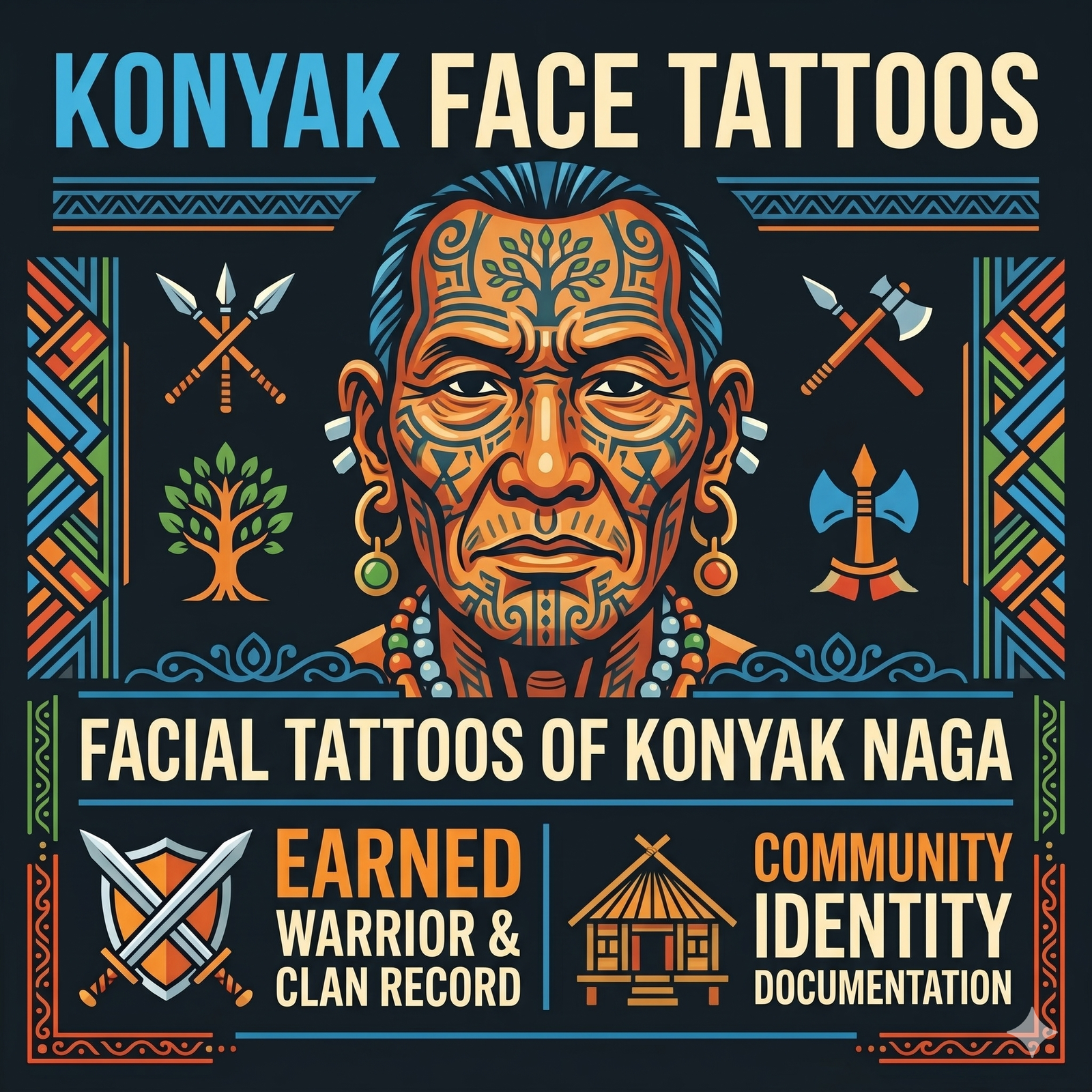
The Konyak Naga tribe of Mon district in Nagaland practiced a system of facial tattooing that functioned as a living record of lineage, warrior status and community identity. Tattoos were awarded for specific acts, including headhunting, and the patterns used encoded information about the wearer's clan, achievements and social position within the tribe. The practice was largely discontinued following Christianization of the region in the mid-twentieth century, and the last generation of fully tattooed elders is now in extreme old age. This piece explores what the tattoos meant, how they were made, what they recorded and what their disappearance means for one of the most unusual documentary traditions in human history.| Detail | Information |
| Subject | Konyak Naga Facial Tattoos |
| Community | Konyak Naga tribe |
| Location | Mon district, Nagaland, India |
| Practice | Facial tattooing as lineage and warrior record |
| Traditional Occasion | Awarded after headhunting or significant deed |
| Current Status | Practice largely discontinued, last tattooed elders aging |
| Recognition | Documented by anthropologists and photographers globally |
| Significance | Living record of genealogy, status and tribal identity |
Identity Encoded in Skin
The Konyak Naga tribe of Mon district in Nagaland practiced a system of facial tattooing that functioned as a permanent record of lineage, warrior status and community identity. Tattoos were awarded for specific achievements, with each pattern encoding information about the wearer’s clan, village, accomplishments and social position. The practice was largely discontinued following Christianization of the region in the mid-twentieth century. Now the last generation of fully tattooed elders, in their eighties and nineties, carry the only remaining complete record of a documentary system that predates paper and writing.
The Konyak Nagas and Their Ordered Society
The Konyak Naga are one of the largest Naga tribes, inhabiting the Mon district of Nagaland, a mountainous region bordering Myanmar. Historically, Konyak society was organized around the institution of the Ang, a hereditary chief whose authority was both political and sacred. Below the Ang, the community was organized into clans and sub-clans whose relationships to each other and to the Ang were precisely defined and carefully maintained.
The Konyaks were among the last Naga tribes to practice headhunting, a tradition that carried enormous ritual and social significance within the community. Headhunting was not random violence. It was a structured practice embedded in the Konyak understanding of power, fertility and the relationship between the living and the dead. A warrior who had taken a head acquired a form of spiritual power that benefited his entire community. The head was brought back to the village with specific rituals and given a place of honor in the morung, the traditional men’s dormitory that served as the social and ritual center of Konyak village life.
Within this framework, facial tattooing found its deepest meaning. The marks on a warrior’s face were not decoration. They were documentation. They were written records of something the community had witnessed and decided deserved to be permanently acknowledged.
Intricate Kolam Floor Art Drawn Daily in South Indian Homes
What the Tattoos Actually Recorded
The system of Konyak tattooing was not a single uniform practice but a complex code that varied between villages and clans while maintaining certain shared principles. The face was the primary surface for significant marks, though tattooing also extended to the hands, chest and legs depending on achievement and status.
For men, the most significant facial tattoos were those associated with headhunting. A warrior who had successfully taken a head in a raid was entitled to specific facial marks that were not available to men who had not achieved this. The marks were gatekept. You could not simply choose to have them. You had to have earned them within the community’s system of recognition.
Beyond the headhunting marks, the tattoos encoded information about clan membership, village of origin and the lineage of the Ang or chief under whose authority the wearer lived. A knowledgeable Konyak elder could read another person’s facial tattoos the way a scholar reads a text, identifying clan, village, status and achievement from the combination of marks, their placement and their specific patterns.
Women’s tattoos operated on a related but distinct system. Women of certain lineages received specific marks that identified their family connection and their status within the community’s hierarchy of clans. The facial tattoos of a woman of the Ang lineage differed from those of common clan women, and these distinctions were visible and legible to anyone within the community who knew how to read them. The technical process of tattooing was performed by specialists, typically older women who had inherited the knowledge of patterns and their meanings. According to extensive research published by the Anthropological Survey of India, the instrument was a thorn or sharpened bamboo point dipped in pigment made from soot and other natural materials. The process was painful and, given the permanence of the marks and their social significance, was treated as a serious ritual occasion rather than a casual procedure.
How Kodava Celebrates Weapons During Kailpodh Festival
The Morung as Institution
Understanding Konyak tattooing requires understanding the morung, the traditional men’s dormitory that was the institutional heart of Konyak social and ritual life. Young men lived in the morung from adolescence, learning warfare, craft, music and the codes of social behavior that governed Konyak community life. The morung was also where the skulls of enemies taken in headhunting raids were kept and honored.
The morung was not simply a dormitory. It was a school, a ritual space and a repository of community memory. The hierarchies established within the morung, including the recognition of warriors through tattooing, created the social structure that organized the broader village community. A young man’s first tattoo, marking his first significant achievement, was a morung event, witnessed by the community and placed within the framework of morung authority.
This institutional connection meant that the tattooing tradition was not simply an individual practice but a community practice, maintained and regulated by the same social institutions that maintained everything else about Konyak life. When those institutions were disrupted, the tattooing tradition was disrupted along with them.
Christianization and the Discontinuation
The Christianization of Nagaland, which proceeded rapidly through the mid-twentieth century largely carried by American Baptist missionaries, transformed Konyak society with thoroughness and speed that is remarkable in the history of cultural change. By the 1960s and 1970s, the large majority of Konyak villages had converted to Christianity, bringing with them the abandonment of the morung system, the end of headhunting and the discontinuation of the tattooing tradition.
The reasons are not difficult to understand. Headhunting was directly prohibited by Christian teaching. The morung’s ritual functions, which were tied to animist spiritual practices, had no place in the new religious framework. And the tattooing tradition, which was inseparable from the headhunting system and the morung institution, lost the social and ritual context that gave it meaning.
The last generation of men to receive the full facial tattoos associated with headhunting were those who had participated in raids before the practice was suppressed. This places the last fully tattooed men in the generation now in their eighties and nineties. Anthropological documentation has established that this generation represents the final living carriers of the complete tattooing system.
Global Attention and Its Complications
The visual power of the Konyak tattooed elders has attracted considerable attention from photographers, journalists and documentary filmmakers from across the world. Images of aged Konyak warriors with full facial tattoos have appeared in major international publications and have been exhibited in galleries globally.
This attention is complicated. The elders who receive the most photographic attention are sometimes described as welcoming visitors and sometimes as exhausted by them. The community benefits economically from tourism in some ways, but the relationship between the Konyak villages and the global fascination with their elders’ faces is not straightforwardly positive. There are questions about dignity, about the terms on which these images circulate and about who benefits from the cultural interest they generate.
Researchers working in North East India studies have noted that the documentation of the Konyak tradition, while valuable for preservation purposes, needs to be conducted in ways that center the community’s own understanding of what is being documented and why, rather than simply extracting visual material for outside audiences.
Quick Comparison Table
| Feature | Konyak Naga Tattoos | Apatani Nose Plugs | Toda Embroidery | Rabari Embroidery |
| Community | Konyak Naga, Nagaland | Apatani tribe, Arunachal Pradesh | Toda tribe, Tamil Nadu | Rabari community, Rajasthan |
| Purpose | Warrior record, lineage, status | Identity, beauty, protection | Ritual and community identity | Community and marital identity |
| Medium | Facial skin, permanent tattoo | Nose plug and tattoo | Woven textile | Embroidered textile |
| Current Status | Discontinued, last elders aging | Largely discontinued | Endangered living tradition | Living tradition |
| Documentation | Extensive global photographic record | Anthropological documentation | Academic and craft documentation | Craft council documentation |
Curious Indian: Fast Facts
- The Konyak Nagas were among the last Naga tribes to practice headhunting, a tradition that ended largely in the mid-twentieth century following Christianization of the region
- Facial tattoos were awarded rather than chosen, with specific marks gatekept behind community-recognized achievements including headhunting
- The tattooing was performed by specialist older women using thorns or sharpened bamboo points and a pigment made from natural soot-based materials
- The last generation of fully tattooed Konyak men took part in headhunting raids before the practice was suppressed and are now in their eighties and nineties
- Women of Ang or chiefly lineage received different tattoo patterns from women of common clans, with the marks being legible as a genealogical record to community members
- The morung, the traditional men’s dormitory and ritual center, was the institutional context within which tattooing was regulated and witnessed
- International photographers have made the faces of Konyak elders among the most widely circulated images of Nagaland globally
- The Anthropological Survey of India has conducted documentation work on the Konyak tattooing tradition as part of broader efforts to record endangered cultural practices in Northeast India
What Is Lost When the Last Face Goes
The disappearance of the Konyak facial tattooing tradition is not simply the loss of a visual practice. It is the loss of a documentary system. The information encoded in those faces—the genealogical connections, the record of specific achievements, the markers of clan and village and lineage—exists nowhere else in a form that is equally permanent and equally public.
Written records, oral histories and photographic documentation can preserve some of what the tattoos contained. But they cannot replicate what the tattoo system actually was, which was a form of identity documentation that required no institution to maintain it, no archive to store it and no translator to make it legible to those within the community who knew the code. It lived on the body of the person it described, available always, indestructible by fire or flood or the passage of time, until the body itself was gone.
The faces of the Konyak elders are archives. They were made to be archives, designed by a community that understood that the most durable place to store important information about a person was the person themselves, written in a medium that could not be separated from its subject and could not be misplaced.
The decision of the Konyak community to accept Christianity and abandon the traditions associated with headhunting and the morung was made by a community navigating the enormous forces of colonial modernity with the tools available to them. The cost of that navigation included the tattooing tradition.
What remains is the last generation of faces. They are being photographed extensively. They are being documented by anthropologists and filmmakers. Some of what they contain is being preserved in these records. But the system that produced them—the morung, the headhunting raids, the specialist tattooists, the community of readers who knew what every mark meant—is gone. The archive exists. The language to read it is almost entirely lost.
That is not a failure of documentation. It is a reminder of what documentation can and cannot do. It can preserve the image. It cannot preserve the meaning. Meaning lives in the community that shares it. When that community changes, the meaning changes with it, and no photograph, however beautiful, can hold it in place.
The Rhythmic Buddhist Chanting of the Monks of Ladakh
If you think you have remembered everything about this topic take this QUIZ
This quiz no longer existsWho are the Konyak Nagas and where do they live?
The Konyak Naga are one of the largest Naga tribes of Northeast India, primarily inhabiting the Mon district of Nagaland, which borders Myanmar. They have historically been one of the most distinctive Naga communities, known for their elaborate material culture, the institution of the Ang or hereditary chief and, until the mid-twentieth century, the practice of headhunting and facial tattooing.
What did the facial tattoos record and how were they read?
The tattoos recorded a combination of genealogical information including clan membership, village of origin and lineage, alongside individual achievements including headhunting. The patterns used differed between villages and between different categories of achievement, and were legible to knowledgeable community members who could identify a person’s background and status from the marks on their face. The system functioned as a permanent, body-worn identity record.
Why did the Konyak tattooing tradition end?
The tradition ended primarily as a consequence of the rapid Christianization of Nagaland in the mid-twentieth century, carried largely by Baptist missionaries. Christian teaching prohibited headhunting, which was the primary occasion for the most significant male facial tattoos. The morung institution, which was the ritual and social context for tattooing, was also dismantled as part of the broader religious and cultural transformation of Konyak society.
Is there any effort to preserve or revive the tradition?
Preservation efforts focus primarily on documentation rather than revival. The Anthropological Survey of India and various independent researchers have documented the tradition through interviews, photographic records and anthropological studies. A revival of the actual tattooing practice would require the revival of the social institutions and belief systems that gave the tattoos their meaning, which is not currently occurring within the Konyak community.
How can the tradition be experienced or learned about today?
The Hornbill Festival held annually in Nagaland brings together cultural representatives of all major Naga tribes including the Konyak and provides a context in which aspects of Konyak culture are displayed and explained. Some of the last tattooed elders continue to receive visitors in Mon district. Photographic books and documentary films produced by researchers and photographers who have worked in Mon district provide the most detailed visual and contextual documentation of the tradition currently available.