How Bengaluru’s Ancient Jasmine Carriers Balance a Goddess’s Presence on Their Heads
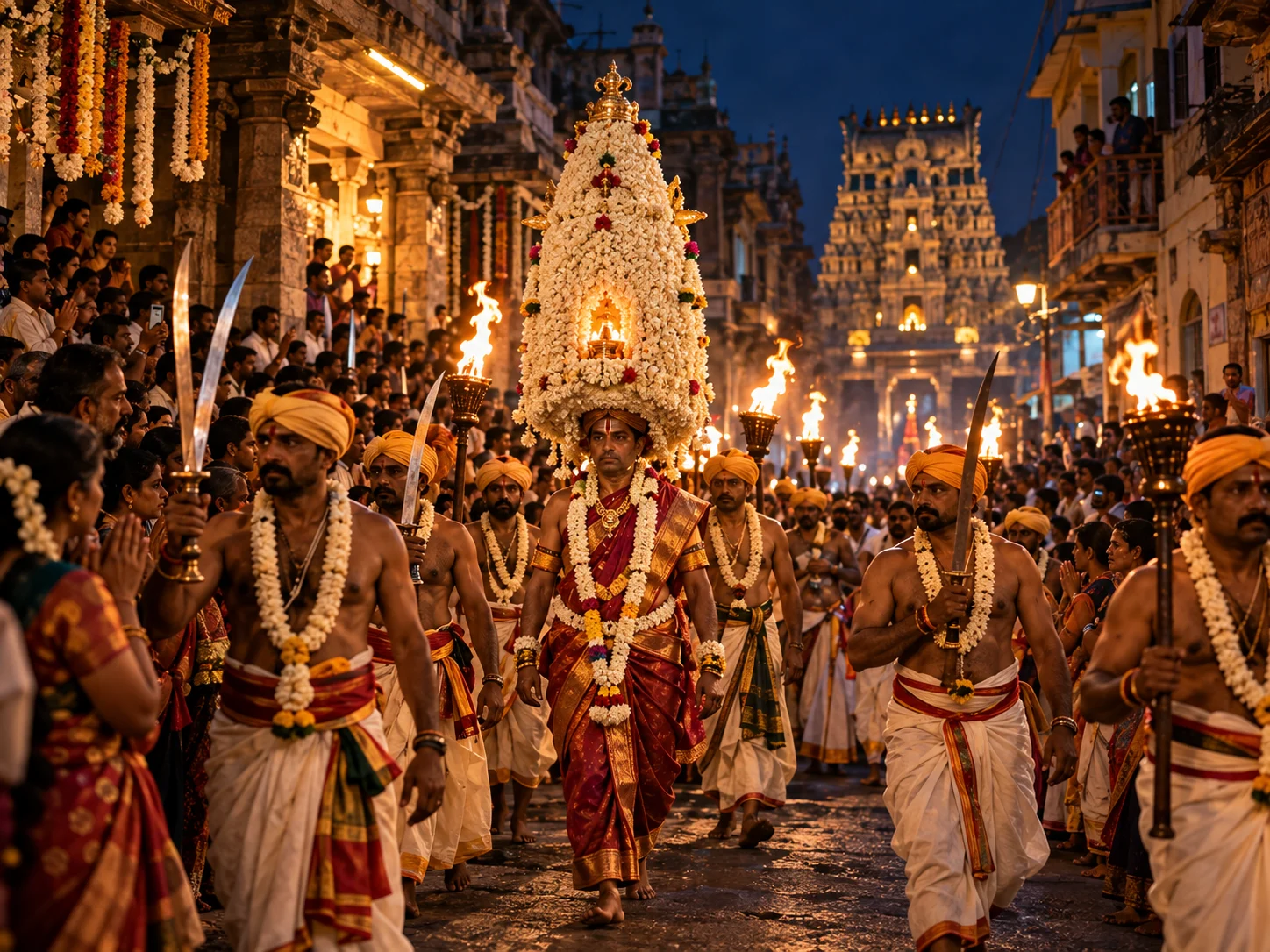
On one night every year in the heart of old Bengaluru, a man dressed as a woman walks barefoot through the streets of the city carrying on his head a pyramid of jasmine flowers that can stand taller than himself, lit from within by a lamp, balanced without hands, swaying with the rhythm of his steps and his devotion. He does not drop it. He has never dropped it. The tradition holds that if the Karaga bearer’s faith is complete, the goddess herself holds the pyramid in place. The Karaga festival of Bengaluru is one of the oldest continuously observed rituals in South India, rooted in a goddess worship tradition that predates the Mahabharata’s arrival in the Deccan, and it is one of the most extraordinary things that any Indian city does every year in plain sight of anyone willing to stay awake to watch it.
Ancient Agricultural Myths That Shape the Magh Bihu Harvest Festival
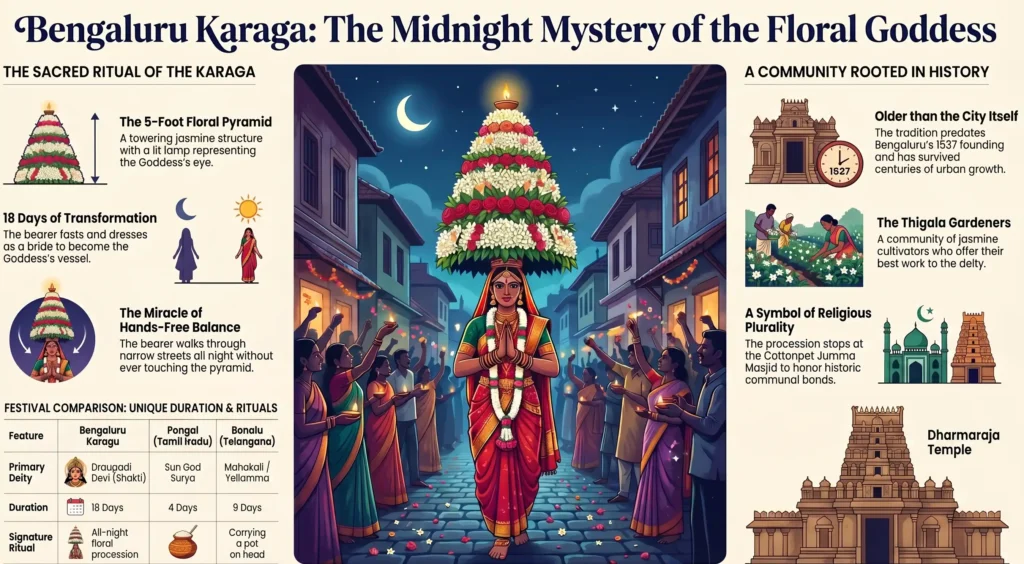
How the Karaga Bearers Balance the Floral Pyramid
Bengaluru today is a city of glass towers and startup campuses, of traffic that begins before dawn and does not end until well after midnight. And then, once a year, on the full moon night of the Tamil month of Panguni, something walks out of a very different Bengaluru and moves through the streets of the old city with a pyramid of jasmine flowers on its head, lit from within, swaying with devotion, and the present tense falls away completely.
The man who carries the Karaga has been fasting and purifying himself for eighteen days. He is dressed in a silk saree the colour of a bride’s, with flowers in his hair and sacred ash on his face. Around him walk hundreds of Veerakumaras, the warrior devotees of the Thigala community, carrying unsheathed swords and torches. The procession will walk through the night. It will not stop until dawn. The Karaga will not fall.
This is not performance. It is not spectacle produced for an audience. It is a community continuing a practice that was old when Bengaluru was young, old possibly before Bengaluru existed in any form that the historical record can establish.
The Thigala Community and Their Goddess
Mythological Origins of the Kumbh Mela and Descent of the Ganga
To understand the Karaga, you must first understand the Thigala community and the specific nature of their relationship with Draupadi Devi. The Thigala are a community of gardeners and flower cultivators whose historic territory includes the old city areas of Bengaluru and the surrounding agricultural lands of the Karnataka-Tamil Nadu border region.
The Thigala community’s presence in Bengaluru predates the city’s formal founding by Kempe Gowda in 1537. The Dharmaraja Temple at Tigalarapet, the festival’s primary site, is believed by community historians and some academic researchers to have existed in some form before the Kempe Gowda period, which would place the Thigala community’s settlement and their goddess worship tradition among the oldest documented elements of the human geography of what would become Bengaluru.
The Draupadi of the Thigala tradition is understood not as the Mahabharata character but as a form of Shakti, the primordial goddess energy, who took the form of Draupadi in the epic narrative but whose essential identity predates and exceeds that narrative. She is worshipped not as a character from the epic but as the living goddess whose power is manifest in the Mahabharata story as one of her many historical appearances in the world.
This theological position connects the Karaga to the deep structural currents of goddess worship in the Deccan that predate the arrival of Sanskrit Puranic tradition. Scholar Alf Hiltebeitel has argued that the Draupadi worship traditions of South India represent a stratum of goddess devotion older than the Mahabharata as a literary text and may have absorbed the Draupadi narrative into an already existing goddess cult.
The Eighteen Days of Preparation
The Karaga that everyone watches on the full moon night is the visible culmination of eighteen days of preparation, purification, and ritual. Understanding these eighteen days is essential to understanding why the main procession carries the weight it does when it finally arrives.
The festival begins with the planting of a sacred pot called the Garuda Dhvaja. From this moment, the temple becomes the centre of daily ritual activity, with morning and evening worship, the recitation of the Karaga Purana, the community’s own narrative account of the festival’s origin and theological significance, and the progressive purification of the Karaga Pujari who will carry the floral pyramid on the final night.
The Karaga Pujari’s preparation is the most demanding individual dimension of the festival. He observes strict fasting, abstaining from certain foods and the ordinary pleasures of daily life. He sleeps in the temple precincts. He performs multiple ritual baths daily. He absorbs the liturgical content of the Karaga Purana through daily recitation.
The transformation of the Karaga Pujari from an ordinary man into the vessel of the goddess is understood as a genuine spiritual process. By the night of the main Karaga, the devotee has completed a preparation in which the goddess’s presence has entered him completely. He dresses as a woman, as a bride of the goddess rather than as a male devotee. The gender transformation is a marker of the spiritual transformation.
The Veerakumaras who escort the Karaga bearer also undergo their own preparation during the festival period. These sword-bearing warriors are understood as the goddess’s army, protecting the Karaga bearer as he moves through the city. Their unsheathed swords are not ceremonial props but are understood as weapons whose presence keeps the goddess’s space cleared of negative energy.
Floral Pyramid and Its Construction
Vishwakarma Puja and the Ancient Theology Behind Worship of Tools
The Karaga itself, the floral pyramid carried on the bearer’s head, is a ritual object of remarkable beauty and considerable structural complexity whose construction is itself a devotional act requiring specialized knowledge transmitted within the Thigala community across generations.
The pyramid is constructed from jasmine flowers, the community’s signature bloom, woven and layered onto a bamboo and metal frame. It is supplemented with other flowers and greenery, arranged in a specific pattern that reflects the visual iconography of the goddess’s form in the Thigala devotional tradition. The completed pyramid can stand between three and five feet in height above the bearer’s head.
At the centre of the floral pyramid, a lamp is placed, lit at the beginning of the procession and maintained throughout the night. This lamp is understood as the goddess’s eye, her living presence within the constructed form. The combination of the flowers, which are Draupadi Devi’s traditional offering, the lamp, which is the goddess’s consciousness, and the bearer who carries them, who is the goddess’s chosen vessel, makes the Karaga a composite ritual object in which the material, the symbolic, and the spiritual are completely fused.
The balance required to carry the pyramid through the night without touching it with the hands is the festival’s most immediately astonishing physical dimension. The bearer must walk continuously for several hours through streets that are uneven, crowded, and occasionally quite narrow, without stumbling or slowing. The crowd surrounding him is large and pressing close, held back by the Veerakumaras but never entirely absent as a physical force.
Those who have carried the Karaga describe the experience of the procession not primarily in terms of physical difficulty but in terms of the specific quality of absorption that preparation has produced. They speak of not feeling the weight, not in the sense of absence but in the sense of awareness being subsumed into something larger. They speak of the goddess’s presence as a stabilizing force, a quality of stillness at the centre of movement that makes the balance possible in a way physical skill alone could not produce.
The Route Through Old Bengaluru
The Karaga procession’s route through old Bengaluru is not arbitrary. It follows a specific path through the neighbourhood of Tigalarapet and surrounding old city areas that connects the festival to the historic geography of the community’s traditional settlement and to specific sites of ritual significance accumulated over centuries of festival practice.
The procession begins at the Dharmaraja Temple at midnight, when the full moon is high and the streets of old Bengaluru have reached the particular quality of stillness that comes just before a large crowd reassembles. It moves through the narrow streets, visiting specific temples and shrines along the route.
One of the most celebrated stops is at the Jumma Masjid in the Cottonpet area, where a tradition of remarkable religious plurality is observed. The Muslim community of the neighbourhood receives the procession with respect and participates in the festival’s movement through their area. This tradition, which has been maintained across generations despite political pressures on communal relations, is one of the Karaga festival’s most celebrated features and statements about the kind of city Bengaluru has historically understood itself to be.
The story behind this tradition traces the Thigala community’s historical relationship with a Muslim saint whose tomb is located along the procession route, and whose descendants have participated in the festival as guests of honour for generations. The procession returns to the Dharmaraja Temple before dawn, completing the circuit and closing the festival’s central ritual night with the immersion of the Karaga in a sacred tank and the distribution of prasad to thousands of devotees.
The Karaga Purana and the Community’s Own Theology
The Thigala community has its own text, the Karaga Purana, which provides the theological and narrative foundation for the festival in the community’s own voice. This text, composed in Kannada and maintained within the community’s religious tradition, is recited during the festival period and functions as both a ritual scripture and a community history.
The existence of the Karaga Purana as a community-specific text is significant in the broader context of Indian religious literature. Most regional festival traditions rely on Sanskrit Puranic sources or oral tradition for their theological authority. The Thigala community’s possession of a written Kannada text that articulates their own theological understanding of the goddess places them in a small group of communities whose relationship with their deity has generated its own literary tradition. This self-documentation is itself a marker of a community’s depth of engagement with its religious practice.
The Draupadi Cult Across South India
The Thigala community’s worship of Draupadi as a Shakti form is not an isolated phenomenon but part of a broader pattern of goddess worship across Tamil Nadu and Karnataka. The Draupadi cult traditions of Tamil Nadu involve a network of Draupadi temples across the Tamil-speaking region whose festivals share structural similarities with the Bengaluru Karaga even as their specific ritual forms differ.
The fire-walking rituals associated with Draupadi temples in Tamil Nadu express the same understanding of Draupadi’s warrior power and devotees’ willingness to undergo physical ordeal as a marker of genuine faith. Both traditions understand the devotee’s body as the primary site of devotional expression and physical endurance as the primary language of genuine commitment.
This connection places the Karaga within a regional religious landscape whose depth and geographic extent are considerably greater than most accounts acknowledge. The festival is not an isolated local tradition but one of the most fully developed expressions of a goddess worship complex that extends across the southern Deccan and has roots in the pre-Sanskrit religious world of the region.
The Jasmine Connection
The Thigala community’s identity as gardeners and flower cultivators, and the specific centrality of jasmine in the Karaga ritual, creates a connection between the festival’s religious significance and the community’s economic and ecological life.
Jasmine is understood across South Indian cultural traditions as inherently auspicious, as connected to the presence of the divine. For the Thigala community, jasmine is both livelihood and liturgy. The cultivation of jasmine for the Bengaluru flower market has historically been one of the community’s primary economic activities. The specific knowledge of jasmine cultivation, including varieties suited to different micro-regions around Bengaluru and techniques for selecting and preparing flowers for the Karaga pyramid, is knowledge that bridges the agricultural and the ritual.
The Karaga pyramid represents the fullest possible expression of this connection. The finest jasmine flowers of the season, chosen with the care that the goddess’s adornment demands, are woven into a form that has both aesthetic and theological requirements. The flowers must be fresh enough to last the entire night. They must be arranged in the specific pattern tradition prescribes. They must be beautiful enough to be worthy of the goddess they are meant to embody.
A community that grows flowers for a living understands what beautiful flowers cost in labour and knowledge and attention. The offering of those flowers in the Karaga is therefore not simply a religious gesture. It is the offering of the community’s best work, given back to the goddess who is understood as the source of the fertility and seasonal abundance that makes their work possible.
Bengaluru’s Urban Growth and the Karaga’s Future
The Bengaluru that the Karaga procession moves through today is almost unrecognizably different from the Bengaluru of a century ago. The city’s explosive growth from a medium-sized administrative centre into one of Asia’s largest technology hubs has transformed the physical, social, and demographic landscape with a speed that few Indian cities have experienced.
The old neighbourhoods of Tigalarapet where the Karaga procession moves are increasingly surrounded by elevated highways and metro construction. The Thigala community has experienced the economic and social pressures of urban transformation in ways that affect the intergenerational transmission of the knowledge and devotion that the festival requires.
The specific agricultural knowledge that the Thigala community has historically carried is under pressure from the urbanization of land that has historically been the community’s agricultural territory. As flower cultivation moves further from the city and younger members move into urban employment sectors, the question of how agricultural and ritual knowledge will be transmitted forward is pressing and unresolved.
The Karaga itself has demonstrated a remarkable capacity for survival across every previous wave of change that Bengaluru has experienced. The festival continued through the colonial period, through independence, through early urbanization, and through the technology boom. The goddess has been present in her pyramid of jasmine without interruption for as far back as any historical record can establish.
The Karnataka government’s recognition of the Karaga as a significant state cultural event, and the attention of scholars and cultural organizations to the festival’s preservation, provide some institutional support. Whether this institutional attention translates into the specific support the Thigala community needs—support for land rights, for agricultural knowledge transmission, for the economic sustainability of jasmine cultivation that feeds the ritual—is a question the history of institutional cultural preservation in India gives limited grounds for optimism about.
What the Karaga Shows the World
Cities are not usually understood as places of ancient ritual. They are understood as places of change, of the new, of the erasure of what came before. Bengaluru, more than almost any other Indian city of the current era, is understood through this lens of perpetual transformation.
The Karaga disrupts this understanding completely. It insists, once a year, on the full moon night of Panguni, that beneath the glass towers and startup campuses, there is a city that has been in continuous relationship with its goddess for longer than any of those structures has existed. That the Thigala community was cultivating jasmine in the fields around what would become Bengaluru before the first software company was incorporated anywhere in the world.
This is not nostalgia. It is not a rejection of the present or a romanticization of the past. It is simply what is true. The Karaga has always existed alongside whatever Bengaluru happened to be at any given moment. It does not compete with the city’s transformations. It continues beneath and around them, rooted in a relationship between a community and its goddess that no urban planning document has ever been required to acknowledge and that will continue regardless of whether it ever is.
The man who carries the pyramid walks through streets that were once narrow lanes between gardeners’ plots and are now bordered by commercial buildings and apartment towers. His feet are still bare on the old stones. The jasmine is still fresh. The lamp still burns at the centre of the pyramid. The Veerakumaras still carry their swords. The goddess still holds the pyramid in place. She has always held it.
How Goa’s Shigmo Festival Carries Myths Older Than Its Own Name
If you think you have remembered everything about this topic take this QUIZ
Results


#1. Which historic community of flower cultivators and gardeners has been the custodian of the Bengaluru Karaga festival for centuries?
#2. On which specific night does the main, historic Karaga procession wind through the streets of old Bengaluru every year?
#3. At which ancient temple site in the Tigalarapet neighborhood is the Karaga festival traditionally centered?
#4. The presiding deity of the Karaga, Draupadi Devi, is worshipped by the community as a manifestation of which cosmic force?
#5. What is the title given to the sword-bearing warrior devotees who undergo intense ritual preparation to protect and escort the Karaga bearer?
#6. What unique written literary text contains the community’s own narrative, theology, and history of the festival in the Kannada language?
#7. During the midnight procession, which historic religious site in Cottonpet does the Karaga bearer visit to showcase a centuries-old tradition of communal harmony?
#8. According to the Quick Comparison Table, what sets the gender dimension of the Karaga completely apart from the Attukal Pongala festival?
What is the Karaga festival and where is it celebrated?
The Karaga is an ancient festival observed by the Thigala community of Bengaluru, Karnataka, centred on the Dharmaraja Temple in the old city neighbourhood of Tigalarapet. Its most celebrated ritual is the main Karaga procession on the full moon night of the Tamil month of Panguni, in which the Karaga Pujari carries a towering pyramid of jasmine flowers on his head through the streets of old Bengaluru from midnight until dawn. The festival spans approximately eighteen days of preparation and ritual before the main procession night and is one of the oldest continuously observed festival traditions in South India.
Who carries the Karaga pyramid and what preparation does he undergo?
The Karaga pyramid is carried by the Karaga Pujari, also called Veerakumara, a male member of the Thigala community who has been selected through what the tradition understands as divine choice. He undergoes eighteen days of rigorous preparation including strict fasting, multiple daily ritual baths, sleep in the temple precincts, and the daily recitation of the Karaga Purana. By the night of the main procession, the Thigala tradition understands the bearer to have been so completely prepared as a vessel for the goddess that he dresses as a woman, as a bride of Draupadi Devi, and carries the pyramid without touching it with his hands, with the goddess understood to be holding it in place through the completeness of his faith.
What is the theological significance of Draupadi Devi in the Karaga tradition?
Draupadi Devi in the Karaga tradition is not simply the queen of the Mahabharata but is understood as a form of Shakti, the primordial goddess energy, who took the form of Draupadi in the Mahabharata narrative but whose essential identity predates and exceeds that narrative. The Thigala community’s Karaga Purana establishes her as a warrior goddess whose power is expressed both in the Mahabharata story and in the living ritual of the festival. Scholars including Alf Hiltebeitel have argued that the Draupadi worship traditions of South India, of which the Karaga is a part, predate the Mahabharata as a literary text and represent a stratum of Deccan goddess worship older than the Sanskrit Puranic tradition.
What is the significance of the Karaga procession visiting the Jumma Masjid?
The Karaga procession’s visit to the Jumma Masjid in Bengaluru’s Cottonpet area, where the Muslim community of the neighbourhood receives the procession with respect, is a tradition documented in accounts of the festival from at least the nineteenth century. It traces to the Thigala community’s historical relationship with a Muslim saint whose tomb is located along the procession route and whose descendants have participated in the festival as guests of honour across generations. The tradition is one of Bengaluru’s most celebrated examples of living communal religious plurality and has been maintained across generations despite the political pressures on communal relations that the twentieth and twenty-first centuries have brought.
How is the floral pyramid constructed and why is jasmine specifically used?
The Karaga pyramid is constructed from jasmine flowers, primarily, woven and layered onto a bamboo and metal frame with a lamp placed at its centre. Jasmine is specifically used because the Thigala community are traditionally jasmine cultivators whose agricultural and ritual knowledge have developed in continuous relationship across centuries. Jasmine is also understood across South Indian devotional traditions as inherently auspicious and connected to divine presence. The flowers chosen for the pyramid are the season’s finest blooms, selected with the care appropriate to the goddess’s adornment. The construction of the pyramid is itself a devotional act requiring specialised knowledge transmitted within the Thigala community across generations.
Sources & References
The Thigala community and pre-Kempe Gowda settlement — The Thigala are a community of jasmine cultivators whose presence in Bengaluru predates the city’s formal founding by Kempe Gowda in 1537, with the Dharmaraja Temple at Tigalarapet believed to have existed before the Kempe Gowda period, making the community’s goddess worship tradition among the oldest documented elements of Bengaluru’s human geography.
Draupadi Devi as Shakti form in Thigala theology — In the Karaga tradition, Draupadi is worshipped not as the Mahabharata queen but as a manifestation of Shakti whose essential identity predates and exceeds the epic narrative, with the Thigala’s own Karaga Purana establishing a theological understanding of the goddess as a warrior form whose power operates both in ancient narrative and in living ritual.
The eighteen-day preparation and spiritual transformation — The Karaga Pujari undergoes eighteen days of fasting, ritual bathing, and purification that the Thigala tradition understands as a genuine spiritual process producing complete transformation, with the bearer dressing as a woman to mark his becoming a vessel of the goddess, after which he carries a pyramid of jasmine without hands during an all-night procession.
Communal plurality and the Jumma Masjid tradition — The Karaga procession’s historical visit to the Jumma Masjid in Cottonpet, where the Muslim community receives the procession with respect, is a documented tradition traced to the Thigala community’s relationship with a Muslim saint and his descendants, representing one of Bengaluru’s most celebrated examples of living communal religious plurality maintained across generations.
Jasmine cultivation and ritual offering — The Thigala community’s identity as master jasmine growers whose agricultural and ritual knowledge have developed in continuous relationship across centuries makes the finest jasmine flowers of the season, chosen and woven into the Karaga pyramid with devotional care, an offering of the community’s best work back to the goddess understood as source of the fertility sustaining their livelihood.