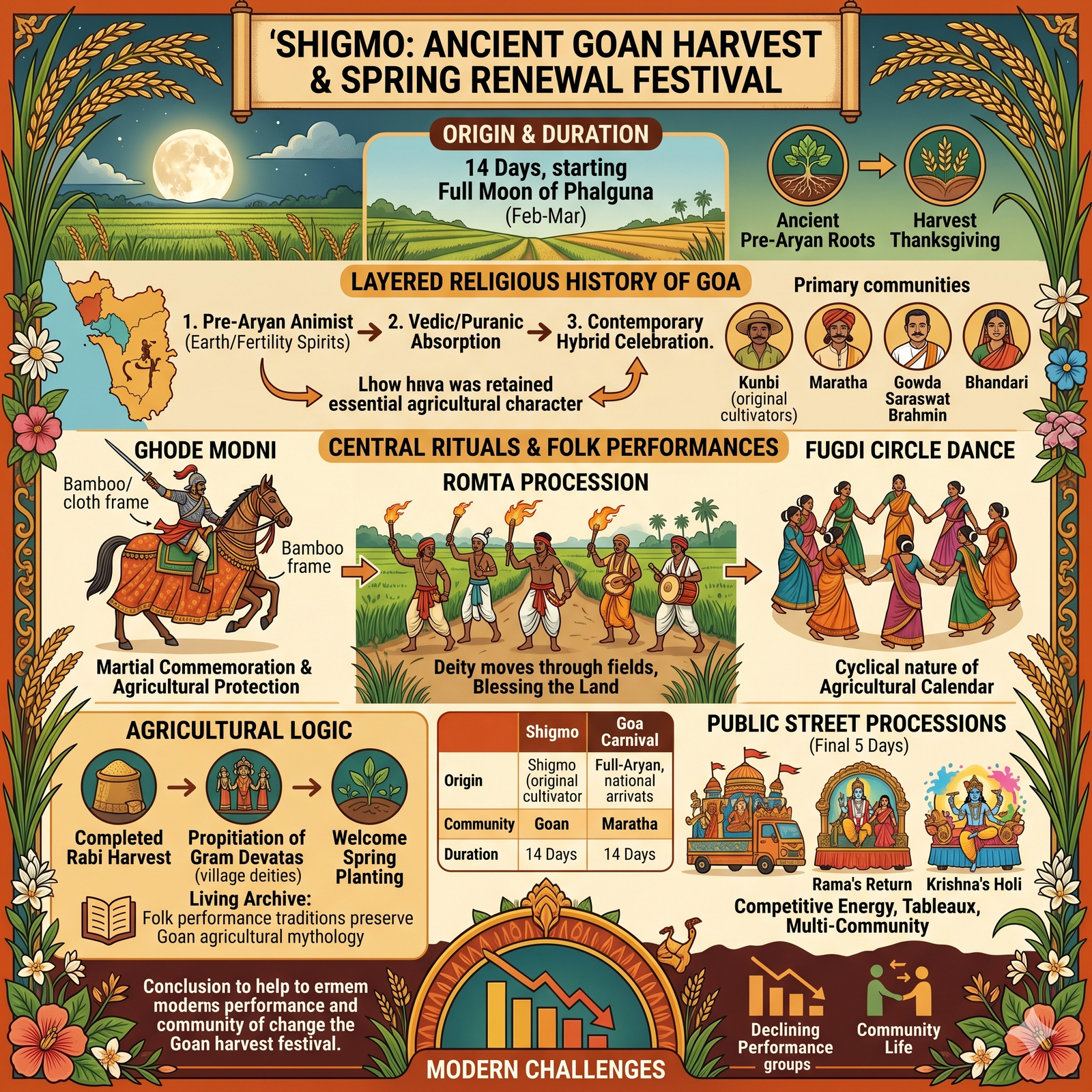
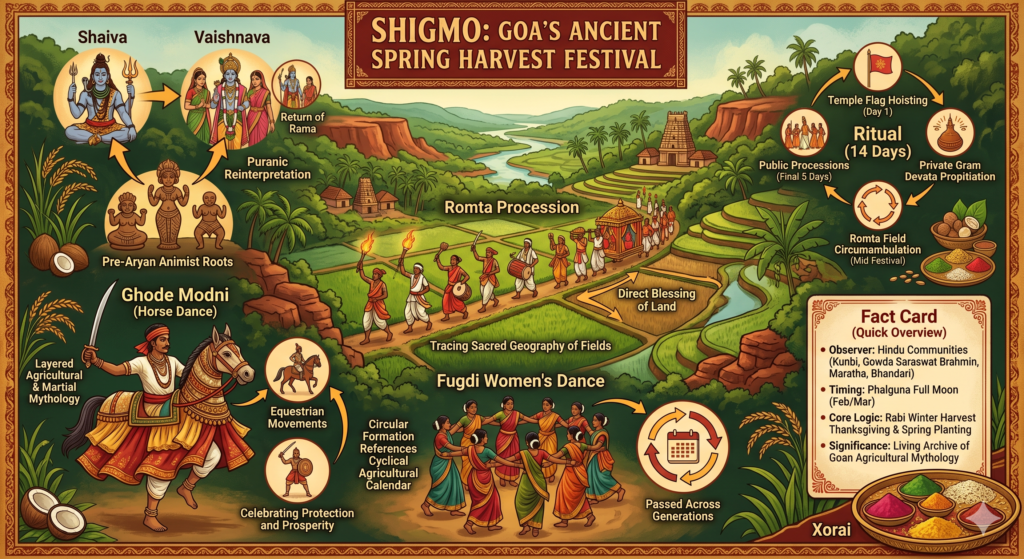
Shigmo is the most ancient festival in the Goan Hindu calendar, observed across fourteen days beginning at the full moon of the Phalguna month and celebrated primarily by the agricultural and warrior communities of Goa's interior villages as a harvest thanksgiving and spring renewal ritual with roots that predate the Aryanization of the Konkan coast. Its folk dances, processional traditions, deity worship, and agricultural observances carry a mythological complexity that reflects the layered religious history of Goa itself, where pre-Aryan animist worship of earth and fertility spirits was gradually absorbed into and reinterpreted through Vedic, Puranic, Shaiva, and Vaishnava frameworks without losing the essential agricultural character that gave the celebration its original purpose. Shigmo is simultaneously a celebration of the completed rabi harvest, a propitiation of the deities who governed its success, a welcome to the spring planting season, and a living archive of Goan agricultural mythology that survives in its folk performance traditions even as the farming communities that created those traditions face significant pressures in contemporary Goa.| Detail | Information |
| Festival Name | Shigmo (from the Sanskrit Shishirotsava, meaning spring festival) |
| Observed By | Hindu communities of Goa, primarily the Gowda Saraswat Brahmin, Maratha, Bhandari, and Kunbi communities |
| Date of Observation | Full moon of the Phalguna month in the Hindu calendar, typically February to March |
| Duration | Fourteen days, with the main street processions on the final five days |
| Agricultural Connection | Marks the end of the rabi winter harvest season and the arrival of spring planting |
| Central Rituals | Shigmotsav folk dances, Ghode Modni horse dance, Romta processions, temple flag hoisting |
| Mythological Roots | Connected to the return of Lord Rama, Krishna’s spring Holi tradition, and pre-Aryan Goan agricultural spirit worship |
| Geographic Heartland | Old Goa, Panaji, Vasco, Margao, and rural Goan village temple communities |
The Land Before the Temples Were Built
Goa’s relationship with agriculture is older than its relationship with most of the institutions that now define its cultural identity. The laterite plateaus and river valleys of the Konkan coast have been cultivated for thousands of years, with rice, coconut, and seasonal vegetables forming the foundation of a subsistence agricultural economy that sustained Goan communities long before the arrival of the Kadamba dynasty, the Vijayanagara kingdom, the Bahmani sultanate, or the Portuguese colonial administration that shaped the Goa most people know from history.
Ancient Agricultural Myths That Shape the Magh Bihu Harvest Festival
The communities most directly connected to this ancient agricultural substrate are the Kunbi, who are considered the original cultivators of Goa’s rice fields and whose ritual practices at Shigmo represent the most direct surviving connection to the pre-Aryan agricultural culture of the region. The Kunbi do not celebrate Shigmo as a Vaishnava festival or a Shaiva festival. They celebrate it as an agricultural festival, with rituals directed toward the spirits of the soil, the forces governing rainfall and soil fertility, and the ancestral cultivators whose labor created the field systems that their descendants continue to farm.
The Gowda Saraswat Brahmins, the Marathas, and the Bhandari community each bring their own religious and cultural frameworks to Shigmo, overlaying the agricultural core with Puranic mythology, Vaishnava devotion, and martial tradition. But underneath all of these subsequent layers, the oldest stratum of Shigmo’s ritual content belongs to the Kunbi and to the agricultural reality of Goan soil.
According to research documented by the Goa State Central Library and the Goa State Museum in Panaji, which holds significant collections of material relating to Goan folk tradition and pre-colonial cultural practice, the Kunbi ritual forms within Shigmo represent some of the most ancient continuously observed agricultural practices on the Konkan coast, preserved in the festival’s folk performance traditions even as the Kunbi community itself has faced significant marginalization within the broader social structure of Goan society.
When the Harvest Ends and the Fire Begins
The agricultural logic of Shigmo begins with the rabi harvest. The rabi season, the winter crop cycle that runs from November through February across most of peninsular India, produces the harvest that Shigmo marks at its conclusion. The rice varieties cultivated in Goa’s river valleys and the secondary crops grown on the laterite plateaus are brought in through December and January, and by the time the Phalguna full moon arrives in February or March the granaries are full and the fields are resting between seasons.
The first ritual acts of Shigmo take place not in the streets but in the village temple courtyards, in ceremonies that are specifically restricted in their participation and that carry the character of the older, pre-public layer of the festival’s religious content. The hoisting of the festival flag at the village temple, called the Shigmotsav dhwajarohana, marks the formal beginning of the festival period and is accompanied by rituals of temple purification, priest preparation, and the specific invocations that signal to the presiding deity of the temple that the festival season has begun.
Mythological Origins of the Kumbh Mela and Descent of the Ganga
These opening temple ceremonies are directed not simply at the major Hindu deities of the Puranic tradition but at the gram devatas, the village deities who in the Goan folk religious system are the specific spiritual presences governing the agricultural fortunes of their particular village territory. The gram devata is not a universal deity. It is a local one, tied to specific fields, specific water sources, specific seasonal patterns of the microclimate it inhabits. Propitiating the gram devata at the beginning of Shigmo is an acknowledgment that the harvest just completed was governed by forces whose domain is precisely local, whose knowledge of the land is particular rather than general, and whose continued favor is essential to the agricultural success of the season to come.
The Romta Procession and Its Ancient Memory
One of the most ritually significant traditions of Shigmo is the Romta, a processional performance in which groups of performers move through the village lanes and fields carrying the presence of the deity outward from the temple into the agricultural landscape it governs. The Romta is not a parade. It is a ritual circumambulation, a deliberate movement through the sacred geography of the village that reconnects the deity’s active presence to every corner of the agricultural territory it protects.
The participants in the Romta carry traditional instruments, torches, and the specific ritual objects associated with the village deity being honored. They move in patterns that follow the boundaries of the village fields rather than the routes of modern roads, tracing a geography that is agricultural rather than administrative in its logic. The deity’s presence, embodied in its processional representation, is carried through the fields that it governs, making contact with the soil and the growing vegetation in an act that the tradition understands as a direct blessing of the land for the coming season.
The mythological understanding behind the Romta connects to a widespread pre-Aryan belief across the Konkan and Deccan regions that agricultural fertility is maintained not passively but actively, through the regular movement of sacred presence through the landscape. The deity that stays inside the temple is a deity whose protective and fertile influence is confined to the temple. The deity that moves through the fields in the Romta is a deity whose power is distributed across the agricultural territory, renewing contact with every rice field, every coconut grove, every laterite plateau where crops will be grown in the coming season.
According to documentation compiled by the Indira Gandhi National Centre for the Arts, which has conducted field research on folk performance traditions across the Konkan coast, the Romta processional form in Goa preserves structural elements of pre-Aryan deity ambulatory ritual that are documented in comparative form across multiple agricultural communities of peninsular India, suggesting a common origin in the Dravidian or pre-Dravidian agricultural culture of the region that predates the Vedic religious framework by centuries or millennia.
The Ghode Modni and the War That Was Also a Harvest
The Ghode Modni, the horse dance of Shigmo, is the most visually spectacular of the festival’s folk performance traditions and the one that most clearly reflects the layering of agricultural and martial mythology in Goan cultural history.
The dance involves performers dressed in elaborate costumes that simulate a warrior mounted on a decorated horse, the horse represented by a bamboo and cloth frame worn around the performer’s waist that creates the visual impression of a horse-mounted rider when the performer executes the specific footwork and movement vocabulary of the Ghode Modni tradition. The movements simulate both equestrian control and military engagement, with performers enacting stylized battle sequences in formations that reference the military history of the communities that created the dance.
The Ghode Modni is associated specifically with the Gowda Saraswat Brahmin and Maratha communities of Goa, whose historical identity includes a martial tradition alongside their agricultural and priestly roles. The dance is understood within these communities as a commemoration of military victories achieved by their ancestors in defense of the Goan agricultural and temple communities they served, victories that made the continued cultivation of the land possible by protecting it from external threat.
But the agricultural dimension of the Ghode Modni is as significant as its martial one. In the Goan folk tradition, the horse is not simply a military animal. It is an agricultural one, connected to the ploughing of fields, the movement of harvested grain, and the economic life of the farming community in ways that give the horse a sacred agricultural role alongside its military associations. The Ghode Modni at Shigmo honors both dimensions simultaneously, celebrating the martial protection that made agricultural prosperity possible and the agricultural prosperity that made the community worth protecting.
The Goa Kala Academy, which has documented and supported Goa’s folk performance traditions since its establishment, maintains records of Ghode Modni performance groups across the state and has noted in its research publications that the tradition is practiced by fewer active groups today than at any previous documented point, with the specialized costume construction, musical knowledge, and movement vocabulary required for authentic performance becoming increasingly difficult to maintain as the agricultural communities that created and sustained the tradition face economic pressures that draw younger members away from traditional cultural practice.
The Mythology of Return
The Puranic mythological layer of Shigmo connects the festival primarily to two narrative traditions that give the spring celebration its devotional dimension alongside its agricultural one.
The first is the return of Lord Rama to Ayodhya after his fourteen years of exile and his victory over Ravana, which in the Vaishnava ritual calendar is associated with the spring festival season and whose celebrations of welcome and homecoming parallel the mood of Shigmo as a festival of abundance regained after the austerity of the winter months. The temple ceremonies and devotional singing traditions of Shigmo in the Gowda Saraswat Brahmin community draw extensively on the Ramayana narrative, with specific devotional compositions performed during the festival period that explicitly connect the joy of the harvest season to the joy of Rama’s return.
Goddess Kamakhya and Mythology Behind the Ambubachi Mela
The second Puranic connection is to Krishna’s spring celebration with the gopis of Vrindavan, the tradition that flows into the broader Holi festival observed across North India at the same period of the Hindu calendar. The playful, abundant, color-associated dimension of Shigmo, which includes traditions of colored powder use in some community celebrations, connects the Goan festival to the pan-Indian Holi tradition while maintaining its specific local character rooted in agricultural rather than purely devotional mythology.
These Puranic layers were applied to a festival whose agricultural core predates them, and their application reflects the process by which Vedic and Puranic religious traditions absorbed and reinterpreted the pre-existing agricultural celebrations of the communities they encompassed. The result is a festival that is genuinely both things simultaneously, a deeply agricultural celebration of the harvest cycle and a devotional celebration of Puranic narrative, with the agricultural and the devotional elements so thoroughly integrated that separating them would damage the integrity of both.
The Street Processions and the Living Archive
The public face of Shigmo, the aspect most visible to visitors and most represented in contemporary media coverage of the festival, is the street procession tradition of the final five days, when tableaux depicting scenes from Indian mythology and history are carried through the main streets of Goa’s towns accompanied by folk music, dance performances, and the participation of thousands of community members.
These processions are organized by the various ward committees and community associations of Goa’s towns and draw competitive energy that has been building across the festival period. The tableaux cover a wide range of mythological subjects, from scenes of the Ramayana and Mahabharata to depictions of local Goan historical events and the legends associated with specific village deities. The folk dances performed alongside the processions, including the Ghode Modni, the Fugdi women’s circle dance, the Dhalo ritual performance, and the Tonyamel folk theatre, represent the full range of Goa’s folk performance heritage in a single extended public event.
The Fugdi, a circular dance performed exclusively by women in interlocking formation, carries its own agricultural mythology within the Shigmo context. The circular formation of the Fugdi references the cyclical nature of the agricultural calendar, the return of seasons, the renewal of fertility, and the continuity of the community’s relationship with the land across the generations of women who have performed the same circle in the same formation at the same season for as far back as the tradition reaches.
According to research published by the Goa State Central Library, the folk performance traditions of Shigmo collectively represent one of the most comprehensive living archives of Goan pre-colonial cultural practice available, preserving in their movement vocabularies, musical forms, costume traditions, and ritual contexts a record of agricultural and spiritual life in Goa that no written document from the pre-Portuguese period could fully capture.
Quick Comparison Table
| Aspect | Shigmo | Goa Carnival |
| Origin | Ancient pre-Aryan agricultural rite, Konkan coast | Portuguese colonial introduction, 18th century |
| Primary Community | Hindu agricultural and warrior communities of Goa | Originally Catholic Goan community, now broadly observed |
| Agricultural Connection | Direct, harvest thanksgiving and spring planting preparation | None |
| Duration | Fourteen days | Four days |
| Central Ritual | Temple flag hoisting, Romta procession, Meji burning | Street parade, music, masquerade |
| Mythological Depth | Pre-Aryan animist, Vedic, Puranic multilayered | No mythological foundation |
| Folk Performance | Ghode Modni, Fugdi, Romta, Dhalo, Tonyamel | Floats, bands, contemporary performance |
Curious Indian: Fast Facts
- The word Shigmo is believed to derive from the Sanskrit Shishirotsava, meaning spring festival, though the agricultural practices it encompasses significantly predate the Sanskrit terminology applied to them by Brahminic religious culture.
- The Kunbi community, considered the original cultivators of Goa’s rice fields, practices the oldest layer of Shigmo ritual, directing their observances toward pre-Aryan earth and fertility spirits rather than the Puranic deities whose mythology was later layered over the festival’s agricultural core.
- The Ghode Modni horse dance requires performers to construct and wear elaborate bamboo and cloth frames simulating a decorated horse around their waists while executing complex footwork that combines equestrian movement vocabulary with stylized military engagement sequences.
- The Romta processional tradition traces the boundaries of village agricultural fields rather than modern road routes, following a sacred geography that is agricultural in its logic and that predates the administrative boundaries of the contemporary Goan landscape.
- The Fugdi women’s circular dance performed at Shigmo uses an interlocking formation that references the cyclical character of the agricultural calendar, encoding the seasonal renewal mythology of the festival in a movement vocabulary passed between generations of Goan women.
- The Goa Kala Academy has documented a significant decline in the number of active Ghode Modni performance groups across the state, with the specialized knowledge required for authentic performance becoming increasingly difficult to maintain as younger community members move away from traditional agricultural life.
- Shigmo’s fourteen-day duration places it among the longest festival observances in the Goan Hindu calendar, reflecting the depth of its ritual complexity and the range of community participation it encompasses across both the private temple ceremonies of the first days and the public processions of the final five.
Conclusion
Shigmo is what happens when a civilization is old enough that its festivals outlast the explanations originally given for them. The Kunbi farmer propitiating soil spirits in a village temple courtyard is performing a ritual whose theological explanation in the pre-Aryan animist framework that created it has been partially lost, partially absorbed into Vedic terminology, and partially reinterpreted through Puranic mythology. But the ritual itself continues, preserved in practice with a durability that no written religious text could have guaranteed.
This is the deepest truth about Shigmo. It survived not because any institution protected it but because the agricultural communities of Goa kept doing what their parents and grandparents had done, not always with full knowledge of why, but with enough understanding of what was at stake to keep doing it. The rice fields required acknowledgment. The gram devata required propitiation. The spring required welcoming. The harvest required thanksgiving. These requirements did not change across the religious and political transformations that Goa experienced over two millennia. So the rituals that responded to them did not change either, at least not in their essential character.
What is changing now is the agricultural community itself. As younger Goans move toward service industries, technology, and the economic opportunities of a state whose identity is increasingly defined by tourism rather than farming, the communities that created and sustained Shigmo’s agricultural ritual core are facing pressures that no festival can fully absorb. The Ghode Modni groups are declining. The Kunbi ritual specialists are aging. The knowledge of which offerings belong to which gram devata in which field boundary is becoming rarer.
Shigmo will continue to be celebrated. Its street processions will remain spectacular. But whether the agricultural mythology at its heart will continue to be practiced with the understanding that gives it meaning is a question that the festival itself cannot answer. Only the communities who carry that understanding can.
Vishwakarma Puja and the Ancient Theology Behind Worship of Tools
If you think you have remembered everything about this topic take this QUIZ
Results


#1. Which community is considered the original cultivators of Goa’s rice fields and practices the oldest, pre-Aryan agricultural layer of Shigmo ritual?
#2. What is the specific agricultural significance of the Shigmo festival in the Goan Hindu calendar?
#3. In the Goan folk religious system, what specific role do the gram devatas play during the opening ceremonies of Shigmo?
#4. According to the text, how does the Romta processional tradition navigate the sacred geography of the village?
#5. Which folk performance tradition involves a horse dance where performers wear bamboo and cloth frames around their waists to simulate equestrian and military movements?
#6. According to the research records of the Goa Kala Academy, what trend has been documented regarding the Ghode Modni performance groups?
#7. What is the mythological significance of the circular formation in the Fugdi dance performed by women during Shigmo?
#8. The word Shigmo is believed to derive from which Sanskrit term?
What is the origin of the Shigmo festival in Goa?
Shigmo originates in the ancient agricultural practices of Goa’s pre-Aryan farming communities, particularly the Kunbi who are considered the original cultivators of Goa’s rice fields. The festival marks the end of the rabi winter harvest and the arrival of spring planting, with rituals directed toward earth spirits, village deities, and ancestral agricultural presences that predate the Vedic and Puranic religious frameworks later applied to the celebration. The name itself derives from the Sanskrit Shishirotsava, meaning spring festival, though the practices it encompasses are considerably older than the Sanskrit terminology.
What is the agricultural significance of the Romta procession?
The Romta is a ritual circumambulation in which the village deity is carried in procession through the agricultural fields and lanes of the village territory it governs. The procession follows the boundaries of the fields rather than modern roads, tracing a sacred agricultural geography. The tradition reflects a pre-Aryan belief that agricultural fertility must be actively maintained through the regular movement of sacred presence through the landscape, making contact with the soil and distributing the deity’s protective and fertile influence across the entire agricultural territory.
What is the Ghode Modni and why is it performed at Shigmo?
The Ghode Modni is a folk dance in which performers wear bamboo and cloth frames simulating decorated horses while executing movement sequences that combine equestrian and military vocabulary. It is performed by Gowda Saraswat Brahmin and Maratha communities and commemorates military victories that protected Goan agricultural communities from external threat. The dance honors both the martial tradition of the performing communities and the sacred agricultural role of the horse in Goan folk culture, celebrating the mutual dependence of military protection and agricultural prosperity.
How does Shigmo connect to pan-Indian festival traditions?
Shigmo connects to pan-Indian traditions through two Puranic mythological associations. The first is the return of Lord Rama to Ayodhya, whose celebratory mood the Vaishnava communities of Goa connect to the abundance of the spring harvest season. The second is Krishna’s spring celebration with the gopis of Vrindavan, the tradition underlying the broader Holi festival observed at the same period of the Hindu calendar. These Puranic connections were applied to a festival whose agricultural core predates them, integrating Shigmo into the wider Hindu festival calendar while preserving its specifically Goan agricultural character.
Why is Shigmo considered more ancient than its public procession form suggests?
The public street processions of Shigmo’s final five days are the festival’s most visible contemporary expression but represent its most recently developed layer. The older layers, the Kunbi earth spirit propitiation, the Romta processional through agricultural fields, the gram devata temple ceremonies of the opening days, and the agricultural divination practices embedded in the ritual forms, all predate the elaborated public procession tradition and carry a mythological complexity rooted in pre-Aryan agricultural culture that is not visible in the street festival experience.