How a Cosmic Chase Across the Heavens Created the World’s Largest Pilgrimage
The Kumbh Mela does not begin with a date on a calendar. It begins with a cosmic event so ancient that the gods themselves were its participants, a churning of the primordial ocean from which the nectar of immortality emerged and was fought over by forces that shaped the architecture of the universe. The descent of the Ganga from the heavens and the spillage of that nectar at four precise points on the Indian landscape are not simply mythological backstory. They are the reason that hundreds of millions of human beings have been walking toward the same rivers at the same celestial moments for at least fourteen centuries, making the Kumbh Mela the largest peaceful human gathering on earth and one of the oldest continuously observed religious traditions in recorded history.
The Churning of the Cosmic Ocean
Every civilization has a story about where sacred things come from. The Kumbh Mela’s answer to that question begins before the nectar. It begins with a war between the devas, the gods of the Hindu cosmological order, and the asuras, the antigods or demons, a conflict so ancient and so foundational to the Vedic understanding of cosmic order that its resolution required a gesture of cooperation that went against the nature of both sides.
The devas had lost their power, their immortality weakened by a curse from the sage Durvasa. The asuras had seized the advantage. The universe was out of balance. Vishnu, the preserver of cosmic order, counseled the devas to seek an alliance with the asuras to churn the primordial cosmic ocean, the Kshira Sagara or ocean of milk, using Mount Mandara as the churning rod and the cosmic serpent Vasuki as the rope. From the churning of this ocean, Vishnu promised, would emerge the amrit, the nectar of immortality, whose consumption would restore the devas to their full power and reestablish the balance of the cosmos.
The churning is described in the Bhagavata Purana, the Vishnu Purana, and the Mahabharata with a visual specificity that has sustained centuries of artistic, sculptural, and performative interpretation. Vishnu himself took the form of a tortoise, Kurma, to serve as the base on which Mount Mandara rested during the churning process. The serpent Vasuki was wound around the mountain, with the devas holding his tail and the asuras holding his head, each side pulling in alternating rhythm to rotate the mountain and churn the ocean.
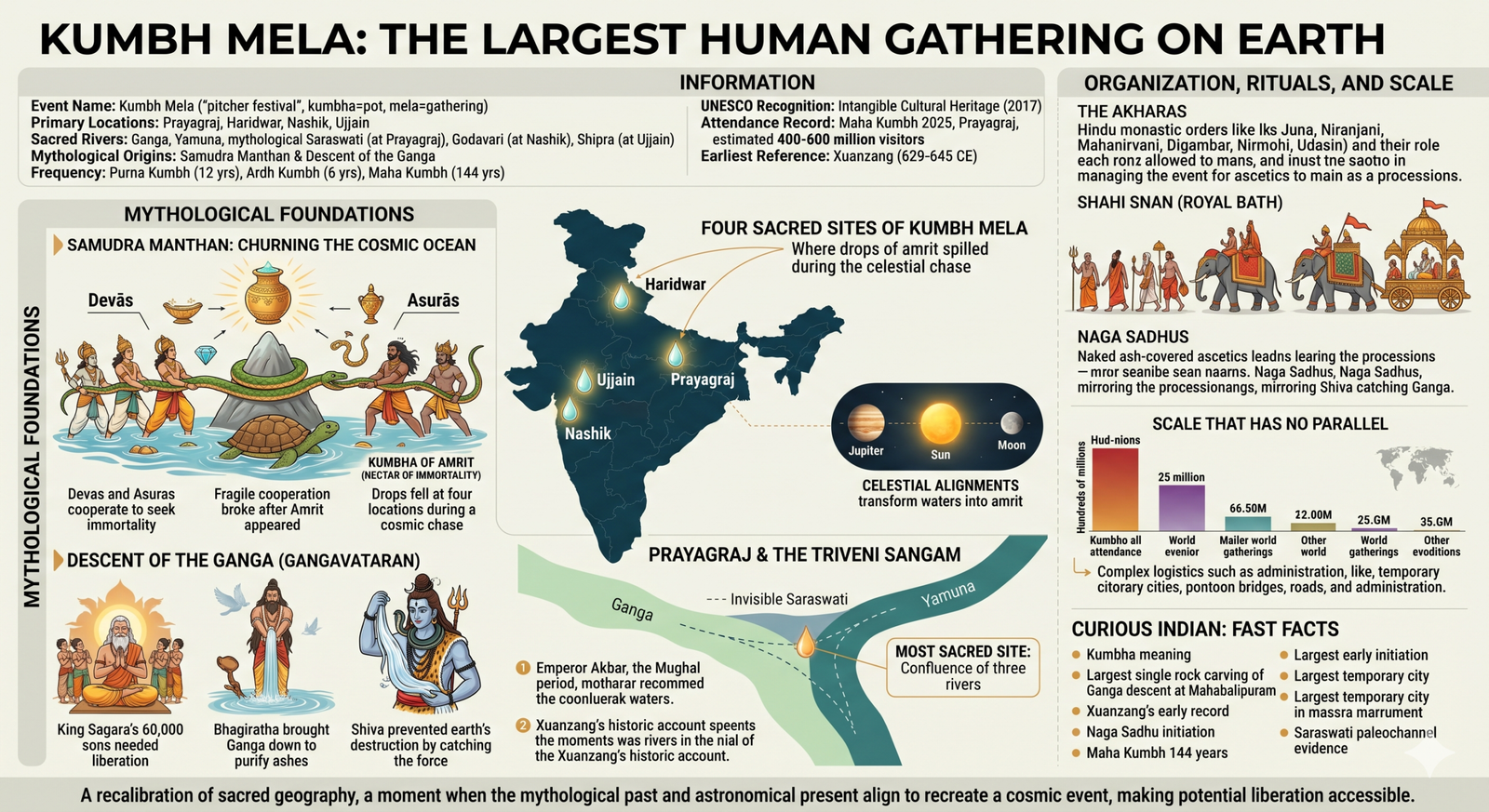
From the churning emerged fourteen sacred treasures, the ratnas, including the divine physician Dhanvantari, the goddess of wealth Lakshmi, the divine horse Uchaishravas, and finally the amrit itself, contained in the kumbha, the sacred pot, carried by Dhanvantari as he emerged from the churned ocean. The moment the kumbha of amrit appeared, the fragile cooperation shattered. The asuras seized the pot. What followed was a cosmic chase across the heavens lasting twelve divine days, which in the framework of Vedic time calculation correspond to twelve human years. During this chase, drops of amrit spilled from the kumbha at four points on the Indian subcontinent.
Hemis Festival: Sacred Cham Dances That Offer Liberation in Ladakh
The Four Sacred Sites
The four places where amrit fell are the four sacred sites of the Kumbh Mela. Prayagraj, at the confluence of the Ganga, the Yamuna, and the mythological underground river Saraswati, is considered the most sacred of the four, the Triveni Sangam where three rivers meet in an alignment of sacred waters that has no parallel in Hindu geography. Haridwar, where the Ganga descends from the mountains to the plains, is the second site. Nashik, on the banks of the Godavari river in Maharashtra, is the third. Ujjain, on the banks of the Shipra river in Madhya Pradesh, is the fourth.
The celestial bodies that were present at the moment of the amrit’s spillage at each location, specifically the positions of Jupiter, the Sun, and the Moon, are recreated by astronomical alignment at specific intervals, and it is at those moments of celestial recreation that the sacred waters at each location are believed to transform into amrit itself, carrying the purifying and liberating power of the original nectar that fell from the cosmic pot.
This is the cosmological logic of the Kumbh Mela’s timing. It is not arbitrary. It is not a festival scheduled for administrative convenience. It is a recalibration of sacred geography, a moment when the mythological past and the astronomical present align to recreate the conditions of a cosmic event, making it possible for human beings to participate in the purifying power of a moment that happened at the beginning of time.
The Descent of the River
The second mythological pillar of the Kumbh Mela’s sacred geography is the descent of the river Ganga herself, a story that is separate from the Samudra Manthan but equally foundational to understanding why the Ganga’s waters carry the particular sacred power attributed to them.
The story is told in the Ramayana, the Mahabharata, and the Puranas. King Sagara of the Ikshvaku dynasty performed a great horse sacrifice whose horse was found near the hermitage of the sage Kapila and apparently killed by him. Sagara’s sixty thousand sons, who had gone to search for the horse, were burned to ashes by the sage’s wrath. The souls of the sixty thousand could not attain liberation because their bodies had not received proper funeral rites performed with sacred water.
Bhagiratha, a descendant of Sagara, undertook a penance of extraordinary duration and intensity to bring the Ganga down from the heavens to the earth, so that her sacred waters could flow over the ashes of his ancestors and liberate their souls. Brahma, pleased with Bhagiratha’s penance, agreed to release the Ganga from the heavens. But the force of the river’s descent from the celestial realm to the earth was understood to be so powerful that it would shatter the earth itself if it fell directly.
Bhagiratha then performed a further penance addressed to Shiva, asking the great god to catch the descending river in his matted hair before releasing her gently to the earth. Shiva agreed. The Ganga descended from the heavens into the vastness of Shiva’s matted hair, was held there, and was released in gentle streams that became the rivers of the Indian subcontinent. Bhagiratha led the river across the earth to the place where his ancestors’ ashes lay, and the Ganga’s sacred waters flowed over them, liberating their souls.
This descent gives the Ganga her quality of sacred water that liberates souls, a quality that makes a ritual bath in her waters at the moment of Kumbh not simply an act of purification but an act of potential liberation from the cycle of rebirth.
Why the Sun God Surya Stands at the Heart of Chhath Puja
Prayagraj and the Triveni Sangam
Of the four Kumbh sites, Prayagraj holds the position of supreme sacred significance, a status that derives from its particular geographical and mythological character. The Triveni Sangam, the confluence of three rivers at Prayagraj, is understood in Hindu tradition as the most sacred point in the sacred geography of the entire subcontinent.
The Ganga and the Yamuna meet visibly at Prayagraj, their waters distinctly coloured at the confluence, the Ganga’s pale green current meeting the Yamuna’s darker blue-green flow in a visual boundary that pilgrims have been observing for millennia. The third river, the Saraswati, is mythological in the sense that it does not flow visibly but is understood to join the confluence from underground, its invisible presence completing the sacred triad.
The Saraswati’s invisibility is itself a subject of considerable religious and scholarly discussion. The physical Saraswati river, which is mentioned extensively in the Rigveda as one of the great rivers of the Vedic world, is now understood by most geologists and historians to have dried up or changed course thousands of years ago. The Saraswati that joins the Triveni Sangam at Prayagraj is either a mythological river whose presence is maintained in tradition regardless of physical reality, or the memory of an actual river whose subterranean remnant may still exist in some form beneath the alluvial plains of the region.
The sacred significance of Prayagraj as a pilgrimage site predates the Kumbh Mela itself. The site is referenced in the Rigveda and appears in multiple Puranic texts as Prayaga, the place of sacrifice, associated with Brahma’s first sacrifice at the beginning of the current cosmic cycle. Xuanzang, the Chinese Buddhist pilgrim who traveled through India between 629 and 645 CE, left an account of what he witnessed at Prayagraj that is among the earliest external historical documentation of mass pilgrimage activity at the site. His description of hundreds of thousands of pilgrims gathered at the river confluence aligns clearly with what would become the formal Kumbh tradition.
The Akharas and the Royal Bath
The organizational structure of the Kumbh Mela reflects the institutional history of Hindu religious life as much as its mythological origins. The akharas, which are the monastic orders of Hindu ascetics organized around different philosophical and sectarian traditions, are the primary institutional framework through which the Kumbh is managed and through which the central ritual of the Shahi Snan, the royal bath, is conducted.
The akharas trace their formal organization to the period of Adi Shankaracharya in the eighth century CE, who is credited with restructuring Hindu monastic organization across the four cardinal directions of the subcontinent. The major akharas include the Shaiva orders of the Juna Akhara, the Niranjani Akhara, and the Mahanirvani Akhara, the Vaishnava orders of the Digambar Akhara and the Nirmohi Akhara, and the Udasin orders associated with the Sikh tradition.
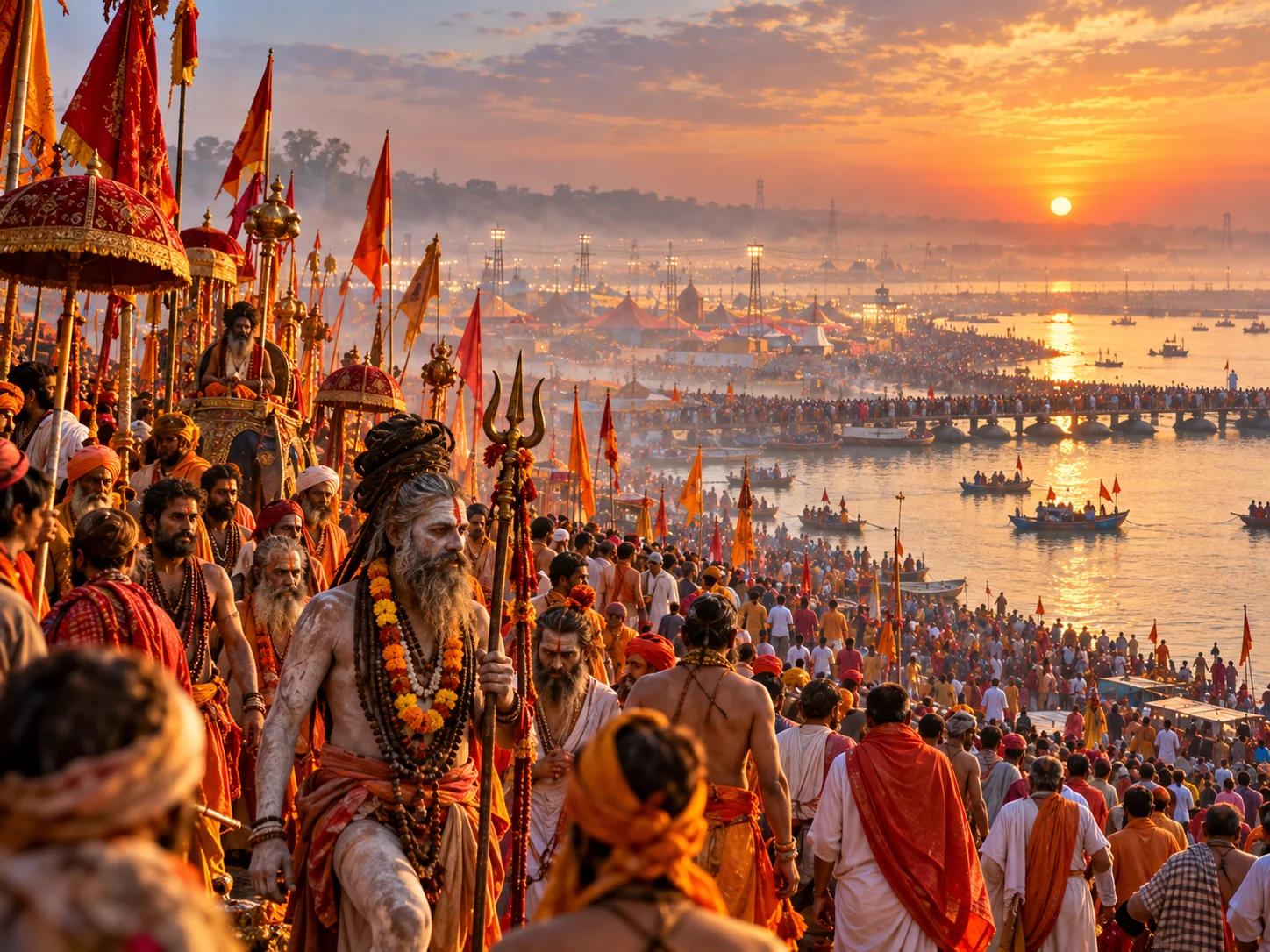
The Shahi Snan, in which the akharas enter the sacred river in a prescribed order of precedence accompanied by their processions of mounted ascetics, decorated elephants, chariots, and thousands of followers, is the most visually spectacular ritual of the Kumbh Mela and the moment toward which the entire gathering builds across its duration. The order of precedence among the akharas at the Shahi Snan has been the subject of disputes resolved over centuries through negotiation and tradition.
The Naga Sadhus, the ash-covered naked ascetics who are members of the Shaiva akharas, lead the most famous of the Shahi Snan processions and have become the most internationally recognizable image of the Kumbh Mela. Their presence at the sacred bathing ghats, moving through the crowds with their matted hair and ash-covered bodies in a visual reference to Shiva himself catching the descending Ganga in his matted hair, connects the living ritual practice of the Kumbh directly to its mythological foundation.
Vishwakarma Puja and the Ancient Theology Behind Worship of Tools
The Largest Gathering on Earth
The Kumbh Mela at Prayagraj was projected to receive between 400 and 600 million visitors across its full duration, a figure that represents the largest peaceful assembly of human beings in recorded history. The logistics of managing this gathering, providing water, sanitation, medical services, crowd management, transportation, and security for a population larger than the United States gathering at a single river site over a period of weeks, represents one of the most complex civil administration challenges that any government in the world undertakes.
The Government of India and the Government of Uttar Pradesh have developed Kumbh administration into a sophisticated infrastructure operation, with temporary cities constructed specifically for the gathering, including pontoon bridges across the Ganga, tens of thousands of kilometres of temporary roads, and administrative systems that function as a complete urban governance structure for the duration of the event before being dismantled afterward.
The formal inscription of the event on the UNESCO Intangible Cultural Heritage Representative List in 2017 recognized the gathering not simply as a religious event but as a living cultural tradition of extraordinary depth and social significance, noting specifically the knowledge systems embedded in the event’s organization, the role of the akharas as institutional custodians of the tradition, and the meaning of the ritual practice for the hundreds of millions of people who participate in it.
The Force That Draws Millions Home
The Kumbh Mela is the oldest, largest, and in some ways the most mysterious mass gathering in human history. Mysterious because the force that draws hundreds of millions of people to four river sites at prescribed celestial intervals is not fully reducible to any single explanation. It is not only religious devotion, though that is central. It is not only cultural identity, though that is present. It is not only social custom, though that sustains it across generations. It is something that the tradition itself describes as the pull of a cosmic event that happened at the beginning of time and that recreates itself, briefly and powerfully, at the moments when the heavens return to the configuration they held when amrit fell from a pot in the middle of a divine chase across the sky.
The Samudra Manthan and the descent of the Ganga are not footnotes to the Kumbh Mela. They are its foundation, the reason that the water at a particular river confluence at a particular moment of celestial alignment is understood by hundreds of millions of people to carry the liberating power of amrit itself. That understanding, maintained without institutional enforcement across at least fourteen documented centuries and almost certainly longer, is itself one of the most remarkable facts about human religious life anywhere in the world.
The rivers are still there. The heavens still move through their configurations. And at the prescribed moments, the people still come.
Goddess Kamakhya and Mythology Behind the Ambubachi Mela
If you think you have remembered everything about this topic take this QUIZ
Results


#1. Which sage’s curse weakened the immortality and power of the devas, leading to the churning of the cosmic ocean?
#2. Who carried the kumbha containing the amrit as it emerged from the churned primordial cosmic ocean?
#3. According to the text, how many divine days did the cosmic chase across the heavens last, corresponding to twelve human years?
#4. What specific astrological alignment triggers the Kumbh Mela at the Nashik location?
#5. Which Chinese Buddhist pilgrim provided one of the earliest external historical documentations of mass pilgrimage activity at Prayagraj between 629 and 645 CE?
#6. Which king’s sixty thousand sons were burned to ashes by the wrath of the sage Kapila?
#7. In which year was the Kumbh Mela formally inscribed on the UNESCO Representative List of Intangible Cultural Heritage?
#8. Which monastic orders trace their formal organization to the period of Adi Shankaracharya in the eighth century CE?
What is the mythological origin of the Kumbh Mela?
The Kumbh Mela’s mythological origins lie primarily in the Samudra Manthan, the churning of the cosmic ocean by the devas and asuras, from which the amrit, the nectar of immortality, emerged in a sacred pot called the kumbha. During a cosmic chase between gods and demons over the pot, drops of amrit fell at four points on the Indian subcontinent, Prayagraj, Haridwar, Nashik, and Ujjain, permanently sanctifying those locations. The Kumbh is held at each site when the celestial bodies return to the positions they held at the moment of the amrit’s spillage there.
What is the connection between the descent of the Ganga and the Kumbh Mela?
The descent of the Ganga from the heavens, achieved through the penance of King Bhagiratha and the intervention of Shiva who caught the river in his matted hair, gave the Ganga her quality of sacred water capable of liberating souls. This liberating power of the Ganga’s waters, particularly at the Triveni Sangam at Prayagraj where the Ganga meets the Yamuna and the mythological Saraswati, is foundational to the Kumbh Mela’s understanding of why a ritual bath at the sacred confluence at the prescribed celestial moment carries the potential for spiritual liberation.
Why is Prayagraj considered the most sacred of the four Kumbh sites?
Prayagraj is called Tirthraj, the king of pilgrimage sites, because of the Triveni Sangam, the confluence of the Ganga, the Yamuna, and the mythological Saraswati. This triple convergence of sacred waters is considered the most powerful sacred geographical point in Hindu tradition. Prayagraj is also the only site where the Maha Kumbh, the gathering that occurs once every 144 years at the most powerful possible planetary alignment, is held, further establishing its supreme sacred status among the four Kumbh locations.
What is the Shahi Snan and why is it the central ritual of the Kumbh?
The Shahi Snan, meaning royal bath, is the ritual procession in which the akharas, the organized monastic orders of Hindu ascetics, enter the sacred river in a prescribed order of precedence on the most auspicious dates of the Kumbh. It is the central ritual because bathing at the precise moment of maximum celestial alignment is believed to recreate the conditions of the original amrit spillage, giving the water its maximum sacred potency. The processions of the akharas, led by Naga Sadhus and accompanied by mounted ascetics, elephants, and chariots, are among the most visually powerful expressions of living Hindu religious tradition.
When did the Kumbh Mela receive UNESCO recognition and what did it acknowledge?
UNESCO inscribed the Kumbh Mela on its Representative List of Intangible Cultural Heritage of Humanity in 2017. The inscription recognized the Kumbh not simply as a large religious gathering but as a living cultural tradition of extraordinary social and spiritual significance, acknowledging the knowledge systems embedded in the event’s organization, the institutional role of the akharas as custodians of the tradition, and the deep meaning of the ritual practice for the hundreds of millions of people who participate in it across its four sacred sites.
Sources & References
The Samudra Manthan and the emergence of amrit — The Kumbh Mela’s primary mythological foundation lies in the Samudra Manthan, the churning of the primordial cosmic ocean by the devas and asuras together, from which the nectar of immortality (amrit) emerged in a sacred pot (kumbha), described in detail in the Bhagavata Purana, Vishnu Purana, and Mahabharata with visual specificity sustained across centuries of artistic and ritual interpretation.
The descent of the Ganga and Bhagiratha’s penance — The Kumbh Mela’s secondary mythological pillar is the descent of the river Ganga from the heavens, achieved through Bhagiratha’s extraordinary penance and Shiva’s intervention, which gave the Ganga’s waters their sacred quality of liberating souls from the cycle of rebirth, documented extensively in the Ramayana, Mahabharata, and Puranic literature.
Xuanzang’s documentation of Prayagraj pilgrimage — The Chinese Buddhist pilgrim Xuanzang, who travelled through India between 629 and 645 CE, documented hundreds of thousands of pilgrims gathered at Prayagraj’s Triveni Sangam, providing the earliest external historical corroboration of large-scale pilgrimage activity at the site that would become formalized as the Kumbh tradition.
The role of the akharas and Shahi Snan ritual — The Kumbh Mela’s organizational structure is maintained through the akharas, monastic orders of Hindu ascetics formally organized since Adi Shankaracharya’s eighth-century restructuring, whose participation in the Shahi Snan royal bathing ritual represents the most visually powerful expression of the festival’s mythological content in contemporary practice.
UNESCO inscription recognizing the Kumbh Mela’s intangible heritage status — In 2017, the Kumbh Mela was inscribed on UNESCO’s Representative List of Intangible Cultural Heritage of Humanity, recognizing it not simply as a religious gathering but as a living cultural tradition of extraordinary social significance carrying knowledge systems embedded in its organization and deep meaning for hundreds of millions of participants across four sacred sites.