How Four Days of Fasting in River Water Renew a Devotion Five Thousand Years Old
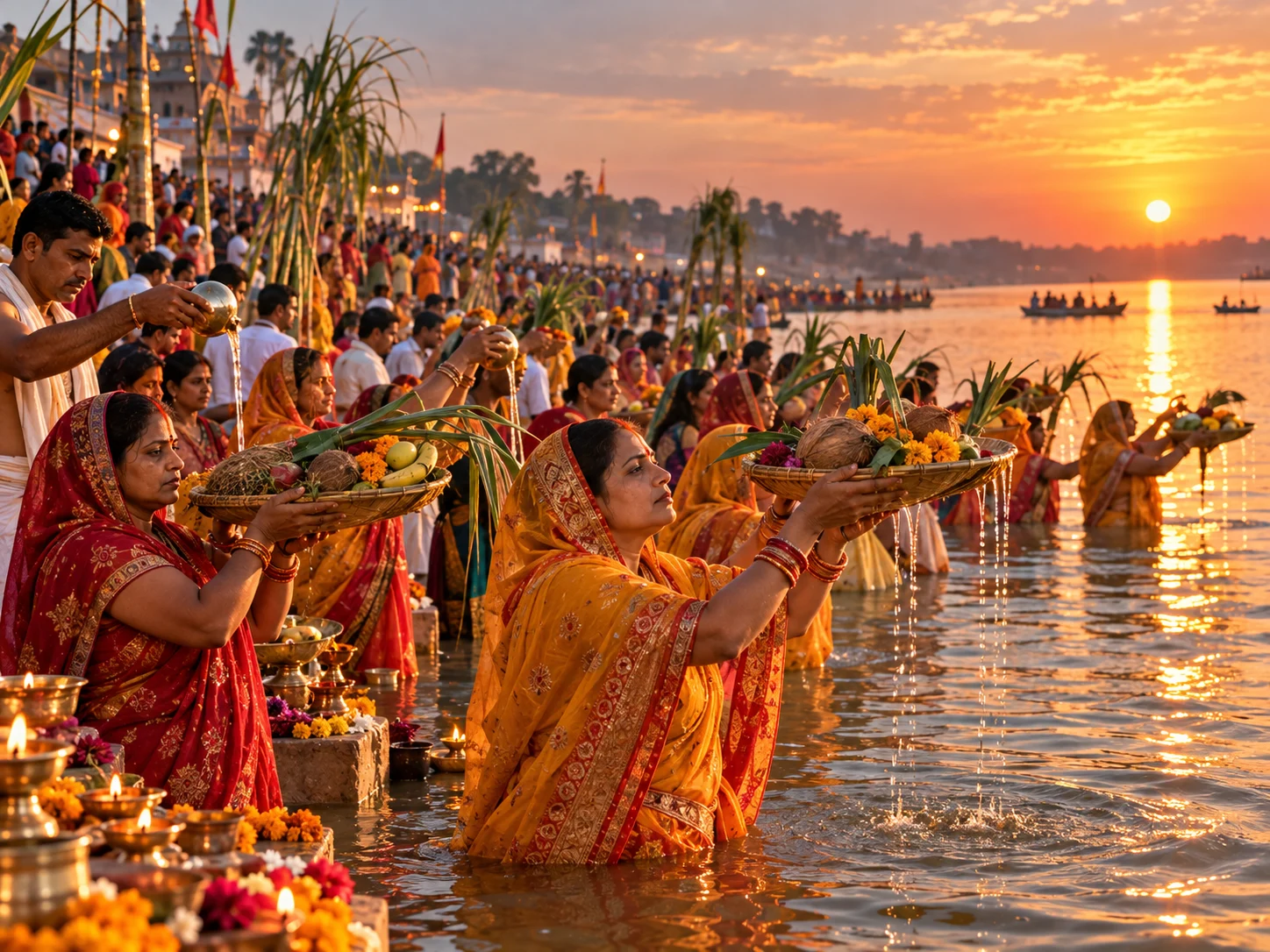
On the banks of the Ganga, the Gandak, and the rivers of the Gangetic plain, there is a moment that occurs twice a year, once at sunset and once at sunrise, when thousands of people stand waist-deep in water with their hands raised toward the sun, offering water and fruit and the accumulated devotion of four days of fasting and vigil to the deity they believe sustains all life on earth. The scene is one of the most visually arresting in all of Indian religious practice. But to understand why the sun god Surya is worshipped in this specific way, at this specific time, in this specific posture, you have to go back much further than the festival itself, back to the Rigveda, back to the earliest moments of the Indian civilisational imagination, when the sun was understood not as a distant star but as the living, breathing, generous source of everything that exists.
The Rigveda and the Oldest Solar Conversation
To understand why Surya occupies the theological position he does in Chhath Puja, you must begin with the Rigveda, the oldest of the four Vedas and one of the oldest religious texts in the world, composed in Sanskrit somewhere between 1500 and 1200 BCE, though drawing on oral traditions considerably older.
The Rigveda contains more than one thousand hymns addressed to various deities, and Surya, the sun god, is among the most important and most frequently invoked. The solar hymns of the Rigveda are not simply poetic celebrations of a natural phenomenon. They are theological statements about the nature of divine power and its relationship to human life.
The Rigveda’s Surya hymns describe the sun as the eye of Mitra, Varuna, and Agni, as the soul of all moving and unmoving beings, as the physician who removes illness, as the source of the honey that flows through the universe and nourishes all existence. The Gayatri Mantra, arguably the most sacred verse in the entire Vedic tradition and still recited daily by millions of Hindus, is addressed to the solar deity Savitr, a form of Surya, and asks that the divine brilliance of the sun illuminate and inspire the worshipper’s intelligence.
This Vedic theological framework established Surya as something considerably more than a nature deity. He is the animating principle of the cosmos, the force that makes life possible, that establishes the rhythm of time through the cycle of days and seasons, that connects the human world to the cosmic order through the most immediate and undeniable daily experience available to every living being regardless of caste, language, or region.
Rann Utsav Under the Full Moon: Where the Salt Desert Comes Alive
Surya in the Puranic Imagination and Mythological Genealogy
The Vedic Surya who appears in the Rigveda is a cosmic principle as much as a personal deity. The Puranic tradition, which developed over the first millennium CE and gave Hindu theology its most elaborate and narratively rich expressions, gave Surya a personal biography, a family, a set of stories, and a more specific divine personality.
In the Puranas, Surya is the son of Aditi and the sage Kashyapa, making him one of the Adityas, the solar deities who together represent the twelve months of the year. His wives are Sanjna, the daughter of the divine craftsman Vishwakarma, and Chhaya, Sanjna’s shadow-double. The children born of Surya’s relationships include Vaivasvata Manu, the progenitor of the current human race, Yama, the god of death, Yami, who becomes the river Yamuna, and Karna, the tragic hero of the Mahabharata.
This last connection is directly relevant to Chhath Puja. Karna, born of the union between Surya and the princess Kunti, is one of the most celebrated solar devotees in all of Indian mythology. His daily ritual of standing in water and offering Arghya to his father Surya is described in the Mahabharata as a practice of such consistent devotion that it became the model for solar worship in the popular tradition. The connection between Karna’s solar devotion and the Arghya ritual of Chhath Puja is explicitly made in the folk traditions of Bihar, where Karna is venerated as an ancestor of the practice.
Chhathi Maiya and the Devotion of Intimacy
The worship of Surya during Chhath Puja is inseparable from the parallel worship of Chhathi Maiya, the folk goddess who gives the festival its name and who represents the sixth day, Shashthi, of the lunar fortnight in the month of Kartik. Understanding Chhathi Maiya and her relationship to Surya is essential to understanding the festival’s complete theological structure.
Chhathi Maiya is identified in different regional traditions with various Sanskrit goddesses, but she is most fully herself in the folk religious imagination of Bihar and the Terai region where she is understood as Surya’s sister, his consort, or his complementary divine principle depending on the specific community tradition consulted. The folk theology that surrounds her is not codified in any Sanskrit text. It lives in the oral tradition, in the Chhath songs called Chhath Geet that women sing throughout the four days of the festival, in the stories passed between generations of families who have observed the vrat for as long as anyone can remember.
This theological pairing, the cosmic male solar deity of the ancient Vedic tradition alongside the intimate female folk goddess of the living community, gives Chhath Puja a completeness of devotional address that neither tradition alone could achieve. Surya receives the formal Arghya offering that connects the festival to the Rigveda. Chhathi Maiya receives the songs and stories and the particular quality of female devotional intimacy that gives the festival its emotional warmth.
The Setting Sun and the Theology of Trust
One of the most theologically distinctive features of Chhath Puja, and one that separates it from virtually every other sun-worship tradition in the world, is its equal insistence on the worship of the setting sun alongside the rising sun.
Most solar worship traditions, across cultures and across history, focus their devotional energy on the rising sun. The dawn is the moment of return, of light overcoming darkness, of life renewed after the vulnerability of night. The rising sun is the triumphant sun, the life-giving sun, the sun that confirms the world’s continuation.
Chhath Puja does not neglect the rising sun, but the Arghya offered at sunset, called Sandhya Arghya, is given equal importance in the ritual sequence. The setting sun, the sun at the moment of apparent defeat, of withdrawal into the darkness that will last the night, is worshipped with the same intensity and the same completeness as the rising sun.
The theological meaning of this parity is profound. In worshipping the setting sun, the Chhath tradition is making a statement about the nature of divine faithfulness that goes beyond simple gratitude for the light. The devotee who offers Arghya to the setting sun is acknowledging that the sun’s power is not diminished by its setting, that the divine sustaining force behind the sun’s light is constant even when the light itself is withdrawn, and that faith in the sun’s return through the night is as important a devotional act as gratitude for its presence in the day. This is a theology of trust rather than simply a theology of gratitude.
How the Karaga Bearers Balance the Floral Pyramid in Karnataka
The Four Days and the Architecture of Devotion
Chhath Puja unfolds across four days in a sequence whose structure encodes specific theological and physiological intentions.
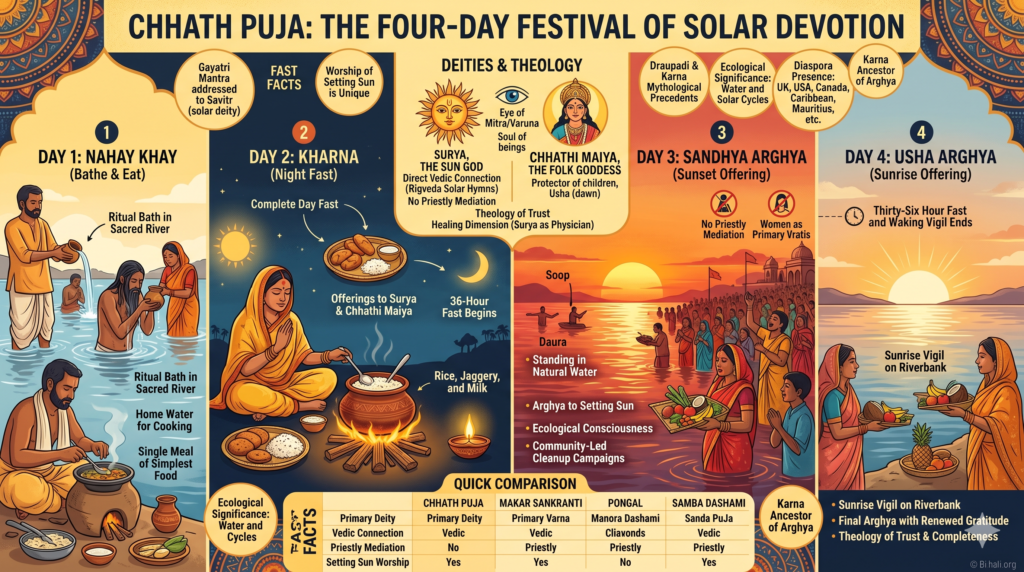
The first day is called Nahay Khay, meaning bathe and eat. Devotees take a ritual bath in a sacred river, bring home the water for cooking, and eat a single meal of the simplest possible food. The second day is Kharna, the day of the night fast. The devotee observes a complete fast through the day, then breaks it after sunset with a specific preparation of rice, jaggery, and milk, cooked in clay pots on fires of mango wood. After this meal, the devotee enters a state of complete fasting and waking vigil that will last thirty-six hours.
The third day, called Sandhya Arghya, is the festival’s first great public moment. As the sun approaches the western horizon, devotees dressed in new clothes of yellow and orange, the colours of solar light, carry bamboo baskets called Soop and Daura filled with fruit, sugarcane, rice preparations, coconut, and flowers to the river. They enter the water and stand facing the setting sun, holding the offerings in their raised hands, as family members pour water over the offerings and the sun and the songs of Chhath fill the riverbank.
The fourth day, called Usha Arghya, is the sunrise offering. Devotees spend the night at the riverbank in vigil, returning to the water before dawn to await the rising sun. The moment when the first rays of sunlight appear on the horizon and the first Arghya is offered is described consistently by those who have witnessed it, and particularly by those who have performed it, as one of the most intense moments of devotional experience available in the Indian religious calendar. The thirty-six hours of fasting and waking vigil, the night spent in open air, and the physical effort of standing in cold water before dawn create physiological and psychological conditions that heighten the encounter with the sun to an extraordinary degree.
Surya as Healer and the Wellness Dimension
The worship of Surya during Chhath Puja carries a strong healing dimension that connects the festival to one of the oldest functions of solar worship in the Indian tradition. In the Rigveda, Surya is described as the physician of physicians, the deity who has the power to remove illness and restore the body to its natural condition of health.
This understanding of the sun as a healing force is not metaphorical in the Chhath context. The ultraviolet light of the sun, particularly at the specific angles at which it reaches the earth during the sunrise and sunset periods when the Arghya is offered, has measurable physiological effects on the human body including the stimulation of vitamin D synthesis and the regulation of circadian rhythms. The tradition’s focus on these specific times of day for solar exposure reflects an empirical knowledge of solar health effects developed through centuries of observation.
Many families who observe the Chhath vrat do so specifically with prayers for the healing of illness in the family, for the recovery of a sick child, for the restoration of health to an elderly parent. The folk songs of Chhath contain numerous references to healing prayers addressed specifically to Chhathi Maiya for the protection of children from illness and childhood diseases that were historically devastating in the communities where the festival is primarily observed.
No Priest, Only the Sun and the Devotee
One of the most socially significant features of Chhath Puja is something it does not have. There is no priest. The absence of priestly mediation in Chhath Puja is not accidental or incidental. It is a structural feature of the festival that reflects a specific theological position: that the devotee’s relationship with Surya is direct, personal, and requires no institutional intermediary.
The vrat, the fast and vigil at the centre of the festival, is undertaken by the individual devotee. The Arghya is offered by the devotee’s own hands. The prayers are spoken by the devotee in whatever language comes naturally to them. The songs are sung by the women of the family and the community rather than by trained liturgical specialists.
This democratisation of divine access is one of the reasons that Chhath Puja has maintained its extraordinary hold on the communities that observe it across centuries of social change. It does not depend on the availability of a particular priest, on the maintenance of a particular temple, or on access to institutional religious infrastructure. In a country where access to religious knowledge and ritual authority has historically been stratified by caste and gender, Chhath Puja represents a form of solar worship that is explicitly available to everyone. The vrat is most commonly undertaken by women, particularly by mothers, and the festival is in many respects a women’s festival in which female devotional authority is primary and uncontested.
The River as Sacred Partner and the Environmental Covenant
The rivers that serve as the primary sites of Chhath Puja worship are not simply convenient venues for the water-based rituals. They are understood as sacred presences in their own right, as partners in the act of solar worship rather than as neutral settings for it.
The Ganga, the Gandak, the Sone, the Koshi, and the other rivers of the Gangetic plain where Chhath Puja is primarily observed carry enormous devotional significance. During the festival, the river’s sacred status is specifically activated in relation to solar worship. The water that the devotee cups in their hands and raises toward the sun is understood as the medium through which the devotee’s devotion travels from the earth to the deity, sanctified both by its origin in the sacred river and by the act of offering.
The ecological consciousness embedded in this understanding of the river as sacred partner has contemporary relevance. The Chhath tradition insists on the cleanliness of the water bodies used for worship. Devotees have historically been among the most active voices for the protection of river water quality, understanding the degradation of the rivers as a religious as well as an environmental problem. The Chhath Puja cleanup campaigns organised by devotees in cities including Patna, Delhi, and Mumbai, where the festival is observed on urban water bodies, represent one of the most grassroots forms of environmental activism connected to religious practice in contemporary India.
Hemis Festival: Sacred Cham Dances That Offer Liberation in Ladakh
Chhath Across the World
The most direct evidence of what Chhath Puja means to the communities that observe it is the extraordinary tenacity with which they have maintained it across every form of migration and dislocation that the twentieth and twenty-first centuries have brought.
Bihari and Jharkhandi communities in Delhi, Mumbai, and other major Indian cities have transformed urban riverbanks, lakes, and temporary water bodies into Chhath ghats every October, negotiating with municipal authorities, managing enormous crowds, and maintaining the ritual integrity of the festival in conditions very different from the village rivers where it was originally observed. Internationally, Bihari diaspora communities in the United States, the United Kingdom, Canada, Australia, and the Caribbean nations have maintained Chhath Puja as a living practice across generations. The festival observed on the banks of the Thames in London, on the shores of Lake Michigan in Chicago, and on the beaches of Port Louis in Mauritius is genuine solar worship, conducted with the same theological seriousness as the festival in Patna or Bhagalpur.
This diaspora tenacity is the most powerful argument for the depth of what Chhath Puja carries. Festivals that are primarily social or recreational adapt easily to new environments. Festivals that carry genuine theological weight and meet genuine spiritual needs travel with their communities and survive the journey intact. The sun, after all, rises everywhere.
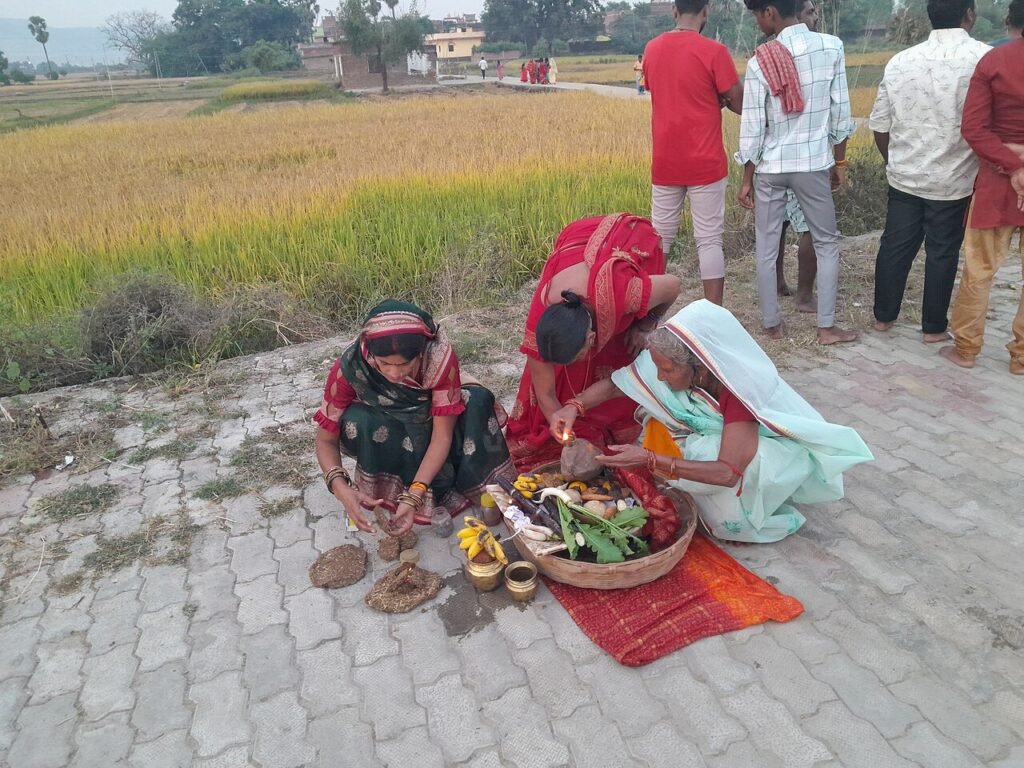
Related to article: Why the Sun God Surya Stands at the Heart of Chhath Puja · Source: Wikimedia Commons · PremRaj.in · CC BY-SA 4.0
The Covenant Renewed Every Year
The relationship between Surya and the Chhath devotee is best understood not as supplication but as covenant. The devotee does not simply ask the sun god for gifts. She offers herself, her comfort, her sleep, her hunger, her physical ease, in a thirty-six-hour period of austerity that is genuinely demanding and genuinely voluntary, and in exchange she asks for the sun’s continued generosity with the gifts that sustain life.
This covenantal structure is theologically sophisticated. It assumes a reciprocal relationship between the human and the divine in which both parties have obligations. The sun is obligated, in this framework, to continue rising, to continue giving light and warmth and the conditions for agricultural life. The devotee is obligated to acknowledge this giving with appropriate gratitude and sacrifice. The Arghya is the formal enactment of this mutual obligation, the moment at which the covenant is renewed for another year.
The physical demands of the vrat, the fasting, the vigil, the standing in cold water, the exposure to the elements through the night spent at the riverbank, are not punishments or tests of worthiness in the usual religious sense. They are the devotee’s way of making the covenant real in their own body, of ensuring that the gratitude they feel is not merely verbal or ceremonial but genuinely costs them something. An offering that costs nothing is not quite an offering.
This logic explains why the most devoted Chhath practitioners, typically the women of the family who have been observing the vrat for decades, describe the physical hardship of the festival not as suffering but as privilege. The difficulty is part of the meaning. The sunrise after the thirty-six hours of fasting and vigil is experienced with an intensity of gratitude that could not be reached through a comfortable night’s sleep and a casual morning prayer.
The sun rises. It always rises. But on the morning of Usha Arghya, standing in the cold river water, watching the first light touch the eastern sky after a night of vigil and prayer, the rising of the sun is not a natural phenomenon. It is a personal response. That is what the Chhath Puja devotee has always known about Surya. And that is why, despite every change that five thousand years of Indian history have brought, the people of Bihar and Jharkhand still walk into the river twice a year, raise their hands toward the sun, and offer their water back to the source of all water.
The sun was there before the first word of the Rigveda was composed. It will be there after the last Chhath song is sung. The covenant is older than the festival. The festival simply keeps it visible.
How the Sibling Bond of Yama and Yamuna Created Bhai Dooj
If you think you have remembered everything about this topic take this QUIZ
Results


#1. According to the text, in which of the four Vedas are the solar hymns addressed to Surya primarily rooted?
#2. Which tragic hero from the Mahabharata is venerated in Bihar’s folk tradition as an ancestor of the Arghya practice?
#3. What is the specific name of the sunset offering ritual that highlights the festival’s unique theological focus on the setting sun?
#4. Which academic journal has published research regarding the environmental ethics and grassroots ecological activism embedded in Chhath Puja?
#5. How long is the period of complete fasting and waking vigil that a devotee enters after breaking the fast on the second day (Kharna)?
#6. Which specific department’s archival collections hold a comprehensive scholarly record of the Chhath Geet oral traditions?
#7. What is the traditional name of the deep bamboo basket carried on the devotee’s head to transport the festival offerings to the river?
#8. Which popular sweet made from whole wheat flour, jaggery, and ghee is most completely identified as the primary food of Chhath Puja?
Why is Surya specifically worshipped during Chhath Puja and not other deities?
Surya is worshipped during Chhath Puja because the festival is rooted in the Vedic understanding of the sun as the ultimate source of life, health, agricultural fertility, and cosmic order. The Rigveda, one of the oldest religious texts in the world, contains extensive solar hymns that establish Surya as the animating principle of the cosmos and the soul of all moving and unmoving beings. Chhath Puja is one of the most direct surviving continuations of this Vedic solar worship tradition, in which the devotee’s relationship with the sun is understood as a covenant of mutual obligation that must be renewed annually through specific acts of gratitude and sacrifice.
What is the theological significance of worshipping the setting sun in Chhath Puja?
The equal worship of the setting sun alongside the rising sun is one of Chhath Puja’s most distinctive and theologically sophisticated features. Most solar worship traditions focus on the rising sun as the symbol of triumph, renewal, and life. By offering Arghya to the setting sun with equal devotion, the Chhath tradition makes a statement about trust in divine faithfulness: the devotee acknowledges that the sun’s power is constant even when its light is withdrawn, and expresses gratitude for the faithfulness of its return through the night. This is a theology of trust rather than simply a theology of gratitude, and it gives the festival a depth that simple sunrise worship cannot achieve.
What is Chhathi Maiya and how does she relate to Surya in the festival’s theology?
Chhathi Maiya is the folk goddess who gives Chhath Puja its name, associated with the sixth day of the lunar fortnight in the month of Kartik. She is understood in different regional traditions as Surya’s sister, his consort, or his complementary divine principle, and is associated in the folk religious imagination with the protection of children, maternal devotion, and the intimate concerns of domestic and family life. Her presence alongside Surya in the festival’s theology gives Chhath Puja a completeness of devotional address: the cosmic male solar deity of the Vedic tradition receives the formal Arghya offering, while Chhathi Maiya receives the songs, stories, and particular quality of female devotional intimacy carried in the Chhath Geet folk song tradition.
Why does Chhath Puja have no priestly mediation and what does this mean for the festival’s character?
The absence of priestly mediation in Chhath Puja is a structural feature of the festival that reflects a specific theological position: that the devotee’s relationship with Surya is direct and personal and requires no institutional intermediary. The vrat is undertaken by the individual devotee, the Arghya is offered by the devotee’s own hands, and the prayers and songs are performed by the devotee and her family rather than by trained liturgical specialists. This democratisation of divine access means that the festival is available to everyone regardless of caste or gender, that it does not depend on institutional religious infrastructure, and that the female devotees who most commonly undertake the vrat hold primary and uncontested religious authority within its practice.
How has Chhath Puja’s worship of Surya connected to ecological consciousness and environmental practice?
The Chhath tradition’s understanding of natural water bodies as sacred partners in solar worship has generated significant environmental consciousness among its devotees. The festival insists on the cleanliness of the rivers and water bodies used for the Arghya ritual, and devotee communities across India’s major cities organise annual pre-festival cleanup campaigns on urban water bodies and riverbanks. This ecological activism is not external to the festival’s theology but follows directly from it: if the river is a sacred participant in the act of solar worship, its degradation is a religious as well as an environmental problem. The festival’s timing in the annual agricultural cycle, its use of seasonal agricultural produce as offerings, and its grounding in the ecology of the Gangetic plain all reinforce this fundamental connection between solar worship and ecological awareness.
Sources & References
Chhath Puja’s Vedic roots and solar theology — Chhath Puja represents one of the most direct surviving connections to Vedic solar worship, with the Rigveda’s solar hymns establishing Surya as the animating principle of the cosmos and the source of all life, knowledge and healing, a theological framework that is renewed through the Arghya offering each time the festival is observed.
The role of Karna and mythological genealogy in Chhath Puja — The festival’s central Arghya ritual derives its mythological model from Karna, the hero of the Mahabharata born of Surya and the princess Kunti, whose daily practice of offering water to his father Surya in the river is preserved in Bihari folk tradition as the ancestor practice of Chhath Puja’s ritual core.
Chhathi Maiya and the folk theological tradition — Chhathi Maiya, the sixth-day goddess at the heart of Chhath Puja, lives entirely in the oral tradition of Bihar’s folk theology, transmitted through the Chhath Geet songs and stories that give the festival its emotional and spiritual texture alongside the Vedic solar theology that Surya represents.
The setting sun and the theology of trust in Chhath Puja — Chhath Puja’s unique insistence on equal worship of the setting sun alongside the rising sun is theologically distinctive among the world’s solar traditions, embodying a covenant relationship between devotee and deity that emphasises trust in divine faithfulness over simple gratitude for received blessings.
Environmental activism and the sacred river in Chhath Puja practice — Chhath devotee communities across India’s major cities organise annual pre-festival river cleanup campaigns, understanding the cleanliness of water bodies as inseparable from the theological meaning of the Arghya offering, making Chhath Puja one of the most significant forms of grassroots religious environmental activism in contemporary India.